1 riyal 1956
Market Prices
51 salesAbout This Note
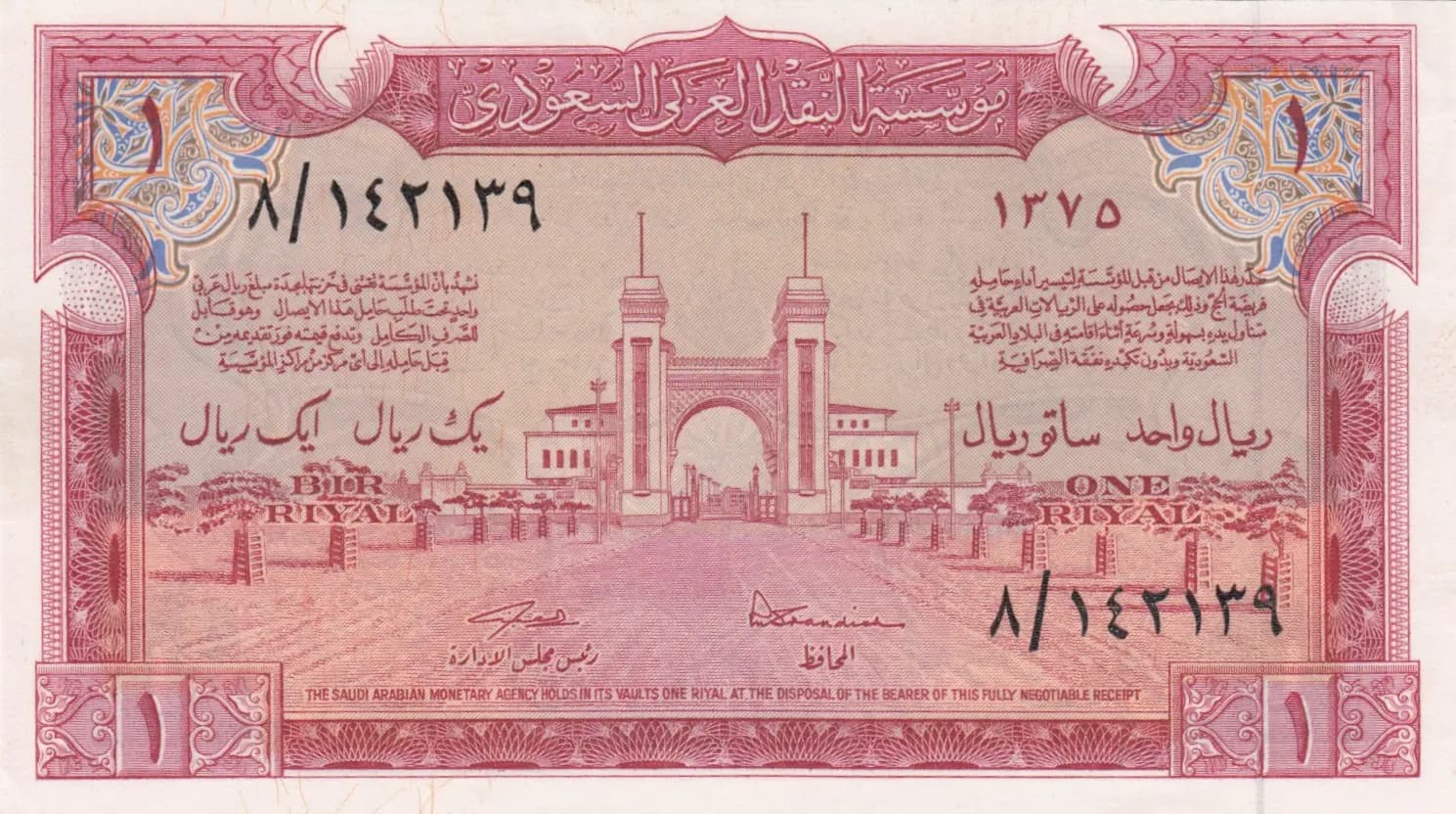
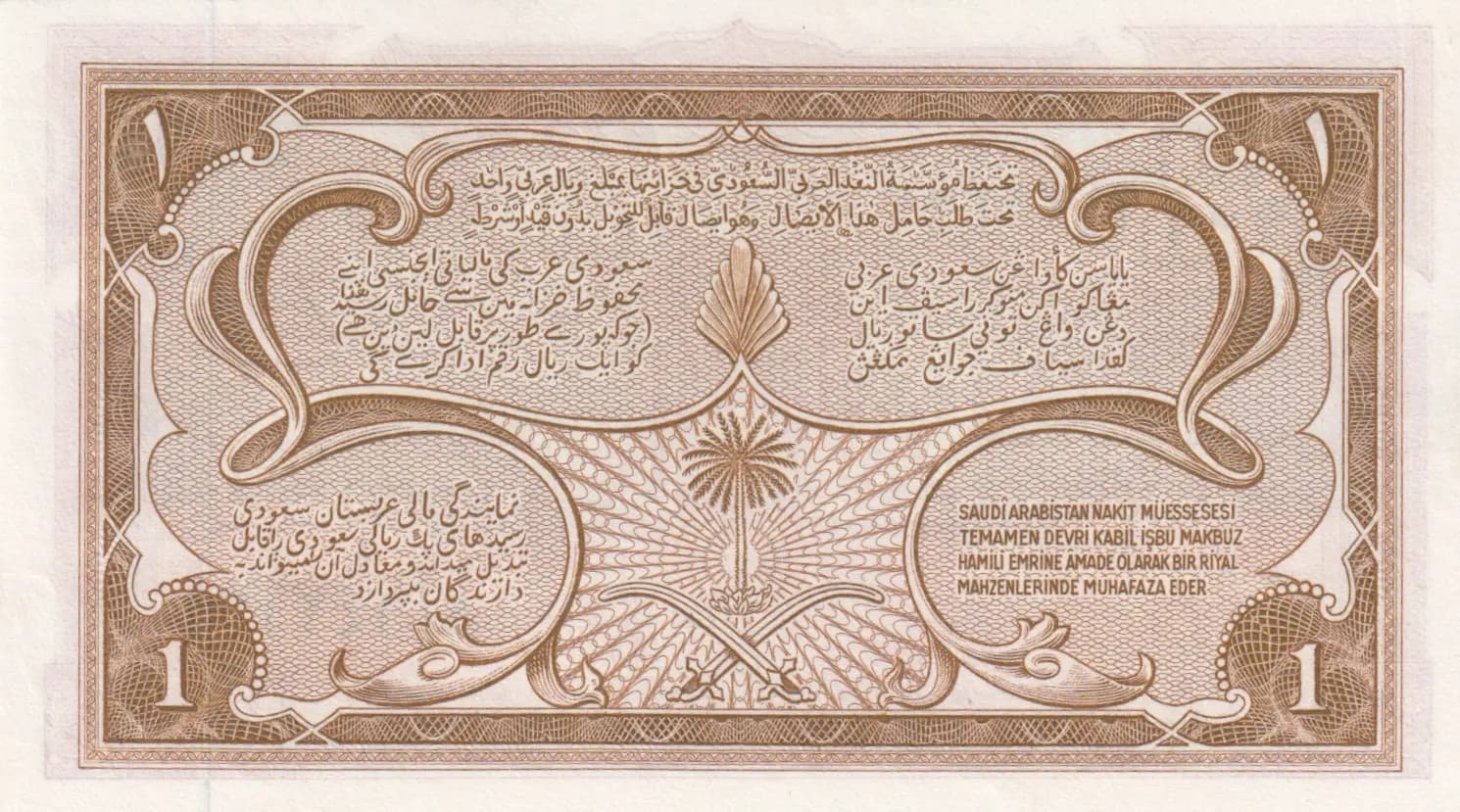
This is a Saudi Arabian 1 Riyal banknote from 1956 (AH 1375), issued by the Saudi Arabian Monetary Agency and cataloged as Pick P-2. The note features a striking pink/rose-colored front depicting the fortified gateway entrance to the Royal Palace in Jeddah with two symmetrical towers, framed by ornate Islamic geometric patterns. The reverse displays an elaborate cream-colored design with a radial sunburst pattern and decorative scrollwork. The UNC condition grade indicates this is an uncirculated specimen with minimal wear, making it a well-preserved example of early Saudi Arabian currency.
Common. eBay market data shows consistent sales across multiple condition grades from 2009-2025, with F-grade notes selling in the $15-50 range and UNC examples commanding $225-356 historically. The consistent availability and relatively modest realized prices across nearly 40 documented sales indicate a regular issue with adequate circulation and survival. This is a foundational Saudi currency note with no evidence of being a short-run or recalled issue.
This note represents the Saudi Arabian Monetary Agency's early currency issues following the kingdom's monetary modernization in the mid-20th century. The depiction of the Royal Palace gateway in Jeddah on the obverse reflects Saudi Arabia's governmental authority and architectural heritage during this formative period of the kingdom's financial independence. The trilingual inscriptions (Arabic, English, and Turkish) on the note demonstrate the international commercial and diplomatic context of Saudi Arabia in 1956, when the nation was asserting its role in regional and global affairs.
The obverse features the Jeddah Gate (entrance to the Royal Palace), a fortified architectural structure with two symmetrical towers flanking a central gateway passage, depicted in the classical architectural style of early 20th-century Saudi Arabian design. Decorative vegetation (stylized trees) flanks the gateway structure. The design is enclosed within an ornate border of Islamic geometric patterns and shell-like corner ornaments executed in gold/orange tones. The reverse displays a sophisticated cream-colored composition dominated by a radial sunburst pattern radiating from the center, surrounded by curved scroll borders and Islamic geometric patterns. Both sides employ classical engraved banknote design principles characteristic of 1950s-era currency production. The color scheme of pink/rose on the obverse and cream/tan on the reverse provides high visual distinction between the two sides.
{"front":{"arabic_top":"مملكة العربية السعودية - Kingdom of Saudi Arabia","arabic_denomination":"ريال واحد سعودي - One Saudi Riyal","english_denomination":"ONE RIYAL","islamic_date":"1375 - Islamic calendar year corresponding to 1956 CE","serial_number":"A/1142139","legal_text_english":"THE SAUDI ARABIAN MONETARY AGENCY HOLDS IN ITS VAULTS ONE RIYAL AT THE DISPOSAL OF THE BEARER OF THIS FULLY NEGOTIABLE RECEIPT"},"back":{"turkish_institution":"SAUDI ARABISTAN NAKIT MUESSESESI - Saudi Arabian Currency Institution","turkish_legal_text":"TEMAMEN DEVRI KABIL ISBU MAKBUZ HAMILI EMRINE AMADE OLARAK BIR RIYAL MAHZENLERINDE MUHAFAZA EDER - This receipt is fully exchangeable and one Riyal is kept in reserve for the bearer","denomination_numeral":"1","arabic_text":"Regulatory and legal text in Arabic (specific content not fully legible in image analysis)"}}
Intaglio (engraved) printing, the standard security printing technique for banknotes of this era. The fine line work visible throughout the design, the intricate geometric pattern execution, the sharp serif typography in multiple scripts, and the multiple layers of decorative elements all confirm professional banknote engraving. The Saudi Arabian Monetary Agency contracted with established international security printers of the period; this note was likely produced by Thomas De La Rue or a comparable European banknote printer, though specific attribution for Pick P-2 would require archival research.
The observed serial number prefix 'A/1142139' is consistent with regular production notes. The Islamic date AH 1375 (1956) is constant for this Pick number. No overprints, color variations, or signature varieties are noted in the visual analysis. This appears to be a standard printing of the base Pick P-2 issue. Collectors should note that signature varieties and serial number prefix variations may exist within this Pick number designation, but the visual analysis does not provide sufficient detail to identify specific sub-varieties beyond the base issue type.