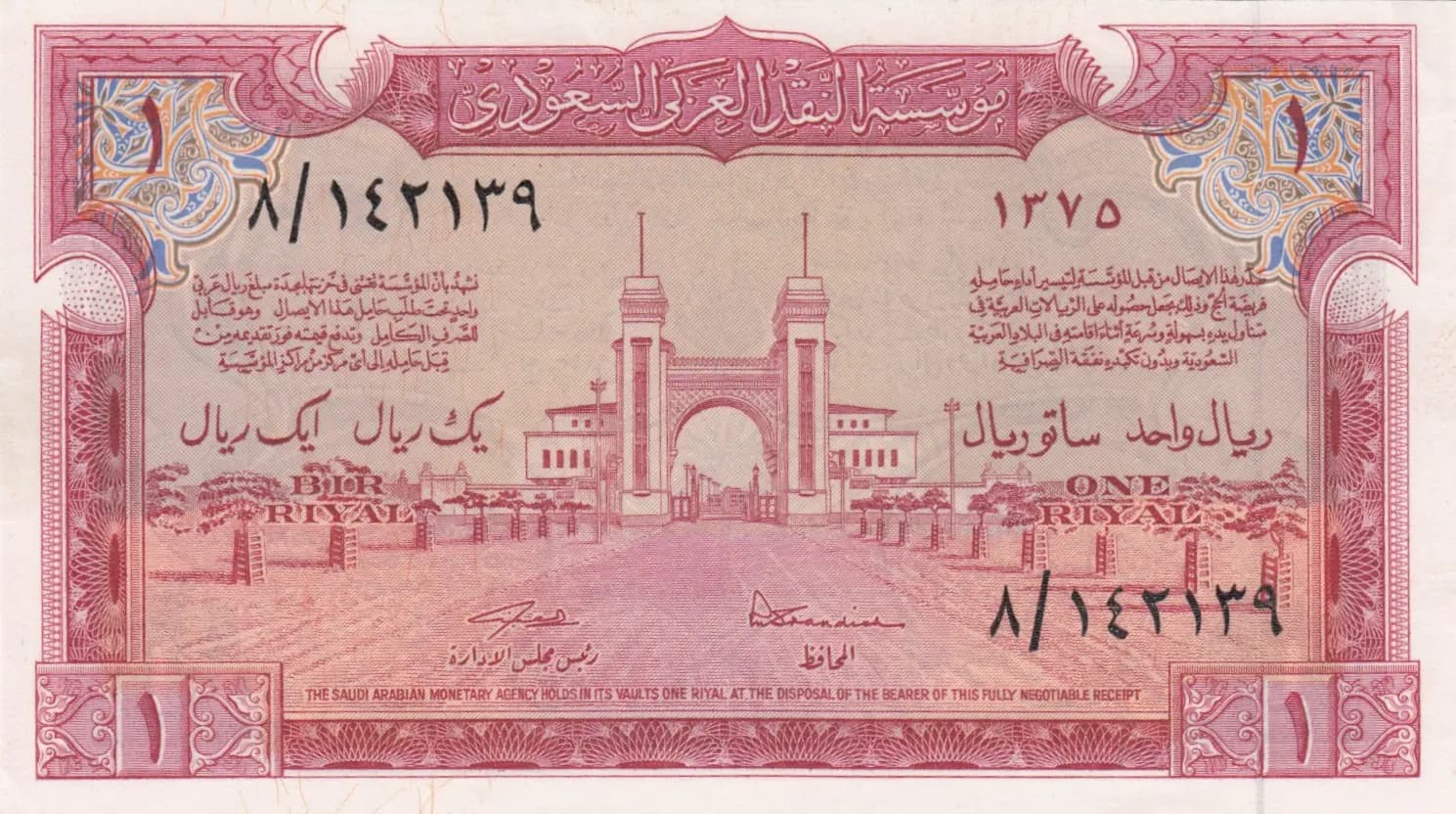
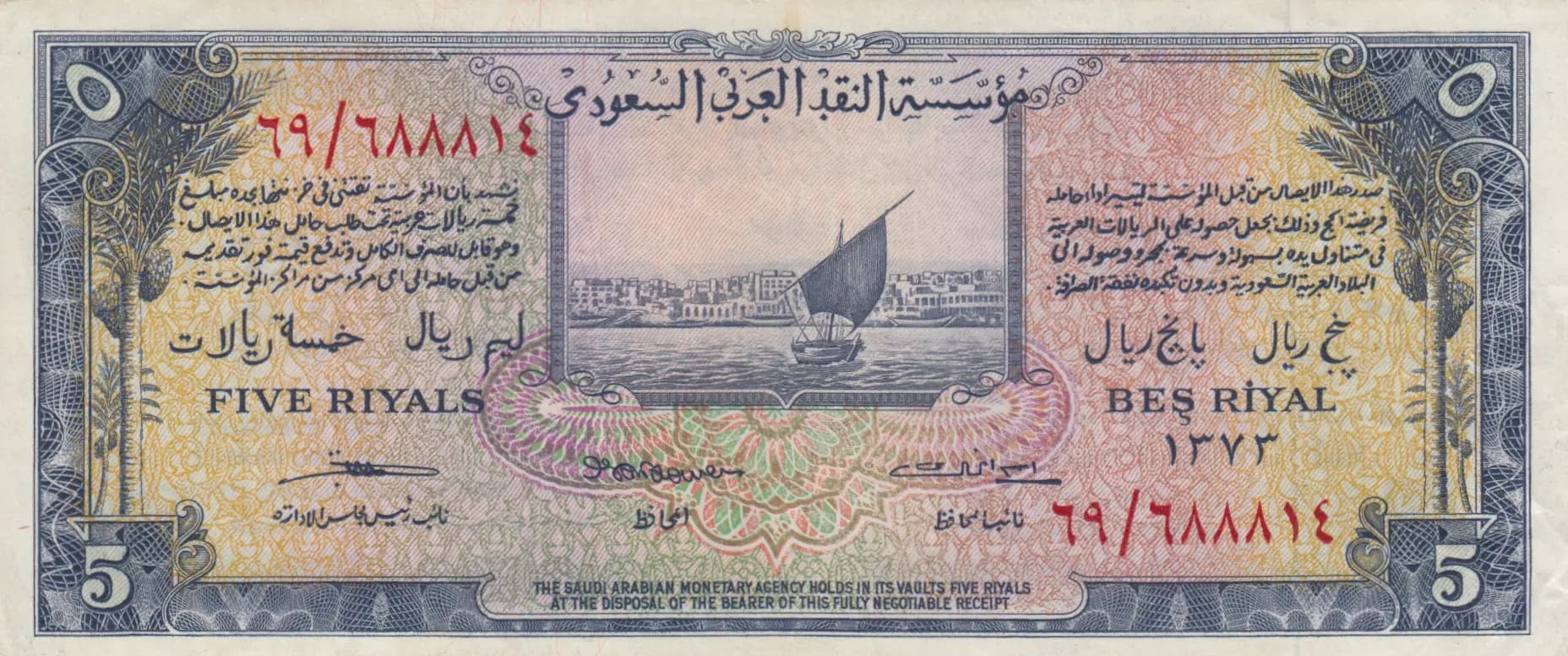
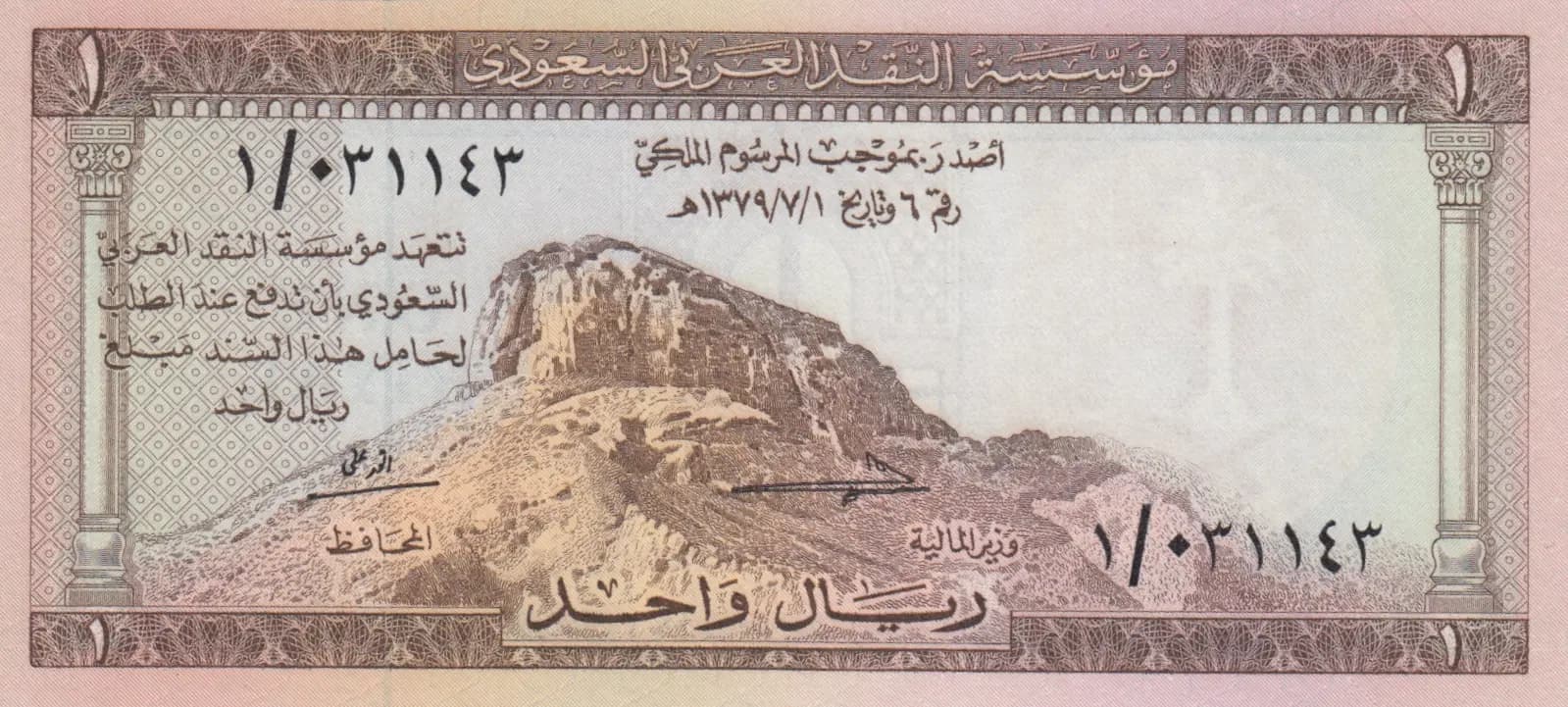
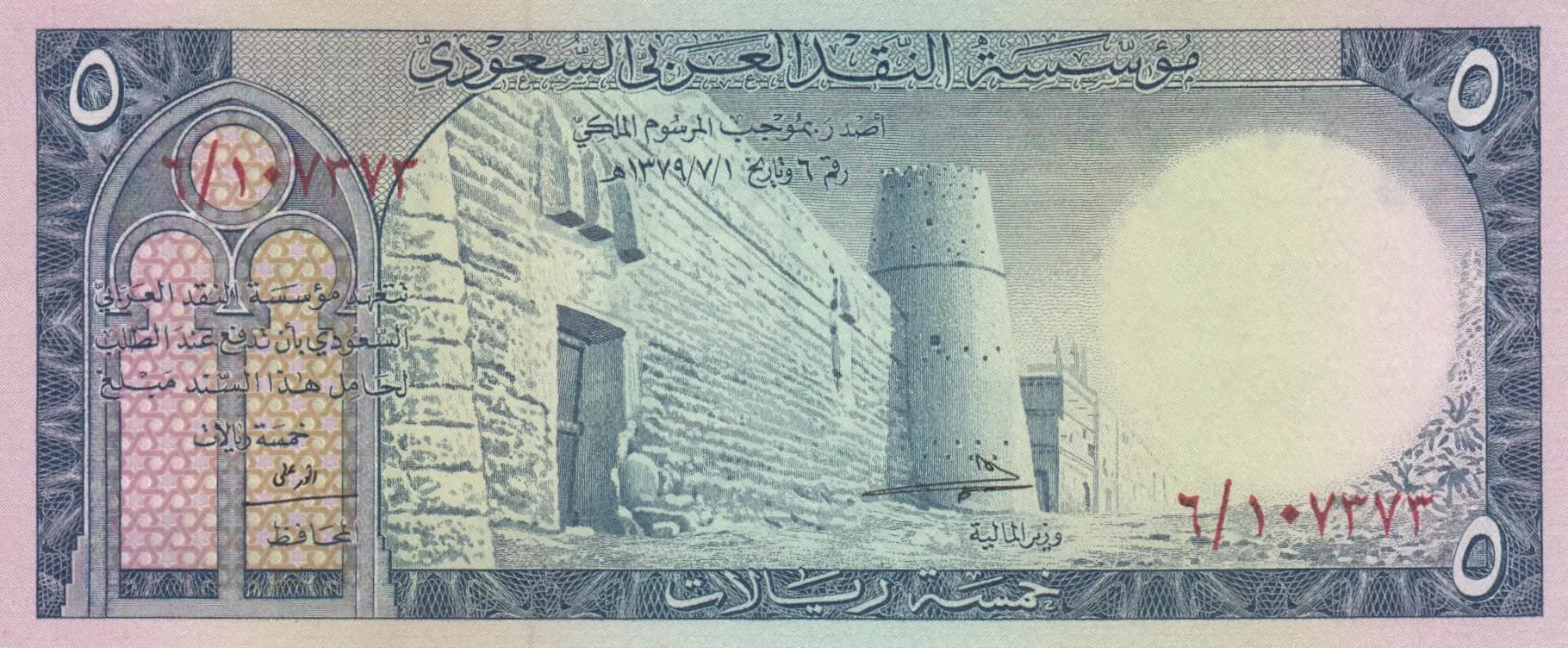
10 riyals 1954
Market Prices
30 salesAbout This Note
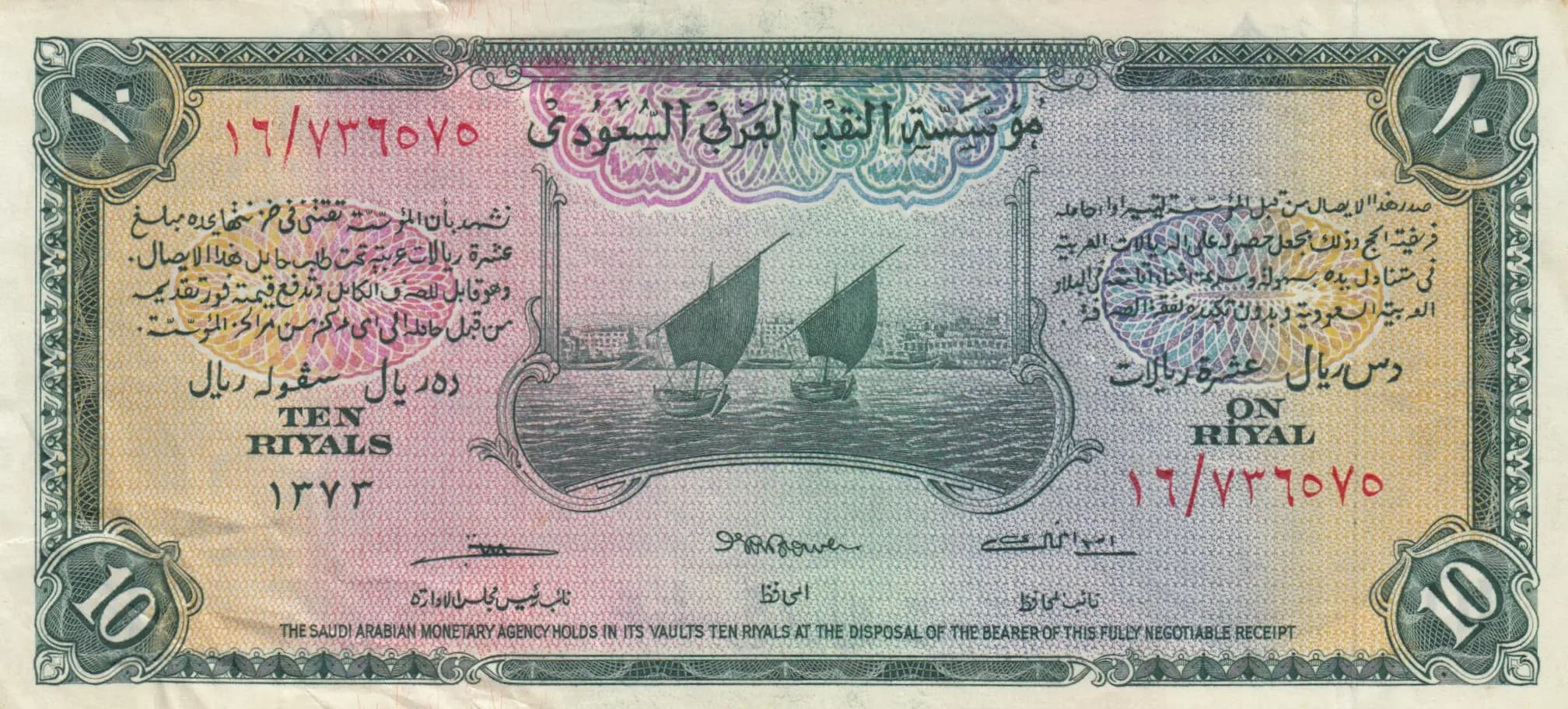
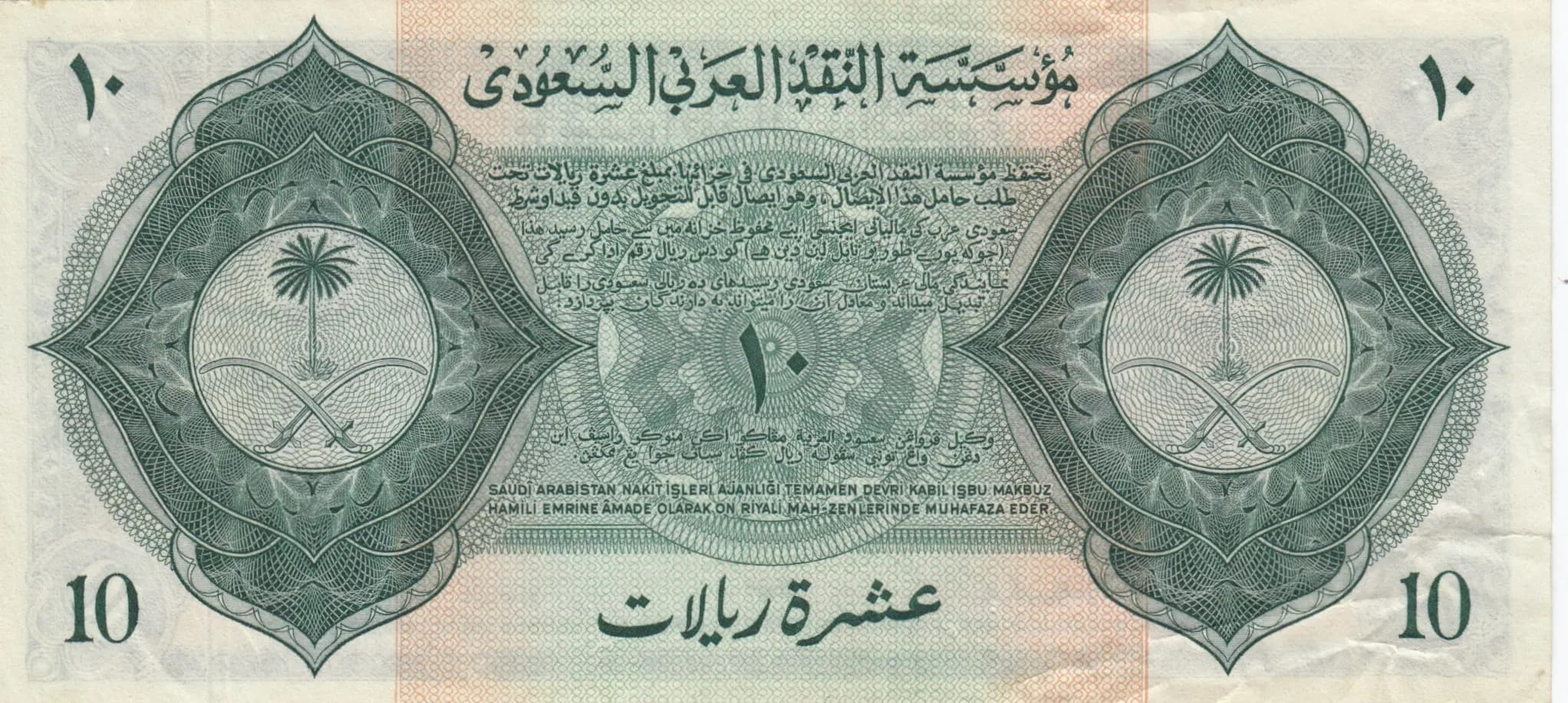
This is a Saudi Arabian Monetary Agency 10 Riyals note from 1954 (AH 1373), Pick P-4, graded VF (Very Fine). The note features beautifully engraved traditional sailing dhows (dhow vessels) at Jeddah on the obverse with ornate Islamic geometric borders in pink, green, and beige tones, while the reverse displays symmetrical medallions with palm tree motifs in green and beige. The note exhibits age-appropriate wear with visible foxing and discoloration consistent with seven decades of storage and light circulation, making it an excellent example of early Saudi currency design.
Common. This is a regular issue banknote from the first Saudi Arabian Monetary Agency series, with no evidence of limited print runs or short-lived circulation. eBay market data confirms common status: VF examples sell regularly in the $30–$120 range (based on 2009–2021 sales), with more recent 2025 data showing PMG 65 examples at $434–$665 but standard VF raw notes in the $90–$116 range. The consistent supply of examples across multiple condition grades and decades of sales indicates substantial original circulation and availability in the collector market. No documented varieties, errors, or special circumstances suggest rarity.
Issued during the formative years of the Saudi Arabian Monetary Agency (established in 1952), this 1954 note represents Saudi Arabia's first independent banknote series, transitioning from colonial-era currency. The dhows depicted at Jeddah symbolize Saudi Arabia's maritime heritage and the critical port city that served as the gateway to Mecca, while the palm tree motifs on the reverse reflect the economic and cultural importance of date palms in the Arabian Peninsula. This design reflects the nation's effort to establish a distinct monetary identity during the early years of modern Saudi state consolidation.
The obverse features two traditional Arabian sailing vessels (dhows) rendered in fine engraving detail, positioned on water with subtle wave patterns, serving as the primary scenic element. These dhows are positioned at Jeddah's waterfront, historically the major Red Sea port. Ornate decorative borders frame the entire note with intricate Islamic geometric patterns combining interlocking lines and arabesque designs in a sophisticated security pattern. Circular medallions containing the denomination '10' are positioned symmetrically in the top left and right corners. The color palette—dominated by pink, green, beige, and gray-blue with gold accents—creates visual hierarchy and aesthetic appeal typical of mid-20th century currency design. The reverse displays two identical large circular medallions with complex Islamic geometric patterns, each containing a stylized palm tree at the center—a symbol of Arabian wealth and sustenance. The composition is symmetrical and balanced, with the central rectangular frame containing Arabic text. The overall design demonstrates the highest standards of intaglio engraving work characteristic of this period.
FRONT: The primary inscription in Arabic appears at top center with decorative calligraphy. English text reads 'TEN RIYALS' (left) and 'ONE RIYAL' (right). The legal tender clause states: 'THE SAUDI ARABIAN MONETARY AGENCY HOLDS IN ITS VAULTS TEN RIYALS AT THE DISPOSAL OF THE BEARER OF THIS FULLY NEGOTIABLE RECEIPT.' Denomination '10' appears in circular medallions at top corners. Arabic numerals show the Hijri date (1373 AH corresponding to 1954 CE) and serial number references. BACK: Arabic text includes 'عشرة رियالات' (Ten Riyals) in the center. The inscription confirms: 'The Saudi Arabian Currency Agency holds in its safekeeping ten riyals at the disposal of the bearer of this negotiable receipt.' Denomination '10' appears in bottom corners. The design incorporates bilingual text reflecting the dual administrative language use of the period.
This note was produced using intaglio (engraved steel plate) printing, the standard security printing method for currency of this era. The fine line work evident in the borders, the detailed rendering of the dhows, and the crisp geometric patterns visible in the visual analysis are characteristic of high-quality intaglio production. The color separations (multiple color plates for the pink, green, beige, and gold elements) were layered sequentially in the printing process. The Saudi Arabian Monetary Agency contracted with established security printers for this series; notes of this period were typically produced by American Bank Note Company or similar international security printers, though definitive attribution requires verification against archival records.
Serial number visible on the note (۱۶/۲۲۷۰۷۰) indicates this is from the standard production run. No overprints, color variants, or notable printing errors are evident from the visual analysis. This note represents the standard variety of Pick P-4, with no identified scarce prefixes or special issues documented for the 1954 series. The pink stamp or marking visible in the upper center area appears to be a collector or handling mark rather than an official variety indicator. Standard signature varieties exist for this issue based on different authorization periods, but the visual resolution does not permit definitive signature identification.