1000 escudos 1964 specimen
About This Note
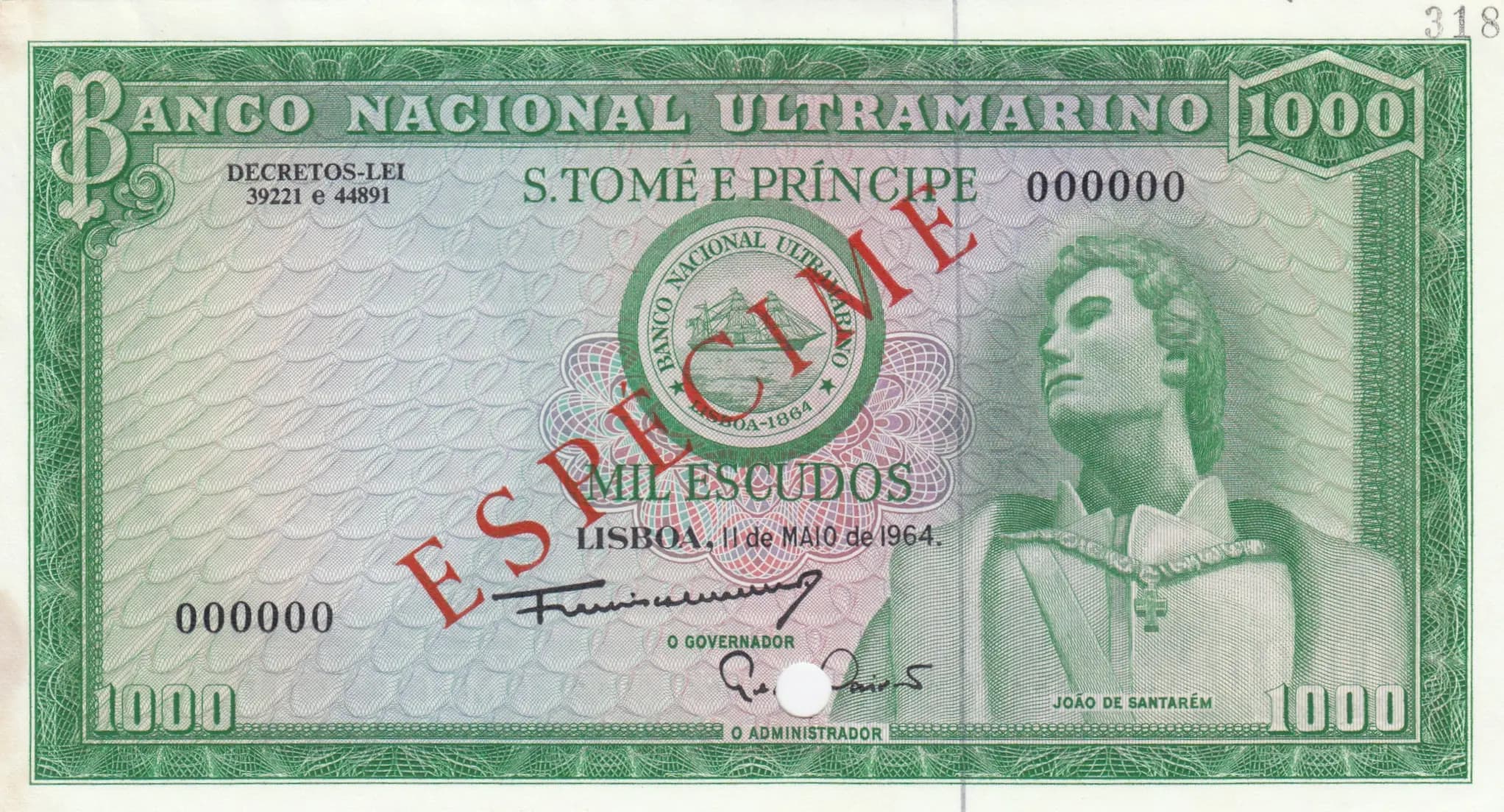
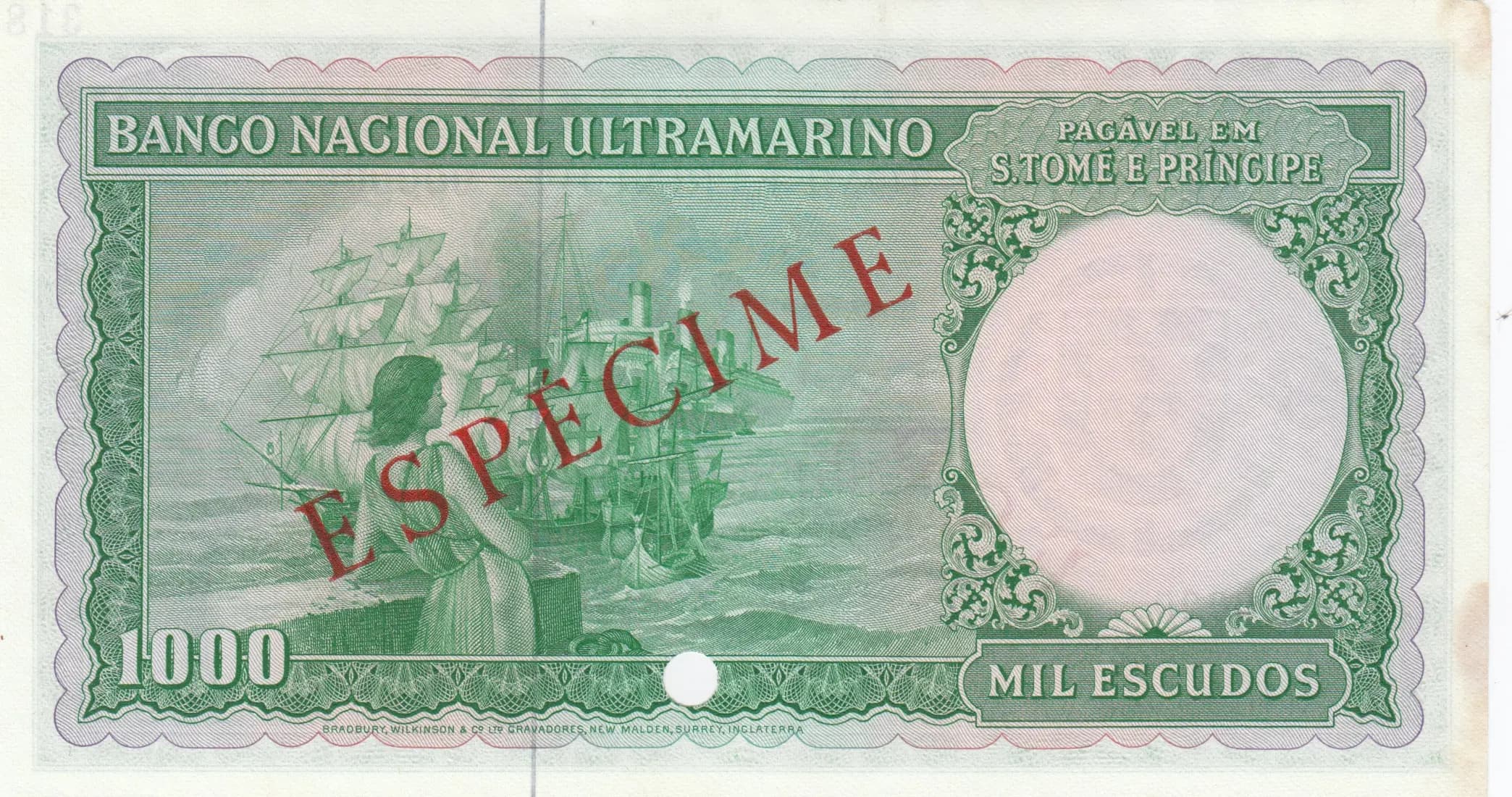
This is a 1000 Escudos specimen note from Banco Nacional Ultramarino dated 11 May 1964, issued for São Tomé e Príncipe during the Portuguese colonial period. The note features an elegant design with a portrait of João de Santarém on the obverse and a detailed maritime scene with a multi-masted sailing ship on the reverse, both executed in fine engraved line-work with green and pink/purple coloring. In AU condition with minor aging and a small puncture mark near center, this specimen note bears the characteristic red diagonal 'ESPECIMEN' overprint and displays excellent preservation for its 60-year age, making it an interesting example of Portuguese colonial currency design.
Common. The 1000 Escudos denomination was a standard circulation and reserve note for São Tomé e Príncipe during the 1964-1970s period of Portuguese colonial administration. While specimen notes (marked 'ESPECIMEN') represent a smaller subset of total production compared to circulation notes, they were produced in standard quantities for distribution to banks and official archives and are not particularly scarce. Specimen notes from this era and issuer regularly appear in the market at modest valuations, and the AU condition grade is achievable for well-preserved examples.
This note was issued during the final decade of Portuguese colonial rule in Africa, as indicated by the 1964 date and the reference to São Tomé e Príncipe as a Portuguese overseas territory. The Banco Nacional Ultramarino, Portugal's historic overseas banking institution, produced currency for all Portuguese colonies through the mid-20th century. The maritime imagery—featuring a prominent sailing ship and port scene—reflects the colonial economy's reliance on maritime trade and reflects the historical importance of these island colonies as trading posts in Portuguese imperial commerce.
The obverse features a dignified left-facing profile portrait of João de Santarém positioned on the right side of the note, surrounded by ornamental corner designs and the circular seal of Banco Nacional Ultramarino featuring a sailing ship at center. A large stylized 'B' appears on the left side. The reverse depicts a detailed engraved maritime scene centered on a large multi-masted sailing vessel in a harbor setting with dock structures and port buildings visible in the background, framed by ornamental borders with a blank decorative oval cartouche on the right side. Both sides employ fine line-work engraving throughout with intricate background patterns and borders, executed in predominantly green with pink and purple accent colors, creating a sophisticated colonial-era design that emphasizes Portugal's maritime heritage and trading history.
FRONT SIDE: 'Banco Nacional Ultramarino' (National Overseas Bank); '1000' and 'Mil Escudos' (One Thousand Escudos); 'S. Tomé e Príncipe' (Saint Thomas and Prince); 'Decretos-Lei 39221 e 44891' (Decree-Laws 39221 and 44891); 'Lisboa, 11 de Maio de 1964' (Lisbon, 11 May 1964); 'O Governador' (The Governor); 'O Administrador' (The Administrator); 'João de Santarém' (João de Santarém—the portrait subject); 'Especimen' (Specimen); Serial number area marked '000000'. BACK SIDE: 'Banco Nacional Ultramarino' (National Overseas Bank); '1000' and 'Mil Escudos' (One Thousand Escudos); 'Pagável em S. Tomé e Príncipe' (Payable in Saint Thomas and Prince); 'Especimen' (Specimen); 'Bradbury Wilkinson & Co Ltd Gravadores, New Malden, Surrey, Inglaterra' (Bradbury Wilkinson & Co Ltd Engravers, New Malden, Surrey, England).
Intaglio engraving (line engraving), as evidenced by the fine detailed line-work visible throughout both sides, intricate portrait rendering, elaborate decorative patterns, and the complex maritime scene with multiple fine lines. The note was produced by Bradbury Wilkinson & Co Ltd, a renowned British security printer specializing in banknote and security document engraving, located in New Malden, Surrey, England. This explains the high quality of the engraved imagery and the sophisticated security features through fine-line complexity.
This is catalogued as Pick P-40s, indicating it is the specimen variety of the base 1000 Escudos note (P-40). The visual analysis confirms this is a specimen note with the red diagonal 'ESPECIMEN' overprint present on both obverse and reverse. The serial number area shows the standard specimen marking '000000'. The printer credit 'Bradbury Wilkinson & Co Ltd' is integral to the design. No date variations or signature varieties are apparent from the 11 May 1964 date shown. The PMG population report indicates P-40cts is the only catalogued variant, suggesting this specimen variety may have limited certified population data.