50 escudos 1958 specimen
About This Note
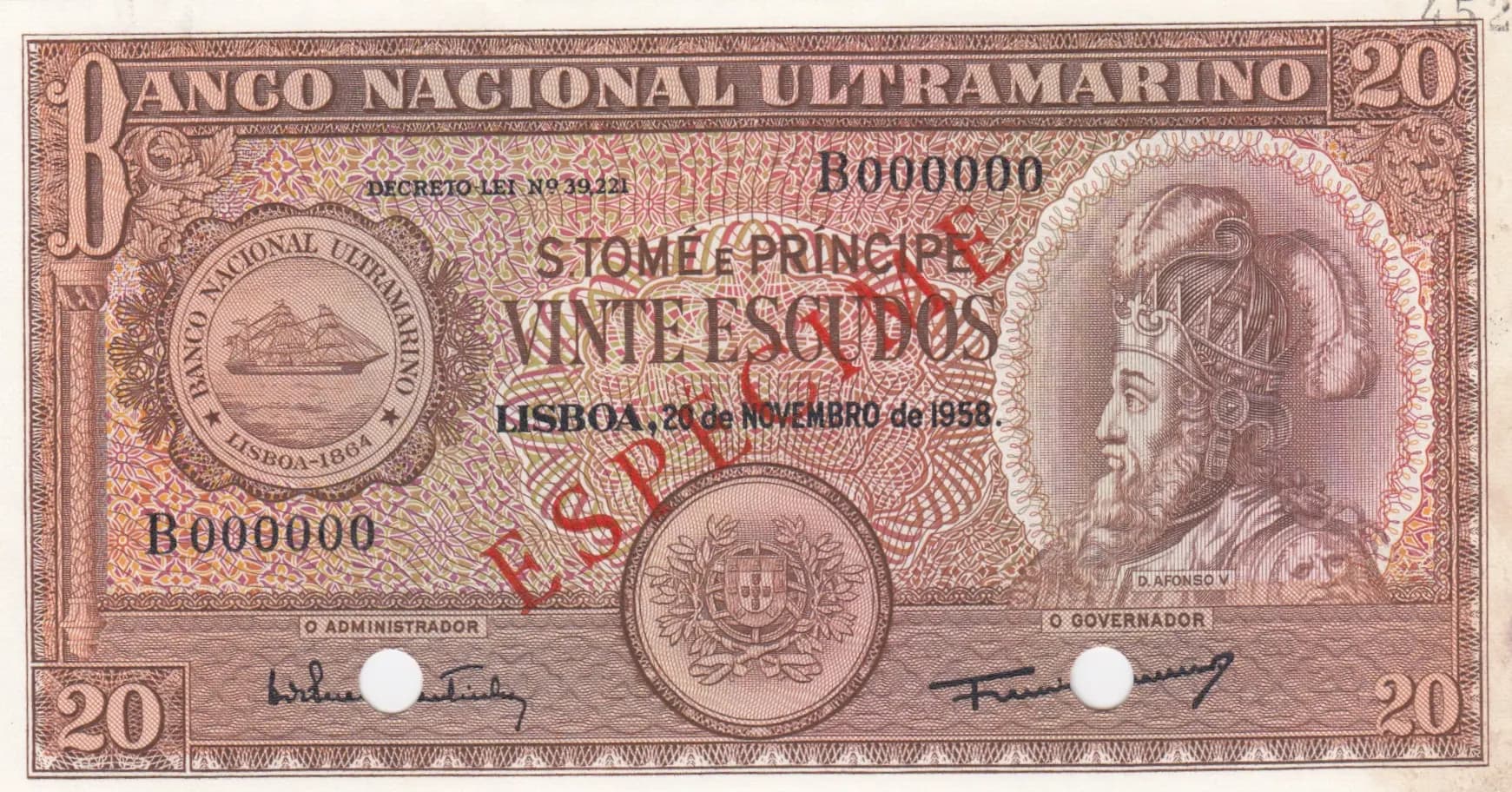
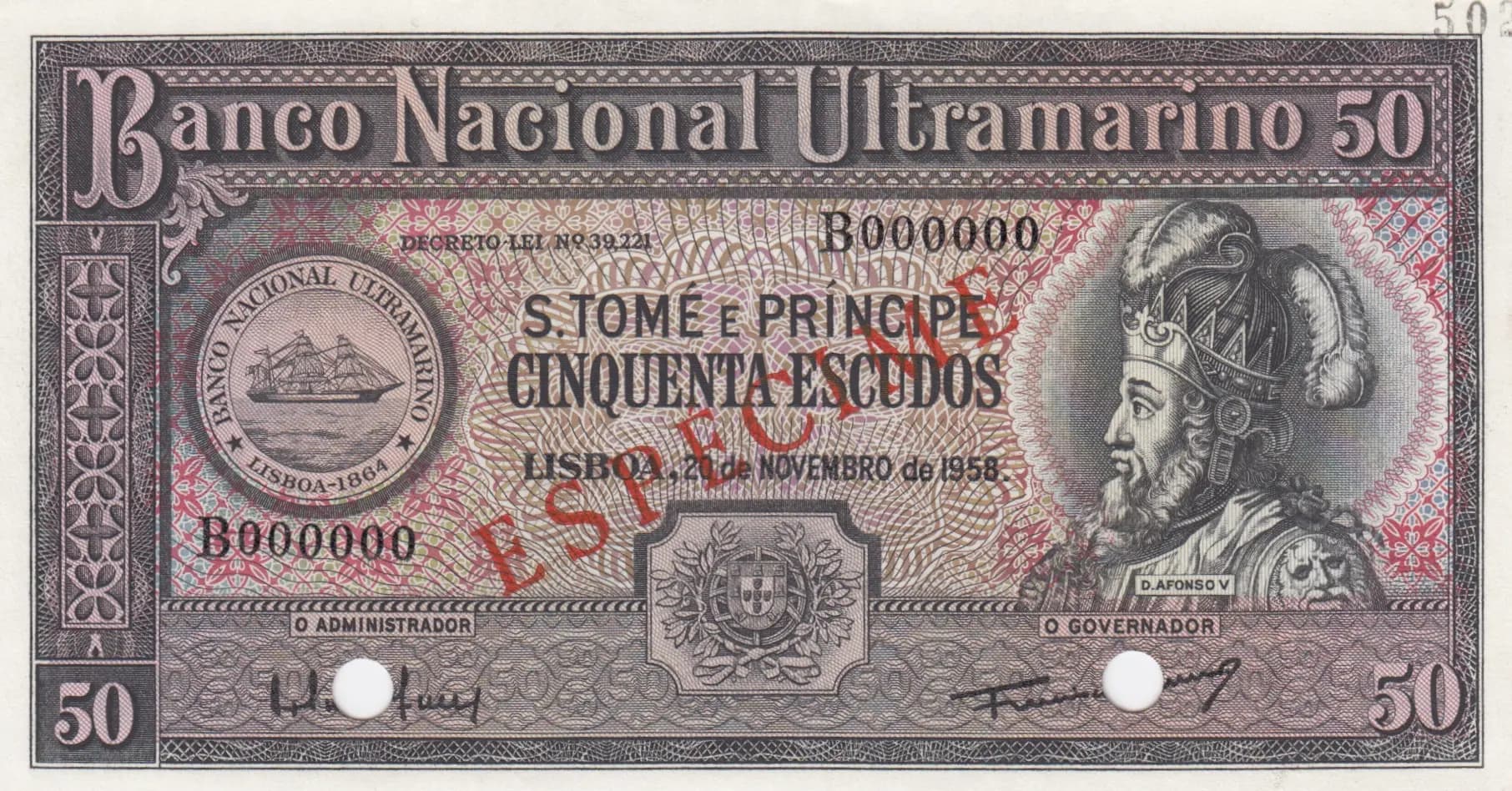
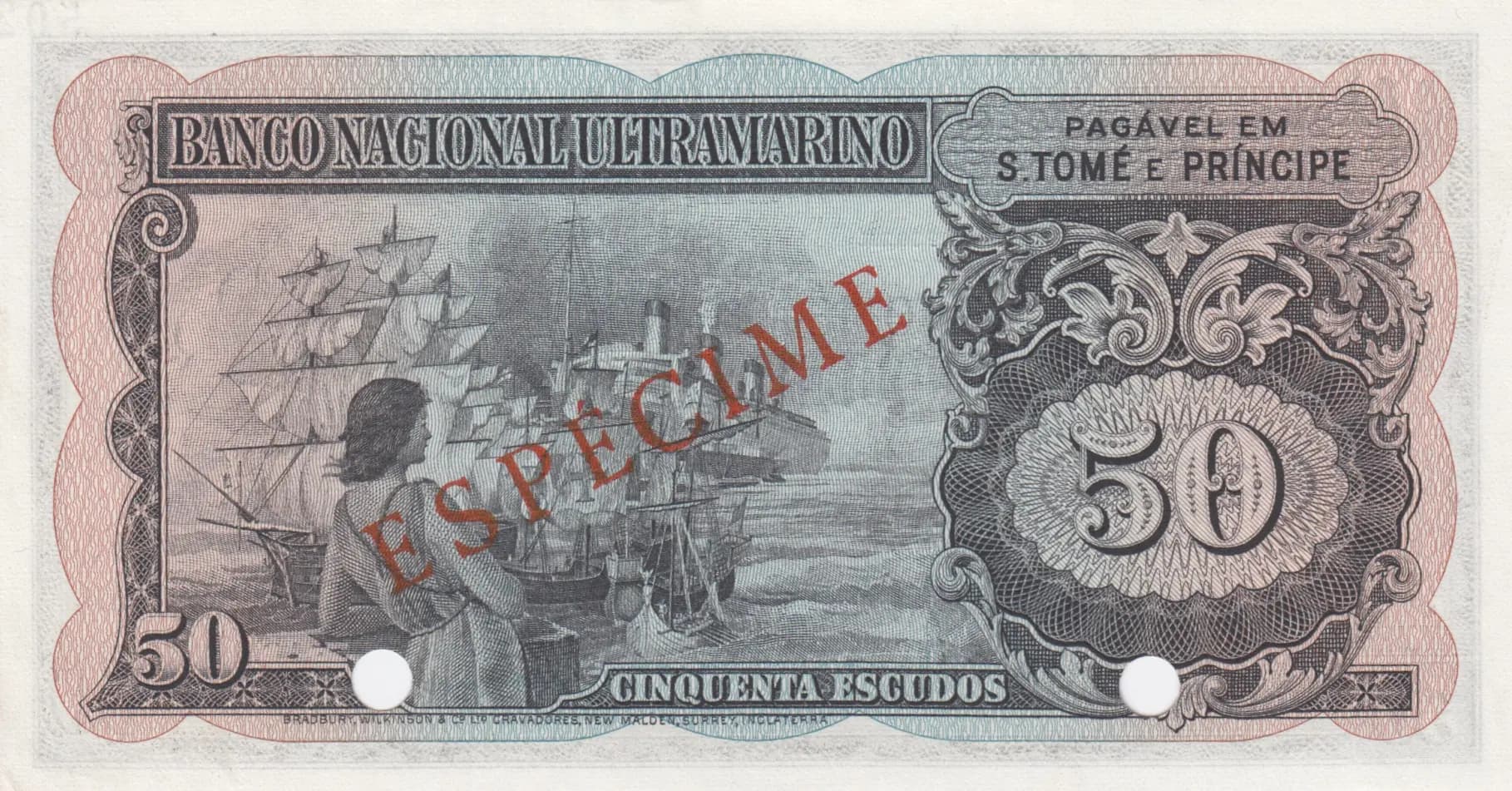
This is an uncirculated 1958 specimen note of 50 escudos from Banco Nacional Ultramarino, issued for the Portuguese colonial territory of Saint Thomas & Prince. The note exhibits excellent preservation with crisp printing, vibrant red overprints reading 'S.TOMÉ E PRÍNCIPE' and 'ESPÉCIME', and the characteristic two punch holes of a specimen note. The design combines historical Portuguese iconography with fine engraving, featuring a bearded portrait believed to be King Afonso V and a detailed multi-masted sailing vessel symbolic of Portugal's maritime heritage.
Common. Specimen notes from the 1958 Banco Nacional Ultramarino issues for Saint Thomas & Prince, while no longer in circulation, were produced in institutional quantities for distribution to banks and archives. The Pick catalog documents one catalogued variant (P-37cts), and specimen examples with punch holes are regularly encountered in the collector market. No specific print run restrictions or rarity designations are associated with this denomination and year. These notes typically trade at modest prices reflecting their common status despite their historical and colonial interest.
This banknote was issued under Decree Law No. 39,121 on November 7, 1958, during the late Portuguese Estado Novo period when Saint Thomas & Prince remained a Portuguese overseas province. The sailing ship depicted on the reverse reflects Portugal's historical dominance as a maritime and colonial power, while the portrait of King Afonso V (the 'African') commemorates the 15th-century monarch who expanded Portuguese exploration along the African coast. The Banco Nacional Ultramarino, headquartered in Lisbon since 1864, served as the central financial authority for Portugal's overseas territories until the 1970s.
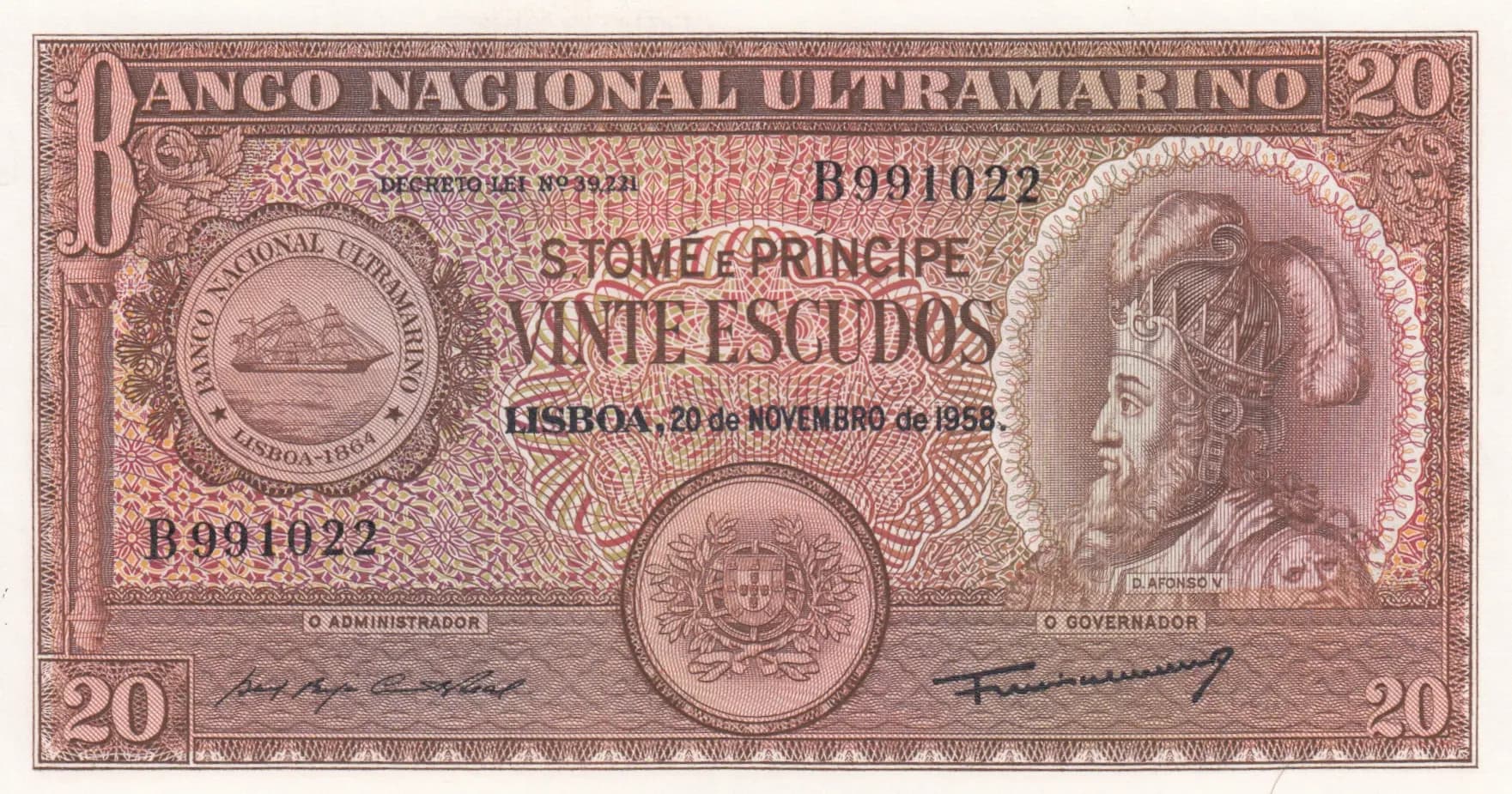
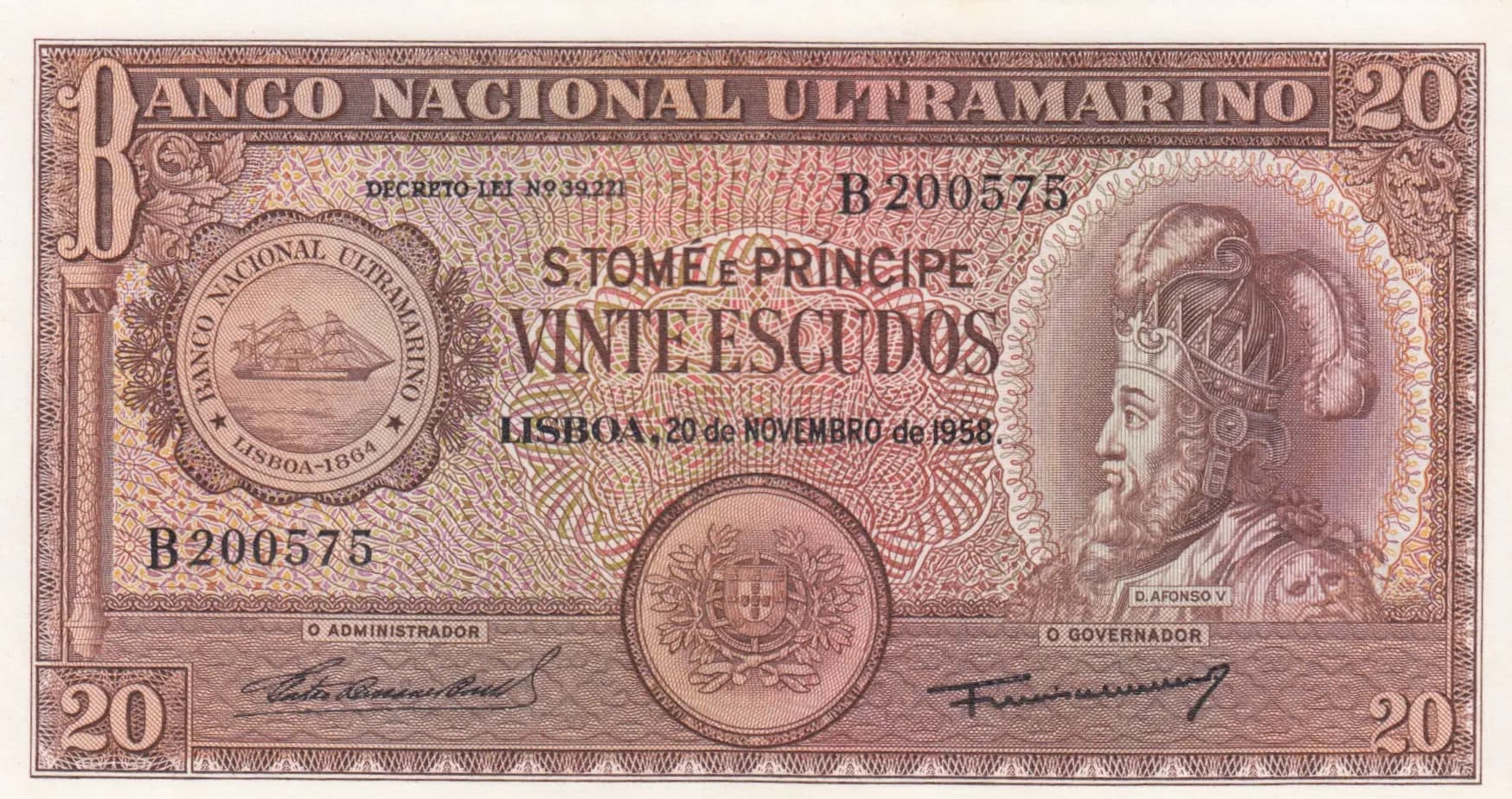
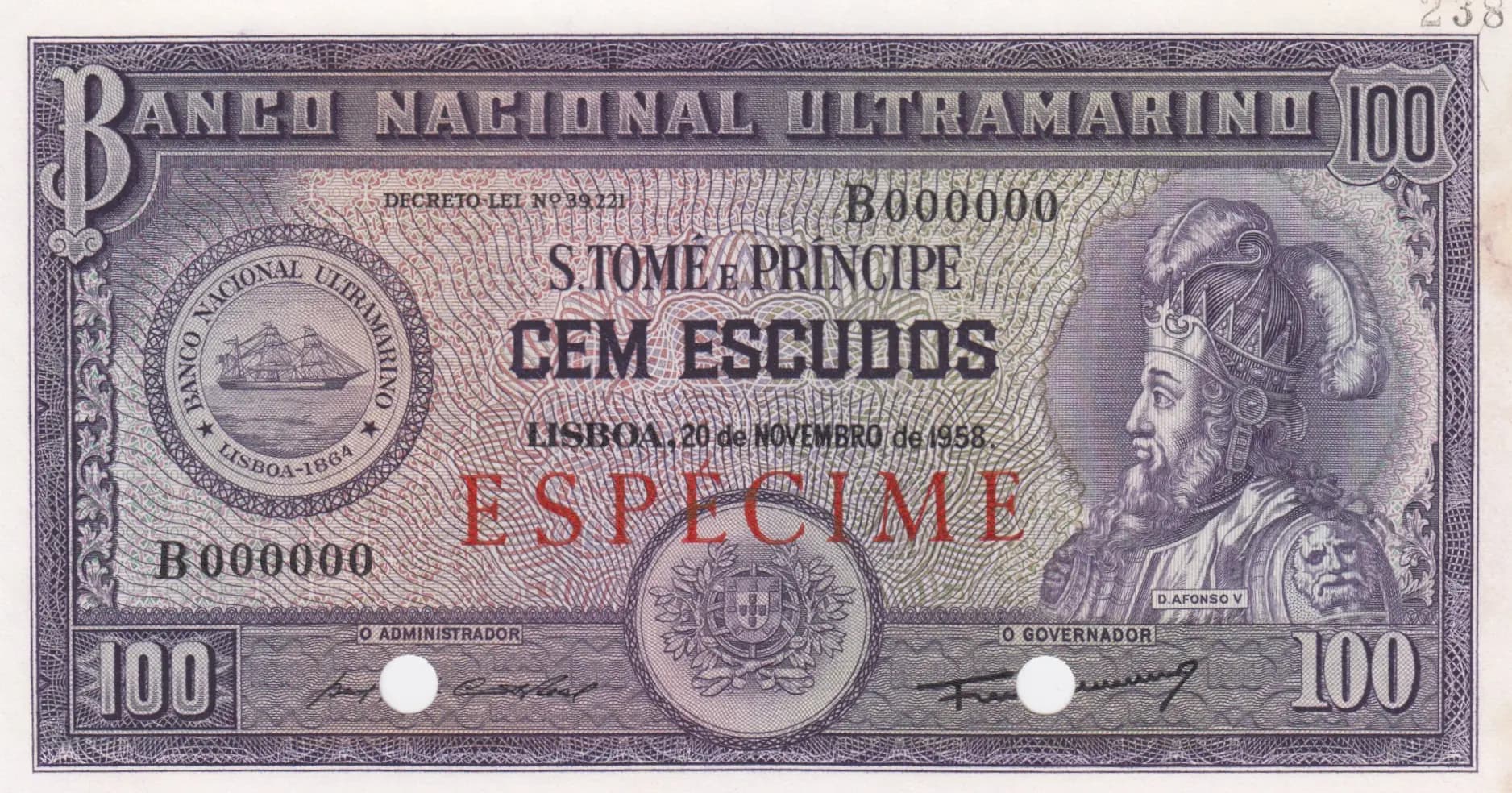
The obverse features King Afonso V in right-facing profile, depicted as a bearded Renaissance-era monarch in formal historical dress with decorative elements, positioned on the right side of the note. The left side bears the circular seal of Banco Nacional Ultramarino with a sailing ship emblem and the founding date 'LISBOA-1864'. The center displays a Portuguese heraldic shield or coat of arms. The entire design is framed by ornamental geometric borders with fine scrollwork and decorative patterns characteristic of mid-20th-century Portuguese bank note engraving. The reverse prominently features a detailed engraving of a large multi-masted sailing vessel, representative of the Age of Discovery and Portuguese maritime traditions. Ornamental scrollwork and decorative cartouches frame the denominations and institutional text.
FRONT: 'Banco Nacional Ultramarino 50' (National Ultramarino Bank 50); 'DECRETO LEI Nº 39,121' (Decree Law No. 39,121); 'S.TOMÉ E PRÍNCIPE' (Saint Thomas and Prince); 'CINQUENTA ESCUDOS' (Fifty Escudos); 'LISBOA - 7 NOVEMBRO de 1958' (Lisbon - November 7, 1958); 'O ADMINISTRADOR' (The Administrator); 'O GOVERNADOR' (The Governor); 'D.AFONSO V' (D. Afonso V). BACK: 'BANCO NACIONAL ULTRAMARINO' (National Ultramarino Bank); 'PAGÁVEL EM S.TOMÉ E PRÍNCIPE' (Payable in Saint Thomas and Prince); '50' (Denomination); 'CINQUENTA ESCUDOS' (Fifty Escudos); 'ESPÉCIME' (Specimen).
Intaglio engraving (copperplate printing), the traditional security printing method employed by Banco Nacional Ultramarino for its banknotes. The fine line work, intricate geometric patterns, and detailed ship engraving visible in both sides are characteristic of intaglio production. The red overprints ('S.TOMÉ E PRÍNCIPE', 'CINQUENTA ESCUDOS', and 'ESPÉCIME') were applied separately, likely via letterpress or offset printing. The two punch holes are hand-applied security markers typical of specimen notes.
This is catalogued as Pick P-37s (specimen variant). The visual analysis confirms the specimen designation through the red 'ESPÉCIME' overprint and the two characteristic punch holes. The serial number shown is 'B000000', typical of specimen notes which often bear zero serial numbers or low-number ranges. The red overprints 'S.TOMÉ E PRÍNCIPE' and 'CINQUENTA ESCUDOS' on the front, and 'ESPÉCIME' on the reverse, are consistent with the standard specimen marking convention. PMG's population data indicates cataloguing of a P-37cts variant, suggesting possible subtypes exist within this Pick number based on technical differences, though the visual analysis does not reveal specific distinguishing characteristics between variants.