1000 dobras 1977 specimen
About This Note
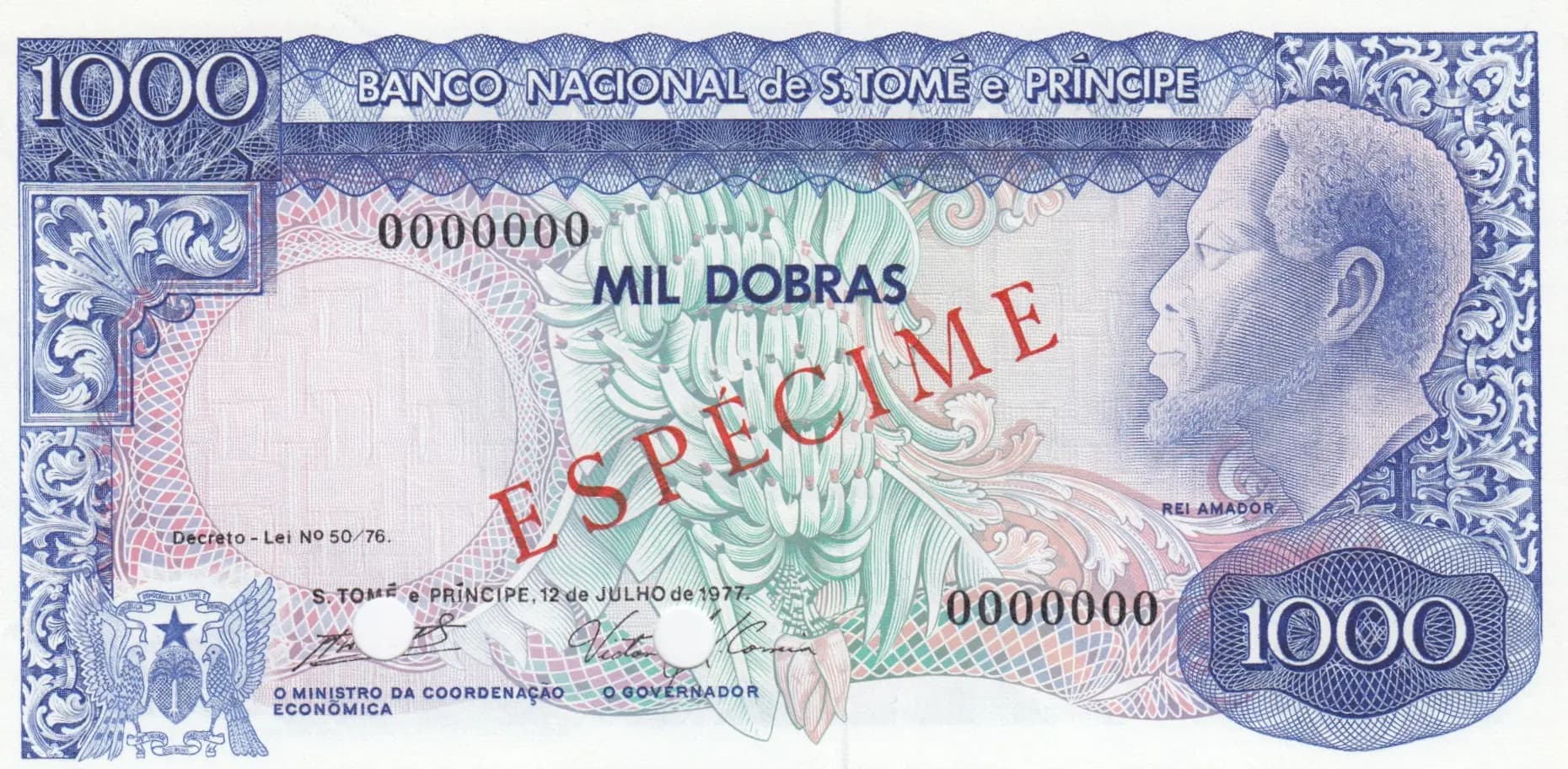
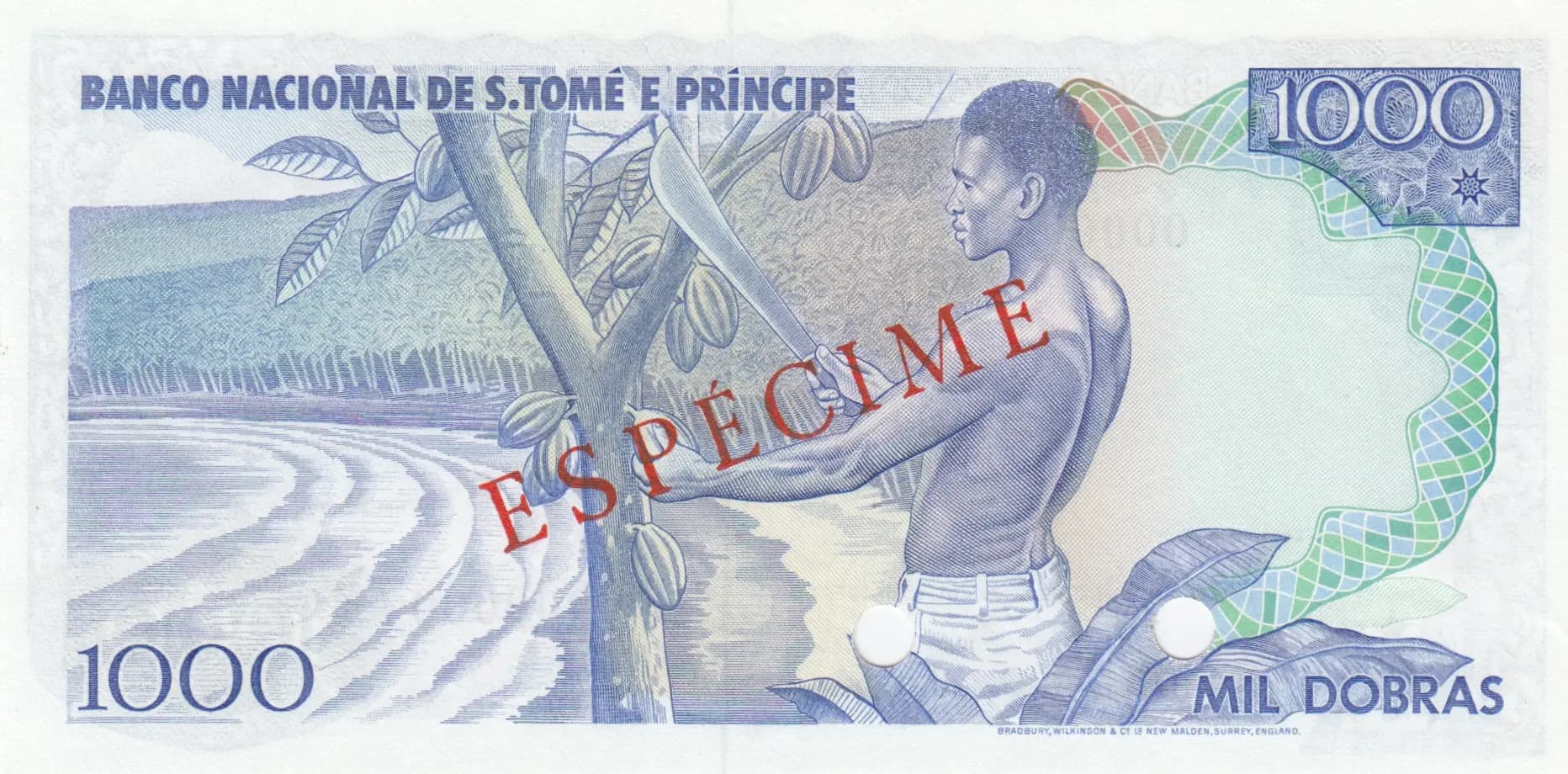
This is an uncirculated 1977 specimen note from São Tomé and Príncipe's first currency issue, displaying exceptional preservation quality typical of unissued specimen printings. The note features striking baroque-style design work with blue and green color dominant, including an ornate front side with a historical portrait and an agriculturally-themed reverse depicting cacao harvesting—reflecting the nation's primary export commodity. The red diagonal 'ESPECIME' overprint and specimen serial number zeros (0000000) confirm this as a non-circulated specimen, making it a desirable item for specialized collectors of African currency and Portuguese-language banknotes.
Common. This is a standard specimen note from the first currency issue of an independent nation with no documented evidence of a restricted print run or special scarcity. Specimen notes, while not intended for circulation, were produced in quantities sufficient for banking distribution and archival purposes. Without specific information indicating a very limited printing (under 1,000 pieces), or documented collector demand commanding premium prices, this note should be classified as common within the specimen category. Uncirculated condition is standard for specimen notes and does not alone indicate rarity.
This denomination was issued on July 12, 1977, shortly after São Tomé and Príncipe's independence from Portugal in 1975, as documented by the Decree-Law No. 50/76 printed on the obverse. The reverse's prominent depiction of cacao pod harvesting directly references the island nation's economic foundation and primary export during the post-independence period. The note's Portuguese-language inscriptions and classical engraved design reflect the country's recent transition to sovereignty while maintaining aesthetic ties to European banking traditions.
The obverse features a formal portrait of a man in profile facing right, positioned on the right side of the note, likely representing a significant historical or political figure from Portuguese colonial or post-independence São Tomé and Príncipe. The design is framed by an ornate baroque-style decorative border in blue with elaborate scrollwork, flourishes, and line patterns. A coat of arms with a star symbol appears in the lower left quadrant. An ornamental square panel with intricate details occupies the left side. The reverse depicts an economically significant scene: a shirtless male figure shown in profile harvesting cacao pods from a tree branch, set against a background of cultivated plantation landscape and vegetation. This agricultural imagery emphasizes cacao as the nation's primary export commodity. A decorative green lattice or mesh pattern appears along the right edge of the reverse. Both sides employ fine engraved line work throughout, with the specimen designation prominently displayed diagonally in red across both sides.
FRONT SIDE: 'BANCO NACIONAL de S.TOMÉ e PRÍNCIPE' (National Bank of São Tomé and Príncipe); 'MIL DOBRAS' (One Thousand Dobras); 'ESPECIME' (Specimen); 'Decreto - Lei Nº 50/76' (Decree-Law No. 50/76); 'S.TOMÉ e PRÍNCIPE, 12 de JULHO de 1977' (São Tomé and Príncipe, July 12, 1977); 'O MINISTRO DA COORDENAÇÃO ECONÓMICA' (The Minister of Economic Coordination); 'O GOVERNADOR' (The Governor); 'REI AMADOR' (King Amador—likely reference to a historical/cultural figure); denomination '1000' appears in upper left and lower right. BACK SIDE: 'BANCO NACIONAL DE S.TOMÉ E PRÍNCIPE' (National Bank of São Tomé and Príncipe); 'ESPECIME' (Specimen); 'MIL DOBRAS' (One Thousand Dobras); 'BRADBURY, WILKINSON & CO LTD NEW MALDEN, SURREY, ENGLAND' (printer attribution); denomination '1000' in upper right.
This note was produced using intaglio (engraved) printing by Bradbury, Wilkinson & Co Ltd, a renowned British security printer located in New Malden, Surrey, England. The exceptionally fine line work, intricate detail in the baroque decorative elements, and the sharp clarity of the agricultural scene are characteristic of traditional engraving and intaglio production. The multi-color printing (blue, green, pink/red, white) was achieved through the standard multi-pass intaglio process. The red specimen overprint was applied as a separate printing operation.
This is the specimen variety (P-55s) as indicated by the red 'ESPECIME' overprint and specimen serial number (0000000). The printer is confirmed as Bradbury, Wilkinson & Co (BWC) per PMG population data. The Pick catalog lists only one variant for the base P-55 number, confirming this is the sole documented variety of the 1000 dobras specimen note from 1977. No alternative signatures, date variations, or serial number prefix variants are apparent from the visual analysis.