100 escudos 1976
About This Note
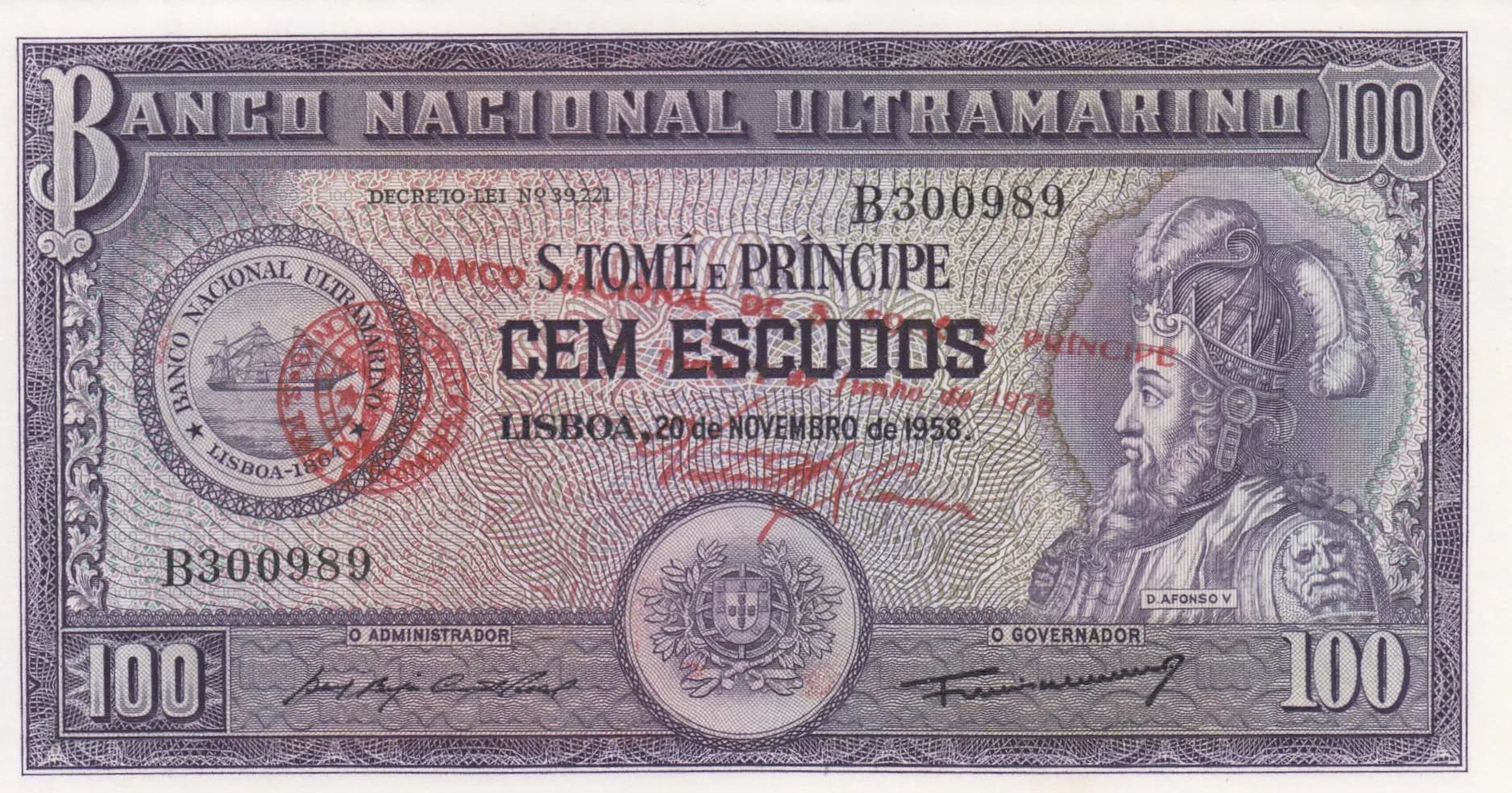
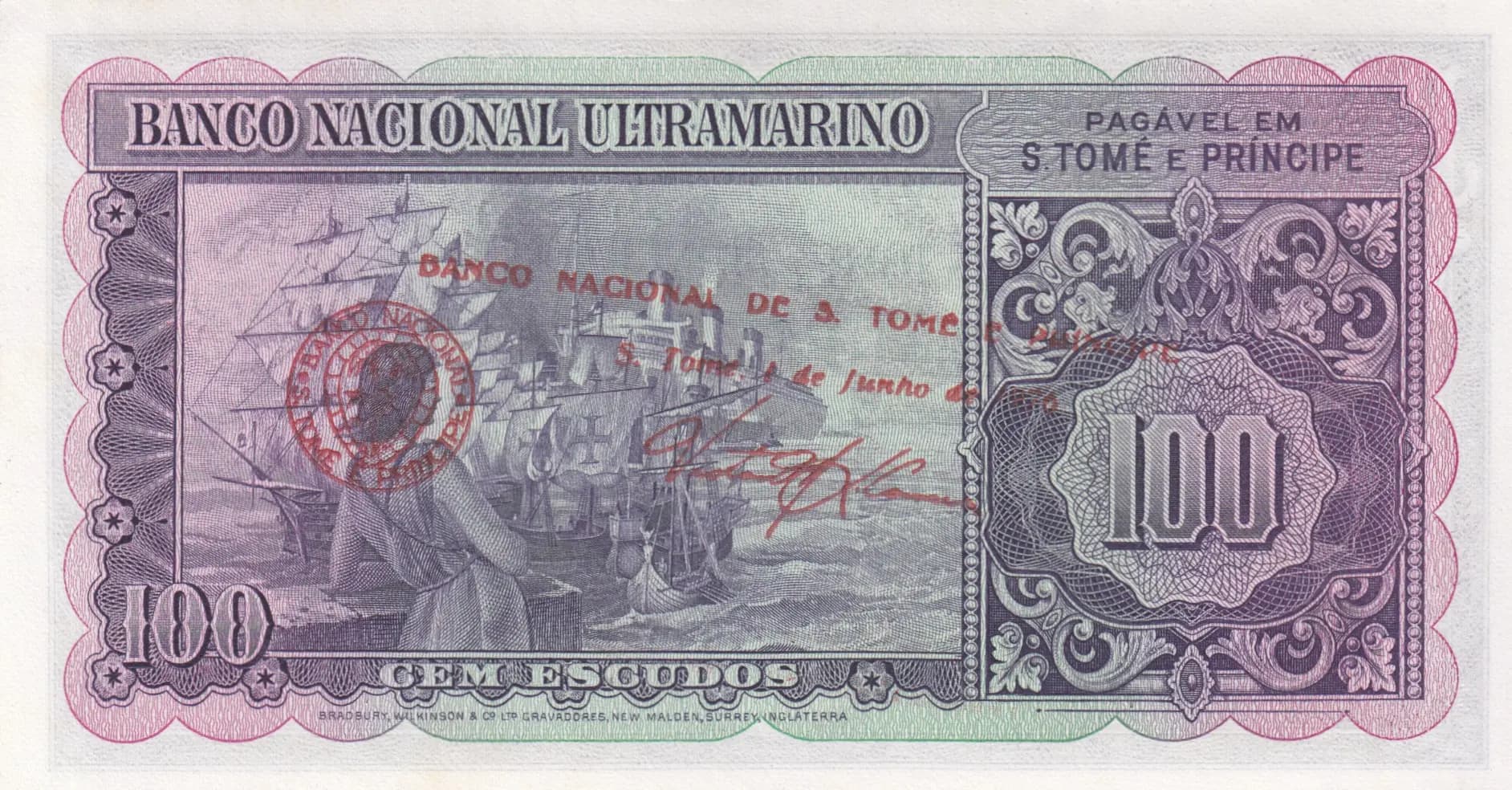
This is a striking 100 Escudos banknote from Saint Thomas & Prince issued in 1976, presented in uncirculated condition with exceptional preservation. The note features fine line engraving throughout with a portrait of King Afonso V on the obverse and a detailed colonial-era waterfront settlement on the reverse, rendered in purple, pink, and green tones. The presence of red stamp overprints and the issuer's transition from Banco Nacional Ultramarino to Banco Nacional de S. Tomé e Príncipe make this an interesting numismatic artifact capturing a pivotal moment in the nation's post-independence monetary history.
Common. While Saint Thomas & Prince banknotes from the immediate post-independence period are not produced in large volumes by global standards, this 100 Escudos denomination was part of the nation's regular currency circulation from 1976 and represents a standard issue within this short-lived series. The uncirculated condition is more noteworthy than the note's scarcity; these notes remain relatively accessible to collectors at modest prices. No evidence of limited print runs, early recalls, or extreme rarity is apparent for this Pick number.
This note was issued on November 20, 1976, just one year after Saint Thomas & Prince achieved independence from Portugal in July 1975. The obverse features a portrait of King Afonso V, reflecting the historical Portuguese connection and cultural heritage, while the reverse depicts what appears to be a colonial-era trading post or settlement, likely representing São Tomé's historical significance as a Portuguese trading center. The issuer's designation as 'Banco Nacional de S. Tomé e Príncipe' represents the newly independent nation's assertion of monetary sovereignty, even as it maintained Portuguese cultural and linguistic ties.
The obverse features a right-facing profile portrait of King Afonso V of Portugal, rendered in fine engraving detail with the monarch wearing period clothing and distinctive headpiece, positioned on the right side of the note. A circular coat of arms seal is centrally placed in the lower portion, with a red circular bank stamp on the left side. The reverse depicts a historically significant colonial waterfront scene featuring a settlement with period architecture, fortifications, and maritime vessels, likely representing the historic port of São Tomé during the Portuguese colonial era. Both sides feature ornate decorative borders with intricate geometric patterns, floral motifs, and ornamental cartouches positioned in the corners, all rendered in the characteristic style of high-security banknote design. Denomination marking '100' appears in an ornamental cartouche on the reverse. The color scheme emphasizes purple/violet, pink/magenta, green, and gray tones with black line work throughout.
{"front":[{"original":"BANCO NACIONAL ULTRAMARINO","translation":"Ultramarino National Bank"},{"original":"S.TOMÉ E PRÍNCIPE","translation":"Saint Thomas and Prince"},{"original":"CEM ESCUDOS","translation":"One Hundred Escudos"},{"original":"DECRETO-LEI Nº 22-A/76","translation":"Decree-Law No. 22-A/76"},{"original":"LISBOA, 20 de NOVEMBRO de 1976","translation":"Lisbon, November 20, 1976"},{"original":"O ADMINISTRADOR","translation":"The Administrator"},{"original":"O GOVERNADOR","translation":"The Governor"},{"original":"D.AFONSO V","translation":"D. Afonso V [King Afonso the Fifth]"}],"back":[{"original":"BANCO NACIONAL ULTRAMARINO","translation":"Ultramarino National Bank"},{"original":"PAGÁVEL EM S.TOMÉ E PRÍNCIPE","translation":"Payable in Saint Thomas and Prince"},{"original":"CEM ESCUDOS","translation":"One Hundred Escudos"},{"original":"BANCO NACIONAL DE S. TOMÉ","translation":"National Bank of Saint Thomas"},{"original":"ASHBURY, WILKINSON & CO LTD GRAVADORES, NEW MALDEN, SURREY, INGLATERRA","translation":"Ashbury, Wilkinson & Co Ltd Engravers, New Malden, Surrey, England"}]}
Intaglio engraving (line engraving) executed by Ashbury, Wilkinson & Co Ltd, a renowned British security printer located in New Malden, Surrey. The visual analysis confirms fine line engraving throughout with intricate geometric and ornamental patterns characteristic of high-security intaglio production. The detailed scenic rendering on the reverse and the portrait on the obverse demonstrate the precision achievable through this labor-intensive process, which was the standard for international banknote production in the 1970s.
The visual analysis indicates this note carries the Ashbury, Wilkinson & Co Ltd printer attribution on the reverse. PMG catalogs two variants: P-46a (printed by BWC - Bradbury Wilkinson Company) and P-46cts. Based on the printer credit visible in the inscription 'ASHBURY, WILKINSON & CO LTD,' this appears to be consistent with the standard catalogue listing. The serial number visible is B3009889. The red overprint stamps present on both sides appear to be authentic bank processing marks from the Banco Nacional de S. Tomé e Príncipe rather than varieties, consistent with contemporary banking practice.