100 dobras 1977 specimen
About This Note
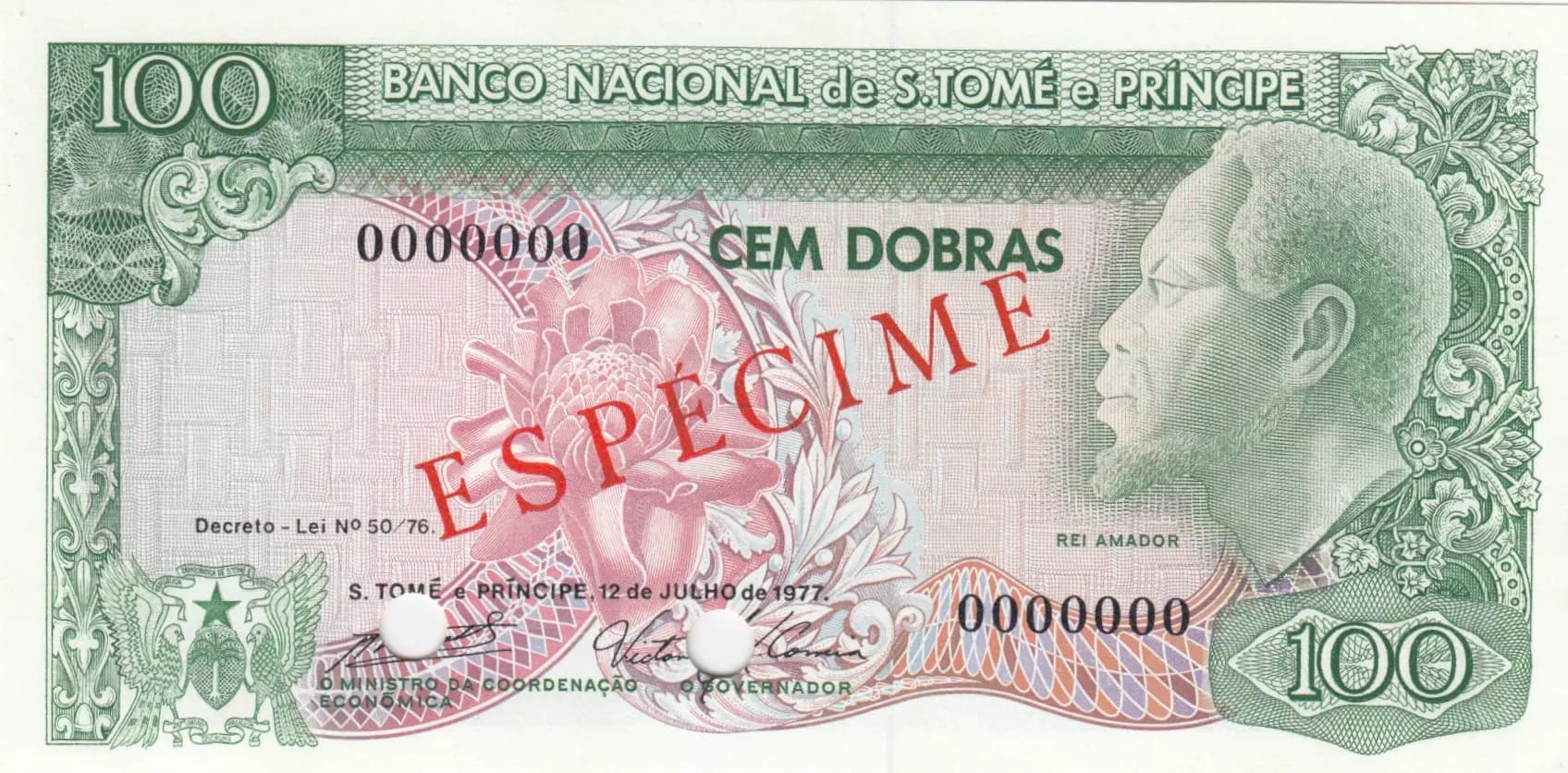
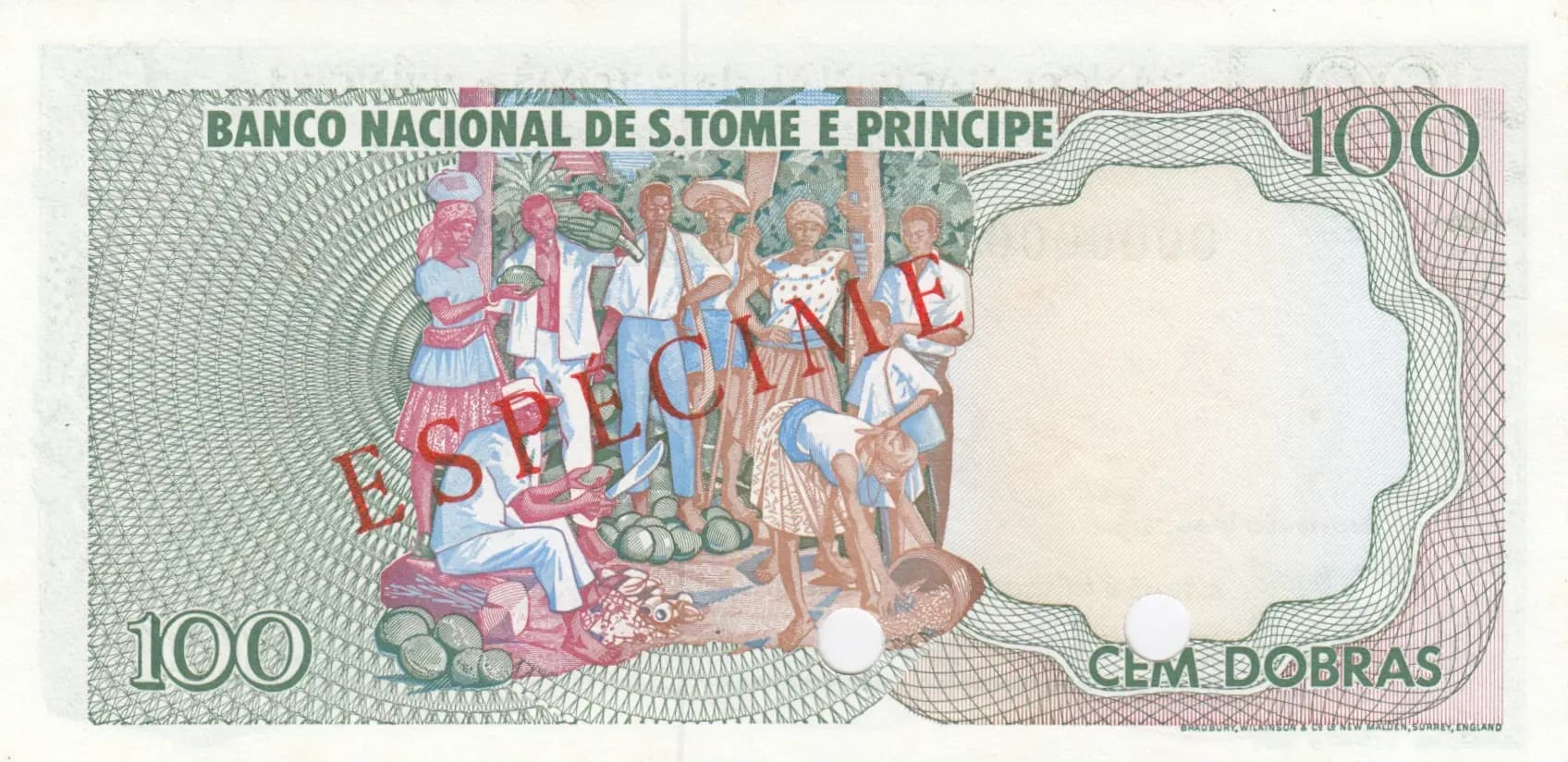
A striking UNC specimen banknote from Saint Thomas & Prince's first post-independence currency issue, featuring vibrant green and pink coloring with ornate engraving throughout. The front displays a portrait of Rei Amador in profile alongside elaborate floral and botanical designs, while the reverse showcases a detailed historical scene depicting colonial-era trading or labor activities with multiple figures. The red diagonal ESPECIME overprint and specimen hole punches confirm this note's status as a non-circulating specimen, making it a significant artifact of the nation's 1977 monetary transition.
Common. While this is a specimen note, specimen versions of early post-independence issues from Saint Thomas & Prince are not exceptionally scarce in the collector market. The first series of notes from 1977 was produced in reasonable quantities by BWC, and specimen examples have appeared with some regularity in dealer inventory and auction sales. Specimen notes from this era and region typically command modest premiums over circulated examples but remain accessible to collectors at standard specimen pricing levels.
This 100 dobras note was issued on July 12, 1977, just two years after Saint Thomas & Prince gained independence from Portugal in 1975, as mandated by Decree-Law No. 50/76. The reverse illustration depicts a historical colonial scene, reflecting the nation's complex heritage during the Portuguese colonial period. The portrait of Rei Amador on the front honors a significant historical figure from the islands' past, while the Banco Nacional de S. Tomé e Príncipe's new issuing authority represented the country's assertion of sovereignty over its monetary system.
The obverse features Rei Amador (King Amador), a historical figure of significance to the islands, rendered in green profile facing right, positioned prominently on the right side of the note. Elaborate ornamental borders in green frame both sides of the obverse, incorporating decorative floral scrollwork, shield or coat of arms elements in corner decorations, and a star symbol on the left side. The center features an intricate pink and rose-colored floral design with sophisticated botanical elements suggesting the islands' natural heritage. The reverse depicts a detailed engraved historical illustration of a colonial-era scene with multiple human figures in period dress engaged in what appears to be trading, labor, or commercial activities, set against architectural backgrounds with wavy line patterns. Extensive guilloche (geometric line) patterns in green cover the left portion of the reverse, serving both aesthetic and anti-counterfeiting purposes. The complex line work and multi-color registration throughout the note demonstrate sophisticated engraving craftsmanship.
FRONT SIDE: '100' (denomination numeral); 'BANCO NACIONAL de S.TOMÉ e PRÍNCIPE' (National Bank of São Tomé and Príncipe); 'CEM DOBRAS' (One hundred dobras); 'ESPECIME' (Specimen - overprint); 'Decreto - Lei Nº 50/76' (Decree-Law No. 50/76); 'S. TOMÉ e PRÍNCIPE, 12 de JULHO de 1977' (São Tomé and Príncipe, July 12, 1977); 'REI AMADOR' (King Amador - portrait identification); 'MINISTRO DA COORDENAÇÃO ECONÓMICA' (Minister of Economic Coordination); 'GOVERNADOR' (Governor). BACK SIDE: 'BANCO NACIONAL DE S.TOMÉ E PRÍNCIPE' (National Bank of São Tomé and Príncipe); '100' (denomination numeral); 'CEM DOBRAS' (One hundred dobras); 'ESPECIME' (Specimen - overprint).
Intaglio engraving (relief printing) executed by Bradbury Wilkinson and Company (BWC), the renowned British security printer noted on the Pick catalog entry. The notes display characteristic features of high-quality intaglio work including fine line guilloche patterns, complex engraved borders, detailed figural illustrations with precise line work, and precise color registration across multiple ink layers. The specimen overprints and hole punches are typical of specimen production protocols established by central banks for archival and distribution purposes.
This is catalogued as P-53s, the specimen variant of the 100 dobras 1977 issue. The 'ESPECIME' (Portuguese spelling) red diagonal overprint and the specimen hole punches are the defining characteristics of the specimen variety. The serial numbers appear as 0000000 in black, consistent with standard specimen production practices. No signature varieties or date variants are apparent from the visual analysis. The note represents the standard BWC production of this specimen type with no noted sub-varieties reported in the PMG population data.