5000 rublei 1921
About This Note
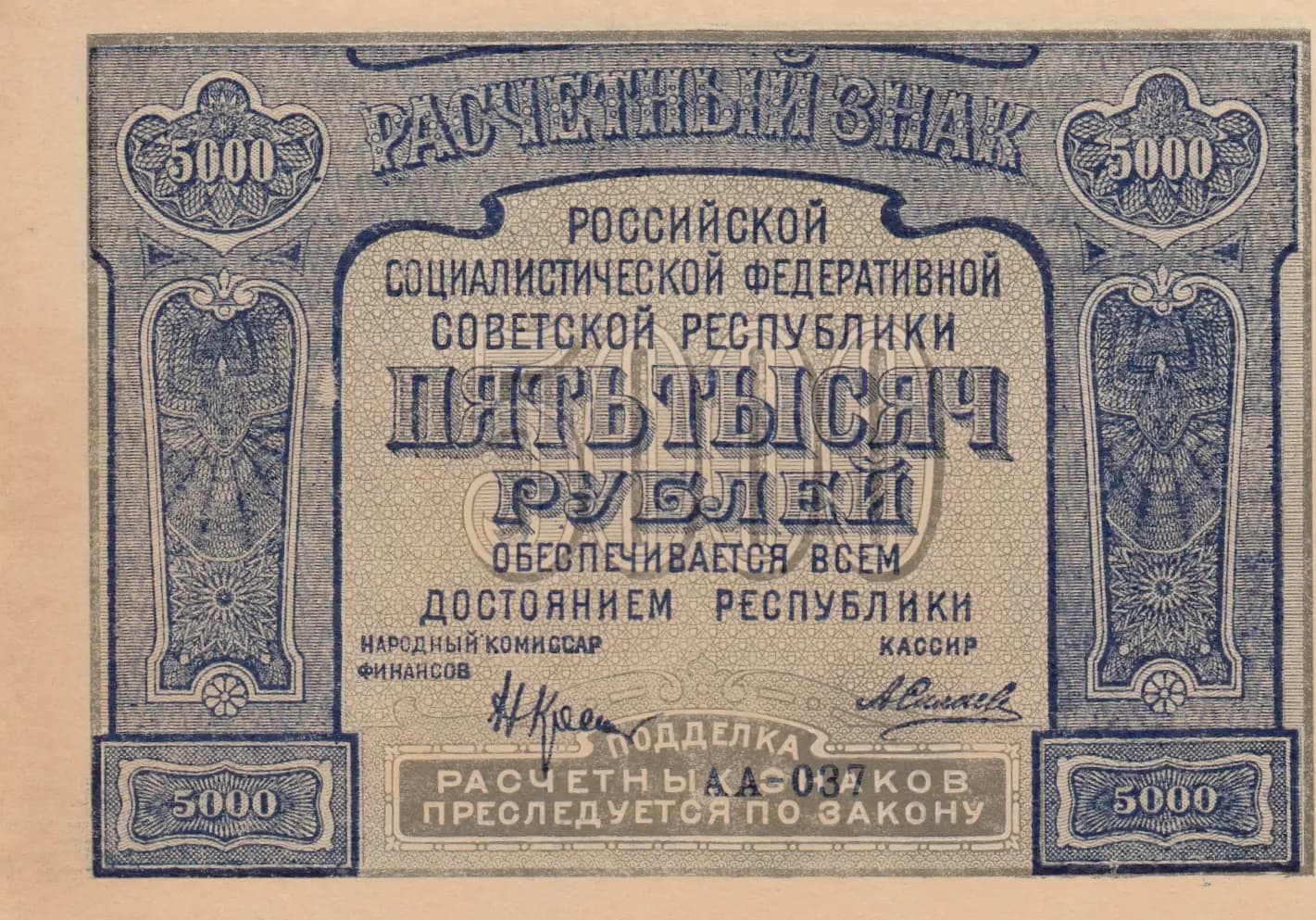
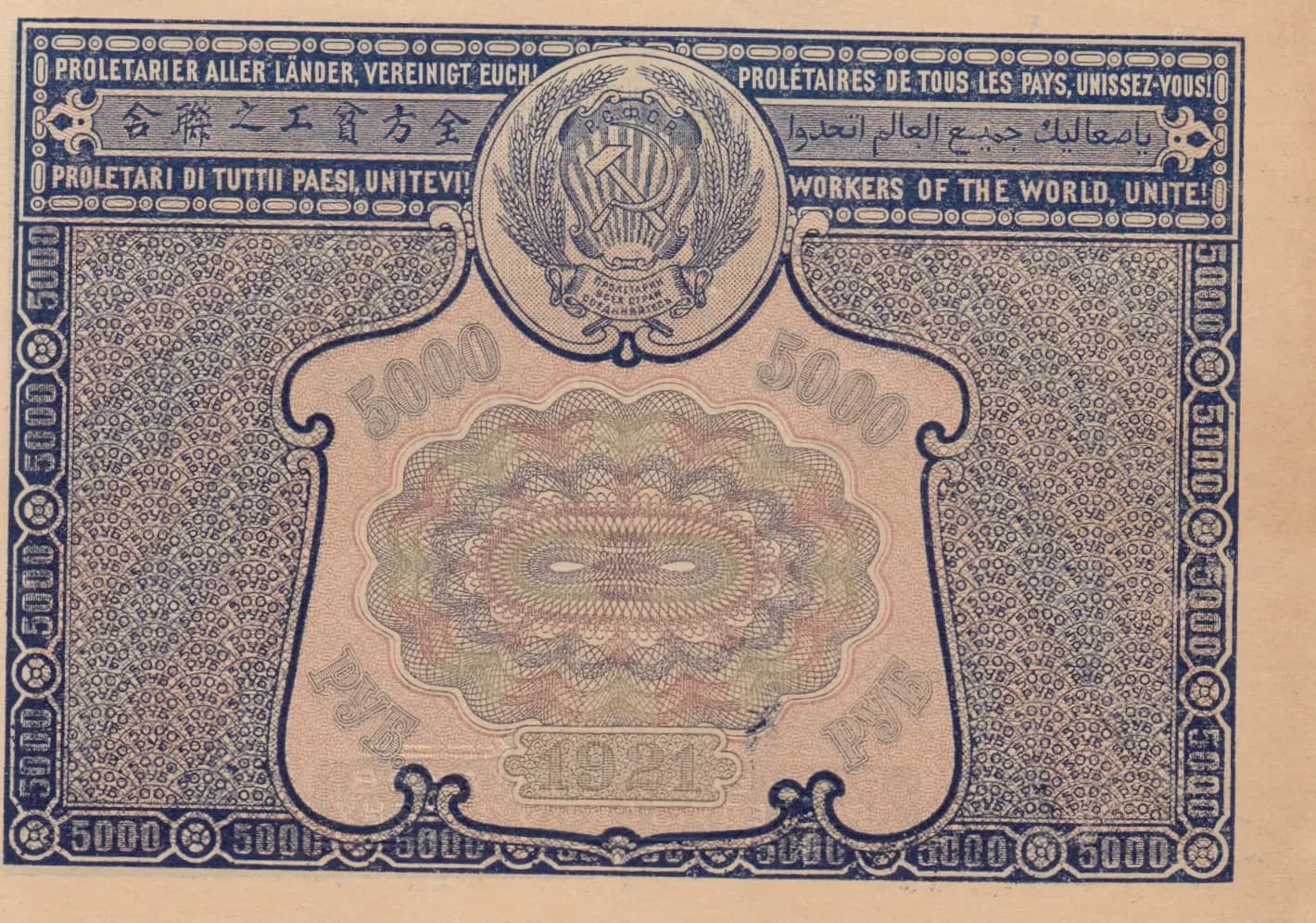
This is a spectacular UNC example of the Russian SFSR 5000 Rublei from 1921, one of the early Soviet revolutionary-era banknotes. The note displays pristine condition with vibrant blue and tan coloring, intricate ornamental borders featuring imperial double-headed eagles, and handwritten signatures of financial officials. The reverse showcases the Soviet hammer-and-sickle emblem with multilingual revolutionary slogans in German, French, Italian, English, Chinese, and Arabic, making it a fascinating artifact of early Communist internationalist ideology.
Common. The 5000 Rublei denomination of 1921 was issued in substantial quantities by the Soviet government to facilitate large transactions during the early NEP (New Economic Policy) period. Despite its historical significance and attractive design, these notes circulated widely and survive in considerable numbers today. The UNC condition grade is more challenging to locate than circulated examples, but the denomination and vintage do not command premium prices in the numismatic market, with typical examples trading well below the threshold for scarce notes.
Issued during the tumultuous period following the Russian Revolution and Civil War, this 1921 note represents the Stare (State) Treasury's attempt to establish monetary authority under the new Soviet regime. The iconography marks the transition from Imperial Russian symbolism—visible in the retained double-headed eagles—to Soviet revolutionary symbolism, exemplified by the prominent hammer-and-sickle emblem on the reverse. The multilingual workers' slogans reflected the Bolsheviks' internationalist aspirations and their expectation of imminent global proletarian revolution.
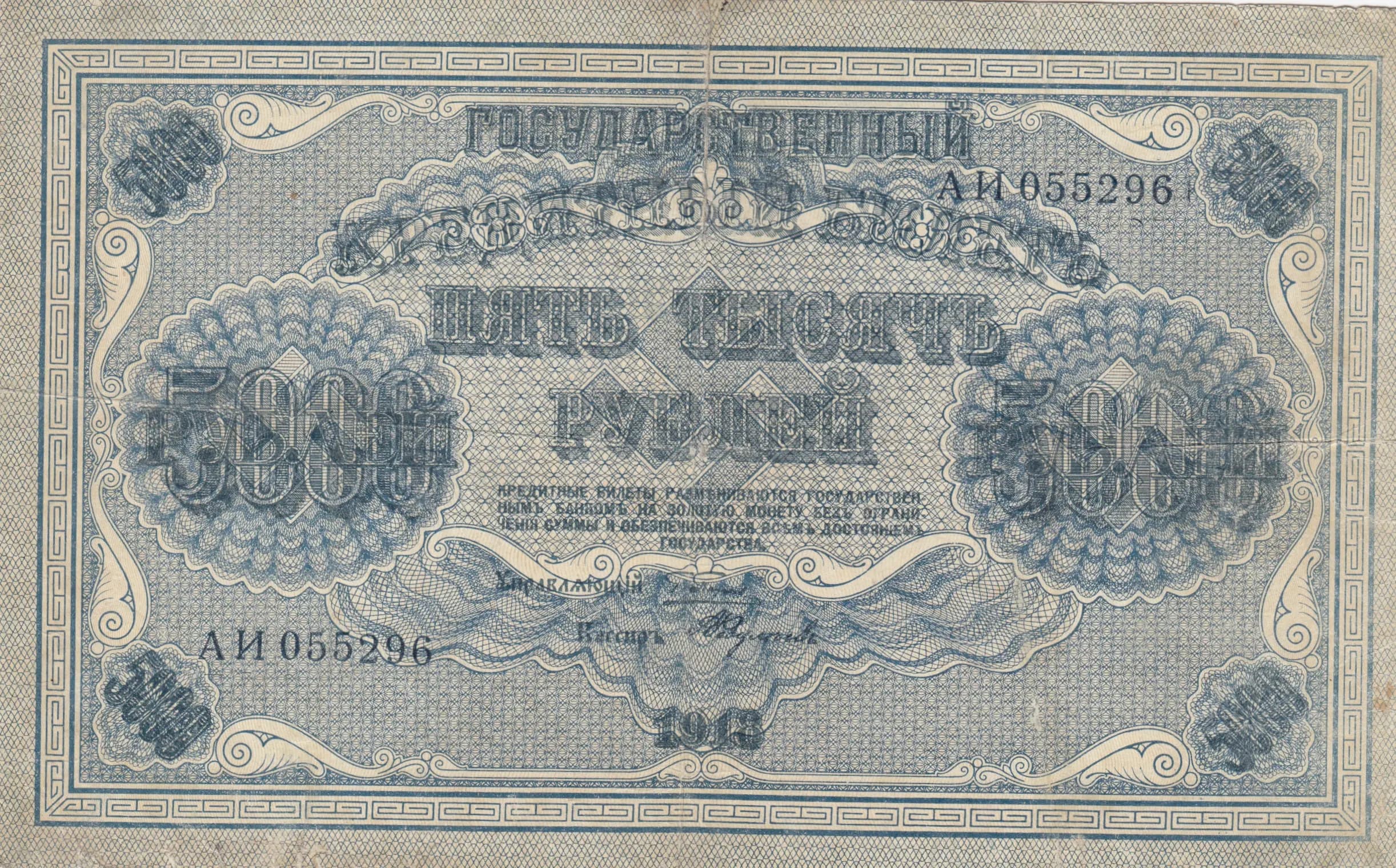
The front features a formal, ornate design centered around a large rectangular cartouche containing the denomination and backing declaration, surrounded by an elaborate frame of floral and geometric ornamental patterns. Imperial double-headed eagles occupy all four corners, representing continuity with pre-Revolutionary Russian authority. The color scheme employs a cream/tan central panel set against darker blue borders. Two signature lines, labeled 'НАРОДНЫЙ КОМИССАР ФИНАНСОВ' (People's Commissar of Finance) and 'КАССИР' (Cashier), appear in the lower portion, with handwritten signatures present. The reverse is dominated by the Soviet state emblem—a hammer and sickle enclosed within a wreath with a star above—positioned centrally at the top. This emblem is flanked and surrounded by the revolutionary slogans in six languages, reflecting Soviet internationalism. A large blank ornamental cartouche with scalloped edges occupies the central field, while geometric repeating patterns fill the background. The denomination 5000 appears in multiple locations on both sides.
FRONT: 'РАСЧЕТНАЯ ЗНАК' (Reckoning Mark/Accounting Sign); 'РОССИЙСКОЙ СОЦИАЛИСТИЧЕСКОЙ ФЕДЕРАТИВНОЙ СОВЕТСКОЙ РЕСПУБЛИКИ' (Russian Socialist Federative Soviet Republic); 'ПЯТЬ ТЫСЯЧ РУБЛЕЙ' (Five Thousand Rubles); 'ОБЕСПЕЧИВАЕТСЯ ВСЕМ ДОСТОЯНИЕМ РЕСПУБЛИКИ' (Backed by all the wealth of the Republic); 'НАРОДНЫЙ КОМИССАР ФИНАНСОВ' (People's Commissar of Finance); 'КАССИР' (Cashier); 'ПОДДЕЛКА РАСЧЕТНЫХ АССИГНАЦИЙ ПРЕСЛЕДУЕТСЯ ПО ЗАКОНУ' (Counterfeiting of accounting notes is prosecuted by law); '5000' (denomination). BACK: 'PROLETARIER ALLER LÄNDER, VEREINIGT EUCH!' (German: Workers of all countries, unite!); 'PROLETAIRES DE TOUS LES PAYS, UNISSEZ-VOUS!' (French: Workers of all countries, unite!); 'PROLETARI DI TUTTI I PAESI, UNITEVI!' (Italian: Workers of all countries, unite!); 'WORKERS OF THE WORLD, UNITE!' (English); Chinese text (Workers of all countries, unite); Arabic text (Workers of the world, unite); '5000' (denomination).
Fine-line engraving on steel plates, executed with intricate detail throughout. The complexity of the ornamental borders, geometric patterns, and the delicate rendering of the wreaths and emblems indicate high-quality intaglio printing. The security features—multiple decorative frames, fine-line patterns, and the overall engraving sophistication—were designed to deter counterfeiting. For this Pick number (P-113a(6)), the note was produced by Soviet state printing facilities; the specific printer is likely the Gosudarstvennaya Tipografiya (State Printing House) in Petrograd or Moscow, though detailed printer attribution for 1921 Soviet issues can be uncertain.
This is cataloged as Pick P-113a(6), indicating it is variety 6 of the P-113a listing. Varieties of the 1921 5000 Rublei typically differ by signature combinations (different individuals holding the offices of People's Commissar of Finance and Cashier) and possibly by minor printing variations. The specific handwritten signatures visible on this note should be examined to confirm the exact signature variety. Without being able to definitively read the handwritten signatures in the provided images, the precise variety cannot be narrowed further, but the Pick designation P-113a(6) establishes its cataloging identity within the standard reference system.