50 rublei 1921
About This Note
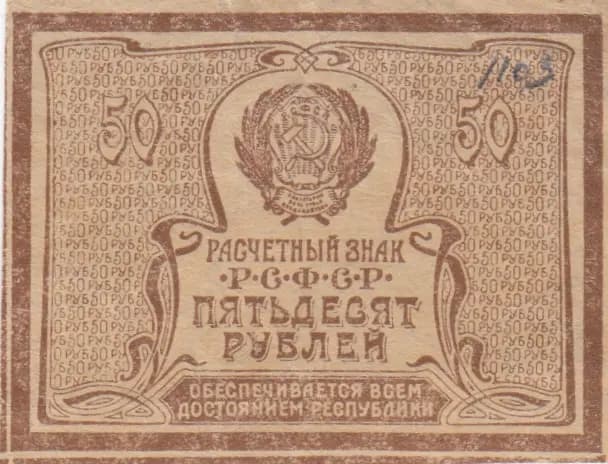
This R.S.F.S.R. 50 Rublei note from 1921 (Pick P-107a) presents a striking example of early Soviet currency design featuring the iconic hammer and sickle emblem within an ornate wreath. The note displays excellent visual preservation with rich tan and brown tones, uniform age-related patina, and no significant damage—consistent with its VF grade. The repeating number security pattern and ornamental border frame exemplify the decorative yet functional design approach of Soviet Treasury notes during the transitional period of the Russian Civil War era.
Common. The 1921 50 Rublei R.S.F.S.R. notes were produced in substantial quantities during the New Economic Policy period as part of the Soviet Treasury's currency stabilization efforts. While individual notes from this era are collectible, this denomination and type remain readily available in the numismatic market across various condition grades. The VF grade with good preservation adds some collector appeal but does not elevate this to scarce status—these notes appear regularly in collections and dealer inventories.
Issued during the turbulent 1921 period when the R.S.F.S.R. (Russian Soviet Federative Socialist Republic) was consolidating control following the Russian Civil War, this note represents the Soviet regime's early effort to establish monetary authority. The prominent Soviet state emblem with hammer and sickle symbolized the worker-state ideology, while the inscription 'Is backed by all the wealth of the republic' reflected Bolshevik claims of socialized wealth backing the currency. The designation 'Rasčetnyj znak' (calculation sign) rather than traditional currency terminology reflects the transitional nature of Soviet monetary policy during War Communism and the New Economic Policy period.
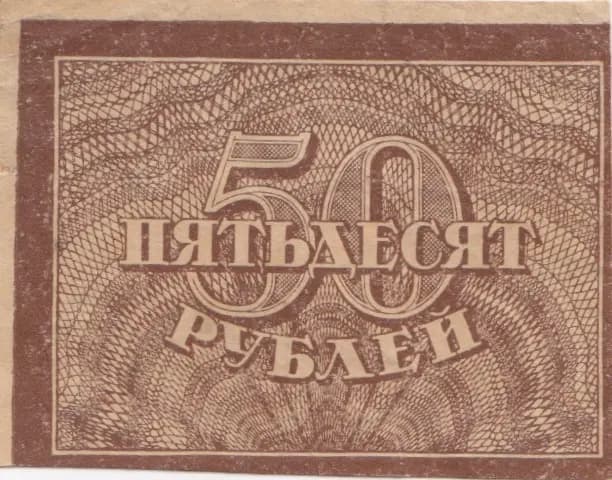
The obverse features a centered Soviet state emblem—the hammer and sickle enclosed within a laurel wreath—positioned at the top center, symbolizing the union of workers and peasants under Bolshevik rule. The design is framed by an ornate decorative border with floral corner ornaments characteristic of early Soviet numismatic design. The denomination and state identification are clearly displayed, with the value rendered both numerically and in full text. The reverse presents a more austere geometric aesthetic, dominated by large numerals '50' overlaid upon the word value 'ПЯТЬДЕСЯТ РУБЛЕЙ' (Fifty Rubles), against a complex geometric cross-hatch or net-like background pattern serving as a security measure. Both sides employ a tan-brown color palette, with repeating security patterns integrated throughout the design.
FRONT SIDE: 'РАСЧЕТНЫЙ ЗНАК' (Rasčetnyj znak) = 'Calculation Sign / Accounting Mark'; 'Р.С.Ф.С.Р.' = 'R.S.F.S.R. (Russian Soviet Federative Socialist Republic)'; 'ПЯТЬДЕСЯТ РУБЛЕЙ' = 'Fifty Rubles'; 'ОБЕСПЕЧИВАЕТСЯ ВСЕМ ДОСТОЯНИЕМ РЕСПУБЛИКИ' = 'Is backed by all the wealth of the republic'. BACK SIDE: '50' = 'Fifty'; 'ПЯТЬДЕСЯТ' = 'Fifty'; 'РУБЛЕЙ' = 'Rubles'.
This note was produced using letterpress/relief printing combined with background security pattern printing, techniques standard for Soviet Treasury notes of this era. The ornate borders, crisp numeral reproduction, and detailed geometric background patterns are consistent with high-quality lithographic or engraved security printing. While specific printer attribution for this Pick number is not definitively confirmed from catalog data alone, such notes were typically produced by Soviet state printing facilities established for currency production during the early Soviet period.
This specimen is cataloged as Pick P-107a, indicating it is the primary listed variety for the 1921 50 Rublei denomination. Early Soviet notes of this type may exhibit variations in printing characteristics, serial numbering, or subtle design elements across different printings. Without visible serial numbers clearly identified in the visual analysis, specific variety distinctions within P-107a (such as serial number prefix variations or printing run markers) cannot be definitively determined from the provided imagery. Collectors should examine serial numbers and printing characteristics against specialized Soviet currency references for precise variety identification.