5 rublei 1922
About This Note
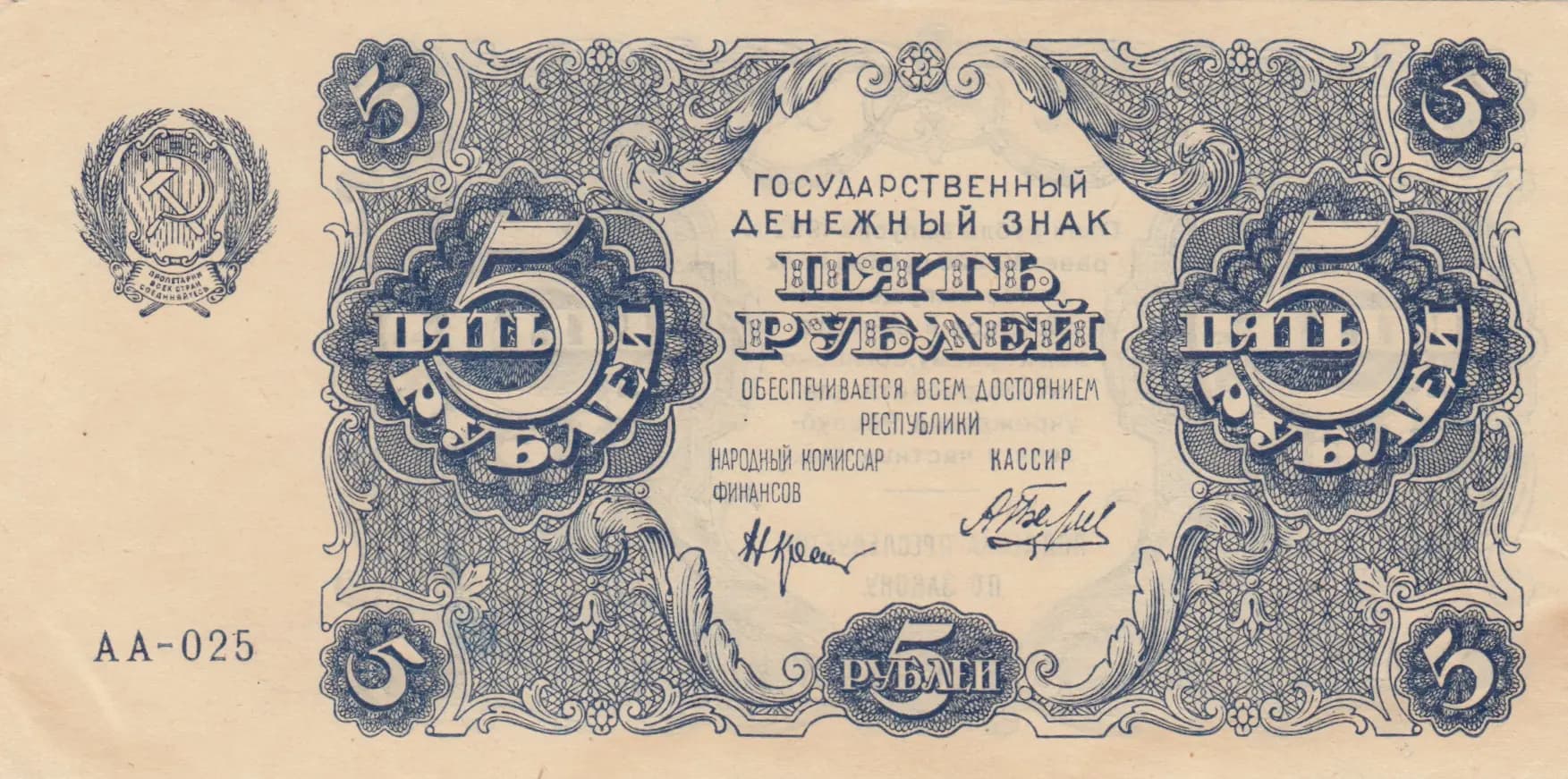
A well-preserved example of the Russian RSFSR 5 Rublei from 1922, graded AU, featuring the distinctive ornate Art Deco border design characteristic of early Soviet currency. The note displays crisp blue and navy ink on cream stock with minimal wear, light age-related patina, and two handwritten official signatures. The serial number AА-025 and intact security engraving make this an attractive example of Soviet monetary reform currency from the critical post-civil war stabilization period.
Common. The 1922 RSFSR 5 Rublei is a standard issue from the Chervonets reform period with substantial print runs. No evidence of recall, limited circulation, or short-lived issuing authority suggests scarcity. Early Soviet currency in AU condition commands modest collector premiums ($15-40 range typically), but the denomination and issue are readily available in the numismatic market. Serial number AА-025 shows no special prefix indicating a premium variety.
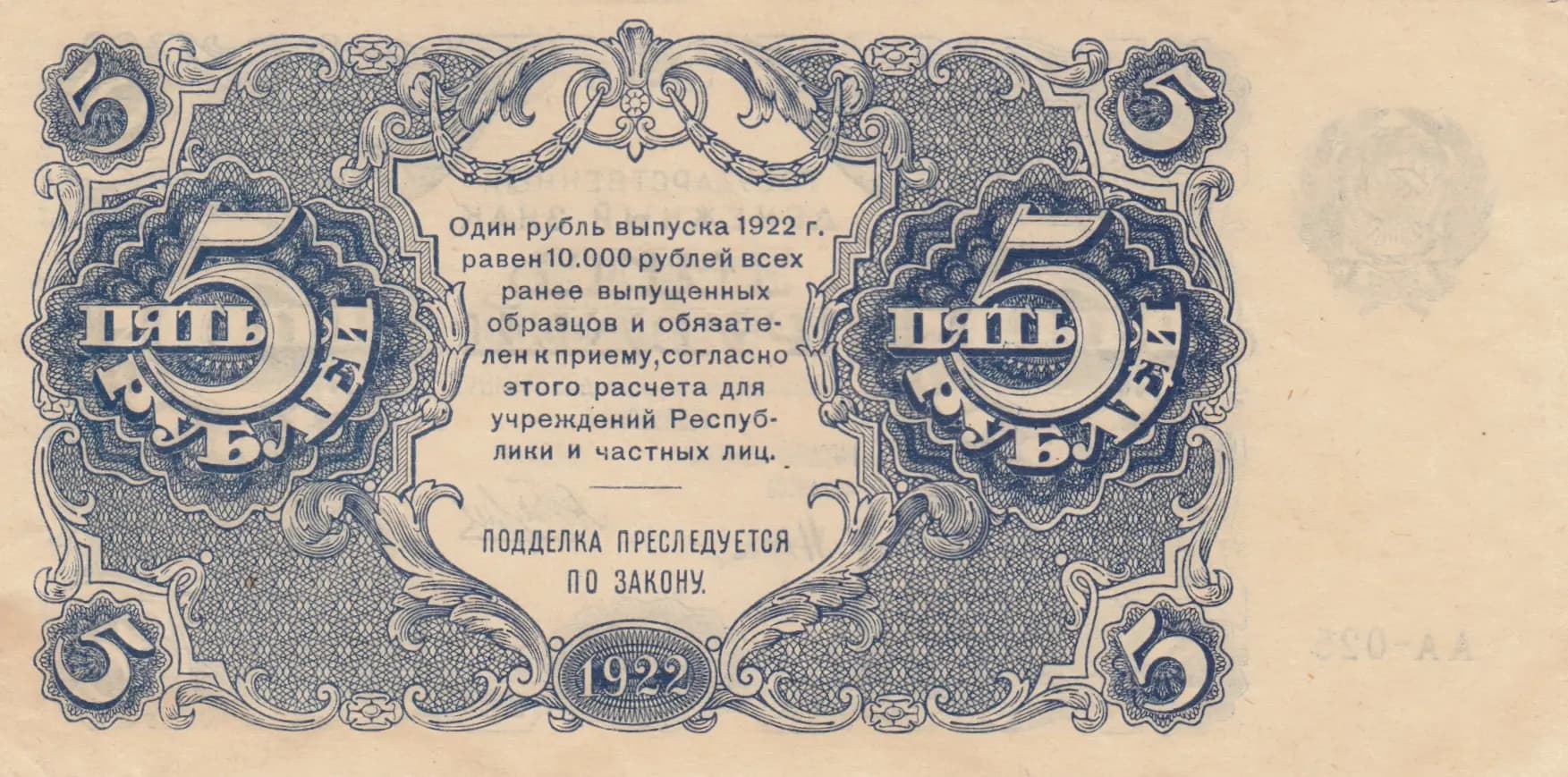
Issued during the Soviet Union's monetary stabilization following the Russian Civil War, the 1922 5 Rublei represents the Chervonets reform era when the RSFSR introduced new 'firm' currency backed by gold reserves. The reverse inscription explicitly establishes the exchange rate (1 ruble of 1922 issue = 10,000 previously issued rubles), reflecting the hyperinflation crisis and the government's effort to restore fiscal credibility through the State Treasury. The prominent Soviet hammer-and-sickle emblem and patriotic text 'Guaranteed by all the wealth of the Republic' reinforce state authority over the new monetary system.
This 1922 Soviet RSFSR note features a formal, symmetrical design executed in the prevailing Art Deco style. The front displays the Soviet state emblem (hammer and sickle in a wreath) in the upper left corner, with the denomination '5' prominently featured in circular medallions positioned on both left and right margins. Ornate floral and geometric scrollwork borders frame the entire note in blue/navy ink, creating an intricate guilloché pattern characteristic of security printing. The center contains official signatures of the People's Commissar of Finance and Cashier above explanatory governmental text. The reverse repeats the corner medallions in all four corners and presents the critical exchange rate information within a decorative oval cartouche at the bottom, stamped with the date '1922'. The overall design emphasizes state authority, modernity, and security through dense engraved ornamentation.
FRONT SIDE: 'ГОСУДАРСТВЕННЫЙ ДЕНЕЖНЫЙ ЗНАК' (State Money Sign/Currency); 'ПЯТЬ РУБЛЕЙ' (Five Rubles); 'ОБЕСПЕЧИВАЕТСЯ ВСЕМ ДОСТОЯНИЕМ РЕСПУБЛИКИ' (Guaranteed by all the wealth of the Republic); 'НАРОДНЫЙ КОМИССАР ФИНАНСОВ' (People's Commissar of Finance); 'КАССИР' (Cashier); Serial number 'АА-025'. BACK SIDE: 'Один рубль выпуска 1922 г. равен 10.000 рублей всех ранее выпущенных образцов и обязателен приему согласно этого расчета для учреждений Республики и частных лиц.' (One ruble of the 1922 issue is equal to 10,000 rubles of all previously issued notes and is obligatory for acceptance according to this calculation for institutions of the Republic and private persons); 'ПОДДЕЛЬКА ПРЕСЛЕДУЕТСЯ ПО ЗАКОНУ' (Counterfeiting is prosecuted by law); '1922' (year); 'ПЯТЬ РУБЛЕЙ' (Five Rubles).
Intaglio engraving (recess printing), the standard security printing method for banknotes of this era. The fine line patterns, decorative guilloché work, and depth of the blue ink impression visible on cream stock are consistent with steel plate engraving. While specific printer attribution for Pick P-129(1) would require archival records, Soviet RSFSR notes of this period were typically produced by State Security Printing facilities under Commissariat of Finance oversight.
The serial number АА-025 (Cyrillic 'AA' prefix) represents a standard variety for early RSFSR notes. No overprints, color variants, or signature varieties are evident. The handwritten signatures visible in the center are typical of this issue and do not constitute a separately catalogued variety. Pick P-129(1) notation indicates the primary variety; later variants may exist with different signature combinations or technical modifications, but this represents the standard catalogued type.