3 rublei 1922
About This Note
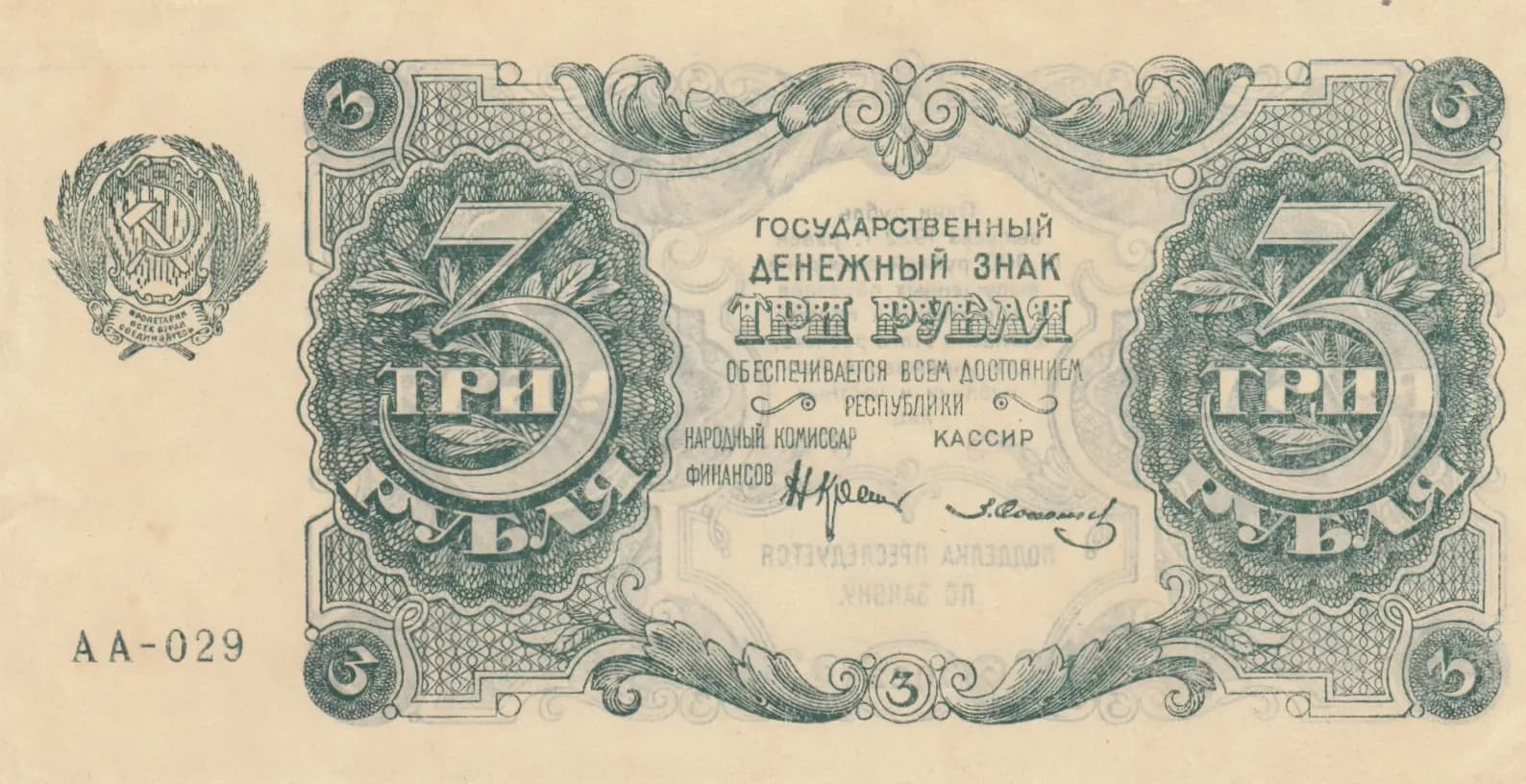
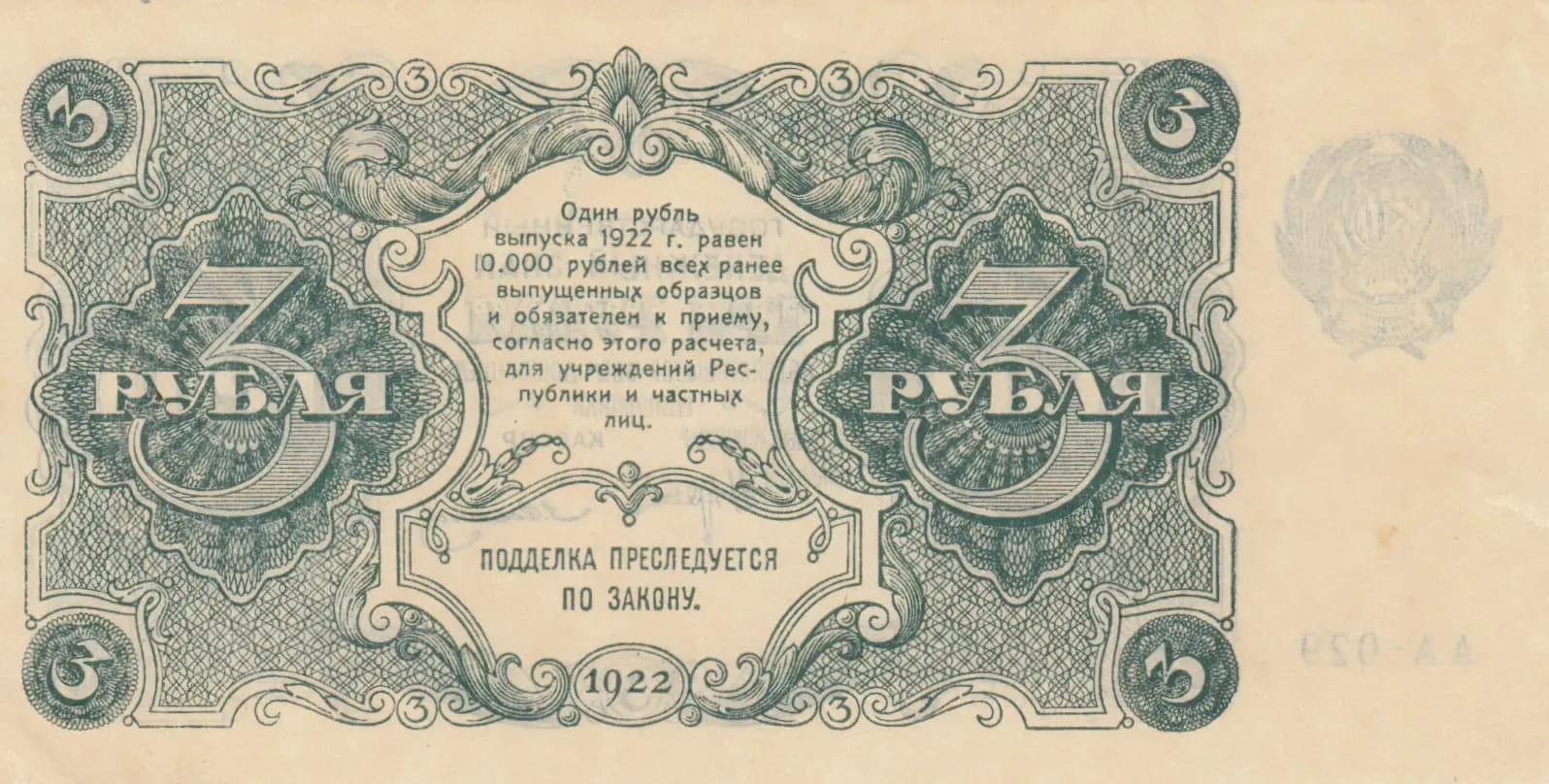
A well-preserved example of the Russian SFSR 3 rublei note from 1922, graded AU, displaying the characteristic ornate Art Nouveau-influenced design typical of early Soviet currency. The note exhibits authentic age-related patina with cream/tan discoloration and foxing consistent with nearly a century of storage, while the intaglio printing remains crisp with fine decorative borders and floral motifs clearly visible on both sides. This denomination is notable as a transitional monetary reform issue, representing the Soviet government's revaluation of hyperinflated currency during the economic stabilization period of the early 1920s.
Common. The 1922 Soviet monetary reform involved substantial print runs of denominations across the currency revaluation. The 3 rublei denomination from this year, while historically significant, was issued in sufficient quantities to ensure availability in the numismatic market today. Notes of this Pick number and condition regularly appear in dealer catalogs and online sales at moderate prices, typically not commanding premiums that would indicate scarcity. The AU grade enhances its desirability among collectors but does not elevate it to rare status.
Issued during the Soviet monetary reform of 1922, this note represents the State Treasury's effort to stabilize the ruble after years of hyperinflation following the Russian Civil War. The inscription on the reverse explicitly states that one 1922 ruble equals 10,000 rubles of previously issued specimens, reflecting the dramatic devaluation and redenomination undertaken by the Bolshevik government. The Soviet coat of arms (hammer and sickle within a wreath) and references to the 'People's Commissar of Finance' underscore the note's origin during the early years of the USSR, when the RSFSR maintained its own currency issuance under Bolshevik monetary policy.
This 3 rublei note exemplifies the formal, ornate aesthetic of early Soviet currency design. The obverse and reverse both feature elaborate Art Nouveau-style decorative borders composed of scrollwork, floral motifs, and laurel wreath elements positioned in the corners. The denomination is displayed prominently in two large circular medallions with ornamental frames, one on each side of the note's upper half. The Soviet state emblem — a hammer and sickle enclosed within a wreath of laurels — appears in the upper left corner of the front side, serving as the issuer's official seal. The center of both sides contains official text indicating this as a state monetary sign guaranteed by the wealth of the Republic, along with spaces for signatures of the People's Commissar of Finance and the Cashier. A date cartouche on the reverse explicitly marks the note as issued in 1922. The overall composition reflects early Soviet propaganda aesthetic, combining traditional heraldic imagery with revolutionary symbolism. No portraits of historical figures appear on the note, maintaining the ideological stance of early Soviet currency design that avoided depicting individuals.
FRONT SIDE: 'ГОСУДАРСТВЕННЫЙ ДЕНЕЖНЫЙ ЗНАК' (State monetary sign); 'ТРИ РУБЛЯ' (Three rublei) — appears twice in circular medallions; 'ОБЕСПЕЧИВАЕТСЯ ВСЕМ ДОСТОЯНИЕМ РЕСПУБЛИКИ' (Is guaranteed by all the wealth of the Republic); 'НАРОДНЫЙ КОМИССАР ФИНАНСОВ' (People's Commissar of Finance); 'КАССИР' (Cashier); 'A A-029' (Serial designation). BACK SIDE: 'РУБЛЯ' (Rublei) — appears twice in circular frames; 'Один рубль выпуска 1922 г. равен 10.000 рублей всех ранее выпущенных образцов и обязателен к приему, согласно этого расчета, для учреждений Республики и частных лиц.' (One ruble of 1922 issue equals 10,000 rubles of all previously issued specimens and is mandatory for acceptance, according to this calculation, for institutions of the Republic and private individuals.); 'ПОДДЕРЖКА ПРЕСЛЕДУЕТСЯ ПО ЗАКОНУ.' (Counterfeiting is prosecuted by law.); '1922' (Year).
Intaglio (copperplate/steel engraving) printing, evidenced by the fine line work, crisp decorative borders, and the precise detail visible in the floral and scroll motifs across both sides. The visual analysis notes elaborate intaglio printing with fine line work throughout, characteristic of high-security banknote production. The watermark area visible in the center further confirms professional banknote printing techniques. While the specific security printer for the State Treasury's 1922 issues is not definitively attributed in readily available references, Soviet notes of this period were produced under government supervision at designated state printing facilities.
The observed serial number designation 'A A-029' suggests this note belongs to an early printing batch. Varieties of the 1922 Soviet issues can be distinguished by serial number prefixes, signatures of officials, and subtle printing characteristics. Without comprehensive comparative analysis of multiple examples, the specific variety classification beyond the standard Pick P-128(10) designation cannot be definitively established from the available visual data. Collectors of this issue typically seek notes with clear, well-preserved signatures and consistent serial number formatting as variety markers.