10 000 rublei 1921
About This Note
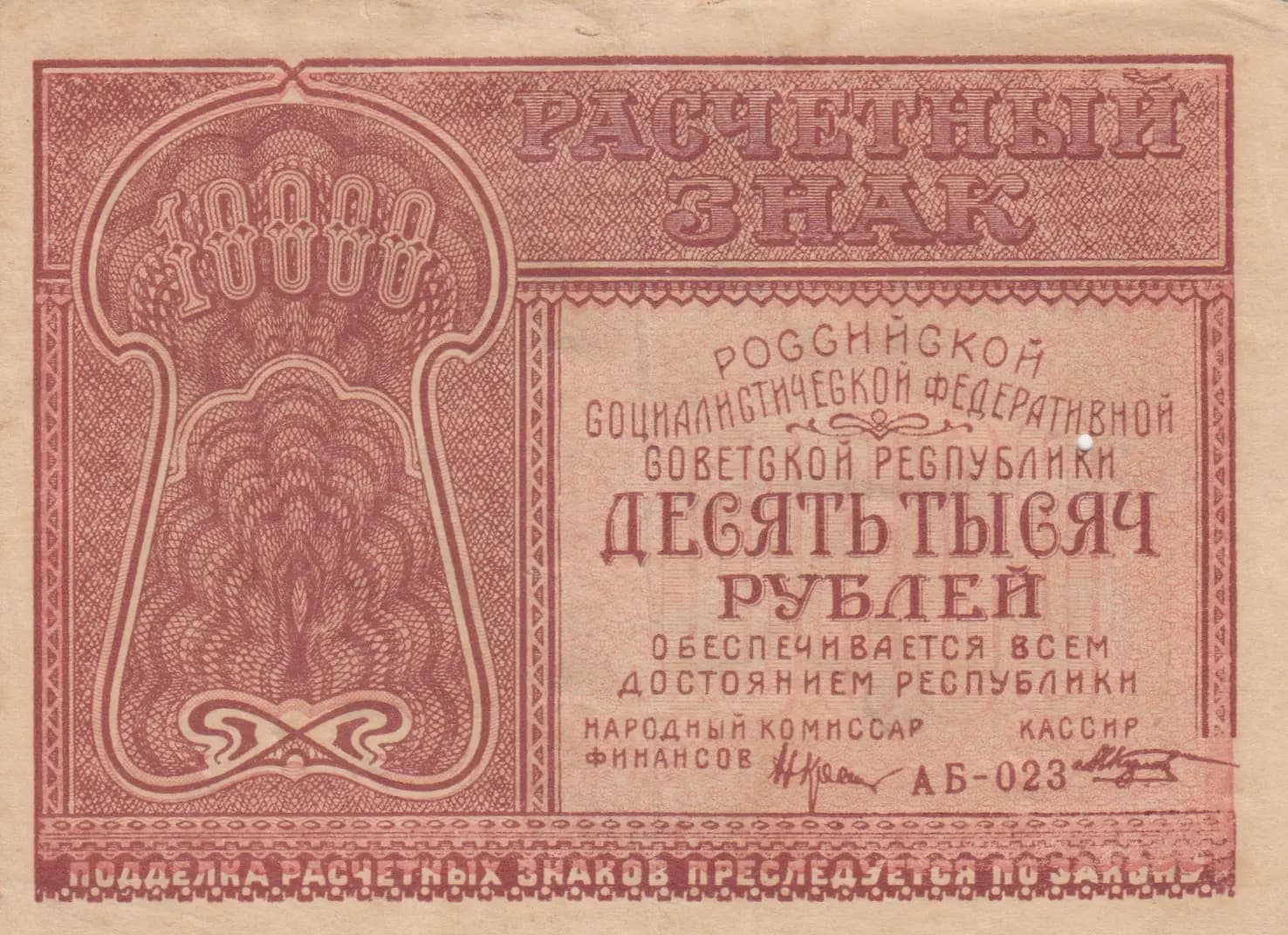
This is a VF-grade 10,000 rubles banknote from the Russian SFSR, issued in 1921 during the early Soviet period. The note features prominent Soviet symbolism including hammer and sickle emblems within ornate oval frames, rendered in red and maroon with intricate engraved linework. Despite visible foxing, yellowing, and age-related patina consistent with historical circulation, the note remains well-preserved with clear inscriptions and detailed decorative borders intact.
Common. The 10,000 rubles denomination of 1921 (Pick P-114) was issued by the RSFSR in substantial quantities during the early Soviet period to meet post-Civil War circulation demands. While these notes are historically significant and desirable to collectors, they were produced in large print runs and remain relatively available in the collector market. The VF condition grade is typical for surviving examples of this issue.
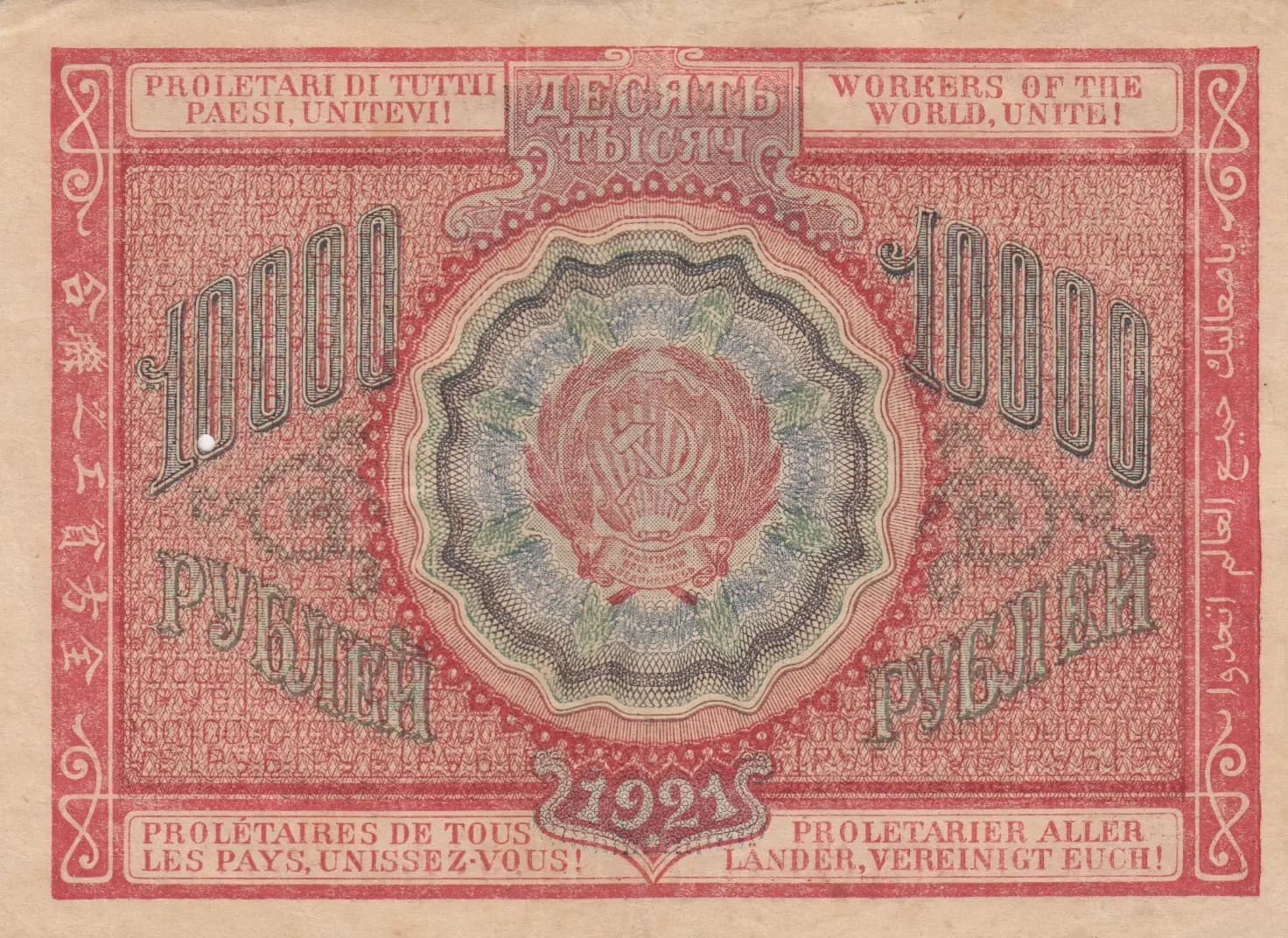
This denomination was issued during the Russian Civil War and early Soviet consolidation period, when the RSFSR was establishing its monetary authority and ideological legitimacy. The back of the note prominently features the revolutionary slogan 'Proletarians of all countries, unite!' in five languages (Russian, English, French, German, and Italian), reflecting the Soviet regime's internationalist aspirations and propaganda efforts to appeal to workers worldwide. The central Soviet coat of arms with hammer and sickle, combined with the guarantee 'Backed by all the wealth of the Republic,' represents the new socialist state's attempt to establish economic credibility while advancing communist ideology.
The front of this note features a large decorative oval frame on the left containing the Soviet eagle emblem (hammer and sickle within a circular ornamental border), flanked by intricate scrollwork and floral motifs. The right side contains the denomination text and issuing authority information arranged within a rectangular box. The reverse displays large numerals '10000' positioned prominently on both left and right sides in decorative font, with the central feature being an elaborate oval medallion containing the Soviet coat of arms (hammer and sickle emblem in red) surrounded by architectural and floral ornamental patterns. Revolutionary slogans in multiple languages frame the borders. The color palette consists primarily of red and maroon on the obverse, with red, pink, green, and black accents on the reverse, all applied over tan paper.
FRONT SIDE: 'РАСЧЕТНЫЙ ЗНАК' (Accounting Note/Payment Certificate); 'РСФСР СОЦИАЛИСТИЧЕСКОЙ ФЕДЕРАТИВНОЙ СОВЕТСКОЙ РЕСПУБЛИКИ ДЕСЯТЬ ТЫСЯЧ РУБЛЕЙ' (RSFSR Socialist Federal Soviet Republic Ten Thousand Rubles); 'ОБЕСПЕЧИВАЕТСЯ ВСЕМ ДОСТОЯНИЕМ РЕСПУБЛИКИ' (Backed by all the wealth of the Republic); 'НАРОДНЫЙ КОМИССАР ФИНАНСОВ' (People's Commissar of Finance); 'КАССИР' (Cashier); 'АБ-023' (Serial designation AB-023). BACK SIDE: 'ПРОЛЕТАРИИ ВСЕХ СТРАН, СОЕДИНЯЙТЕСЬ!' (Russian: Proletarians of all countries, unite!); 'WORKERS OF THE WORLD, UNITE!' (English); 'PROLÉTAIRES DE TOUS LES PAYS, UNISSEZ-VOUS!' (French); 'PROLETARI DI TUTTI PAESI, UNITEVI!' (Italian); 'PROLETARIER ALLER LÄNDER, VEREINIGT EUCH!' (German); '10000' and 'РУБЛИ' (Rubles); '1922' (date).
This note was produced using traditional intaglio (engraved) printing techniques, characteristic of high-security banknote production of the period. The complex geometric patterns, fine detailed linework, ornamental borders, and decorative elements visible throughout demonstrate the precision of steel plate engraving. The multiple color printing layers visible on the reverse, combined with the intricate nature of the security design elements, indicate multi-pass printing using engraved plates. Soviet banknotes of this era were typically produced by the State Security Printing Works (Государственная типография).
This specific example displays the serial designation 'АБ-023' (AB-023), indicating it belongs to a particular printing series. The note is dated 1922 on the reverse, which represents the publication/authorization date rather than the actual year of printing, as was common practice for Soviet banknotes of this period. The signature block area indicates positions for 'НАРОДНЫЙ КОМИССАР ФИНАНСОВ' (People's Commissar of Finance) and 'КАССИР' (Cashier), typical of RSFSR notes from this era. Collectors should note that Pick P-114(3) notation suggests this is one of three main varieties of this denomination, with variations likely related to signature combinations or serial number series.