5 rublei 1918
“Baku”
About This Note
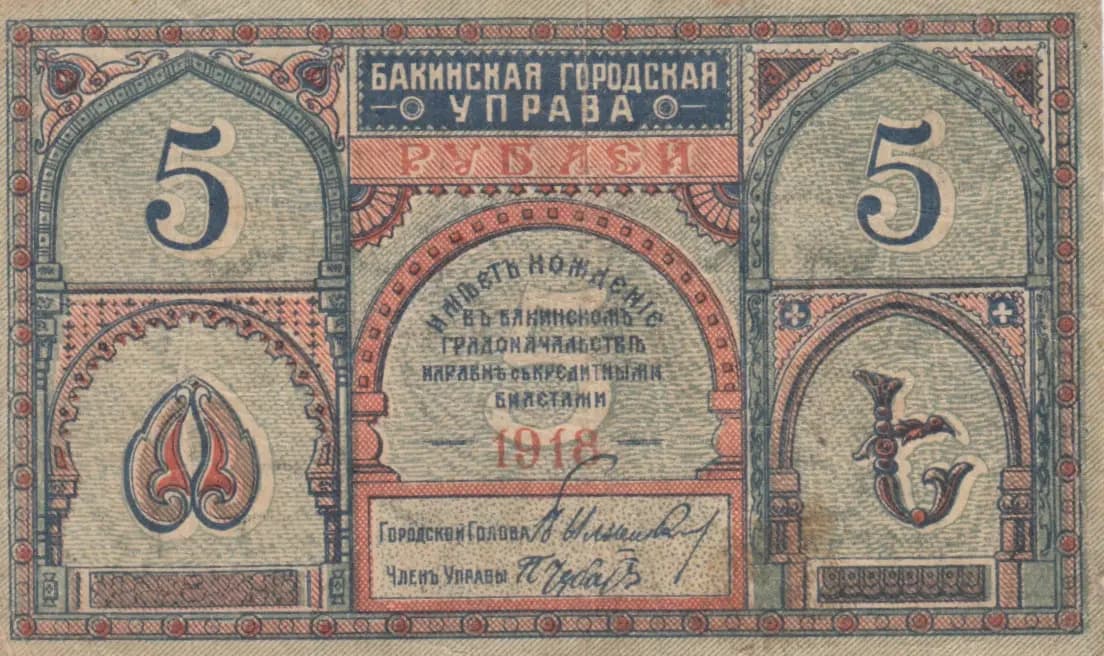
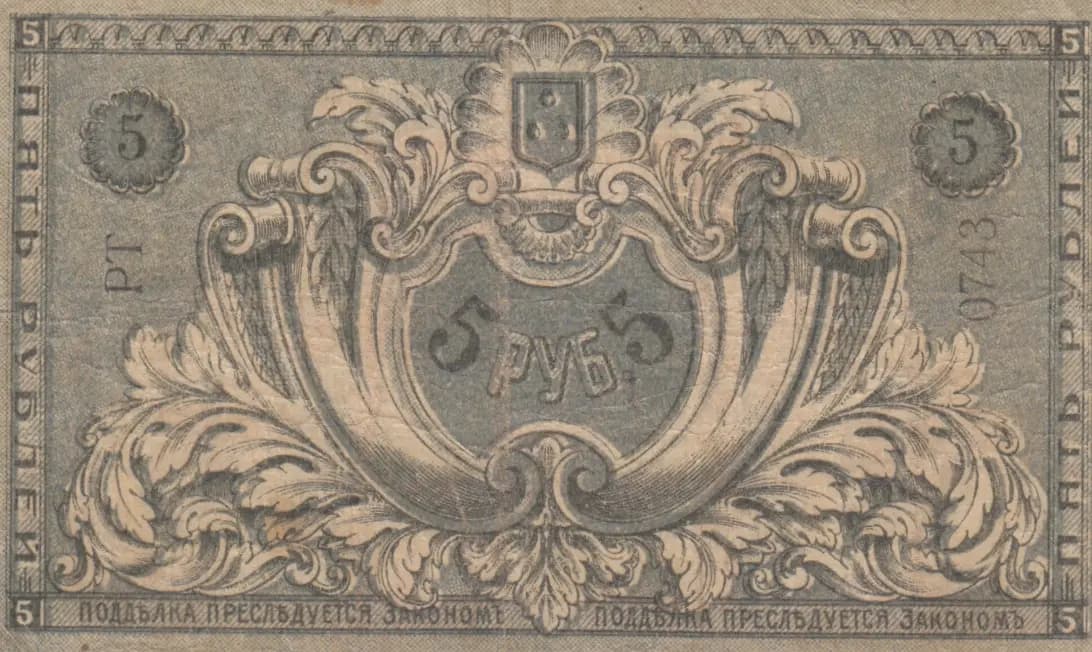
This is a VF-grade 5 ruble banknote issued by the Baku City Government in 1918, representing an important piece of Russian provincial currency from the turbulent early Soviet period. The note features distinctive ornamental designs with cream and red coloring on the obverse and baroque-style scrollwork on the reverse, with handwritten administrative signatures visible. The moderate wear, creasing, and age-related discoloration are consistent with circulation during this historically significant but brief period of local monetary authority.
Common. Provincial Russian Civil War-era banknotes from local authorities like the Baku City Government were typically produced in substantial quantities to meet local circulation needs, and numerous examples have survived to the present day in various grades. The Pick catalog listing (P-S723) indicates this is a documented variety within standard numismatic reference systems, suggesting it was not a limited or emergency issue. Examples appear regularly in dealer offerings and collections of Russian Civil War currency.
Issued during the Russian Civil War period when Baku—a major Caucasian oil center—operated under local administrative control, this banknote represents the Baku City Government's attempt to manage local currency during a time of political fragmentation and central authority collapse. The formal inscriptions 'БАКИНСКАЯ ГОРОДСКАЯ УПРАВА' (Baku City Administration) and titles such as 'Городской голова' (City Mayor) and 'Член Управы' (Member of Administration) reflect the local governance structure asserting monetary sovereignty. The counterfeiting warning ('ПОДДЕЛКА ПРЕСЛЕДУЕТСЯ ЗАКОНОМ') indicates the authorities' concerns about currency security during this chaotic transitional period.
The obverse displays a symmetrical layout with large denomination numerals '5' positioned in upper corners, framed by an intricate decorative border composed of geometric and floral patterns in red, blue, and black on a cream ground. The central composition features a header banner containing the issuer's name in Cyrillic text, with two circular ornamental medallions—the left containing a stylized tulip or lotus motif, the right bearing what appears to be a heraldic trident or crown symbol. Below these are handwritten signatures of the City Mayor and Administration members, authenticating the note. The reverse presents a formal heraldic composition dominated by a shield-shaped coat of arms with internal Cyrillic character at the apex, surrounded by elaborate baroque-style scrollwork, acanthus leaf flourishes, and symmetrical ornamental designs in grayscale. The denomination numeral '5' appears in all four corners in a lighter gray tone against the white background.
FRONT: 'БАКИНСКАЯ ГОРОДСКАЯ УПРАВА' (Baku City Administration); 'РУБЛИ' (Rubles); '1918' (year); 'Городской голова' (City Mayor/Head); 'Член Управы' (Member of Administration); handwritten signatures of administrative officials. BACK: '5' (denomination in all four corners); 'РУБЛЬ' (Ruble); 'ПОДДЕЛКА ПРЕСЛЕДУЕТСЯ ЗАКОНОМ' (repeated twice - 'Counterfeiting is prosecuted by law').
This note was produced using intaglio engraving (recess printing), evidenced by the fine detail work visible in the ornamental borders, scrollwork, and the sharp quality of the typographic elements. The multi-color printing on the obverse (red, blue, black on cream) suggests the use of multiple engraved plates or a multi-stage printing process. The elaborate baroque designs and security engraving patterns are characteristic of early 20th-century Russian provincial currency production, likely executed by a regional printing facility capable of handling security printing during the Civil War period.
This specific note is identifiable as the standard Baku City Government 5 ruble issue of 1918, cataloged as Pick S723. The handwritten signatures visible on the obverse are characteristic of provincial Russian currency from this period, where local officials manually signed notes to authenticate them. Variations among surviving examples would reflect different signature combinations from successive administrative officials, typical for Civil War-era local currency. No major varieties (such as color variants or significant overprints) are apparent from the visual analysis of this specimen.