5 rublei 1918
“Rostov”
About This Note
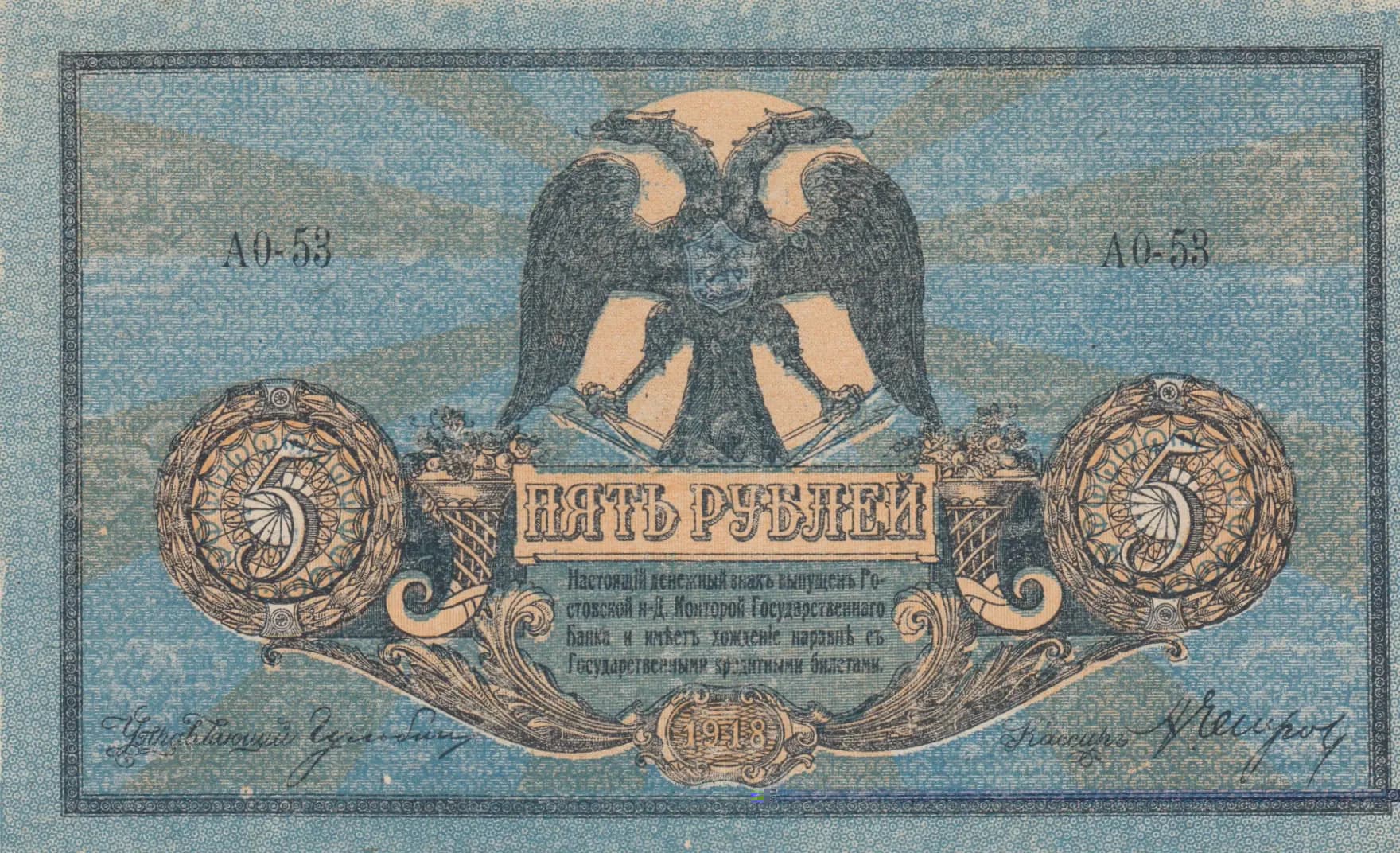
This is a 5 Rublei banknote from 1918 issued by the Rostov State Bank Branch, graded UNC despite visible signs of historical aging and patina. The note features an impressive double-headed eagle centerpiece with ornate circular medallions and decorative scrollwork in tan and beige against a light blue-green background, representing Imperial Russian heraldic tradition during the tumultuous post-Revolutionary period. The exceptional preservation and intricate engraved design make this an important example of Russian emergency currency from the Civil War era.
Common. The 1918 Rostov 5 Rublei notes were issued in substantial quantities during the Civil War period as emergency currency, and examples survive in moderate numbers in the collector market. While regional branch issues have somewhat limited appeal compared to central bank notes, they are not scarce. The UNC grade is more notable than rarity—most survivors show moderate to heavy wear. Pick S410b is a standard catalog listing for this issue without reported significant print run restrictions.
This 1918 Rostov issue represents a critical moment in Russian monetary history when regional State Bank branches issued their own notes as the central government collapsed during the Russian Civil War. The double-headed eagle, Russia's traditional imperial emblem prominently displayed on the front, reflects the continued use of pre-Revolutionary heraldic imagery even as political authority fragmented across the former empire. The inscriptions emphasizing legal tender status and counterfeiting penalties underscore the desperate effort to maintain monetary credibility in a collapsing state structure.
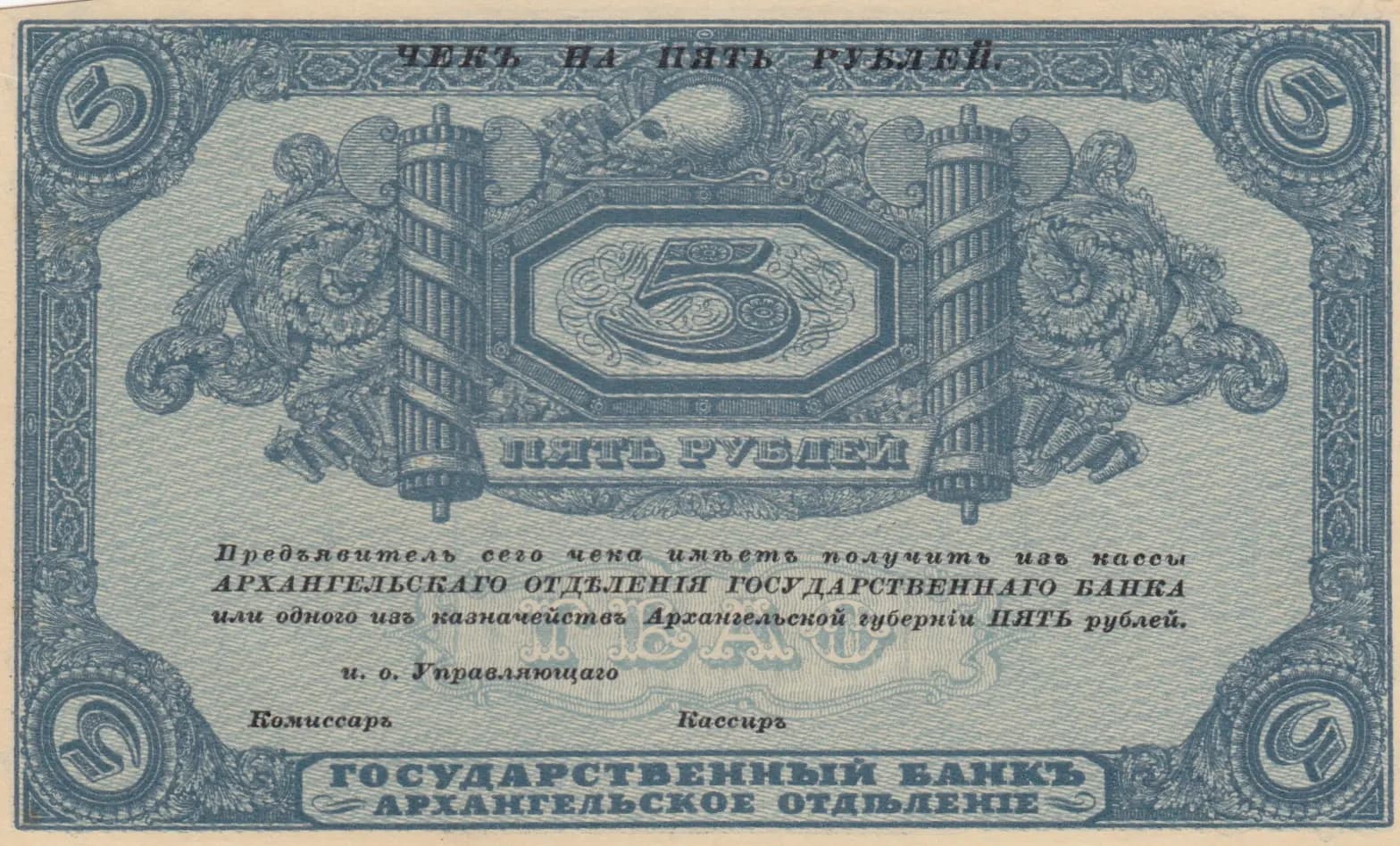
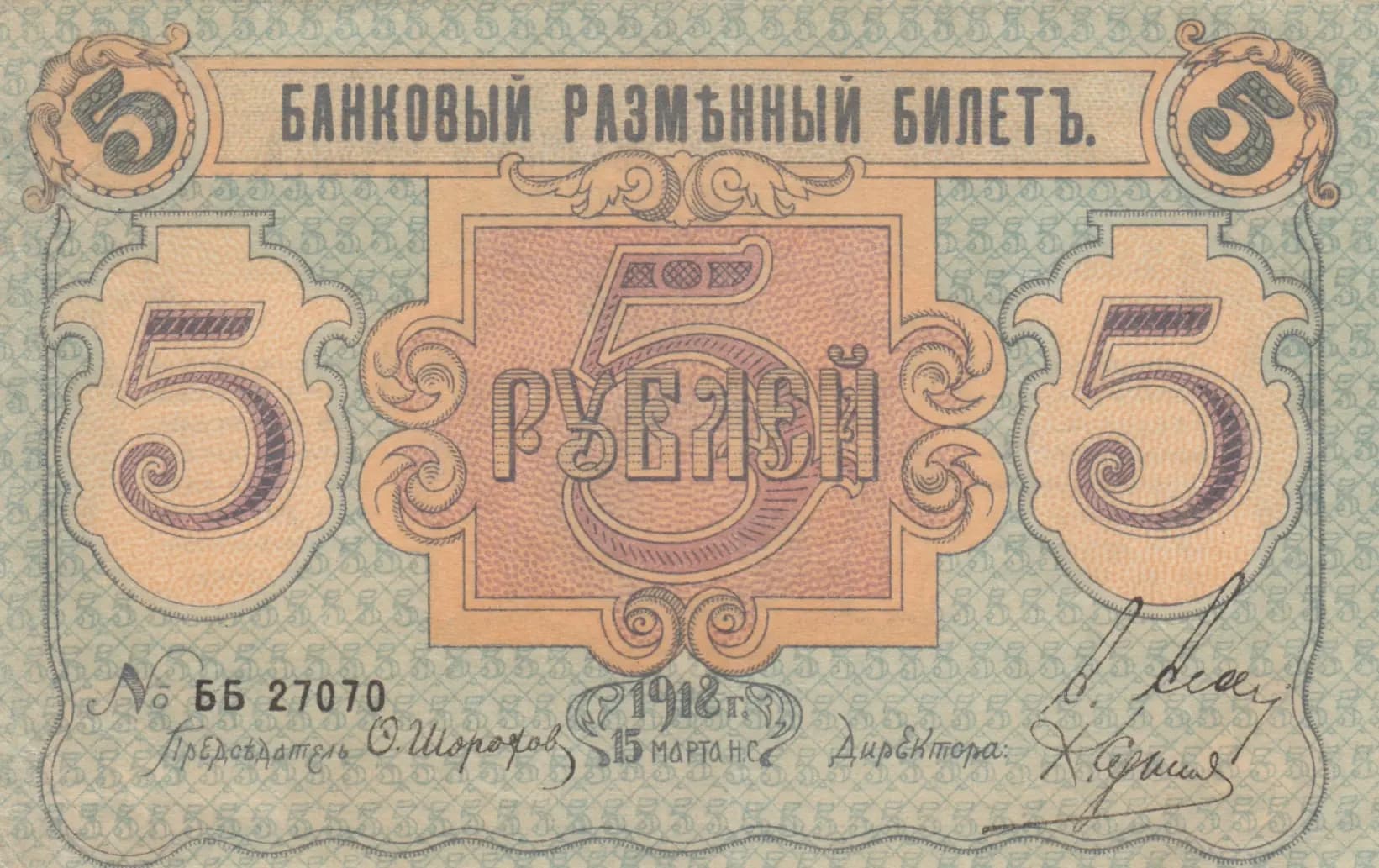
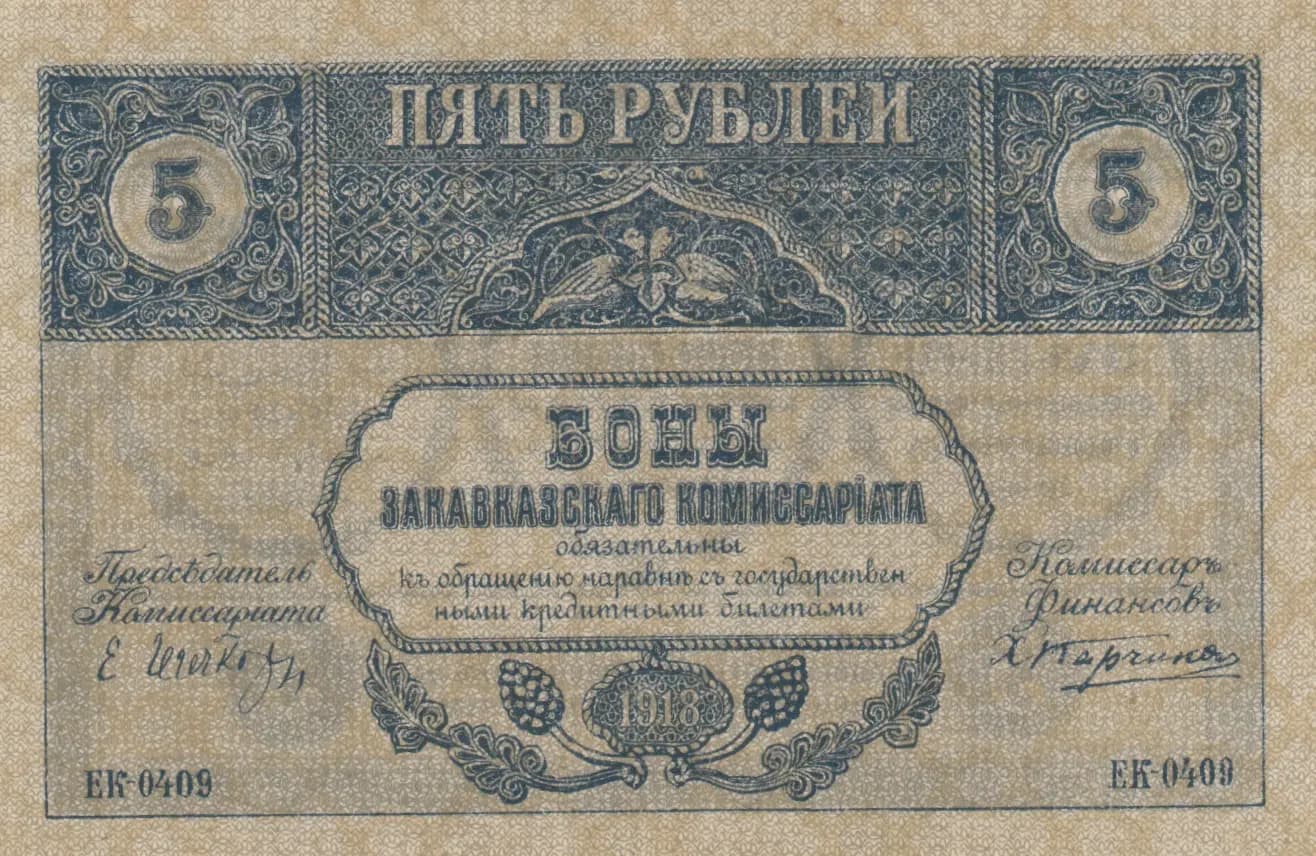
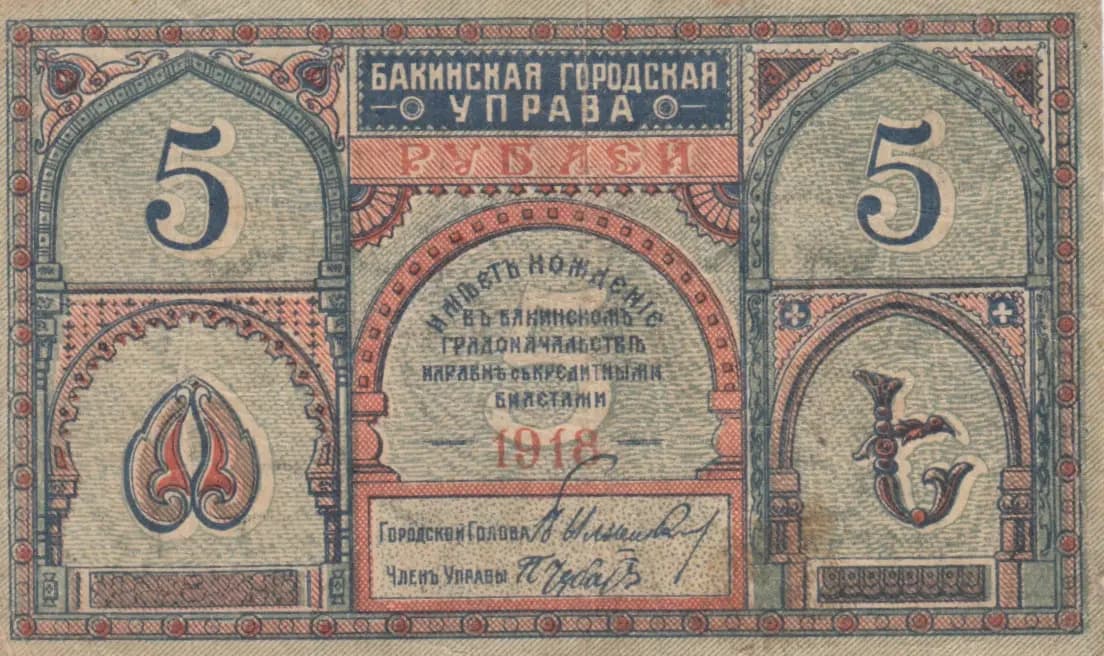
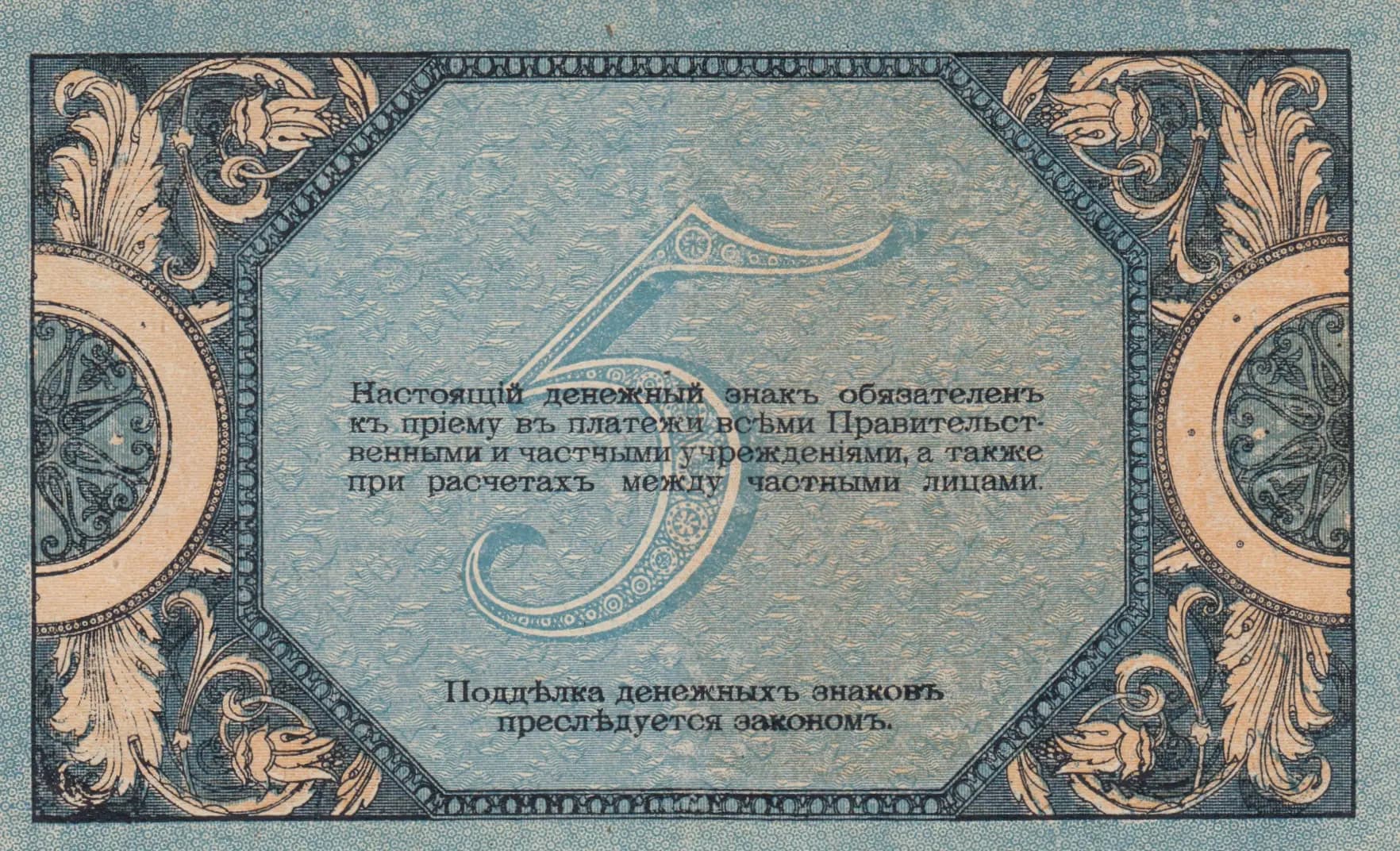
The obverse features Russia's double-headed eagle with spread wings as the dominant central motif, depicted in black and dark gray against a peachy-cream circular background. Two symmetrical ornate circular medallions with intricate geometric patterns flank the eagle on either side, rendered in tan and beige. A decorative banner containing the Cyrillic denomination 'ПЯТЬ РУБЛЕЙ' is positioned below the eagle. The reverse displays a large shield-shaped cartouche frame in the center with elaborate floral scrollwork in all four corners, flanked by matching ornate circular medallions identical to those on the front. Both sides employ a light blue-green background with fine ornamental borders framing the entire design. The overall aesthetic combines Imperial Russian heraldic tradition with Art Nouveau decorative sensibilities characteristic of early 20th-century Russian currency design.
FRONT SIDE: 'ПЯТЬ РУБЛЕЙ' (Five Rubles) - the denomination; Serial number 'А0-53' appears in upper left and right corners; Year '1918'; 'Настоящий генеральный знак Министерства Государственного Банка и имеет хождение наравне с металлическою' (This is an official seal of the Ministry of the State Bank and has circulation equal to metallic currency). BACK SIDE: 'Настоящий денежный знак обязателен к приему в платежи всеми Правительственными и частными учреждениями, а также при расчетах между частными лицами.' (This monetary note is obligatory for acceptance in payments by all Government and private institutions, as well as in settlements between private individuals.) 'Подделка денежных знаков преследуется законом.' (Counterfeiting of monetary notes is prosecuted by law.)
Intaglio engraving (recess printing), evidenced by the intricate line work, detailed geometric patterns in the medallions, fine border details, and the overall depth and precision visible in the ornamental elements. The Rostov State Bank Branch notes of this period were typically produced by established Russian security printers, likely utilizing facilities inherited from Imperial-era currency production. The complexity of the engraved designs and the fine detail visible in both the medallions and scrollwork are characteristic of high-quality intaglio work.
This specimen carries the serial number 'А0-53' (Cyrillic 'A' prefix with zeros and sequential numbering). Varieties of the 1918 Rostov issues are primarily distinguished by serial number prefixes and ranges. The 'A' prefix with early sequential numbers indicates an early print batch. No overprints or signature variations are evident on this example. Pick S410b encompasses the standard design without major documented sub-varieties, though serial number research among collectors may reveal distribution patterns across different printing sessions.