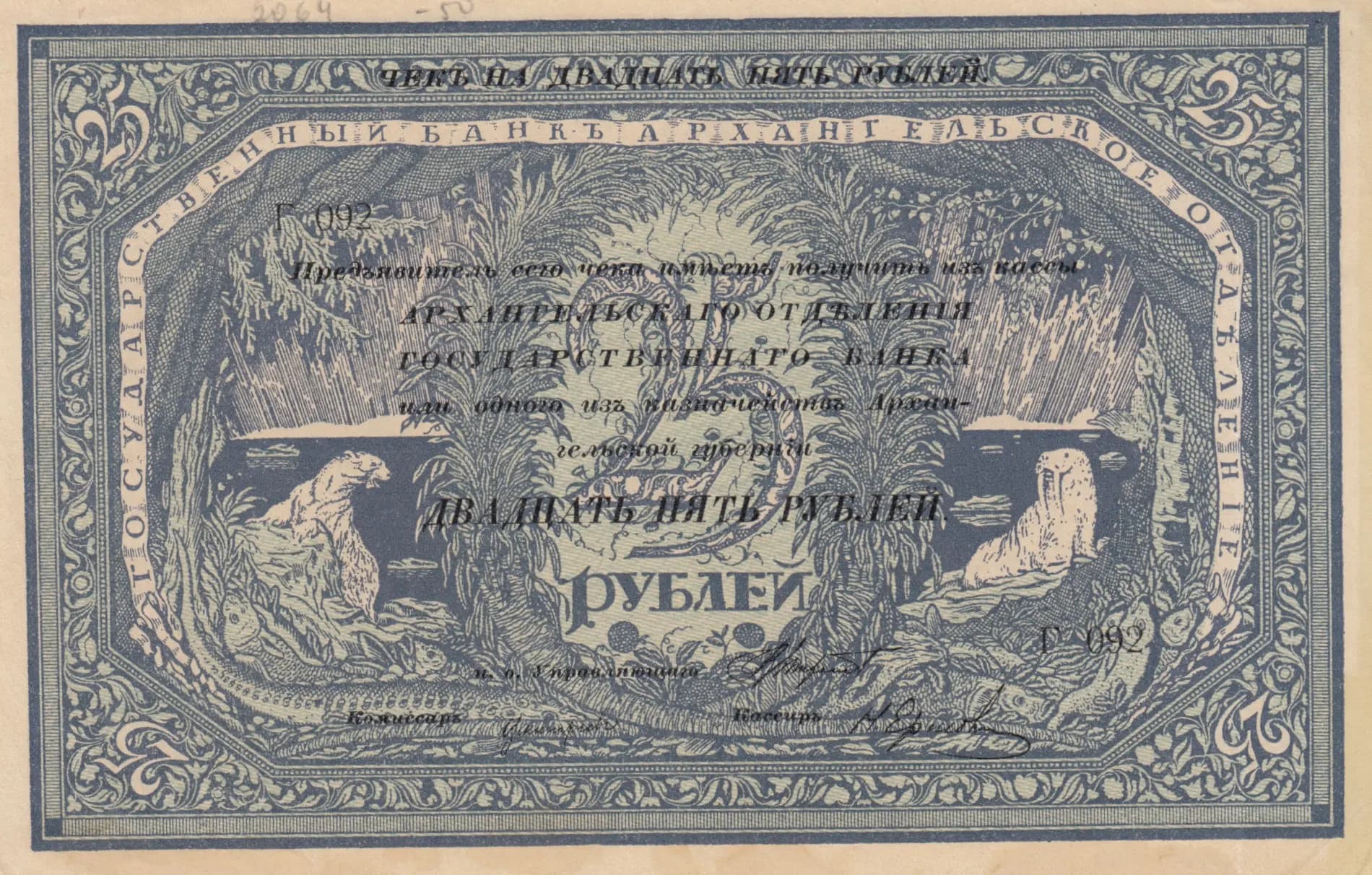
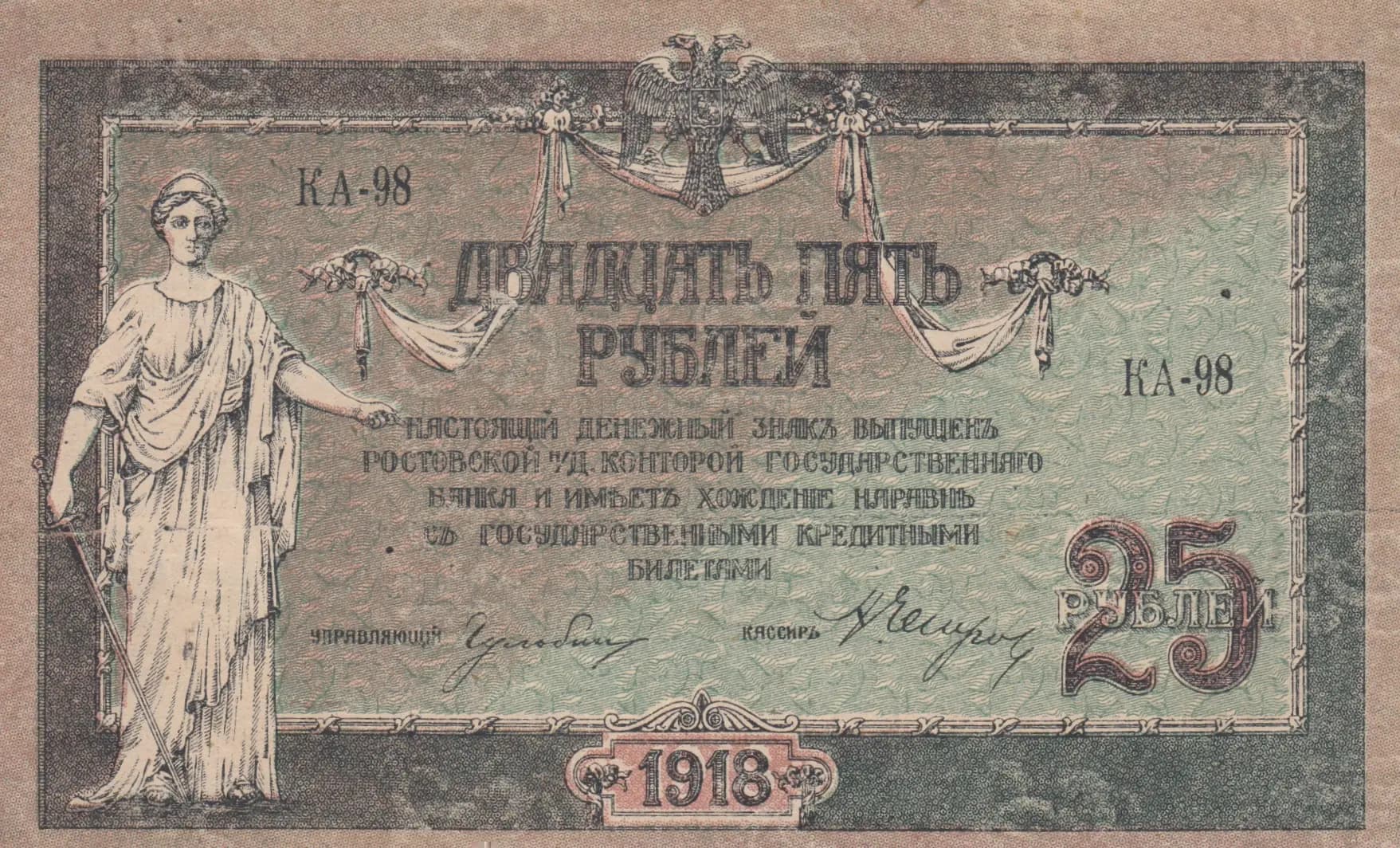
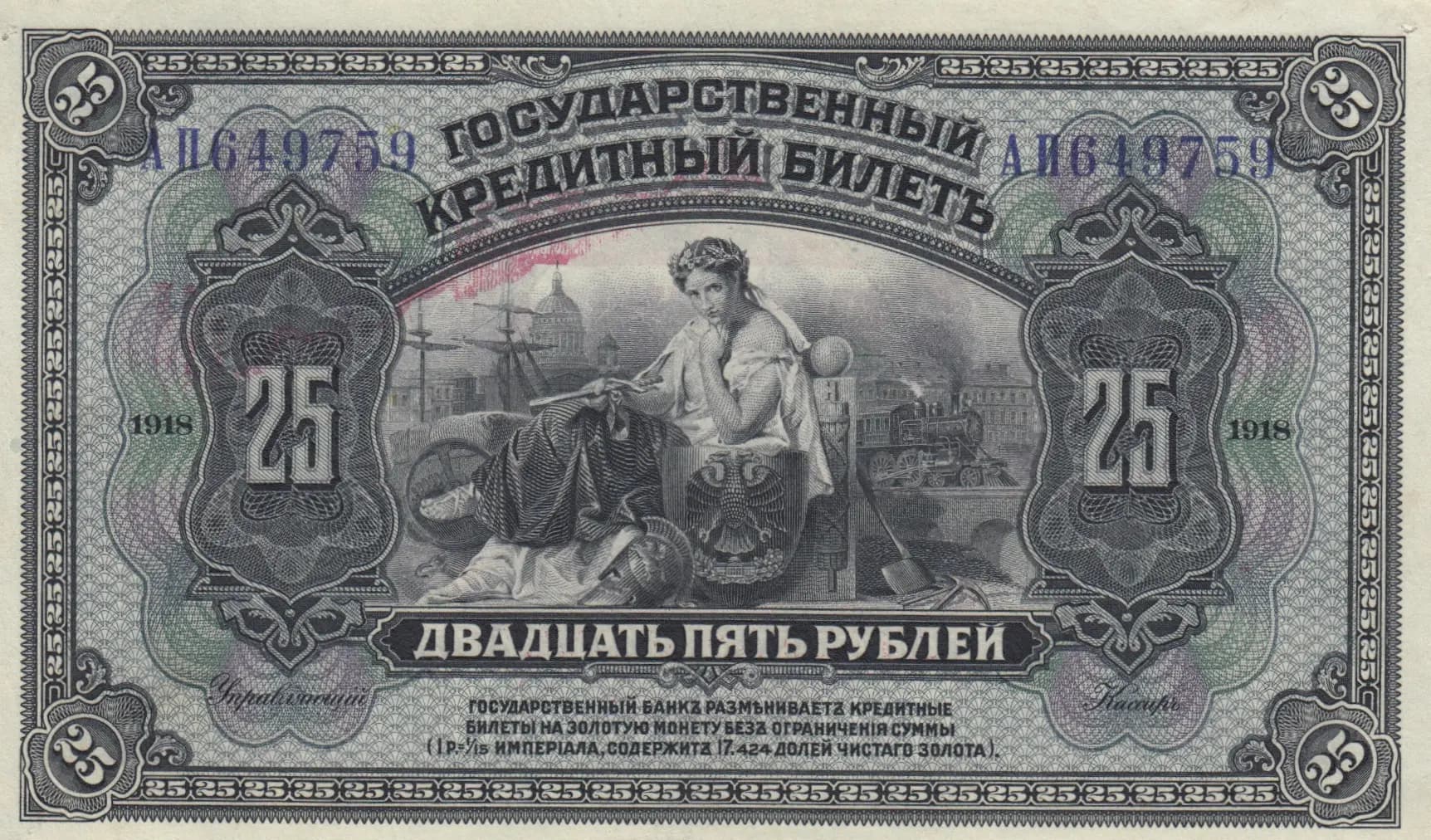
25 rublei 1918
“Baku”
About This Note
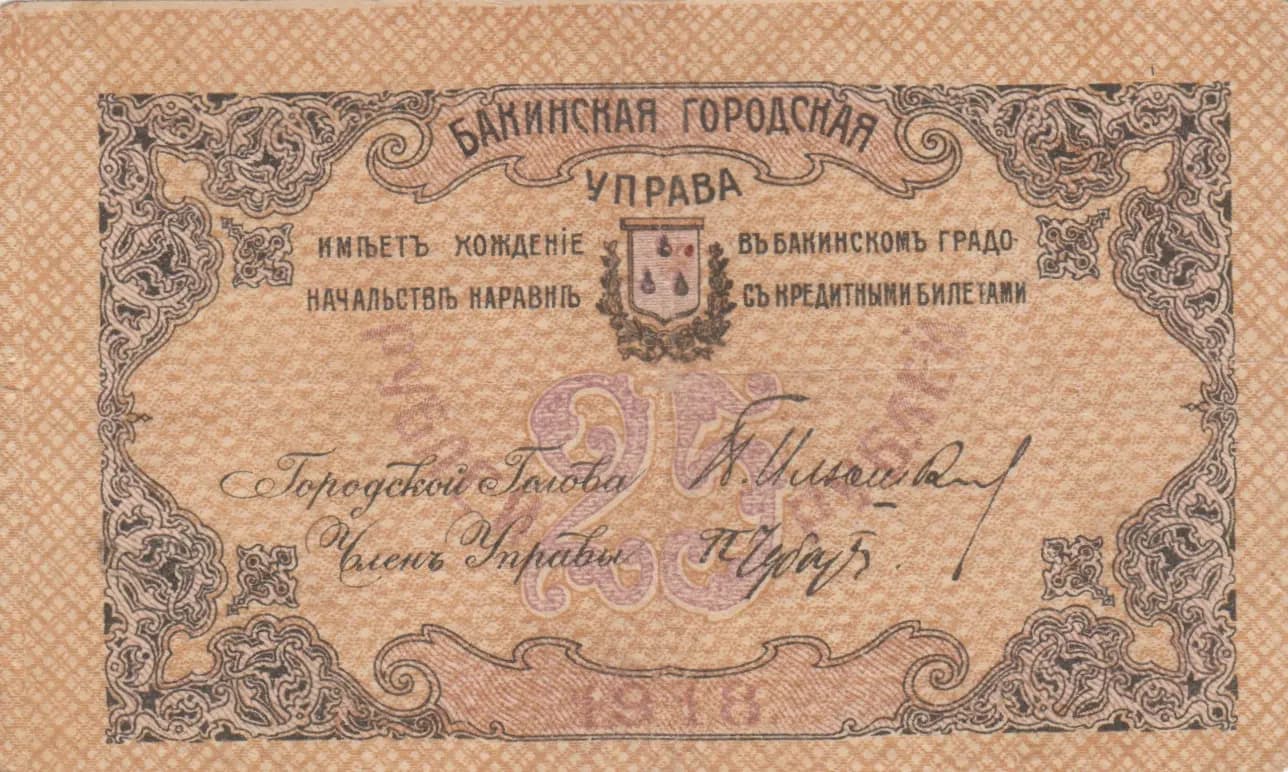
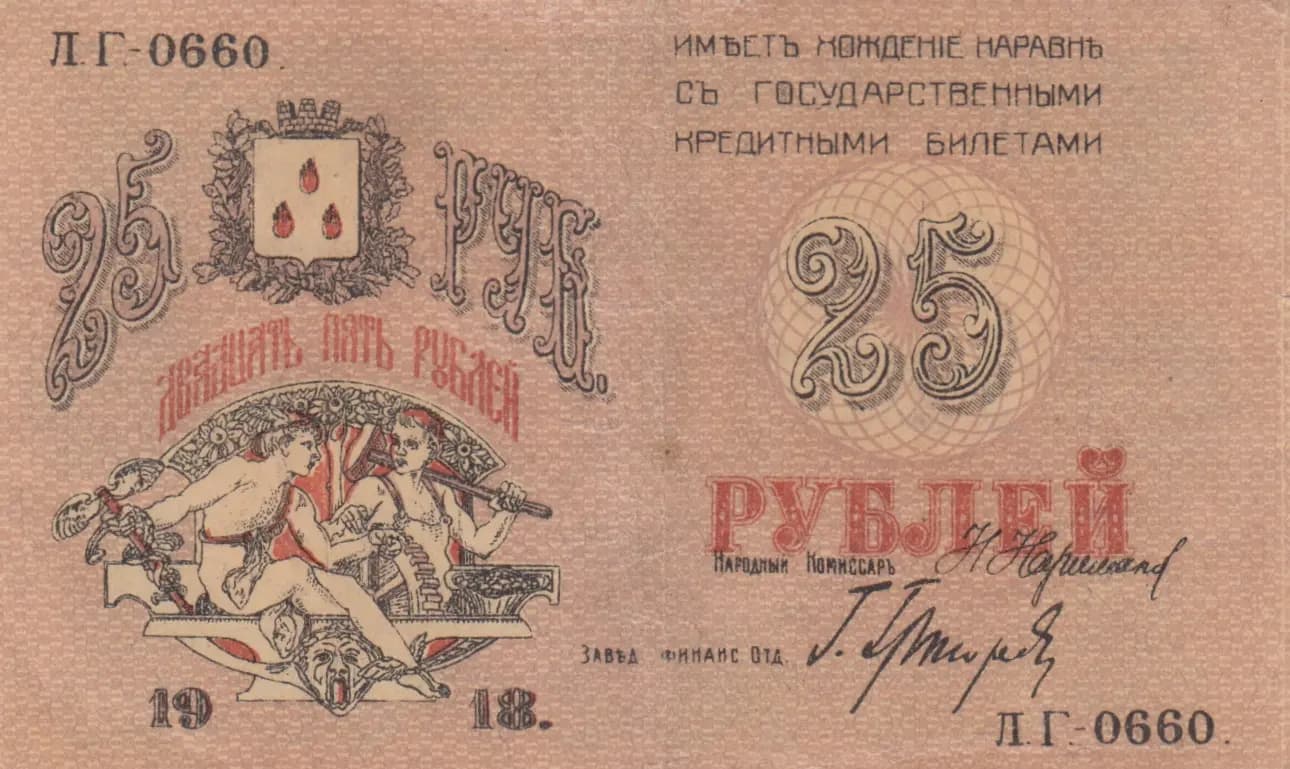
This is a VF-grade 25 rublei note issued by the Soviet Baku City Administration in 1918, representing a fascinating transitional piece from the Russian Empire to early Soviet governance. The note displays exceptional Art Nouveau design with ornate heraldic imagery, cherub figures, and intricate engraved security work, all rendered in a warm tan/beige patina consistent with careful preservation. The presence of handwritten signatures and bilingual imperial/Soviet inscriptions makes this a notable collector item documenting the political upheaval in the Caucasus region during the Russian Civil War.
Common. Regional emergency currency issued by local Soviet authorities during the Russian Civil War period represents a large class of notes. While Baku City Administration notes are historically significant and of strong collector interest, the 25 rublei denomination of 1918 appears regularly in the market. The VF condition grade and intact state do not indicate scarcity. These notes, while desirable for Russian Civil War and regional currency collectors, lack the extreme rarity markers (very limited print runs, rapid recall, or severe attrition) that would classify them as scarce or rare. The established Pick catalog designation (P-S732) and regular availability in numismatic commerce confirm common status.
Issued during the tumultuous period of the Russian Civil War when regional authorities in Baku issued their own currency, this note reflects the transition from Imperial Russian financial systems to Soviet control. The heraldic imagery with three red teardrop shapes and the reference to 'Russian Empire' on the front, coupled with Soviet nomenclature ('People's Commissar,' 'Finance Department') on the signatures, illustrates the ideological and administrative conflict occurring in 1918 Baku. The inscription designating the note as having equal status to government credit notes underscores the precarious legitimacy these local emissions required during a period when multiple issuing authorities competed for financial control.
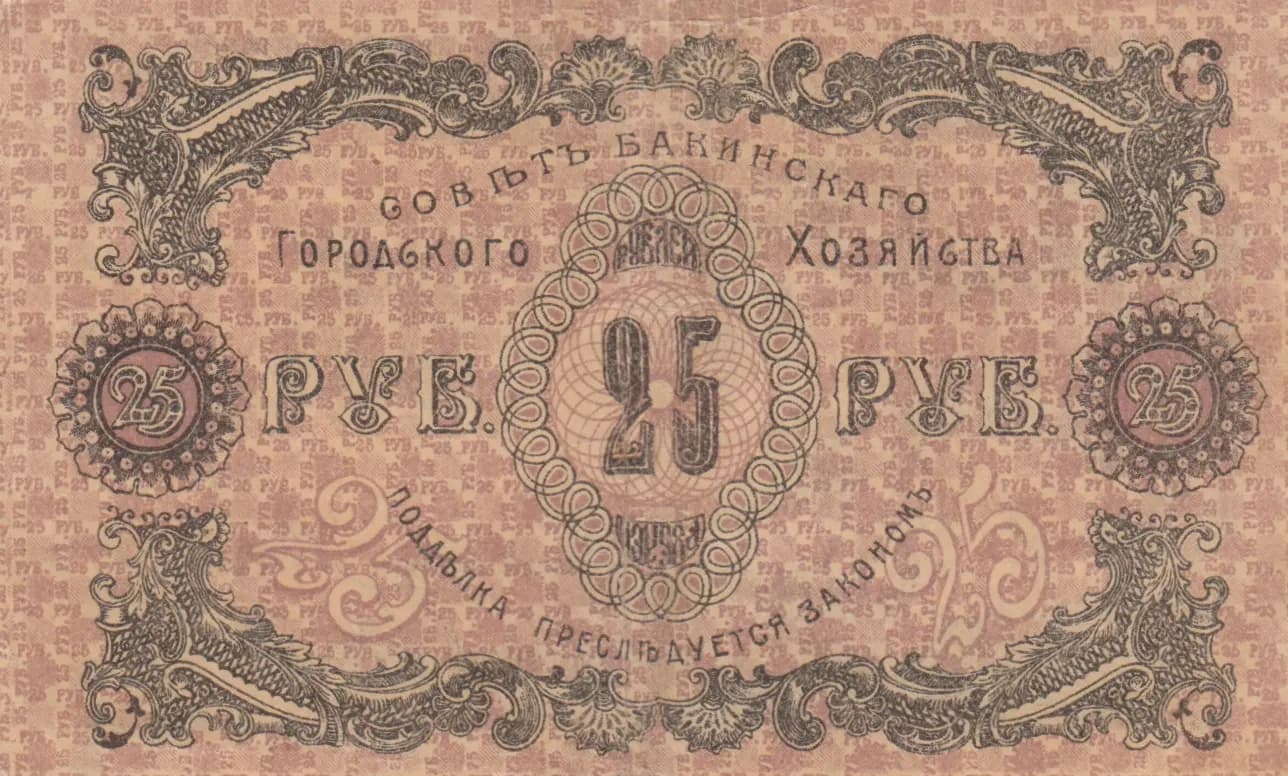
The front features a classical Art Nouveau composition dominated by a heraldic coat of arms in the upper left containing three red teardrop or flame-like shapes on a white shield, surrounded by ornamental foliage. Below this are two cherub or putto figures (classical child-like allegorical figures) positioned beneath an ornate decorative parasol or umbrella with elaborate patterning. The entire composition is framed by intricate scrollwork and floral motifs in the Art Nouveau style. The back reverses the design emphasis with a large circular medallion dominating the center, bordered by an interlocking chain or rope pattern, with the denomination '25' prominently displayed in ornate numerals. Corner rosettes and geometric medallions provide additional security patterning. Handwritten signatures appear on the front, indicating manual authorization by finance officials. The color scheme throughout is predominantly tan/beige with black engraving and white background elements.
FRONT SIDE: 'ЛГ-0660' (Document designation/reference number); 'РОССИЙСКАЯ ИМПЕРИЯ' (Russian Empire); 'ИМЕТЬ ХОЖДЕНИЕ НАРАВНЬ СЪ ГОСУДАРСТВЕННЫМИ КРЕДИТНЫМИ БИЛЕТАМИ' (To have circulation equal to government credit notes); '25 РУБЛЕЙ' (25 Rubles); 'Народный Комиссаръ' (People's Commissar); 'Заведующий Финанс Отд.' (Head of Finance Department); '19 18' (1918). BACK SIDE: 'СОБСТВЕННОСТЬ БАРИНСКОГО ГОРОДСКОГО ХОЗЯЙСТВА' (Property of the Barinsky/Baku City Economy); '25 РУБ.' (25 Rubles, abbreviated, appears twice); 'ДОЛЖНА ПРЕСЛЕДУЕТСЯ ЗАКОНОДН' (Counterfeiting shall be prosecuted by law [text appears incomplete]).
Steel plate engraving (intaglio/recess printing), characteristic of high-security banknote production in the early 20th century. The intricate line work, fine hatching patterns, elaborate border designs, and security features visible throughout (particularly the complex interlocking circular patterns on the reverse and the detailed corner medallions) are consistent with professional engraved security printing. The layered decorative work and the clarity of fine details suggest this was produced by an established security printer, likely using traditional engraved steel plate techniques common to Imperial Russian and early Soviet currency production.
This example features handwritten signatures in the authorization blocks typical of 1918 Baku issues, where manual signing by finance officials was standard practice rather than printed signatures. The reference number 'ЛГ-0660' visible on the front may represent a batch or plate identification marker. No major overprints or alterations are visible. Varieties for this Pick number may exist based on different signature combinations, plate variants, or minor inscription text differences, but the primary distinguishing feature of this variety is the handwritten authorization rather than printed signatures. No secondary overprints or emergency markings are evident on this example.