25 rublei 1918
“Rostov”
About This Note
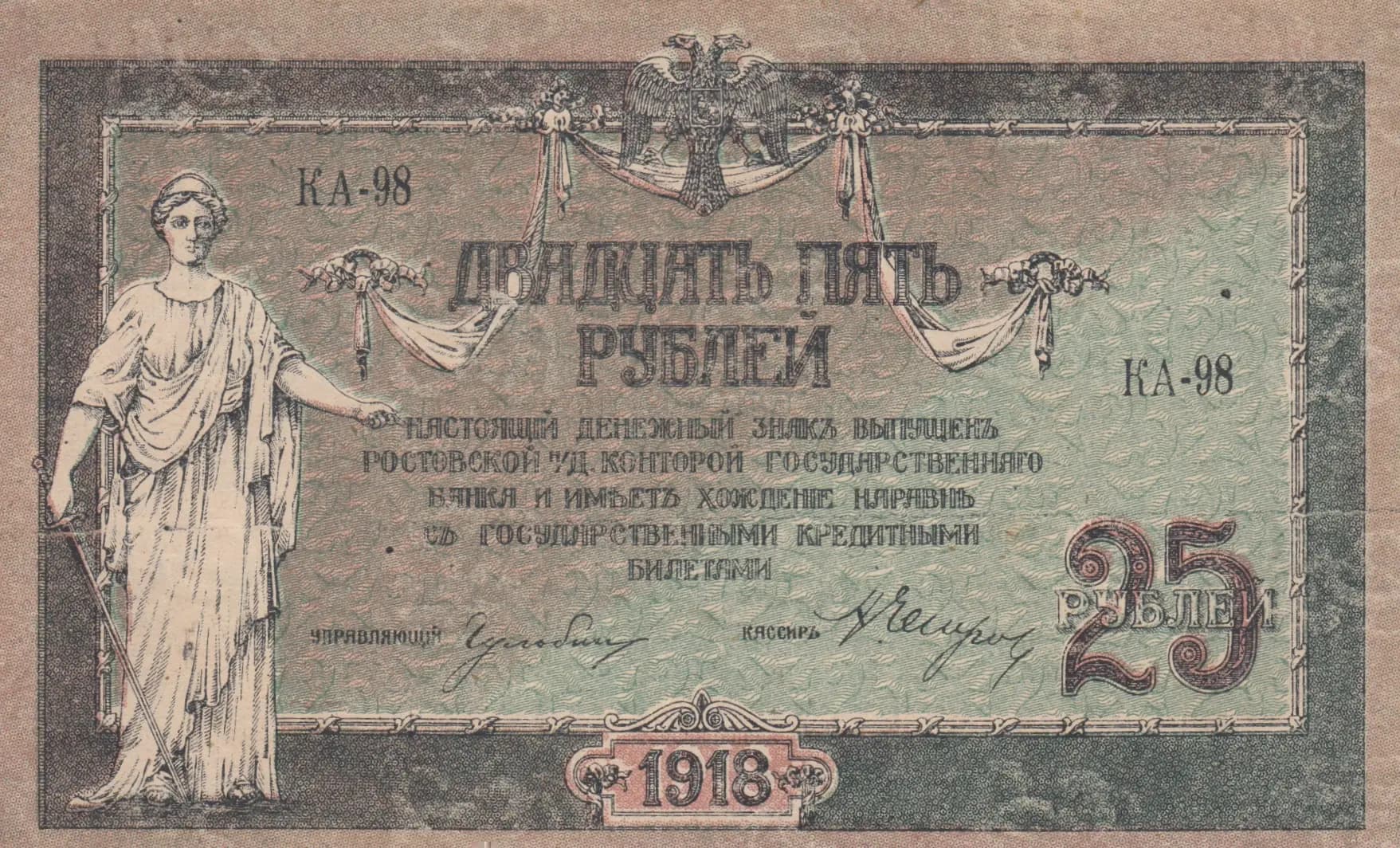
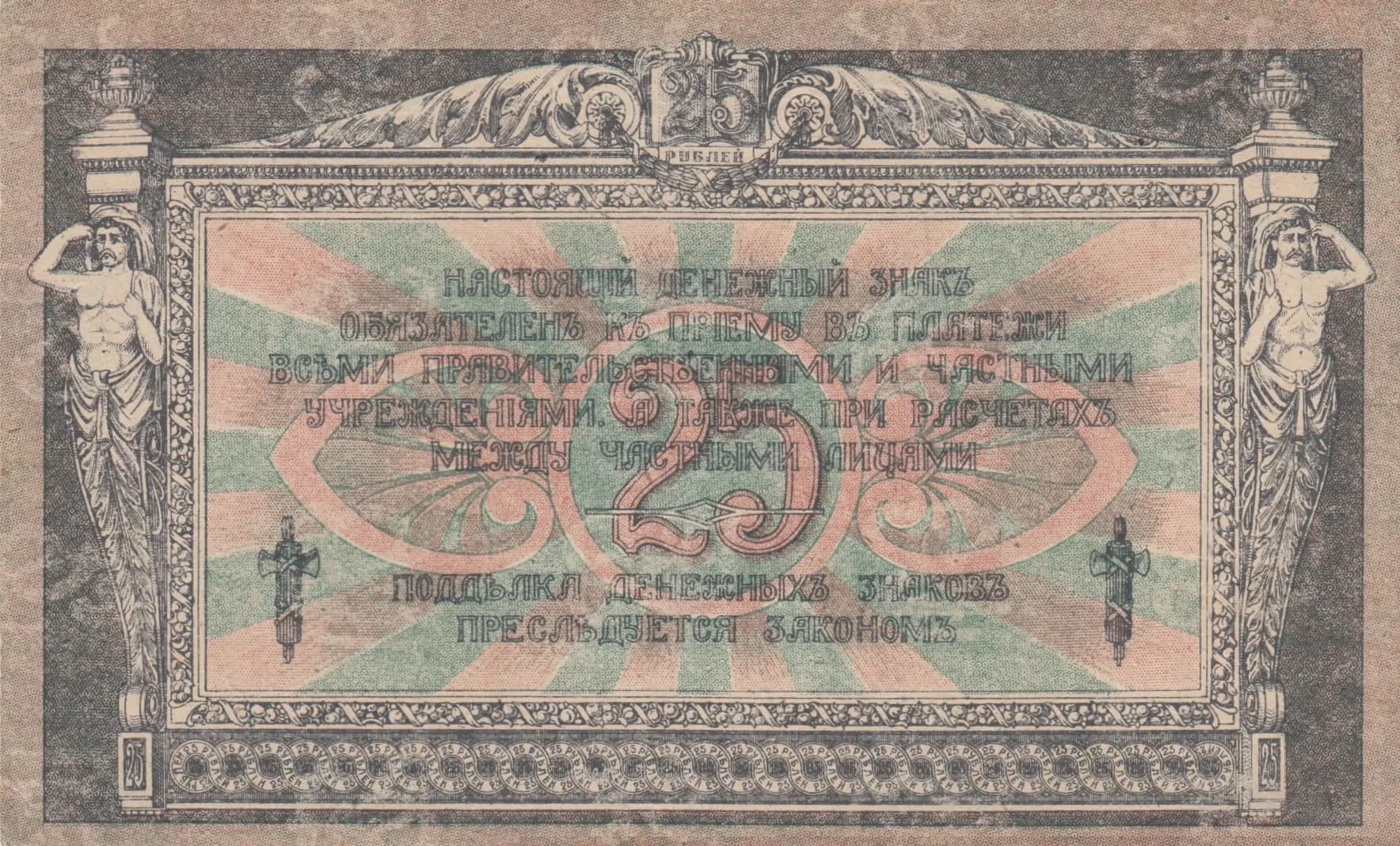
This 25 Rublei note from 1918 represents a significant piece of Russian Civil War-era currency issued by the Rostov branch of the State Bank. The obverse displays a classical allegorical female figure in Art Nouveau style alongside the Imperial double-headed eagle, while the reverse features ornate caryatid figures framing geometric patterns in green and salmon tones. The note shows honest wear consistent with VF grade, including age-related foxing and creasing, making it a well-circulated example of this important regional issue.
Common. While Rostov branch issues from 1918 represent a specific regional variant, the 25 Rublei denomination in this series was produced in substantial quantities during the Civil War period. No evidence suggests unusually limited print runs, recalls, or significant scarcity for this Pick number. VF grade examples are readily encountered in the collector market, indicating healthy survival rates. The denomination and issuer do not carry the premiums associated with rare regional notes.
Issued during the Russian Civil War in 1918, this Rostov branch note represents the transitional period when regional State Bank branches continued issuing currency as central authority fragmented. The presence of the Imperial double-headed eagle and classical allegorical imagery reflects the continuation of pre-revolutionary design traditions even as the Bolsheviks consolidated power. The inscriptions asserting the note's legal status and interchangeability with state credit notes underscore the monetary chaos of the period, when numerous competing authorities issued their own banknotes.
The obverse features a classical female allegorical figure representing Liberty or Commerce, rendered in draped Greco-Roman style, positioned on the left side holding a staff or torch. The Imperial double-headed eagle coat of arms dominates the top center, reinforcing state authority. Elaborate Art Nouveau ornamental borders frame the design with garland swags, floral festoons, classical urns, and architectural elements. The denomination '25' appears prominently in the lower right. The reverse displays an ornate rectangular frame supported by classical male caryatid figures (draped male torsos serving as architectural supports) at the left and right corners, typical of neoclassical design. The central field contains vertical striped geometric patterns in contrasting green and salmon/pink tones with Orthodox cross symbols positioned symmetrically. The entire design emphasizes classical legitimacy through allegorical and architectural vocabulary.
FRONT SIDE: '25' and 'ДВАДЦАТЬ ПЯТЬ РУБЛЕЙ' (Twenty Five Rubles); 'КА-98' (serial designation KA-98); '1918'; 'РУБЛЕЙ' (Rubles); Main text: 'ПОСТОЯЩИЯ ДЕНЕЖНЫЙ ЗНАКЪ ВЫПУЩЕНЪ РОСТОВСКОЙ УЛ КОНТОРОЙ ГОСУДАРСТВЕННАГО БАНКА И ИМЕЕТЪ ХОЖДЕНИЕ НАРАВНЕ С ГОСУДАРСТВЕННЫМИ КРЕДИТНЫМИ БИЛЕТАМИ' (This monetary note is issued by the Rostov branch of the State Bank and has circulation equal to state credit notes). REVERSE SIDE: '25 РУБЛЕЙ' (25 Rubles); 'НАСТОЯЩИЙ ДЕНЕЖНЫЙ ЗНАКЪ ОБЯЗАТЕЛЕНЪ К ПРИЕМЪ ВО ВСЕМИ ПРАВИТЕЛЬСТВЕННЫМИ И ЧАСТНЫМИ УЧРЕЖДЕНИЯМИ ОДЪ ЛИЦЪ ПРИ РАСЧЕТАХЪ МЕЖДУ ЧАСТНЫМИ ЛИЦАМИ' (This monetary note is obligatory for acceptance by all government and private institutions and persons in settlements between private individuals); 'ПОДДЕЛКА ДЕНЕЖНЫХ ЗНАКОВ ПРЕСЛЕДУЕТСЯ ЗАКОНОМ' (Counterfeiting of monetary notes is prosecuted by law).
This note was produced using intaglio engraving, evident from the fine line work, intricate geometric patterns, and deeply detailed ornamental borders visible throughout both sides. The complexity of the classical figures, caryatid details, dentil molding, and the crisp definition of security elements all indicate engraved steel plate printing. The precise registration of the multi-color striped pattern on the reverse suggests careful plate work and sequential color application. This was the standard security printing technique employed for Imperial and early Soviet State Bank notes.
Pick S412b indicates this is variety 'b' of the Rostov 25 Rublei series. The serial designation 'КА-98' visible on the obverse represents the specific print batch. Varieties within this series typically relate to signature combinations, plate variations, or minor design differences between printings. The presence of Orthodox crosses on both sides and the specific color palette (greens and salmon tones on reverse) are consistent with documented varieties of this issue. Collectors should note serial number prefixes as these may distinguish between separate printing runs from the Rostov branch during the limited period of its operation in 1918.