1000 rublei 1920
About This Note
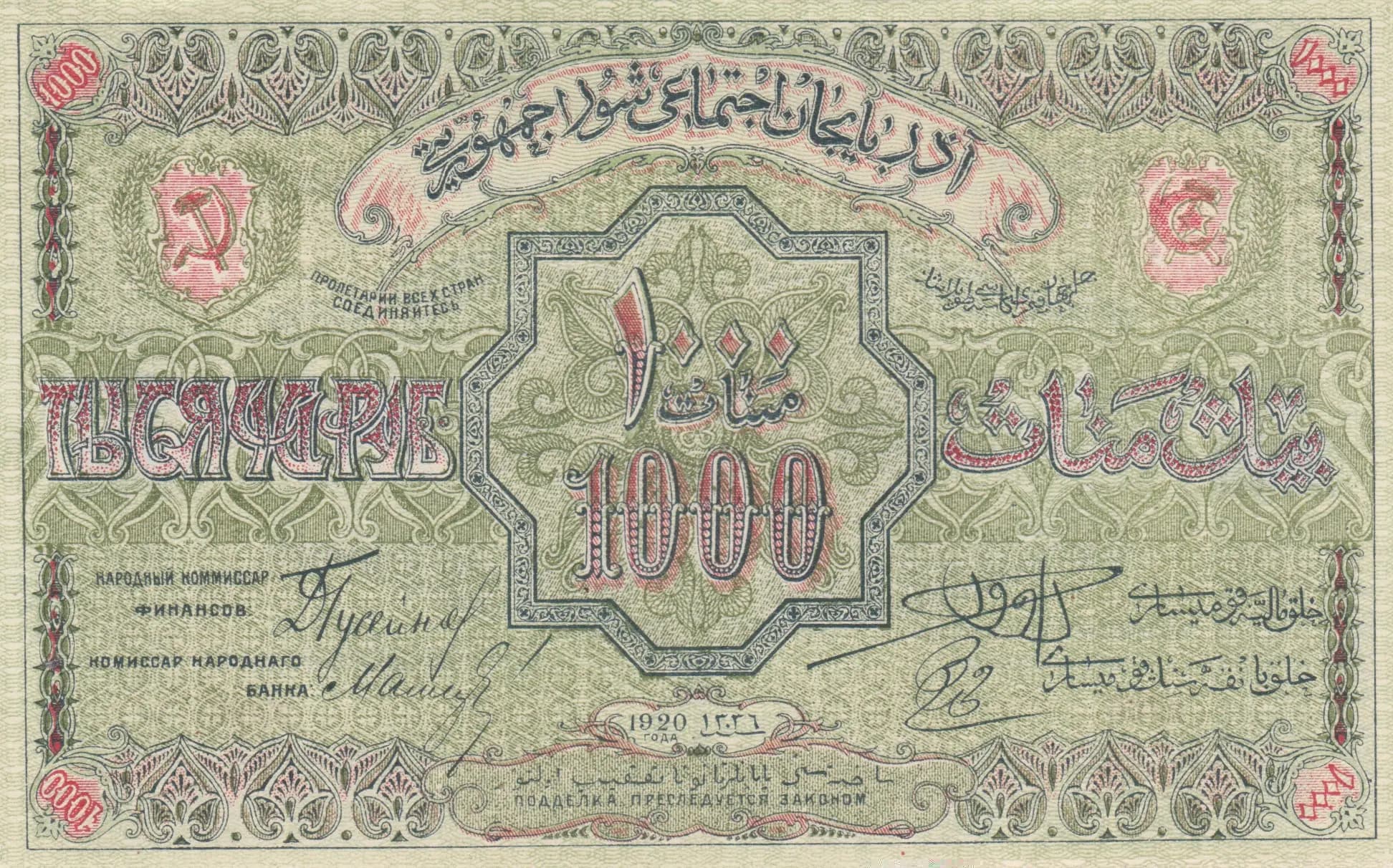
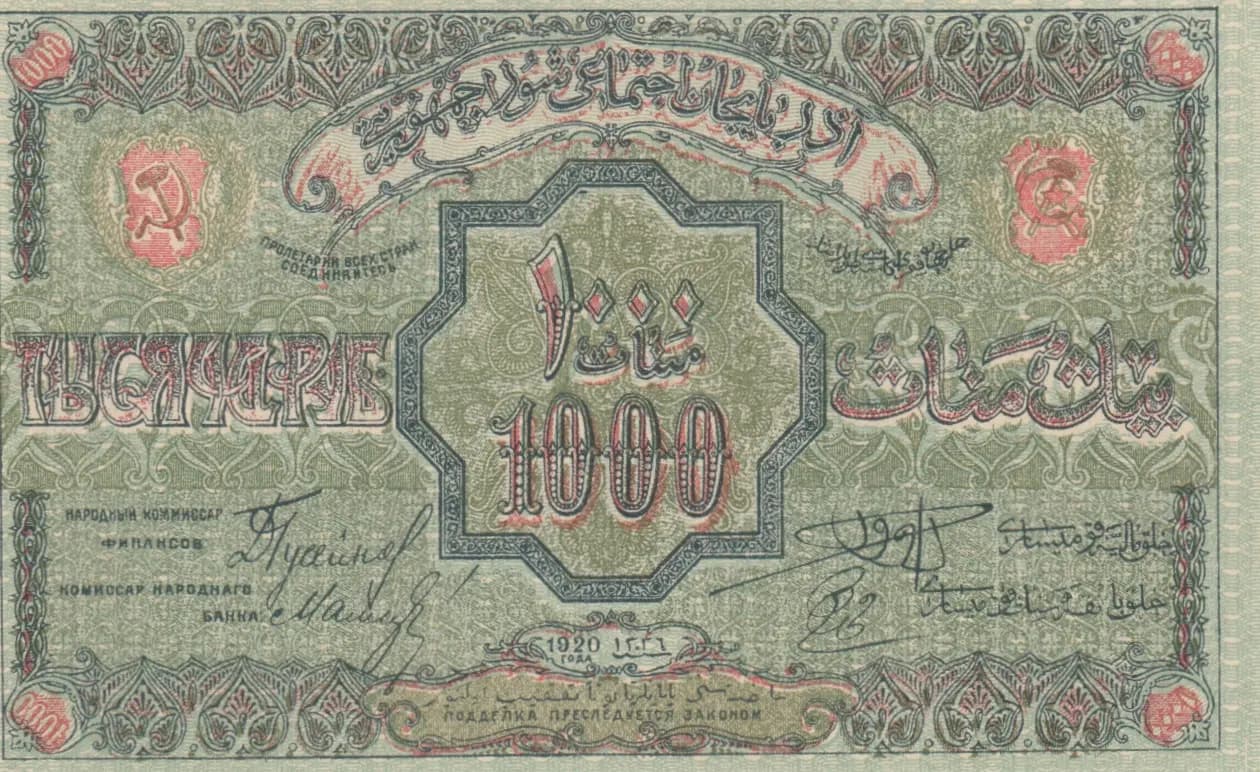
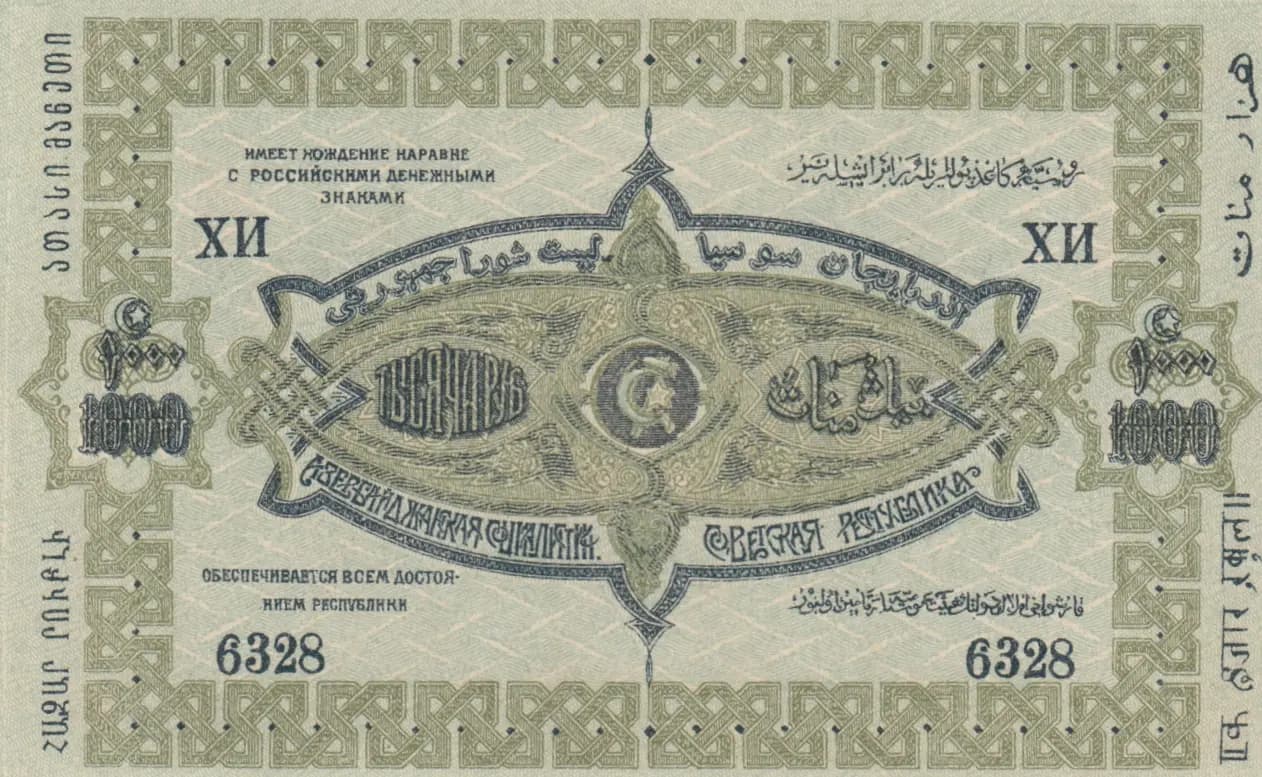
This 1000 Rublei note from the Azerbaijan S.S.R. (1920) presents a fascinating example of early Soviet monetary design with bilingual Cyrillic-Arabic text reflecting Azerbaijan's cultural context. The note exhibits the characteristic ornate Art Nouveau styling of the period with elaborate geometric borders, hammer-and-sickle emblems in all four corners on the front, and a striking symmetrical eye motif dominating the reverse. Despite showing visible age-related wear including foxing, creasing, and handwritten signatures on the front, the UNC grade suggests this is a well-preserved example of a historically significant transitional-period banknote from a short-lived Soviet republic.
Common. While this represents an early emission from a short-lived Soviet republic (Azerbaijan S.S.R., 1920-1922 period of initial monetary independence), the 1000 Rublei denomination in this series was produced in substantial quantities to meet inflationary demands of the period. The note's survival in UNC condition, while desirable for collectors, does not indicate rarity—many such notes were preserved in institutional holdings. Azerbaijan's transition to Soviet rubles and subsequent monetary consolidations means these notes were not heavily circulated in commerce, allowing many examples to survive in fine condition. The relative ease of acquiring examples of this Pick number at moderate prices confirms its common status among early Soviet-era collectors.
Issued during the early years of the Azerbaijani Soviet Socialist Republic's formation (1920), this note reflects the tumultuous post-Revolutionary period when newly-formed Soviet republics were establishing their own monetary systems under central Soviet authority. The bilingual inscriptions in Russian and Arabic acknowledge Azerbaijan's predominantly Muslim population and geographic position, while the repeated hammer-and-sickle symbols and text declaring the note is 'backed by all the wealth of the Republic' and 'circulates equally with Russian monetary signs' emphasize the assertion of Soviet sovereignty and the integration of Azerbaijan's economy into the broader Soviet monetary system. The note's declaration that 'counterfeiting is prosecuted by law' underscores the serious challenges of currency stability during this chaotic period of Russian civil conflict and territorial consolidation.
The front features a formally symmetrical design centered on an octagonal frame containing the denomination '1000,' surrounded by intricate floral and geometric guilloche patterns in shades of olive green with pink/red accents. Four Soviet hammer-and-sickle emblems in red occupy the corners, representing the socialist state authority. The color palette of greenish background with red and cream tones creates visual hierarchy. Multiple signatures appear in the lower portion, indicating authorization by different Soviet officials. The back presents a completely different aesthetic dominated by a large ornamental eye design serving as the central vignette, executed in dark blue/navy ink on a cream/beige background. This eye motif incorporates a crescent moon symbol within its geometric framework, likely referencing Azerbaijan's Islamic cultural heritage. The back's border features interlocking geometric patterns characteristic of Central Asian Islamic artistic traditions, synthesizing Soviet revolutionary iconography with local cultural symbolism. Serial number 6328 appears in mirror format, and Roman numeral XII (section 12) markers denote the printing series.
FRONT SIDE: '1000' (numeric), 'ТЫСЯЧА' (thousand in Russian), 'ألف' (thousand in Arabic), 'РУБЛЕЙ' (rubles in Russian), 'روبل' (ruble in Arabic), 'НАРОДНЫЙ КОМИССАРИАТ ФИНАНСОВ' (People's Commissariat of Finance), 'КОМИССАР НАРОДНОГО БАНКА' (Commissioner of the People's Bank), '1920' (year), 'ПОДДЕЛКА ПРЕСЛЕДУЕТСЯ ЗАКОНОМ' (Counterfeiting is prosecuted by law). BACK SIDE: 'ИМЕЕТ ХОЖДЕНИЕ НАРАВНЕ С РОССИЙСКИМИ ДЕНЕЖНЫМИ ЗНАКАМИ' (Circulates equally with Russian monetary signs), 'XII' (Roman numeral 12, appearing twice), '1000' (denomination, appearing twice), '6328' (serial number, appearing twice), 'ОБЕСПЕЧИВАЕТСЯ ВСЕМ ДОСТОЯНИЕМ РЕСПУБЛИКИ' (Backed by all the wealth of the Republic), 'ВРЕМЕННАЯ СИЛУЭТНАЯ РЕВОЛЮЦИОННАЯ' (Temporary silhouette revolutionary).
This note was produced using intaglio (copperplate engraving) printing, evidenced by the fine detail of the elaborate guilloche patterns, precise geometric borders, and the dimensional quality visible in the ornamental designs. The complex security features including multiple layers of geometric patterning and the precision required for the symmetrical eye vignette are characteristic of high-security intaglio production. The dual-color printing (green/red on front; blue on back) required multiple passes through the press, a standard technique for Soviet notes of this era. While specific printer attribution for P-S712 is not definitively documented in standard references, notes of this period from Azerbaijan were produced under supervision of the People's Commissariat of Finance as indicated by the inscriptions, likely utilizing facilities under Soviet central control.
This specific example exhibits serial number 6328 with Roman numeral series XII, identifying it as a mid-range serial from the first printing run. The signature varieties are evident in the lower portion where multiple officials' signatures appear, consistent with authorization requirements of the Azerbaijan S.S.R. financial commissariat. No major overprints or significant varieties are noted on this example. Collectors should note that signature varieties exist within this Pick number depending on which officials authorized the note, though such distinctions are minor and do not significantly affect value or desirability for most collectors.