1000 rublei 1920
“Turkestan”
About This Note
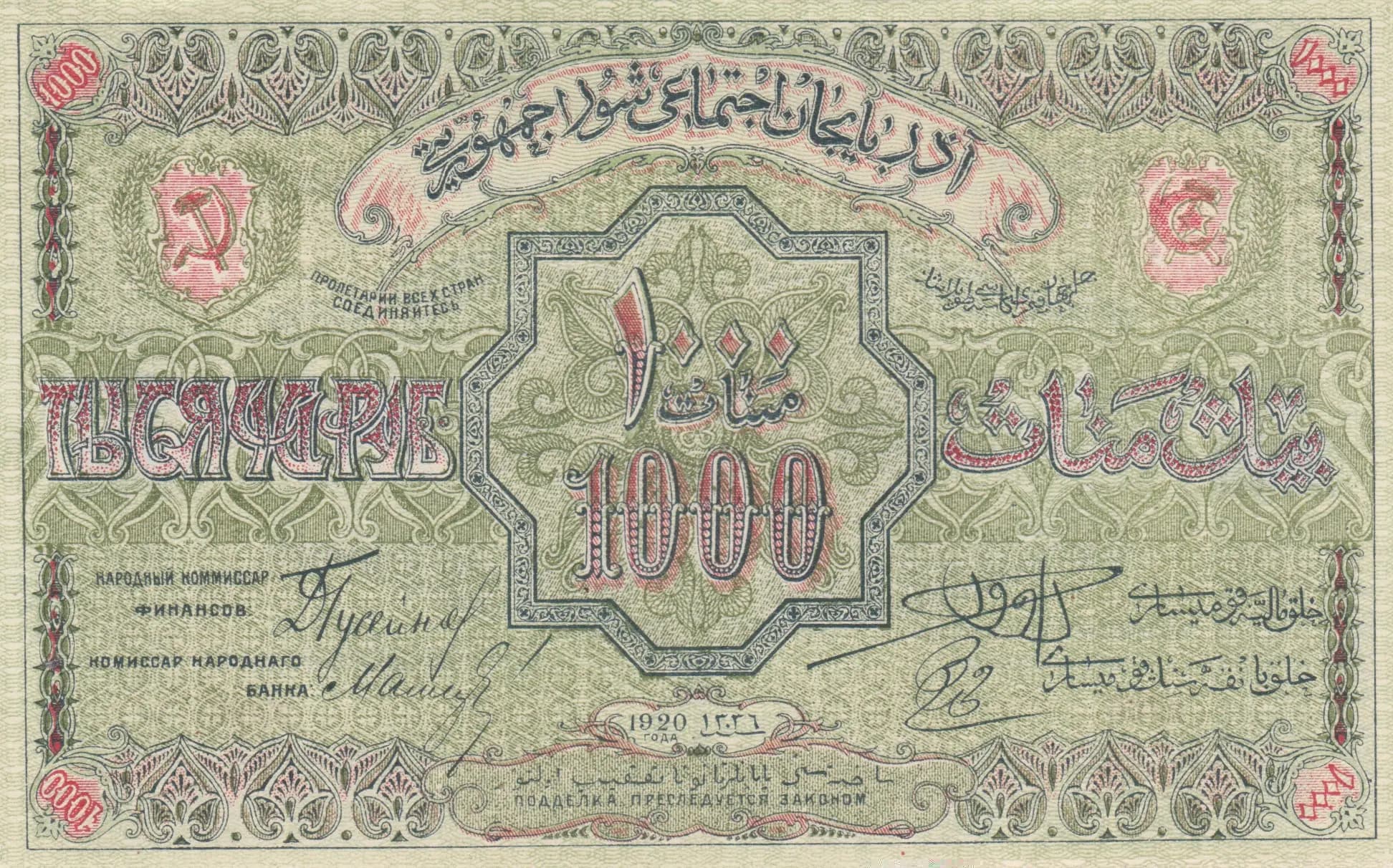
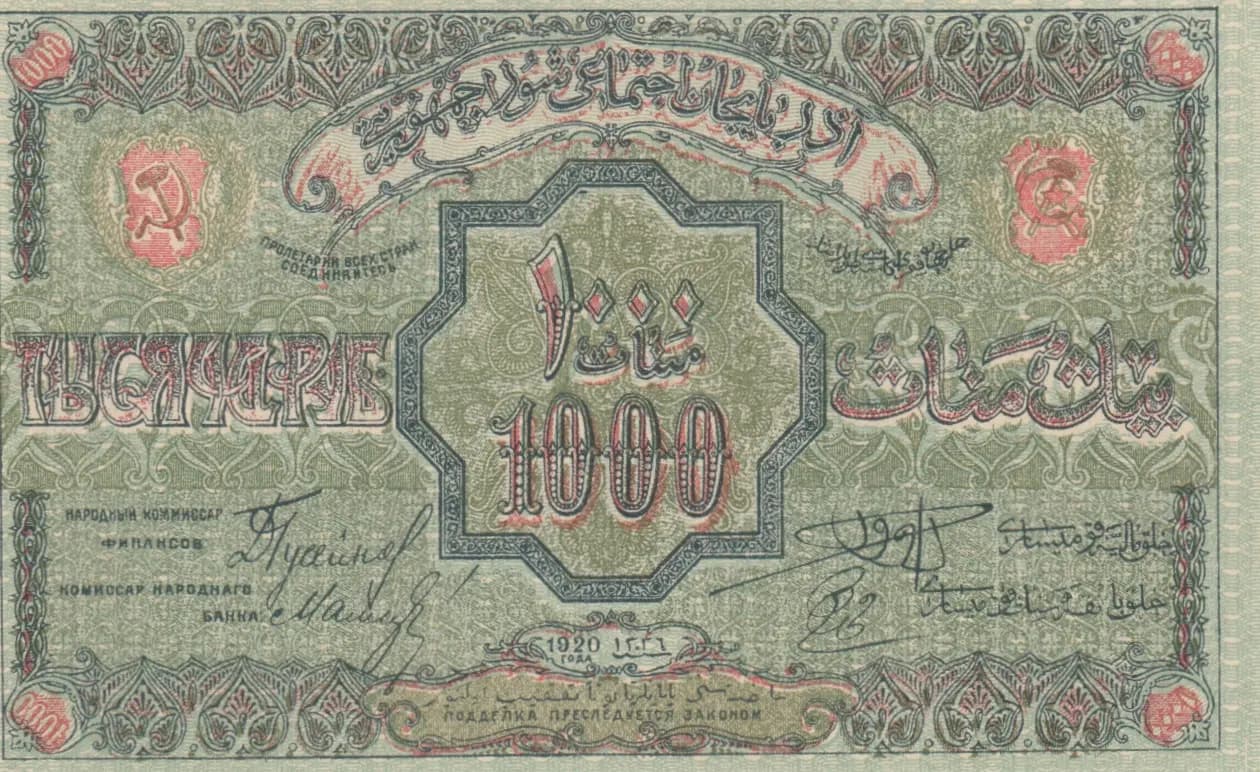
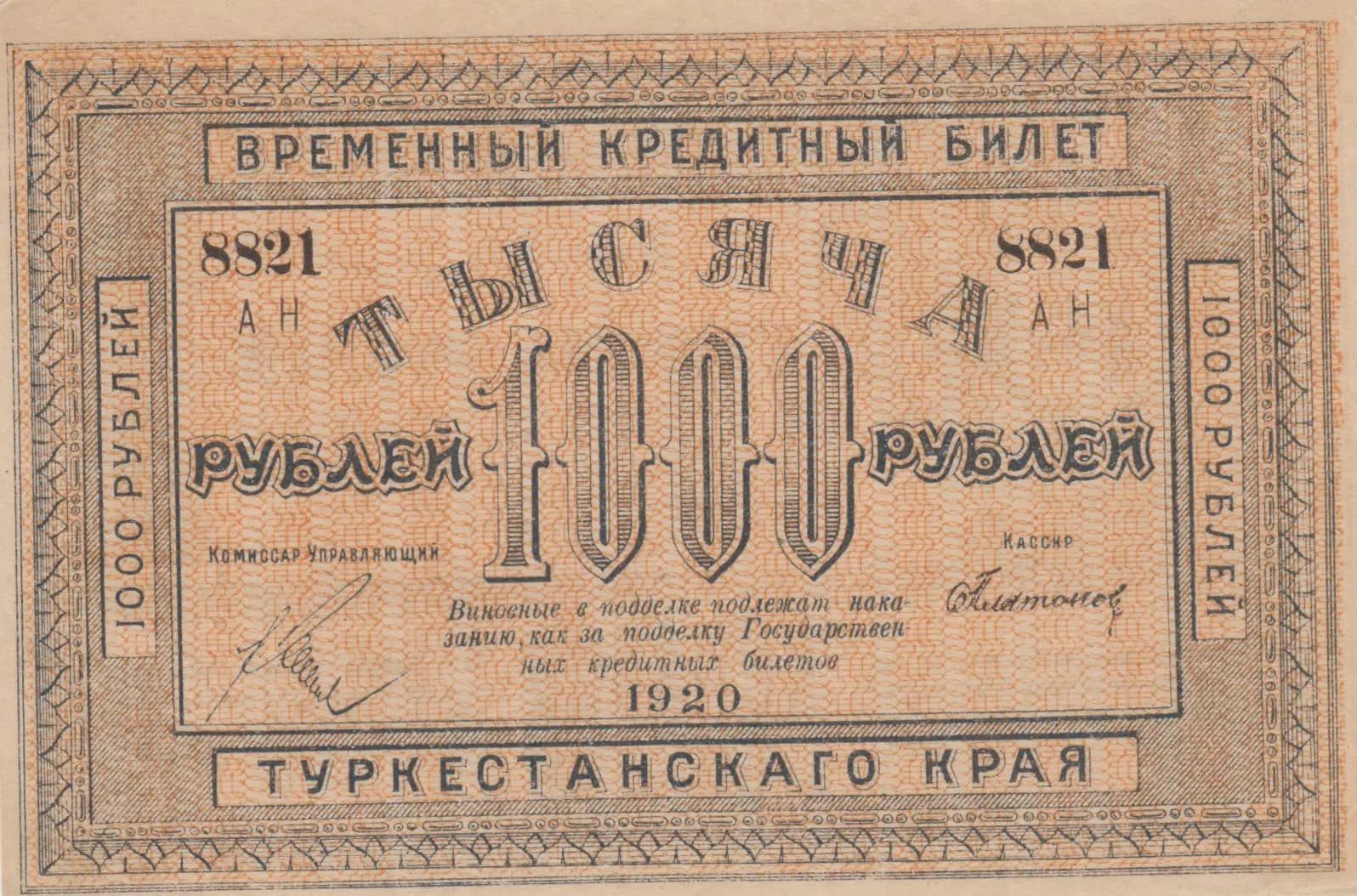
This is a 1000 Rublei note issued by the Tashkent State Bank Branch in 1920, representing a fascinating example of Soviet-era Turkestan currency during the Russian Civil War period. The note is in AU (About Uncirculated) condition with visible but moderate aging characteristics including some discoloration and foxing, displaying the ornamental geometric designs and bilingual (Russian-Persian) inscriptions typical of this regional issue. The presence of both Cyrillic and Persian script reflects the multicultural administration of Turkestan under early Soviet control, making this a notable piece of numismatic and historical significance.
common
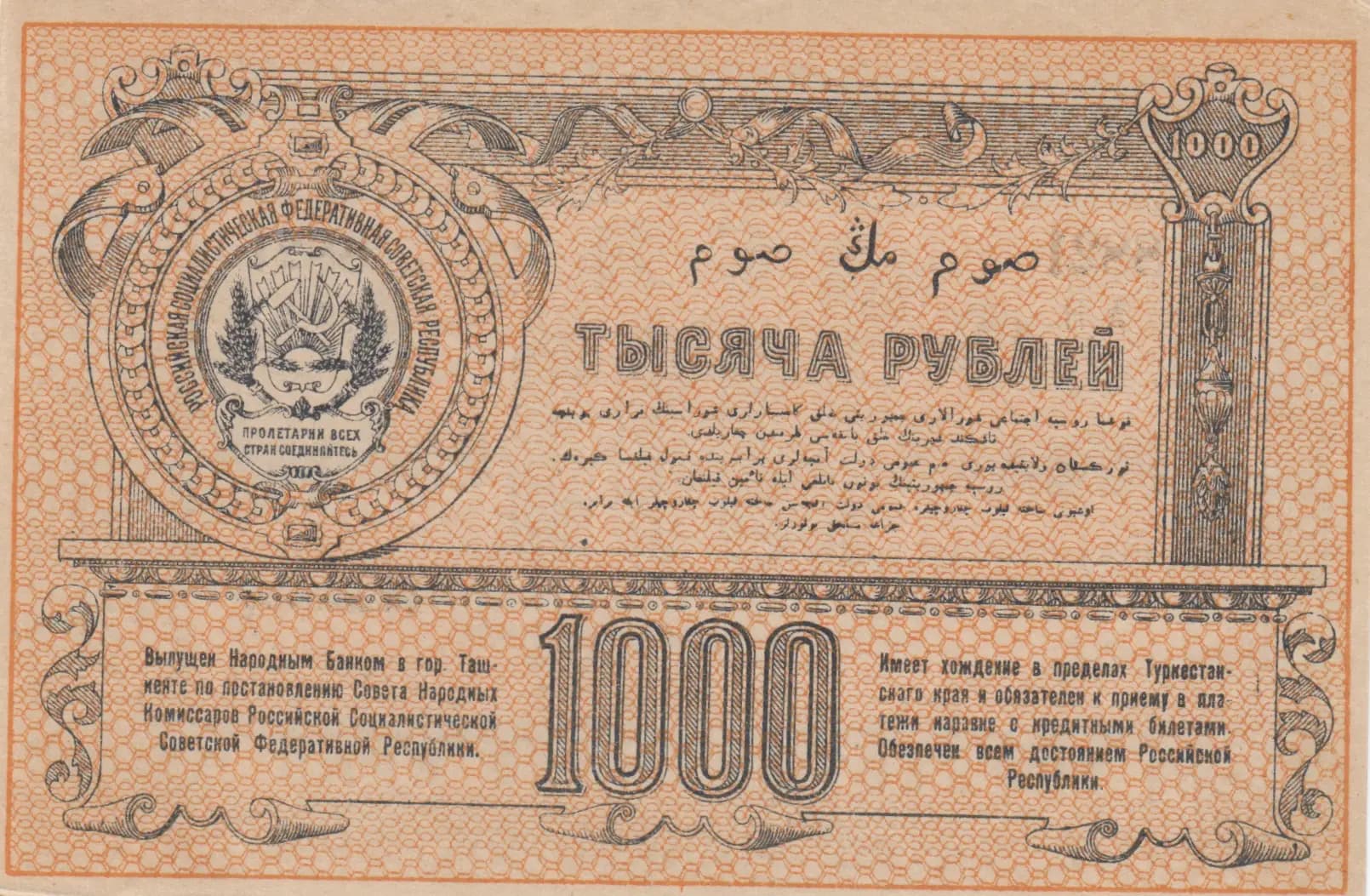
This temporary credit note was issued during the turbulent period of 1920 when the Soviet government was consolidating control over Central Asia following the Russian Civil War. The circular state seal on the reverse featuring wheat sheaves symbolizes the Soviet emphasis on agricultural production and worker solidarity, reinforced by the communist motto 'Workers of the world, unite!' prominently displayed on the back. The bilingual Russian-Persian inscriptions and the explicit declaration that the note is 'guaranteed by all the assets of the Russian Republic' reflect the early Soviet attempts to legitimize their rule in the culturally diverse Turkestan region.
The front of this note features a light tan and beige background with classical ornamental border designs and geometric patterns executed in fine line work. The central focus is the large denomination numerals '1000' with 'РУБЛЕЙ' (Rubles) clearly displayed, along with the issuing location 'ТУРКЕСТАНСКОГО КРАЯ' (Turkestan Region). Serial numbers appear on both left and right margins in vertical text arrangement, with the date 1920 visible in the lower portion. The reverse displays an elaborate circular state seal positioned on the left side, featuring concentric decorative rings and a central emblem depicting wheat sheaves or grain motifs—Soviet agricultural symbolism central to the communist ideology of the period. The seal is surrounded by text in both Russian Cyrillic and Persian script, with the large denomination numeral '1000' prominently centered at the bottom. The bilingual presentation reflects the regional context of Turkestan, which had significant Persian-speaking populations. Fine engraving and line work throughout creates a sophisticated security design typical of early Soviet currency production.
FRONT SIDE: 'ВРЕМЕННЫЙ КРЕДИТНЫЙ БИЛЕТ' (Temporary Credit Note) | '1000 РУБЛЕЙ' (1000 Rubles) | 'ТУРКЕСТАНСКОГО КРАЯ' (Of Turkestan Region) | '1920' (Year) | 'Комиссар управляющий' (Commissar in charge) | 'Выкосные в подделке подлежат наказанию как за подделку Государственных кредитных билетов' (Counterfeiters are subject to punishment as for counterfeiting State credit notes) | Serial number: 8821. BACK SIDE: 'ТЫСЯЧА РУБЛЕЙ' (One thousand rubles) | 'هزار روبل' (Persian: One thousand rubles) | 'ПРОЛЕТАРИИ ВСЕХ СТРАН СОЕДИНЯЙТЕСЬ' (Workers of the world, unite!) | 'Выпущен Народным Банком в гор. Ташкенте по постановлению Совета Народных Комиссаров Российской Социалистической Советской Федеративной Республики' (Issued by the People's Bank in Tashkent by decision of the Council of People's Commissars of the Russian Socialist Soviet Federative Republic) | 'Имеет хождение в пределах Туркестана, свято как в Разделении и приему в виде платежа с кредитными билетами. Обеспечен всем достоянием Российской Республики' (Has circulation within Turkestan, sacred in distribution and acceptance as payment with credit notes. Guaranteed by all the assets of the Russian Republic).
This note was produced using intaglio engraving (line engraving) on a flat printing press, the standard security printing technique employed by the Soviet State Bank for credit notes during this period. The fine line work, decorative geometric patterns, and detailed circular seal all exhibit the characteristic appearance of intaglio printing, which creates raised impressions and fine detail difficult to counterfeit. The consistent quality of the engraving across both front and back sides indicates production by a professional state security printing facility, likely the Tashkent branch operations under Soviet central printing authority.
The observed serial number 8821 on this specimen represents one of the circulation variations for this Pick number. Varieties for P-S1173 (3) may include different serial number ranges and possible signature variations by different commissars, though the visual analysis confirms 'Комиссар управляющий' (Commissar in charge) without specific signature identification. The bilingual nature of the note (Russian and Persian) is consistent across the issue and not a distinguishing variety marker. No overprints or subsequent variations are apparent on this examined specimen, indicating it is a standard issue example from the 1920 Tashkent emission.