1000 rublei 1920
About This Note
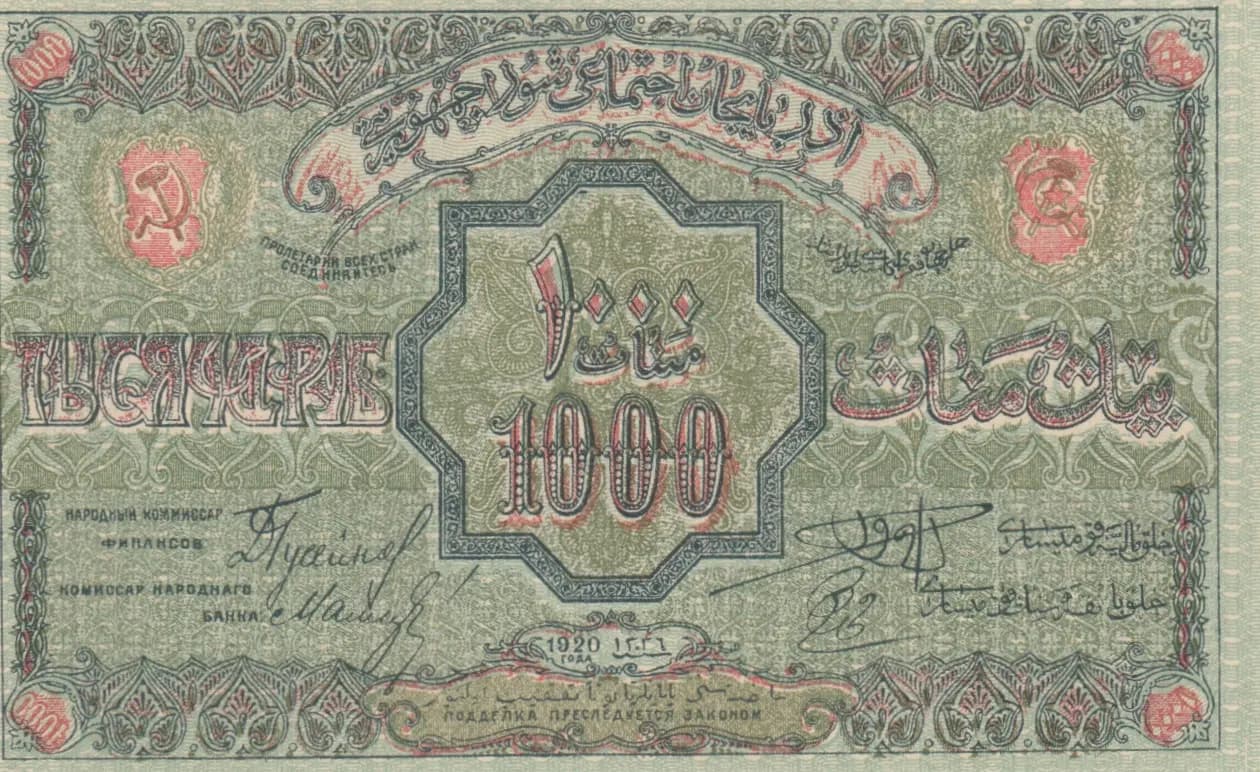
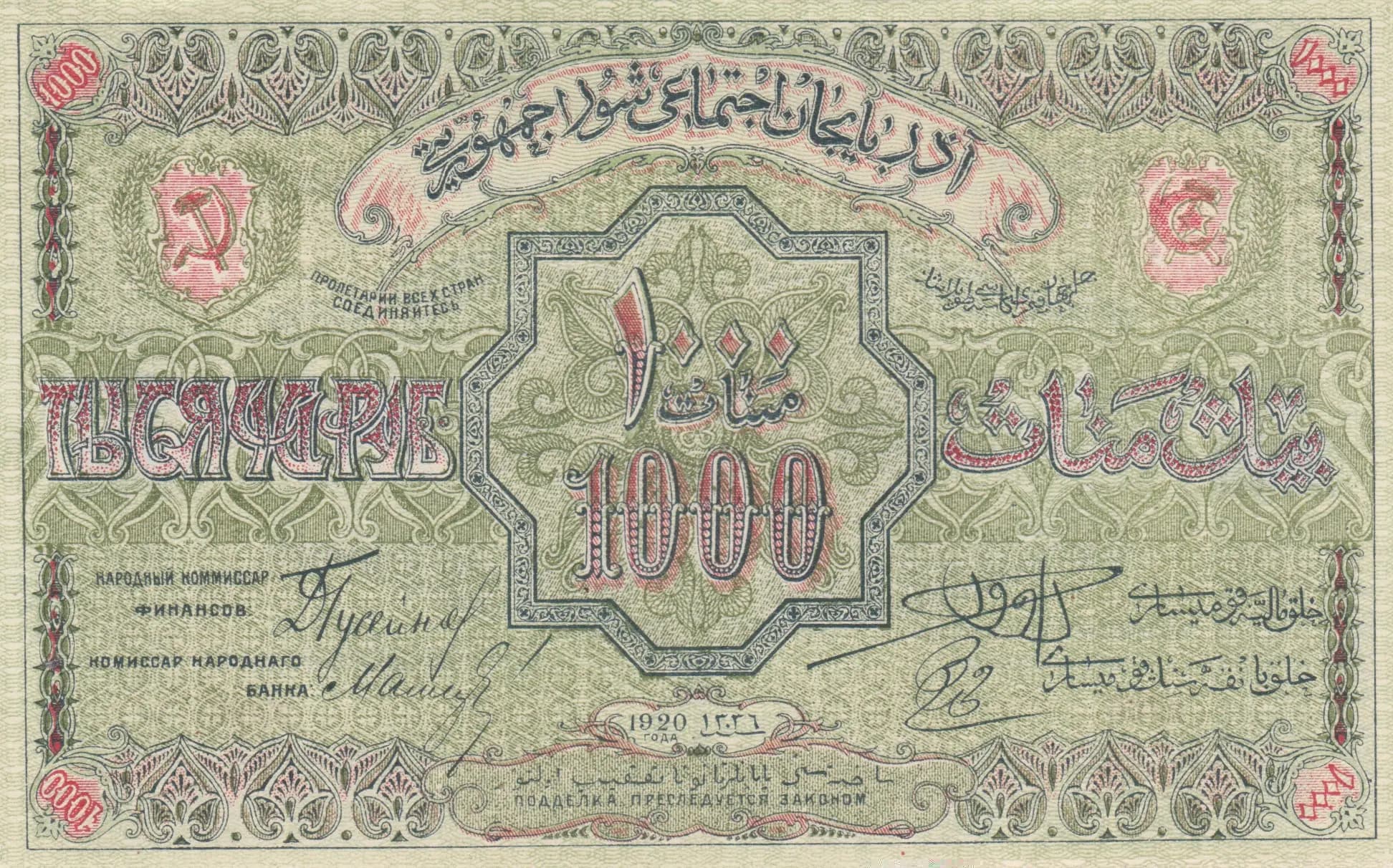
This is a spectacular 1000 Ruble banknote from 1920 issued by the Azerbaijan S.S.R. during the early Soviet period, presented in UNC condition despite visible aging consistent with a 100+ year old historical document. The note features striking bilingual design elements in Russian Cyrillic and Arabic script, with ornate geometric and floral borders in green and red/pink, reflecting the cultural and administrative character of the Caucasian Soviet republic. The exceptional decorative quality, presence of hammer-and-sickle and red star Soviet symbols, multiple official signatures, and rare Arabic bilingual presentation make this a significant piece of Soviet monetary history from the transitional post-Civil War period.
common. This denomination and issuer combination from 1920 is widely available in the international numismatic market. Early Soviet banknotes from the Azerbaijan S.S.R., while historically significant, were produced in substantial quantities given the immediate post-Civil War currency stabilization demands. The Pick catalog listing (P-S711) without any notations regarding limited print runs or special varieties indicates standard circulation issues. These notes, though aesthetically striking and over a century old, remain relatively affordable on the secondary market, typically trading in the $15-40 range depending on condition, which is the typical price range for common historical Soviet currency.
This banknote was issued during a critical period in early Soviet history when the Azerbaijan S.S.R. was consolidating its position within the new Soviet state following the Russian Civil War. The bilingual Cyrillic-Arabic design reflects the demographic and cultural reality of Azerbaijan as a predominantly Muslim region with a significant Turkic-speaking population under Bolshevik control. The prominent Soviet symbols—hammer and sickle, red stars, and references to the People's Commissariat of Finance and the People's Bank—demonstrate the revolutionary financial apparatus establishing its authority in the periphery of the former Russian Empire, with the note's claim to circulate 'equal to Russian monetary signs' emphasizing the integration of this regional republic into the Soviet monetary system.
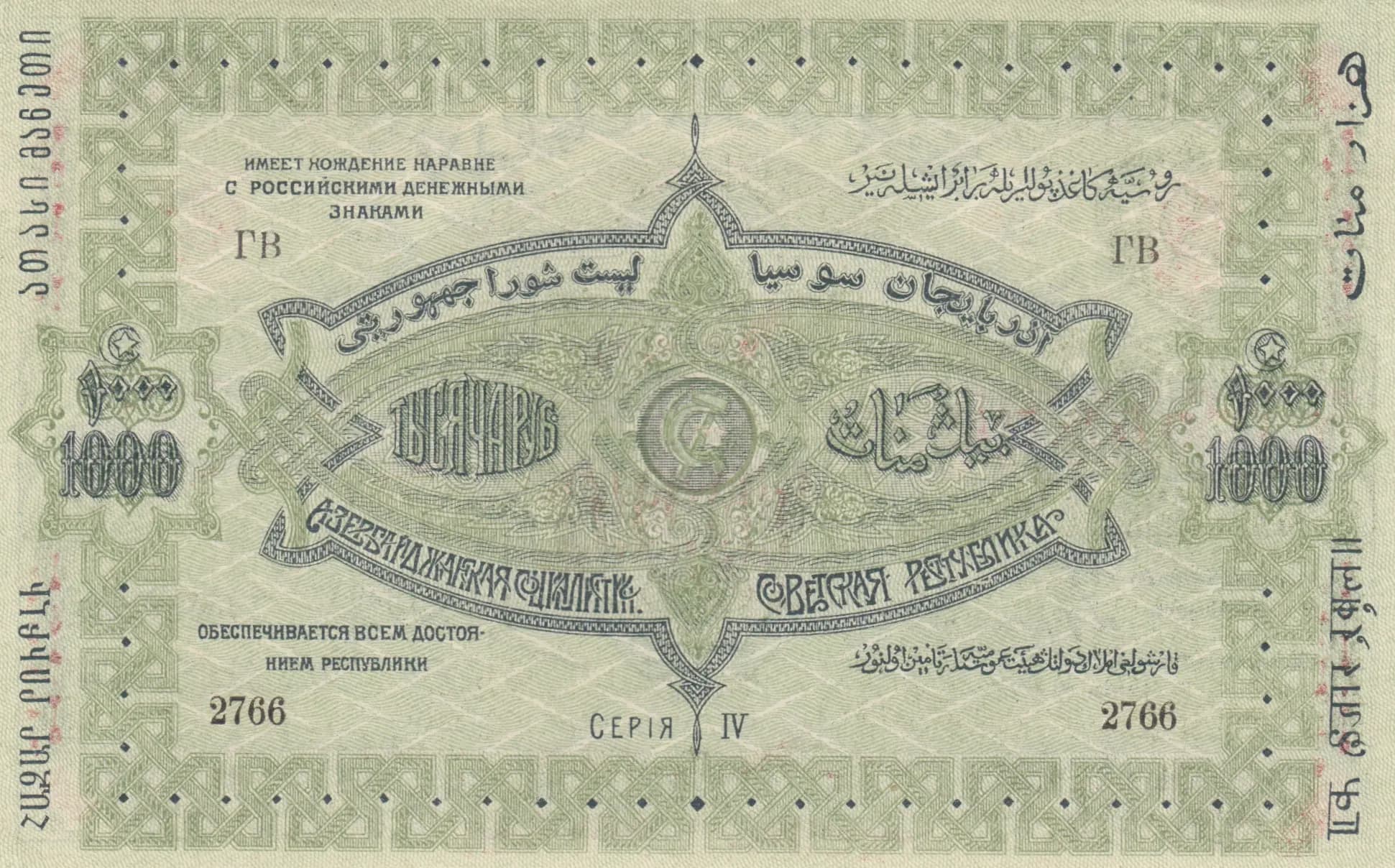
This banknote features a sophisticated Art Deco-influenced design executed in an ornate style typical of early Soviet currency production. The obverse displays a complex arrangement of cream/beige background with framing elements in green and red/pink, centered around a large octagonal cartouche containing the denomination '1000.' The design incorporates symmetrical decorative arches with Arabic calligraphy elements in the upper portion, reflecting the Islamic cultural heritage of Azerbaijan. Chain-like ornamental borders frame both lateral edges, while red circular stamps bearing hammer-and-sickle symbols and red stars occupy the four corners, establishing Soviet sovereignty. The reverse presents a mirror-image composition with emphasis on geometric lattice patterns forming the border, with two large '1000' denominations positioned in the left and right margins. The bilateral text presentation—Russian Cyrillic paired with Arabic script—appears throughout both sides, emphasizing the bicultural character of the Azerbaijan S.S.R. administrative authority. No figurative portraits or specific landmarks are depicted; instead, the design relies entirely on geometric abstraction and symbolic elements to convey state authority and national identity.
FRONT SIDE: 'РСФСР' (RSFSR - Russian Soviet Federative Socialist Republic) | '1000' and 'ТЫСЯЧА' (One Thousand) | 'НАРОДНЫЙ КОМИССАР ФИНАНСОВ' (People's Commissar of Finance) | 'КОМИССАР НАРОДНОГО БАНКА' (Commissar of the People's Bank) | '1920 ГОДА' (Year 1920) | 'ВКЛАДЧИКА ПЕРЕВОДИТСЯ ЗАЙМОМ' (Depositor's transfer is made by loan) | Arabic: 'روسيا' (Russia) and 'جمهورية روسيا السوفياتية الاتحادية الاشتراكية' (Russian Soviet Federative Socialist Republic). BACK SIDE: '1000' (denomination) | 'ИМЕЕТ ХОЖДЕНИЕ НАРАВНЕ С РОССИЙСКИМИ ДЕНЕЖНЫМИ ЗНАКАМИ' (Has circulation equal to Russian monetary signs) | 'ГБ' (State Bank abbreviation) | 'ОБЕСПЕЧИВАЕТСЯ ВСЕМ ДОСТОЯНИЕМ РЕСПУБЛИКИ' (Secured by all property of the Republic) | 'СЕРИЯ IV' (Series IV) | '2766' (serial number) | 'СОВЕТСКАЯ РЕСПУБЛИКА' (Soviet Republic) | Arabic: 'روسيا السوفياتية الاشتراكية الاتحادية' (Russian Soviet Federative Socialist Republic).
The banknote was produced using traditional letterpress and lithographic printing methods characteristic of Soviet security printing in 1920. The fine geometric lattice borders, intricate ornamental designs, and the clarity of bilingual text indicate skilled multi-color lithographic work. The sharp definition of the decorative elements, the precise registration of the red stamp marks in the corners, and the fine-line work throughout suggest production by a state security printing facility. The color separation into distinct areas of cream, green, and red/pink indicates a multi-plate production process. This level of technical sophistication is consistent with output from the Soviet State Security Printing Works or similar official Bolshevik-era printing establishments.
This specific example is identified as Series IV with serial number 2766. The series designation is visible on the reverse. Varieties for this Pick number (P-S711) are primarily distinguished by series letters and serial number ranges; Series IV represents one of the standard production runs. The presence of multiple signature variants is typical for this issue, as different officials authorized the note at various stages of production. No known overprints, watermark variants, or exceptional printing errors are documented for this denomination and issuer combination. The bilingual design format remained consistent across the entire production run.