10 rublei 1918
About This Note
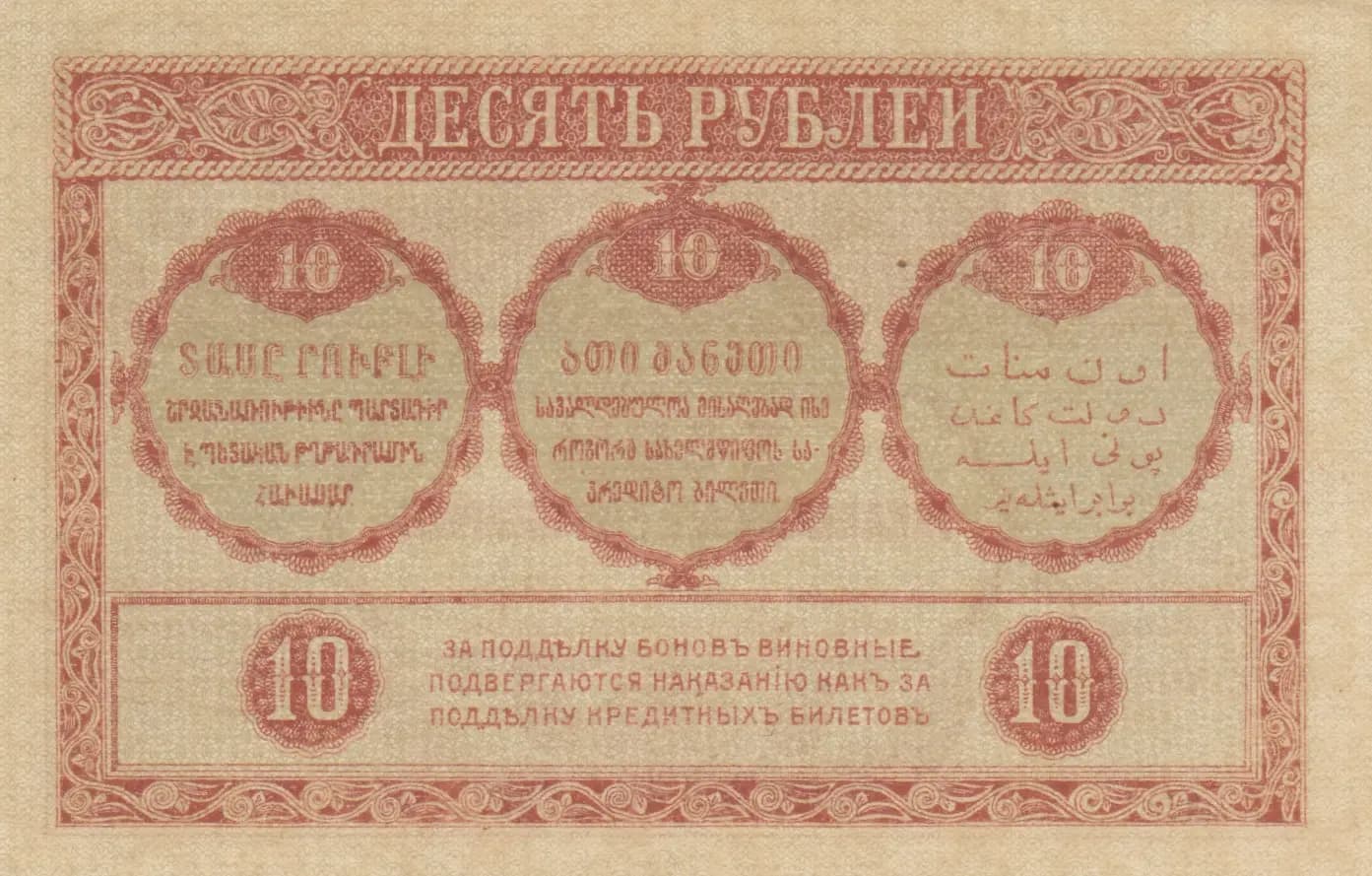
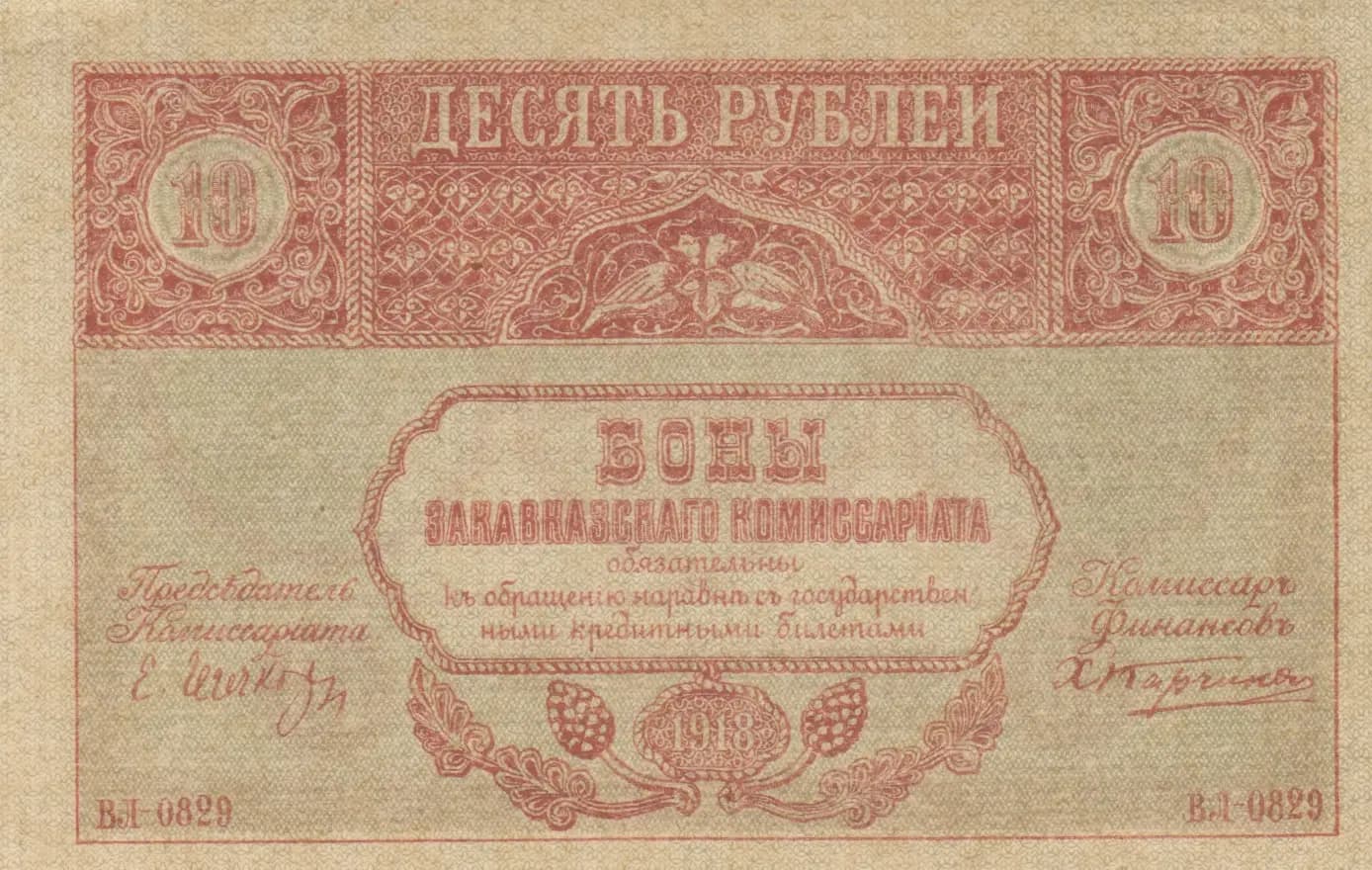
This 1918 Transcaucasian Commissariat 10 rublei note (Pick S604) is a multilingual bond certificate presented in uncirculated condition with vibrant cream and red-brown coloring. The note's exceptional design features three circular medallions with inscriptions in Russian Cyrillic, Armenian, Georgian, and Arabic/Persian scripts—reflecting the diverse ethnic composition of the Transcaucasus region. The obverse and reverse both display fine ornamental borders, decorative cartouches, and elaborate security printing that demonstrates sophisticated engraving techniques for the period.
Common. The Transcaucasian Commissariat issued bonds in multiple denominations and quantities during 1918-1920 as emergency currency. While these notes are historically significant and represent a short-lived regional authority, they were produced in sufficient quantities for their intended circulation and appear regularly in collections of Russian Civil War-era currency. UNC examples are more desirable than circulated versions, but the denomination and issuer do not command premium pricing typical of truly scarce issues. No evidence of limited mintages, recalls, or extreme scarcity applies to this Pick number.
Issued by the short-lived Transcaucasian Commissariat during the Russian Civil War period, this note represents an attempt to establish monetary authority in the ethnically diverse South Caucasus region before the area's incorporation into the Soviet Union. The prominent use of four different scripts (Russian, Armenian, Georgian, and Persian) on the same note reflects the commissariat's effort to legitimize its authority across multiple populations and demonstrates the transitional, multinational character of post-1917 Russian politics. The reference to 'bonds' (боны) rather than standard currency, along with the statement that these circulate 'on equal terms with state credit notes,' indicates this was emergency currency issued during a period of monetary chaos and political upheaval.
This banknote employs a sophisticated multilingual design typical of transitional post-revolutionary regional authorities. The obverse features three prominent circular medallions arranged horizontally, each containing the denomination in different scripts (Russian Cyrillic, Armenian, and Georgian with Arabic/Persian text), surrounded by ornamental circular borders with fine geometric detailing. The reverse displays an elaborate decorative cartouche in the upper-center portion, flanked by what appears to be a double-headed eagle or Orthodox cross emblem, with grape vine and floral wreath motifs visible in the ornamental design. Two signature lines for the Chairman of Ministers and Commissar of Finances appear in the lower portion of the reverse, with serial numbers 'В.І. 0829' printed in the bottom corners on both sides. The entire note is framed by an intricate decorative border with corner flourishes and geometric patterns. The cream/beige paper stock contrasts sharply with the red-brown printing throughout, creating strong visual definition.
OBVERSE SIDE: 'ДЕСЯТЬ РУБЛЕЙ' (Ten Rubles in Russian); 'ВИСЕ РАНІЕ' (Ten Rubles in Armenian); 'ათი ლარი' (Ten in Georgian); 'ده روبل' (Ten Rubles in Arabic/Persian); 'ЗА ПОДЪЪЛЬКУ БОНОВ ВИНОВНЫЕ ПОДВЕРГАЮТСЯ НАКАЗАНИЮ НАК'Ь ЗА ПОДЪЪЛЬКУ КРЕДИТНЫХ'Ь БИЛЕТОВ'Ь' (For counterfeiting bonds, those guilty are subject to punishment as for counterfeiting credit notes). REVERSE SIDE: 'ДЕСЯТЬ РУБЛЕЙ' (Ten Rubles); 'БОНЫ' (Bonds); 'ЗАКАВКАЗСКАГО КОМИССАРИАТА' (Transcaucasian Commissariat); 'образцомъ' (specimen/sample); 'для обращенiя наравнь со государством ными кредитными билетами' (for circulation on equal terms with state credit notes); 'Председатель Министра' (Chairman of Ministers); 'Комиссаръ Финансовъ' (Commissar of Finances); Serial identifier 'В.І. 0829' (appearing twice).
This note was produced using intaglio (engraved) printing techniques, evidenced by the fine detail visible in the ornamental borders, the three-dimensional quality of the decorative cartouche, and the crisp, well-defined line work throughout the design. The use of multiple ornamental vignettes, elaborate corner flourishes, and the precision of the multilingual text blocks all indicate classical engraved banknote production. The security features incorporated through ornamental complexity and fine-line borders are characteristic of European security printing standards of the period. Specific printer information for Transcaucasian Commissariat bonds is not definitively documented in standard catalogs, but the quality of engraving suggests work by an established security printer, possibly Russian State Security Printing facilities or a similar institution.
The observed specimen carries serial number 'В.І. 0829' printed on both obverse and reverse corners. Varieties in Transcaucasian Commissariat bonds are generally determined by serial number prefixes and sequences. The 'В.І.' prefix appears to be standard for this issue. No overprints or secondary printings are evident on the examined note. The signatures are printed rather than handwritten, which is typical for the entire series. Minor varieties may exist based on serial number ranges, but without extensive comparative research across multiple examples, specific variety designation beyond the standard Pick catalog entry cannot be definitively established.