10 rublei 1918
“Turkestan”
About This Note
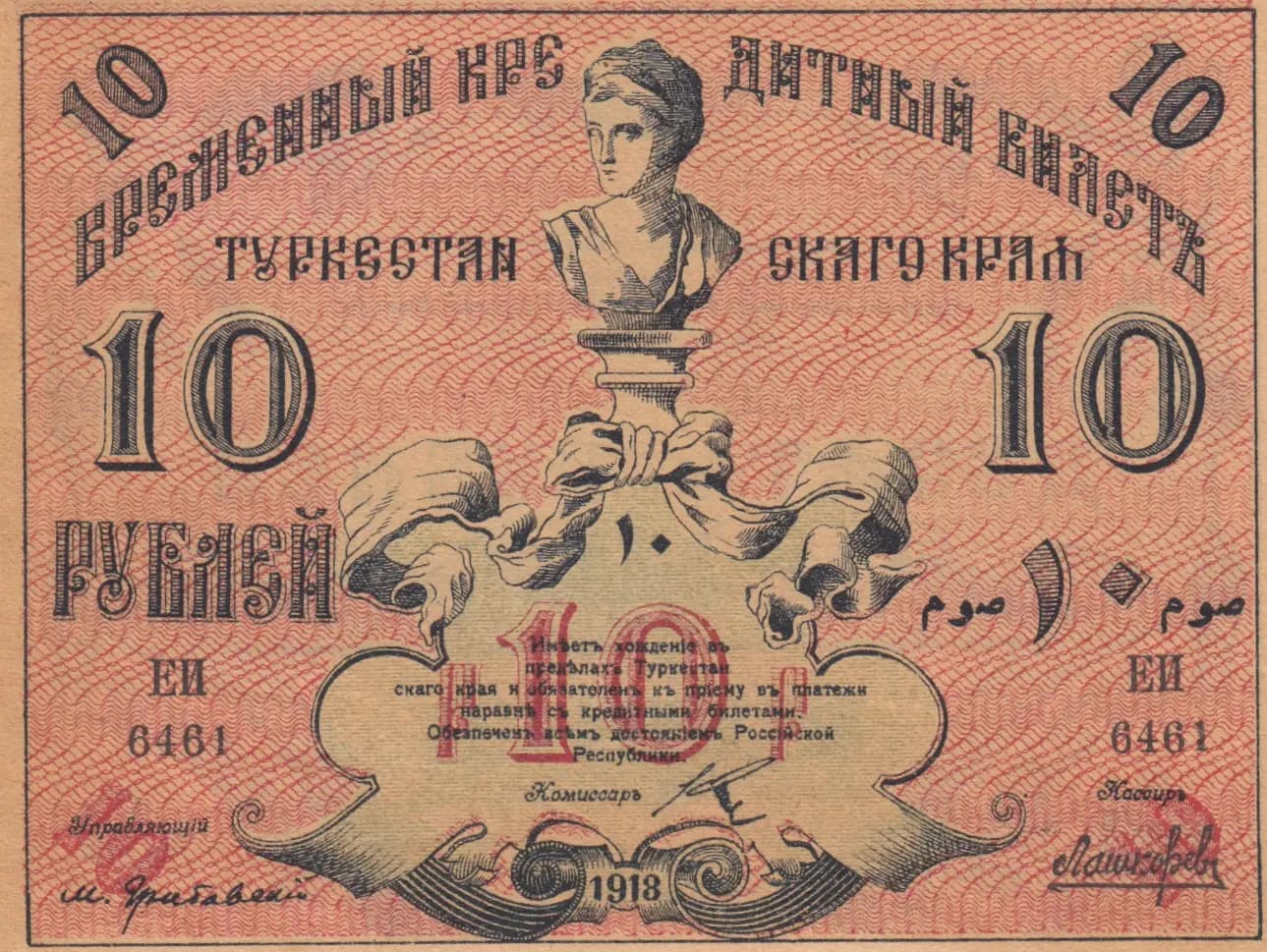
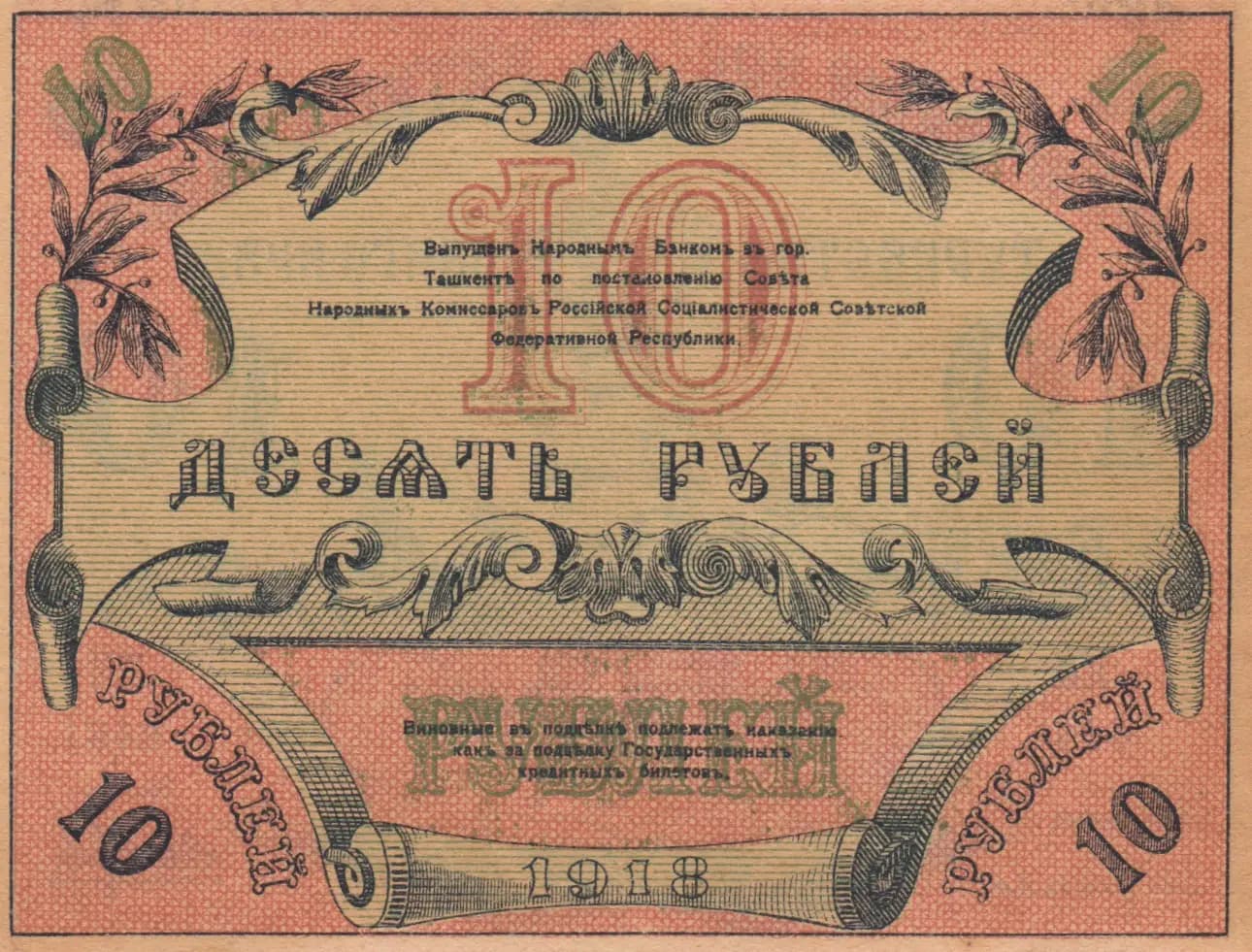
This is a 10 Rublei banknote issued by the Tashkent State Bank Branch in 1918, representing an early Soviet monetary issue from the Turkestan region during a period of significant political transition. The note exhibits UNC condition with crisp, well-preserved design elements including a classical female bust on the obverse and cornucopia imagery on the reverse, both rendered in the salmon-pink and black color scheme characteristic of this series. As a regional Soviet issue from the Civil War era, this Tashkent emission is historically significant, capturing a moment when local banking authorities maintained some autonomy in currency production.
Uncommon. This is a regional Soviet issue from the early Civil War period (1918) with limited geographic distribution to the Tashkent area. While not exceptionally rare, these Central Asian regional emissions had smaller print runs compared to Moscow-issued notes, and many were subsequently withdrawn or destroyed during monetary reforms. The UNC condition grade and intact preservation further reduce availability, as most surviving examples exhibit wear from circulation. However, specimens do appear periodically in specialized Russian and Soviet banknote markets, preventing classification as truly rare.
This note was issued during the Russian Civil War (1918-1922) when the newly formed Soviet state struggled to establish unified monetary control across its vast territories. The Tashkent branch represented Soviet authority in Central Asia, and the explicit reference to 'Issued by the People's Bank for the city of Tashkent by resolution of the Council of People's Commissars of the Russian Socialist Federative Soviet Republic' reflects the early Soviet administrative structure. The classical allegorical imagery—including the idealized female bust symbolizing the Russian state and the cornucopia representing agricultural prosperity—continues pre-revolutionary design traditions while the denominational text shifts entirely to Cyrillic Soviet nomenclature, marking the transitional nature of this emission.
The obverse features a classical allegorical bust of a female figure with upswept hair, representing the Russian state or liberty, mounted on a fluted architectural pedestal with ornamental scrollwork and foliate elements. The composition is centered with large denomination numerals '10' positioned in the upper left and right corners. A decorative cartouche with curved borders frames inscriptional text below the bust. The reverse displays an elaborate ornamental design dominated by paired cornucopia (horns of plenty) on both left and right sides, filled with grain and wheat ears symbolizing agricultural abundance and prosperity. Large denomination numerals '10' appear in a central decorative cartouche, with the full denomination text 'ДЕСЯТЬ РУБЛЕЙ' and the official issuance statement arranged on a central banner. Both sides employ a fine crosshatch background pattern in salmon-pink, providing security and visual continuity. The overall design aesthetic reflects Art Nouveau influences combined with classical allegorical symbolism, characteristic of late Imperial Russian and early Soviet banking practice.
FRONT SIDE: 'РОССИЙСКИЙ КРЭ' (Russian [Empire/Credit]), 'ДИТНИЙ ВМПУСК' (State Issue), 'ТУРКЕСТАН' (Turkestan), '10' (denomination), 'РУБЛЕЙ' (Rubles), '6461' (serial number), '1918' (year). BACK SIDE: '10 ДЕСЯТЬ РУБЛЕЙ' (Ten Rubles), 'Выпущен Народным Банком за гор. Ташкентэ по постановлению Совета Народных Комиссаров Российской Социалистической Союзной Федеративной Республики.' (Issued by the People's Bank for the city of Tashkent by resolution of the Council of People's Commissars of the Russian Socialist Federative Soviet Republic), '1918' (year), '10 РУБЛЕЙ' (Ten Rubles).
This note was produced using intaglio (engraved) printing, evidenced by the fine crosshatch patterns, delicate line work in the scrollwork and borders, and the crisp registration visible in both denomination indicators and text elements. The salmon-pink background demonstrates skillful multicolor printing coordination typical of high-security banknote production. The decorative engraving throughout—particularly the ornamental cartouches, pedestal detailing, and cornucopia imagery—indicates work by a skilled security printer, consistent with early Soviet state printing practices. The precise line work and fine detail suggest production by a major Russian state printer, though specific printer identification would require archival documentation from the Tashkent State Bank.
The observed serial number '6461' with the noted bilateral printing (appearing on both left and right sides) is typical of this Tashkent emission. Varieties for Pick S1154 are primarily distinguished by serial number ranges and possible signature or text variants reflecting different printings during 1918. The specific form of Cyrillic text and the cartouche design suggest this is from the primary printing authorized by the Tashkent State Bank Branch. Examination of different serial number blocks may reveal minor design state variations, though the core design remained consistent throughout the 1918 issue.