10 rublei 1909
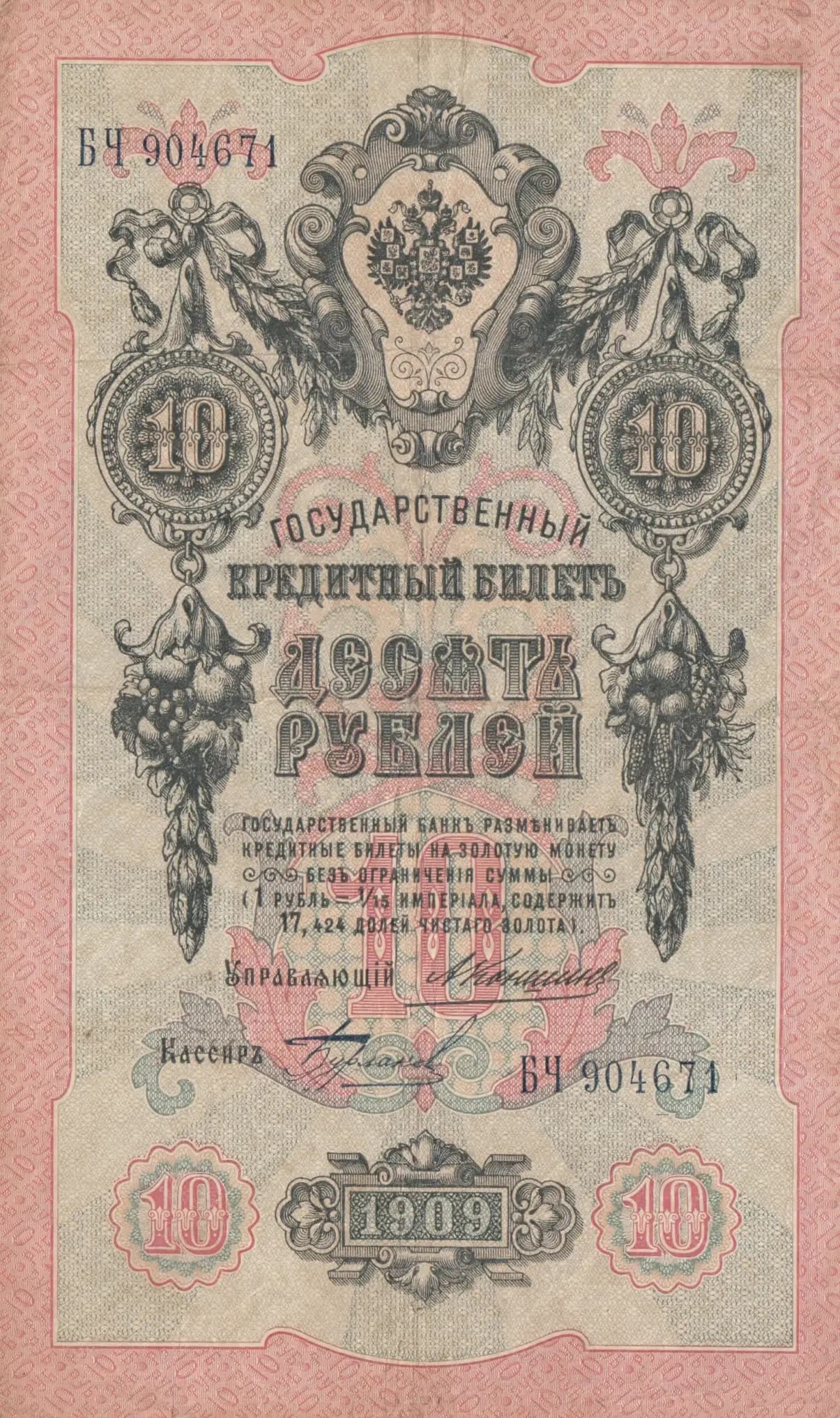
“Sig.Baryshev”
About This Note
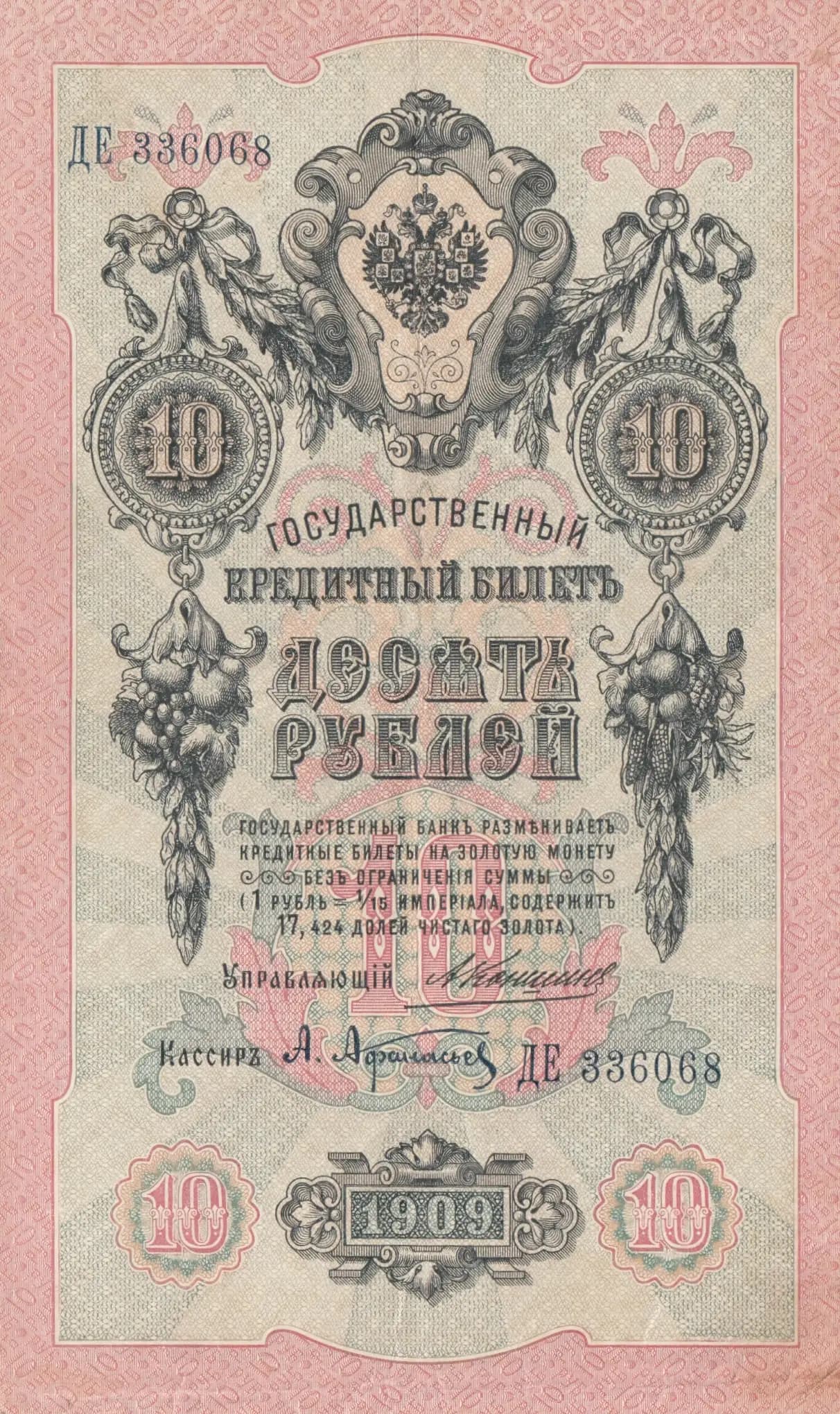
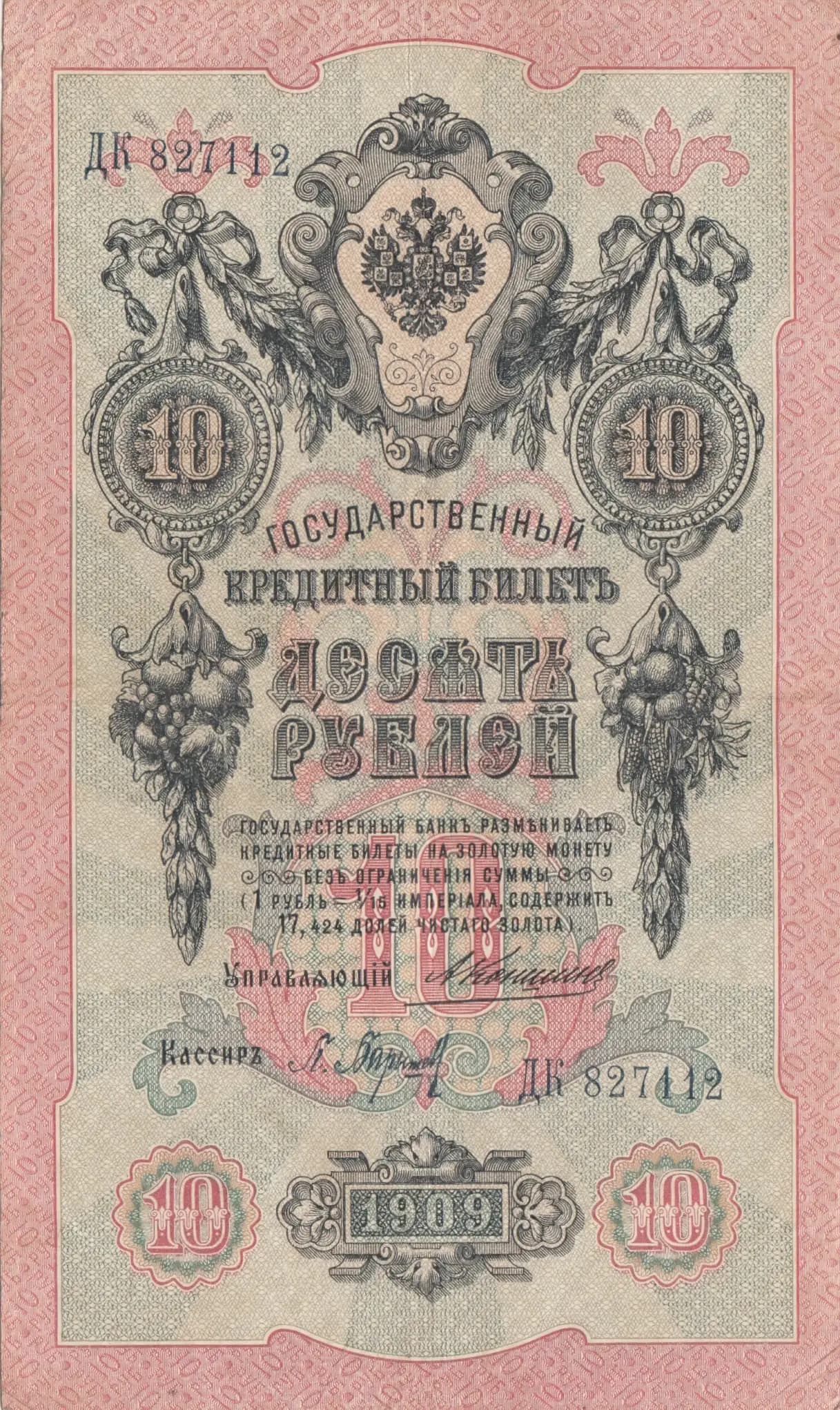
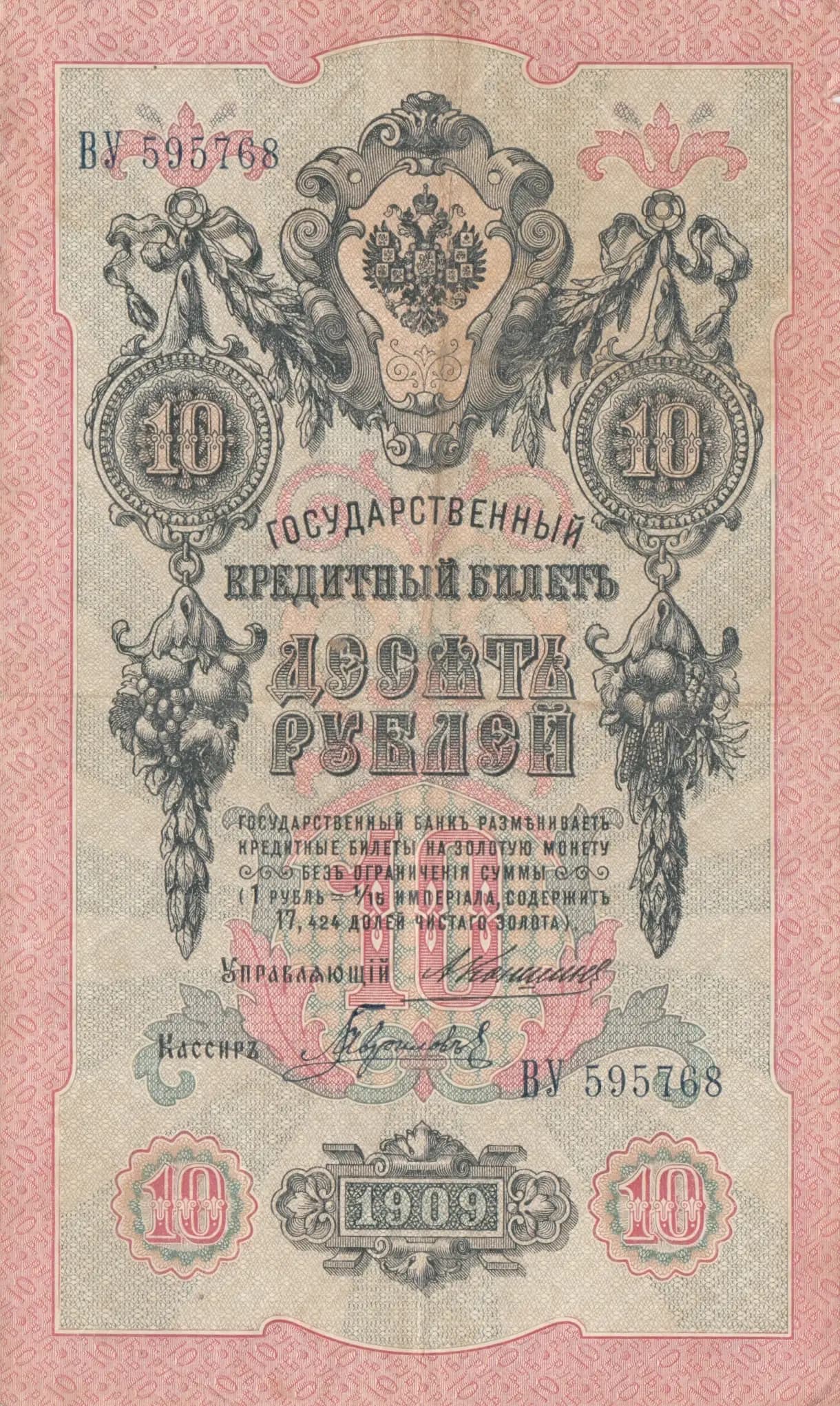
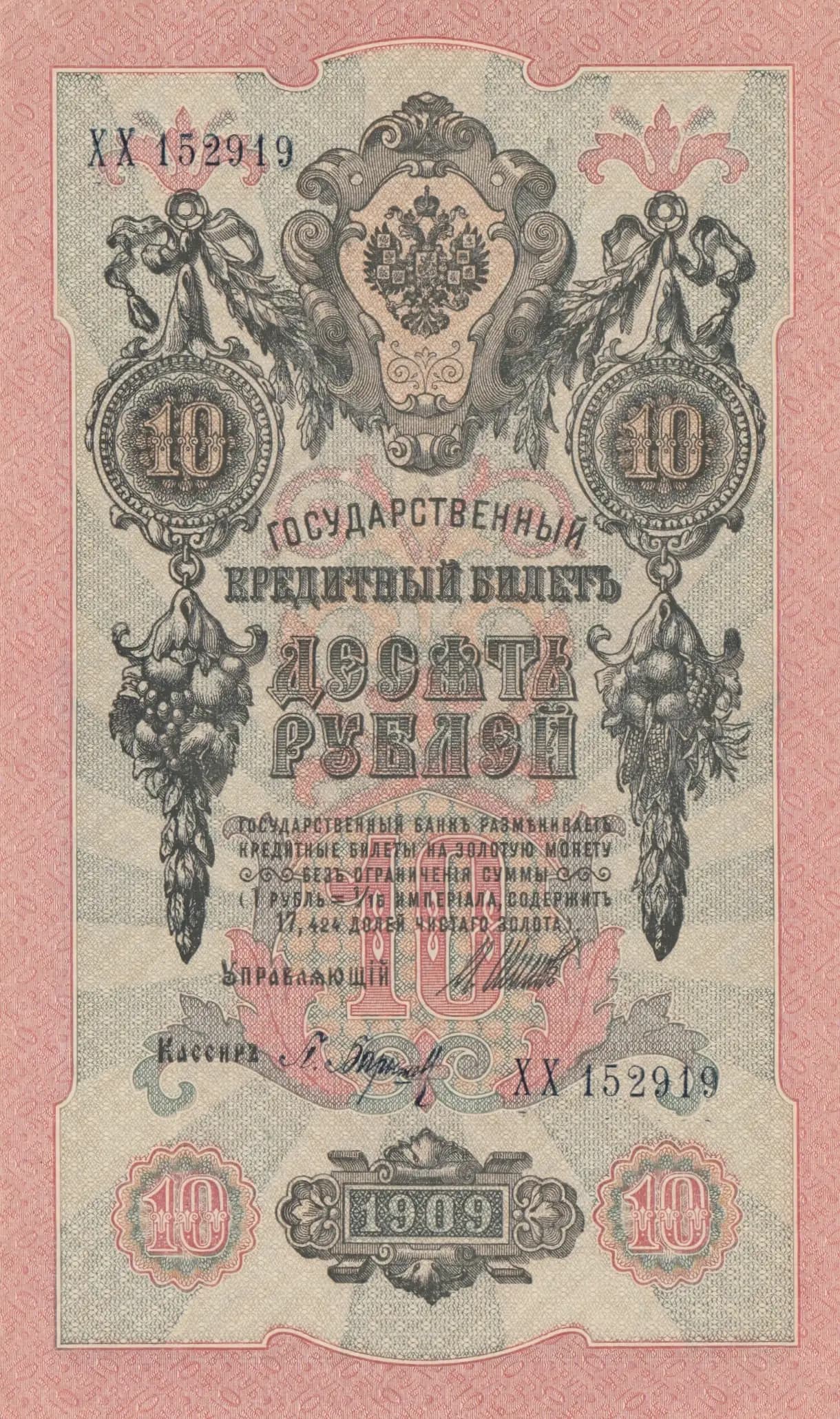
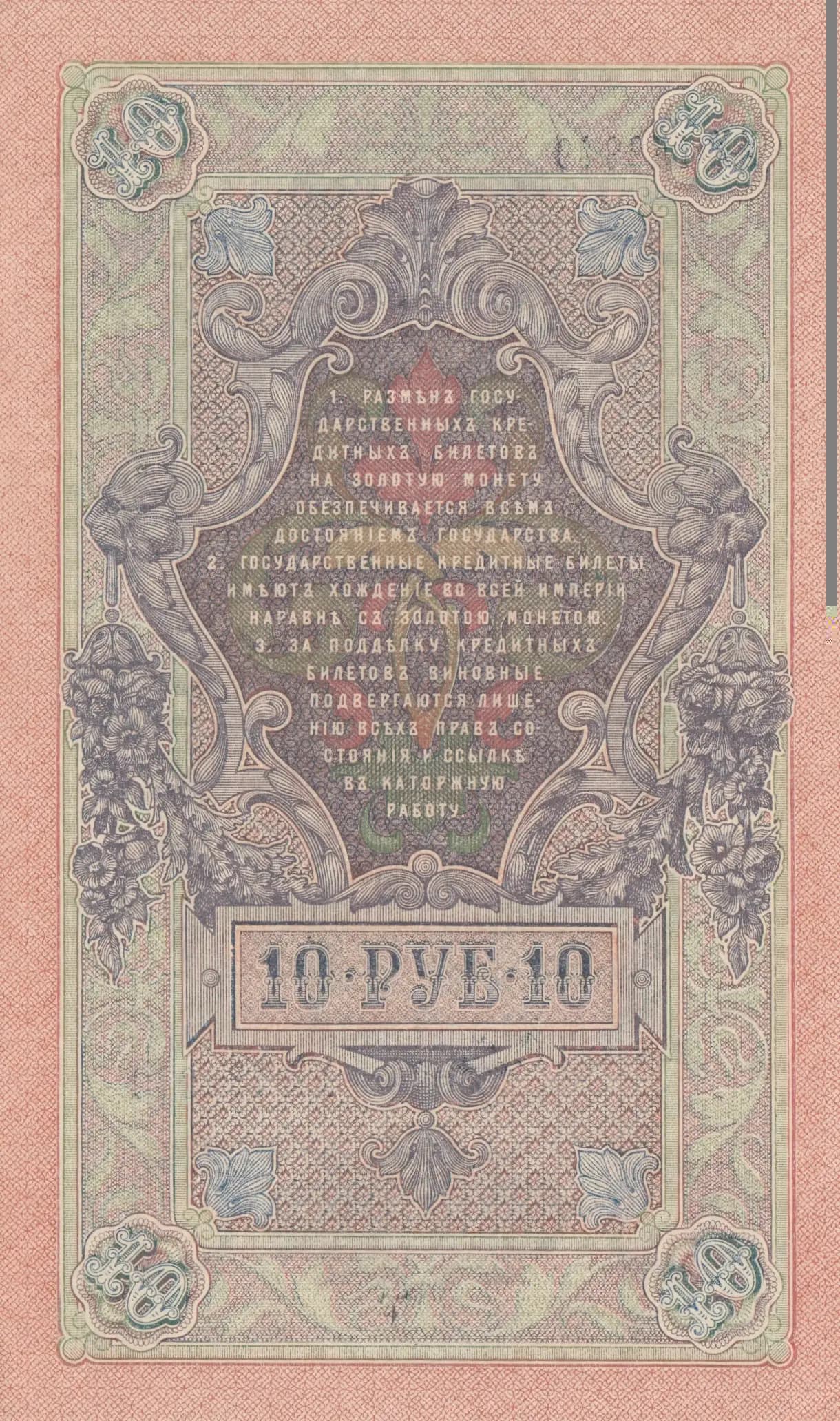
An exceptional example of the Russian Imperial 10 ruble credit note from 1909, graded AU with outstanding preservation. The note displays the characteristic pink/salmon coloration with cream-colored central panels, featuring elaborate baroque engraving throughout. The obverse showcases allegorical winged female figures representing commerce and harvest flanking an ornate double-headed imperial eagle, while the reverse contains authoritative state text guaranteeing the note's gold convertibility—exemplifying the final decade of Tsarist monetary authority before revolutionary upheaval.
Common. The 1909 10 ruble Imperial credit note (Pick 11c) was issued in large quantities during the height of the Russian gold standard era. While individual notes in AU condition command modest collector premiums over heavily circulated examples, this denomination and date represent standard production runs of the State Bank. The Pick catalog designation '11c(2)' indicates this is one of several identified varieties from a substantial emission, not a limited or short-run issue. Collector interest in Russian Imperial currency exists but is moderate relative to Western European contemporary issues.
This 1909 credit note represents the Russian Empire's mature gold standard monetary system under the State Bank, issued during the reign of Tsar Nicholas II. The prominent double-headed eagle coat of arms and the guarantee text stating that 'State credit notes circulate throughout the entire Empire equal to gold coin' reflect the empire's commitment to sound money in the pre-World War I period. The allegorical figures depicting harvest abundance symbolize imperial prosperity and agricultural wealth, key pillars of the Russian economy before the 1917 revolution fundamentally altered the monetary system.
The obverse features a symmetrically composed baroque design with a prominent double-headed eagle bearing the imperial crown positioned in an ornate shield cartouche at the center top. On either side are allegorical female personifications—likely representing Commerce and Abundance or Agriculture—depicted as winged classical figures in draped robes, each holding bundles of wheat and grain symbolizing imperial economic prosperity. The denomination '10' appears in circular medallions at lower left and right corners. The reverse contains dense authoritative text within an ornate rectangular frame, emphasizing the State Bank's guarantee and the note's legal circulation equivalence to gold coin. The entire design employs fine line engraving with elaborate scrollwork, floral motifs, and geometric patterns characteristic of high-security currency production of the Edwardian era.
FRONT SIDE: 'Государственный кредитный билет' (State Credit Note) — 'Десять рублей' (Ten Rubles) — 'Государственный банк разменивает кредитные билеты на золотую монету без ограничения суммы' (The State Bank exchanges credit notes for gold coin without limit of sum) — 'Рубль императора содержит' (The Imperial ruble contains [gold content specification]) — Serial number: XX 152919 — Year: 1909 — Signature: Л. Филипов (L. Filipov) — 'Россия' (Russia). BACK SIDE: 'В разрешение государственных кредитных билетов на золотую монету обеспечивается всем достоянием государства' (By authority, state credit notes for gold coin are guaranteed by all the possessions of the State) — 'Государственные кредитные билеты имеют хождение во всей империи наравне со золотою монетою' (State credit notes circulate throughout the entire Empire equal to gold coin) — '10·РУБ·10' (10 Rubles 10).
Intaglio engraving (copperplate/steel plate), the standard security printing method for Russian Imperial credit notes. The crisp, detailed line work visible in the ornamental elements, the security text, and the allegorical figures indicates professional bank note engraving. The complexity of the design with multiple color registration (pink/salmon background with cream and black overprinting) suggests a multi-pass printing process typical of Imperial Russian State Bank production circa 1909.
The note is cataloged as Pick 11c(2), indicating it is the second identified sub-variety of the Pick 11c type. Key identifying features for this specific variety include the signature 'Л. Филипов' (L. Filipov), the serial number prefix 'XX', and the 1909 date. The color scheme (pink/salmon with cream panels) and the specific engraved design with the allegorical figures holding harvest bundles are consistent with the 1909 emission of this denomination. Collector notes reference 'Sig. Baryshev,' possibly indicating a provenance or cataloging notation related to a known collection or dealer.