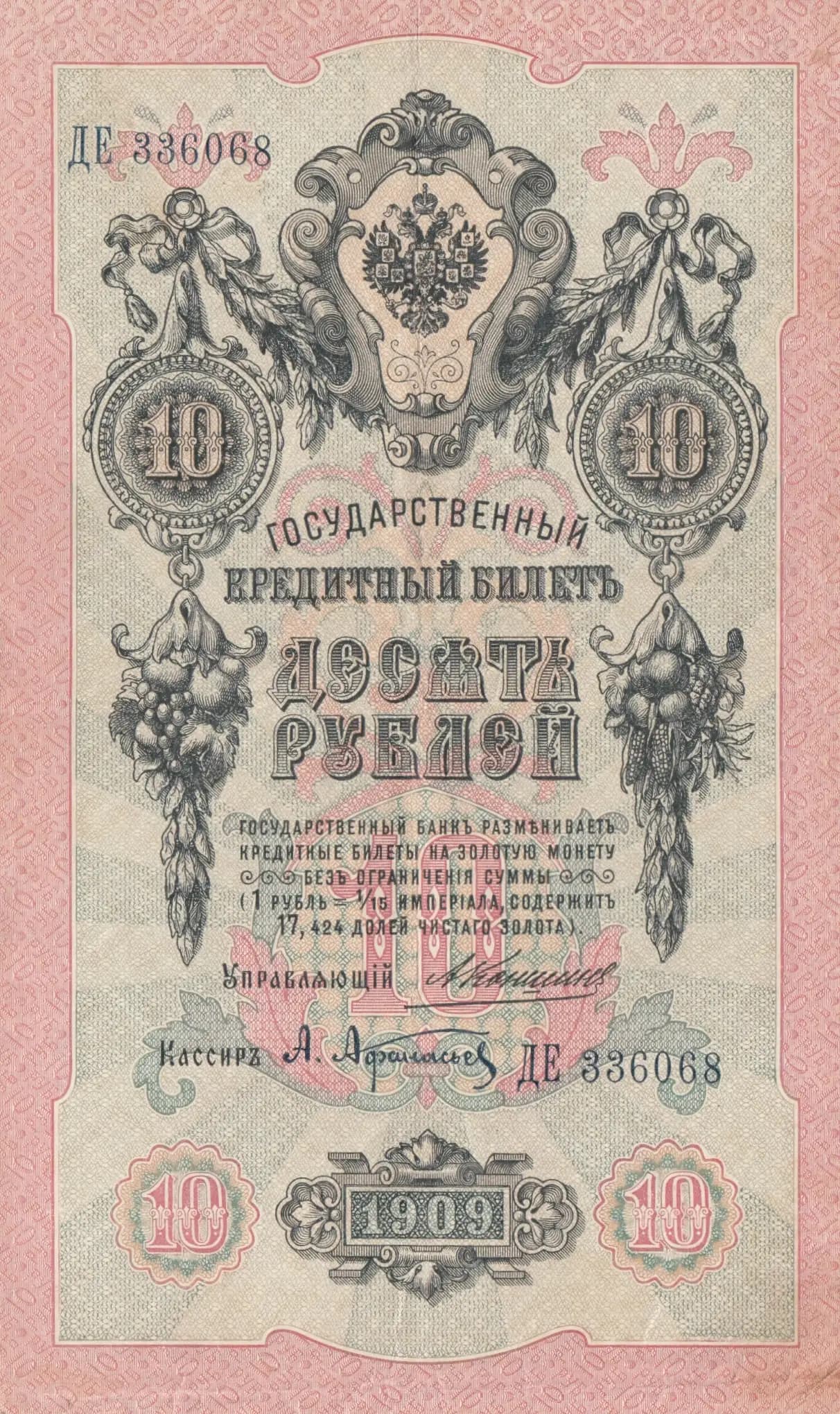
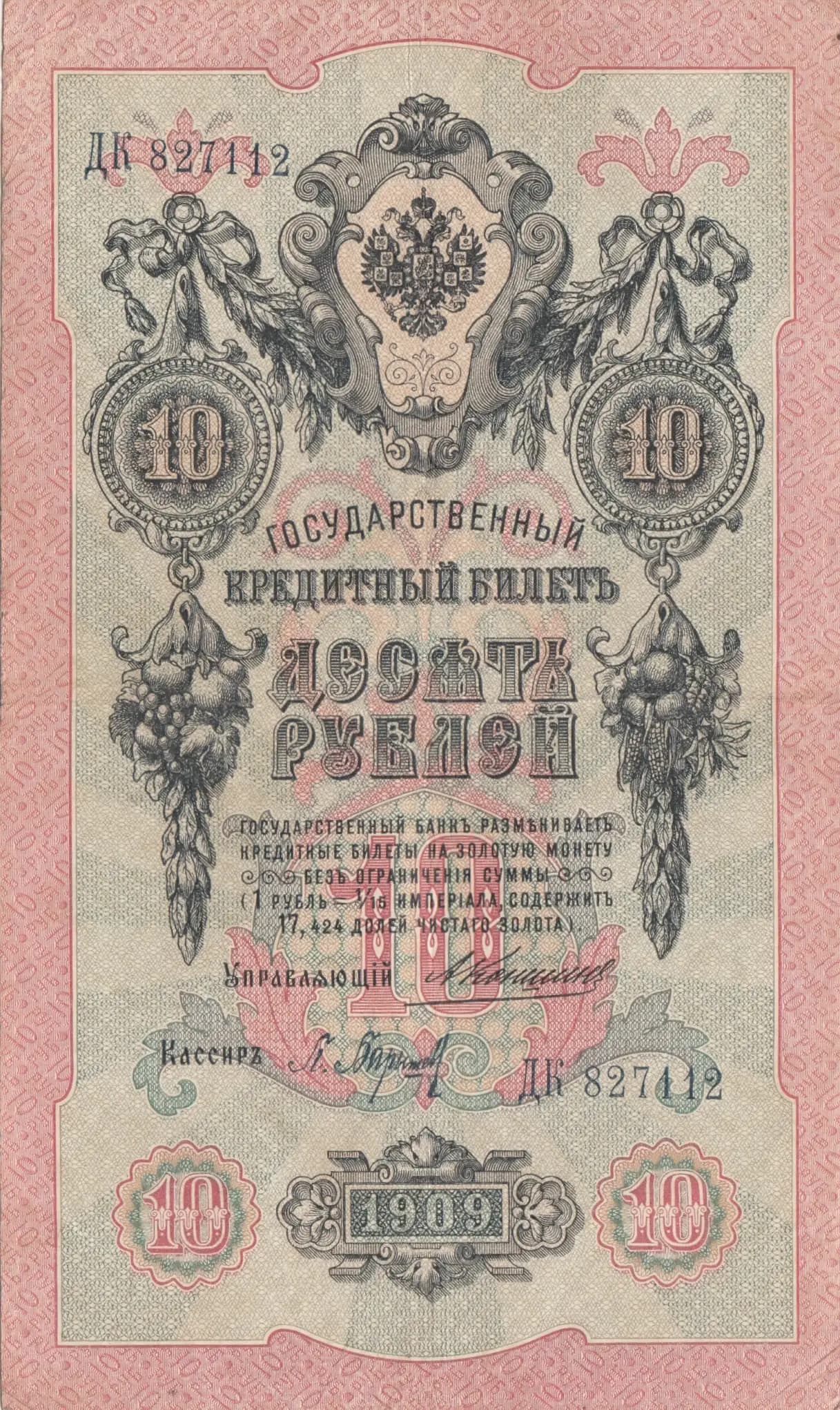
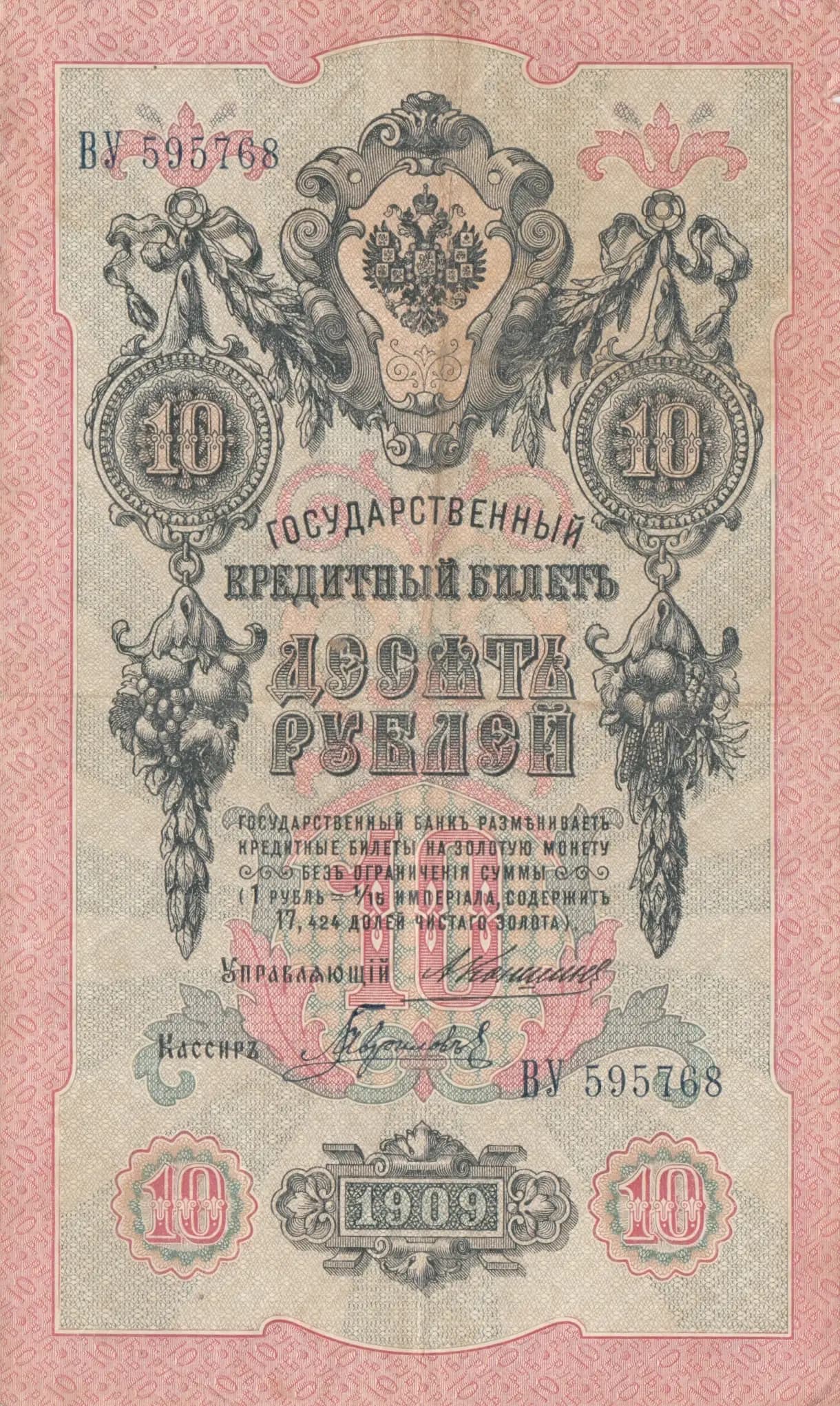
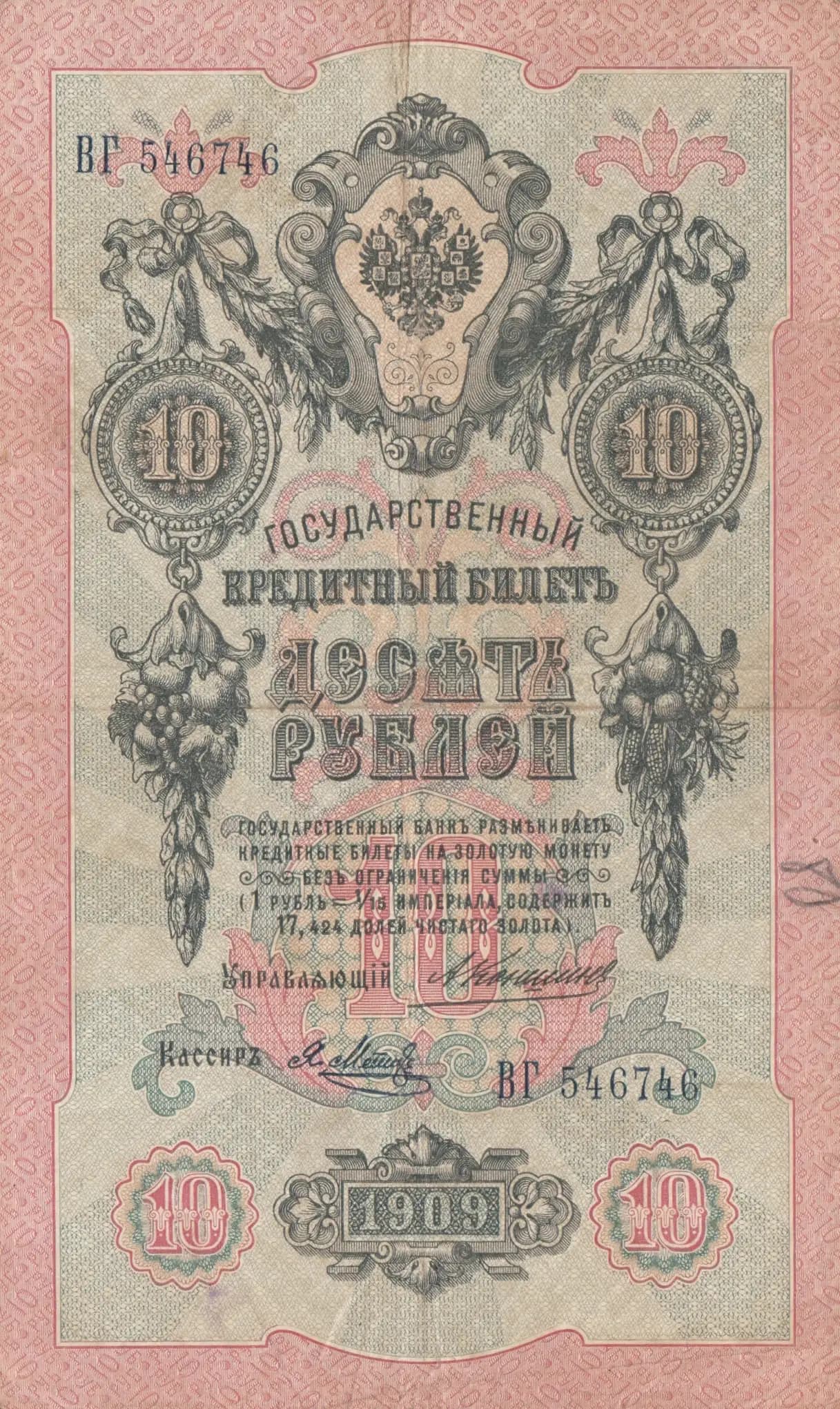
10 rublei 1909
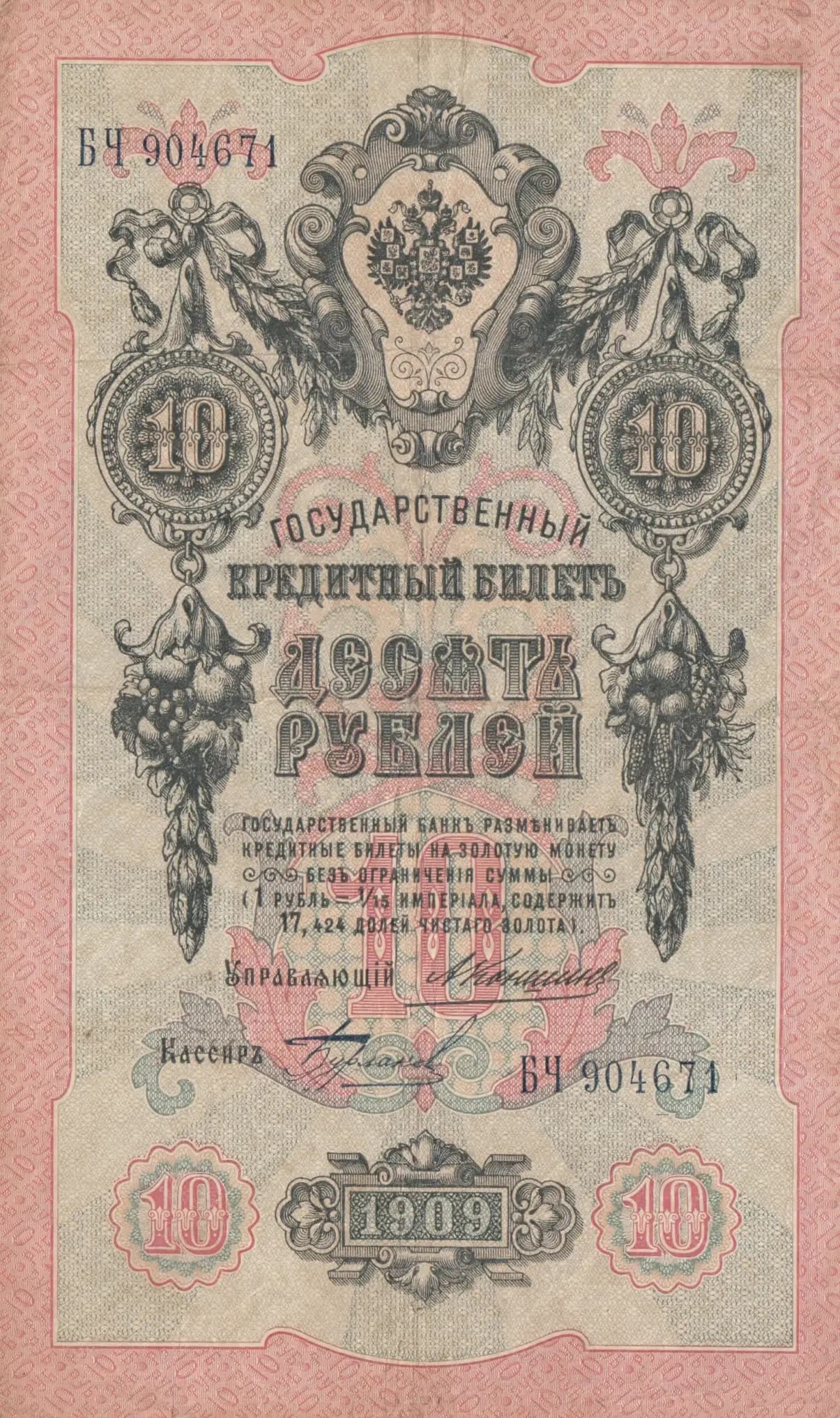
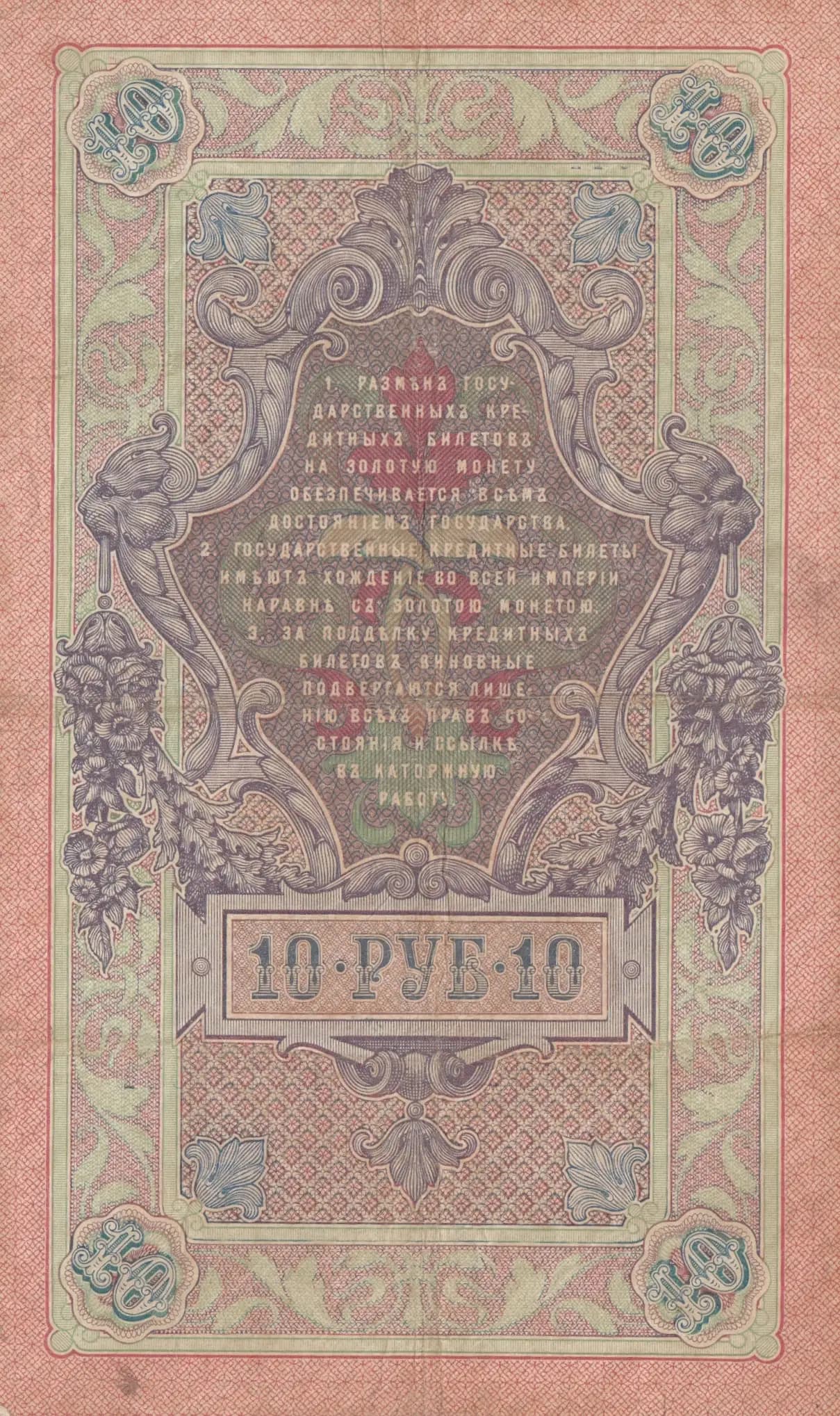
“Sig.Burlakov”
About This Note
A handsome example of the Russian Empire's 10 Rublei banknote from 1909, graded VF, featuring the characteristic ornate baroque design with pink and cream coloring. The note displays the Imperial double-headed eagle coat of arms prominently, flanked by cherub figures holding wreaths and laurel branches, with decorative grape bunches and circular denomination medallions. Despite visible age-related foxing, fold creases, and general circulation wear consistent with its 115+ year history, the intricate engraved detail remains well-preserved, making this a solid collector example of late Imperial Russian currency.
Common. The 10 Rublei note from 1909 (Pick P-11b series) was part of a standard issue during the late Imperial period and was produced in substantial quantities for general circulation. While the Russian Revolution and subsequent currency devaluation eventually rendered most Imperial notes out of circulation, many examples survive in various conditions due to the large print runs. VF condition examples appear regularly in the collector market at modest valuations typical of early 20th-century Russian Imperial notes. No specific indication of small print runs, recalls, or scarcity affecting this Pick number is evident from catalog data.
This note was issued during the final decade of Imperial Russia under Tsar Nicholas II, at a time when the Russian Empire backed its currency with gold reserves. The inscriptions and imagery reflect the state's guarantee that credit notes could be exchanged for gold coins without limit, a standard practice for major European powers in the pre-World War I era. The elaborate baroque design with Imperial regalia symbolized the stability and authority of the Russian state during this period of economic development, though within a decade the empire would face revolution and the end of the Romanov dynasty.
The obverse features a highly symmetrical, ornate baroque composition centered on the Russian Imperial coat of arms—the double-headed eagle with imperial crown and scepter in a shield. This central motif is flanked by two cherub or putto figures positioned at the top corners, each holding wreaths and laurel branches symbolizing honor and achievement. Decorative elements include grape bunches suspended on either side, reinforcing themes of prosperity and bounty. Two large circular medallions containing the numeral '10' serve as denomination markers on the left and right edges of the design. The entire composition is rendered in fine engraved linework on a pink/rose background with cream-colored central panel, creating strong visual contrast. The reverse presents an equally ornate rectangular frame with baroque corner flourishes, scrollwork, and symmetrical decorative elements, containing the legal text regarding gold redemption and counterfeiting penalties on a pale yellow-green and pink/mauve background. The elongated text field and decorative cartouche at bottom maintain the formal, state-sanctioned aesthetic.
FRONT SIDE: 'ГОСУДАРСТВЕННЫЙ КРЕДИТНЫЙ БИЛЕТ' (State Credit Note) | Serial number 'БЧ 904671' appears at top and bottom | Denomination numerals '10' in circular medallions | 'ДЕВЯТЬ РУБЛЕЙ' (Nine Rubles) - NOTE: Visual analysis indicates text discrepancy; catalog indicates 10 Rublei but text reads 9 Rubles, suggesting possible transcription variance | '1909' (year) | 'ГОСУДАРСТВЕННЫЙ БАНК РАЗМЕНИВАЕТ КРЕДИТНЫЕ БИЛЕТЫ НА ЗОЛОТУЮ МОНЕТУ БЕЗ ОГРАНИЧЕНИЯ СУММЫ (1 РУБЛЬ = 1/15 ИМПЕРИАЛА, СОДЕРЖИТ 11,424 ДОЛЕЙ ЧИСТОГО ЗОЛОТА)' (The State Bank exchanges credit notes for gold coins without limit of sum; 1 ruble = 1/15 imperial, contains 11.424 parts of pure gold) | Signature blanks for 'СПРАВЛЯЮЩИЙ' (Acting official) and 'Кассир' (Cashier) | REVERSE SIDE: 'РАЗМЕНИВАНИЕ ГОСУДАРСТВЕННЫХ КРЕДИТНЫХ БИЛЕТОВ НА ЗОЛОТУЮ МОНЕТУ ОБЕСПЕЧИВАЕТСЯ ВСЕЙ ДОСТОЯНИЕМ ГОСУДАРСТВА. ГОСУДАРСТВЕННЫЕ КРЕДИТНЫЕ БИЛЕТЫ ИМЕЮТ ХОЖДЕНИЕ ВО ВСЕЙ ИМПЕРИИ НАРАВНЕ С ЗОЛОТОЮ МОНЕТОЮ И ЗА ПОДДЕЛКУ КРЕДИТНЫХ БИЛЕТОВ ВИНОВНЫЕ ПОДВЕРГАЮТСЯ ЛИШЕНИЮ ВСЕХ ПРАВ СОСТОЯНИЯ И ССЫЛКЕ НА КАТОРЖНУЮ РАБОТУ' (The conversion of State Credit Notes into gold coins is guaranteed by all the wealth of the State. State Credit Notes are legal tender throughout the entire Empire equal to gold coins, and for counterfeiting of credit notes the guilty parties are subject to deprivation of all rights of status and exile with hard labor) | Denomination '10·РУБ·10' (10 Rubles) in cartouche at bottom
Intaglio engraving (copperplate/steel plate engraving), the standard security printing method for Imperial Russian banknotes of this era. The fine line work, intricate scrollwork, and baroque flourishes visible throughout both sides are characteristic of high-quality engraved banknote production. The detailed rendering of the Imperial coat of arms, cherub figures, and border elements required skilled engraving work. The note bears hallmarks of Russian state printing practices of the period, likely produced by the State Printing Works or an authorized Imperial security printer. Multiple color printing was employed to create the layered pink, cream, and pale green tones visible in the visual analysis.
Pick catalog designation P-11b(4) indicates this is part of the 10 Rublei 1909 series, specifically variety P-11b(4). The signature designation 'Sig. Burlakov' in the collector notes likely refers to one of the authorized signatories (Справляющий or Кассир position) on the note, as Imperial Russian banknotes required manuscript signatures of officials. Serial number БЧ 904671 is specific to this individual note. Varieties within this issue may be distinguished by different signature combinations, serial number prefixes, or minor design variations; however, without comprehensive variety catalogs for Russian Imperial notes, specific variance details beyond the P-11b(4) designation cannot be definitively stated.