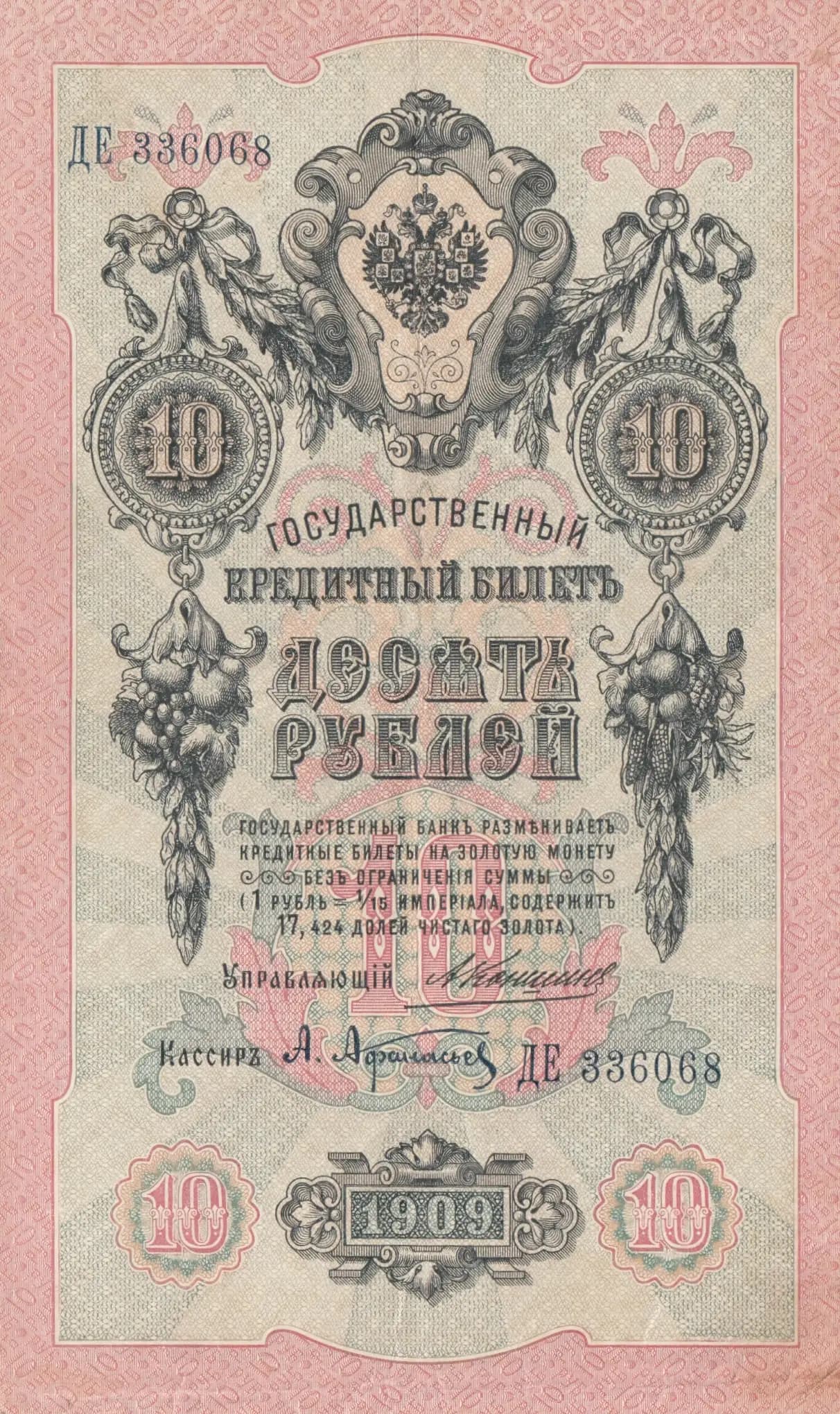
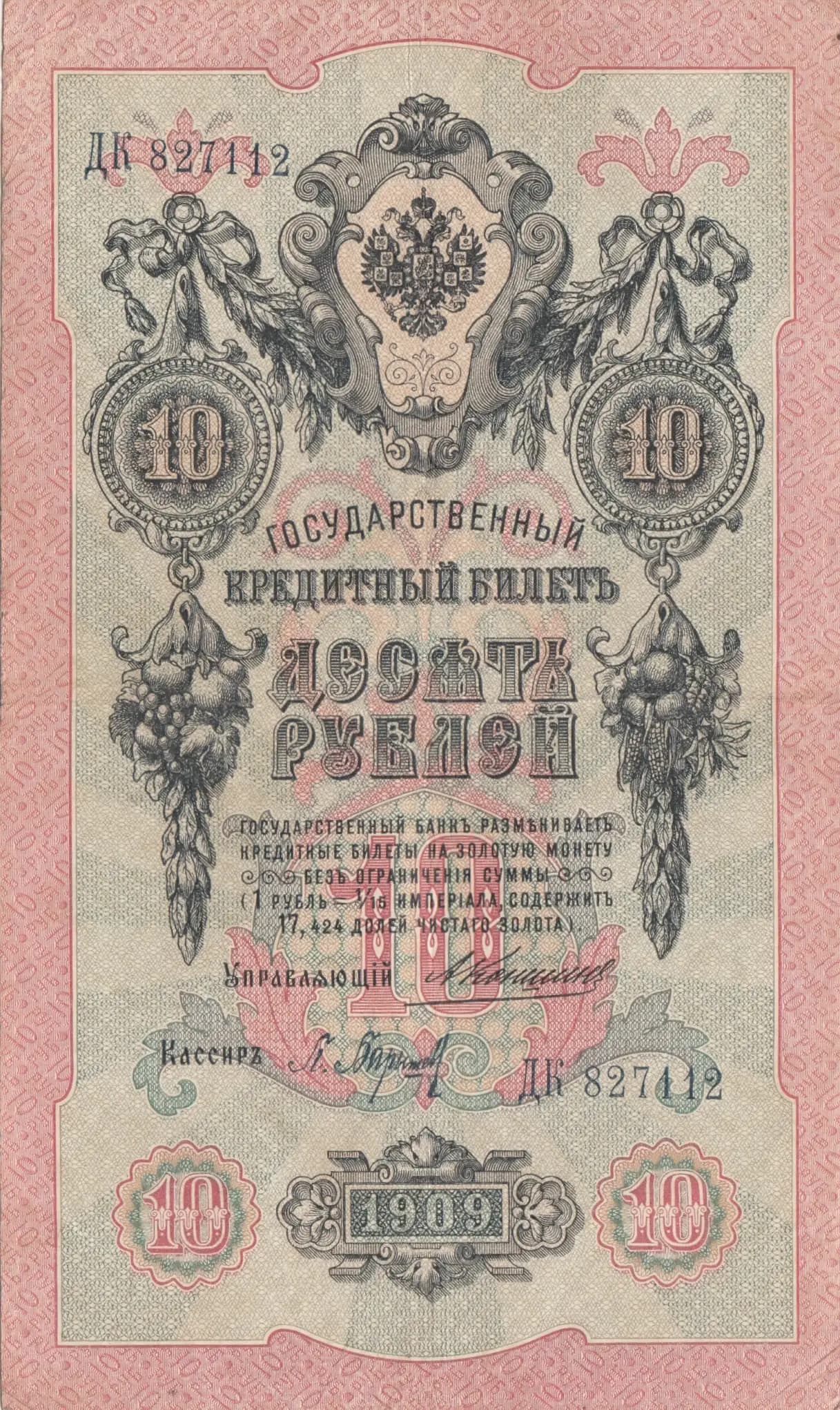
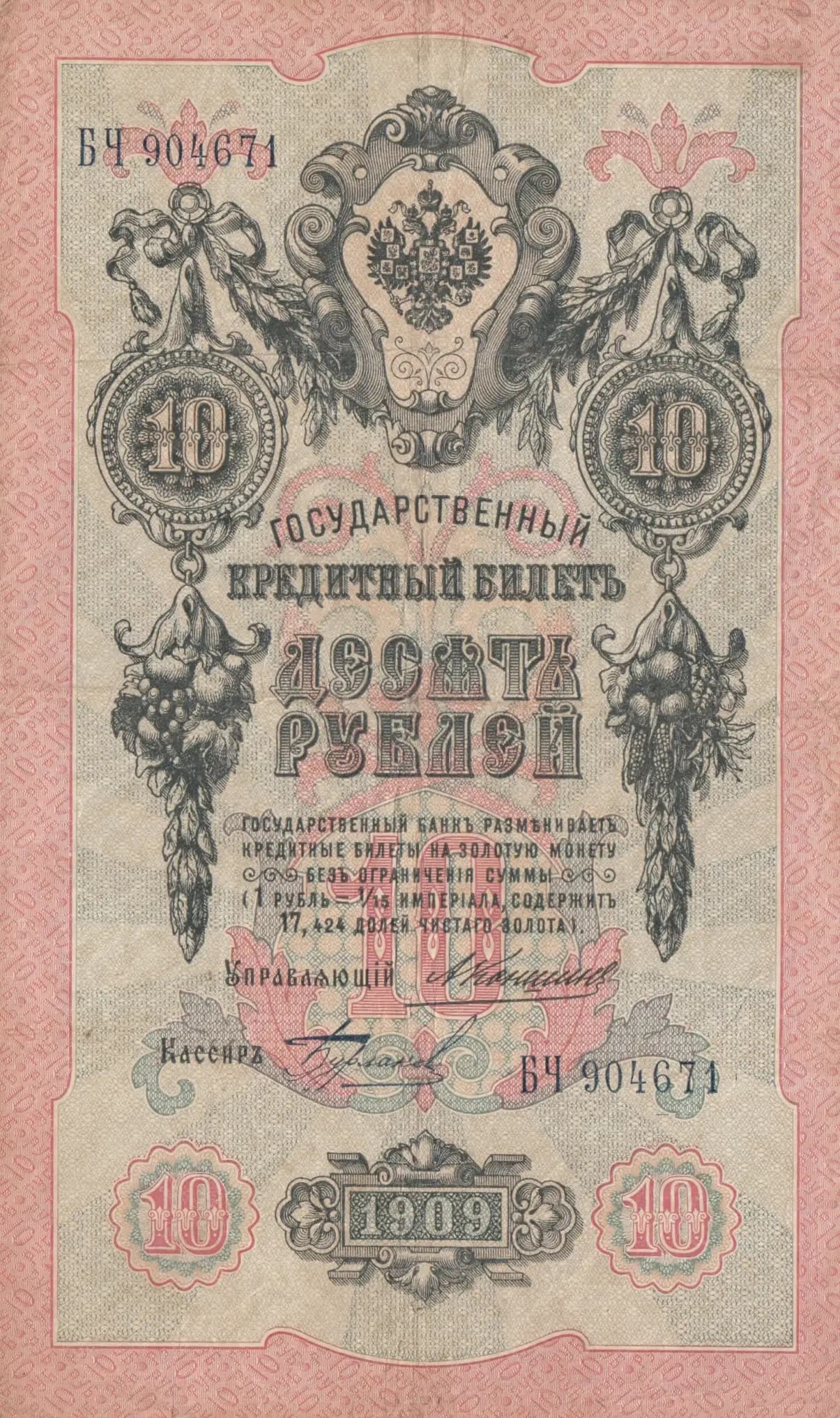
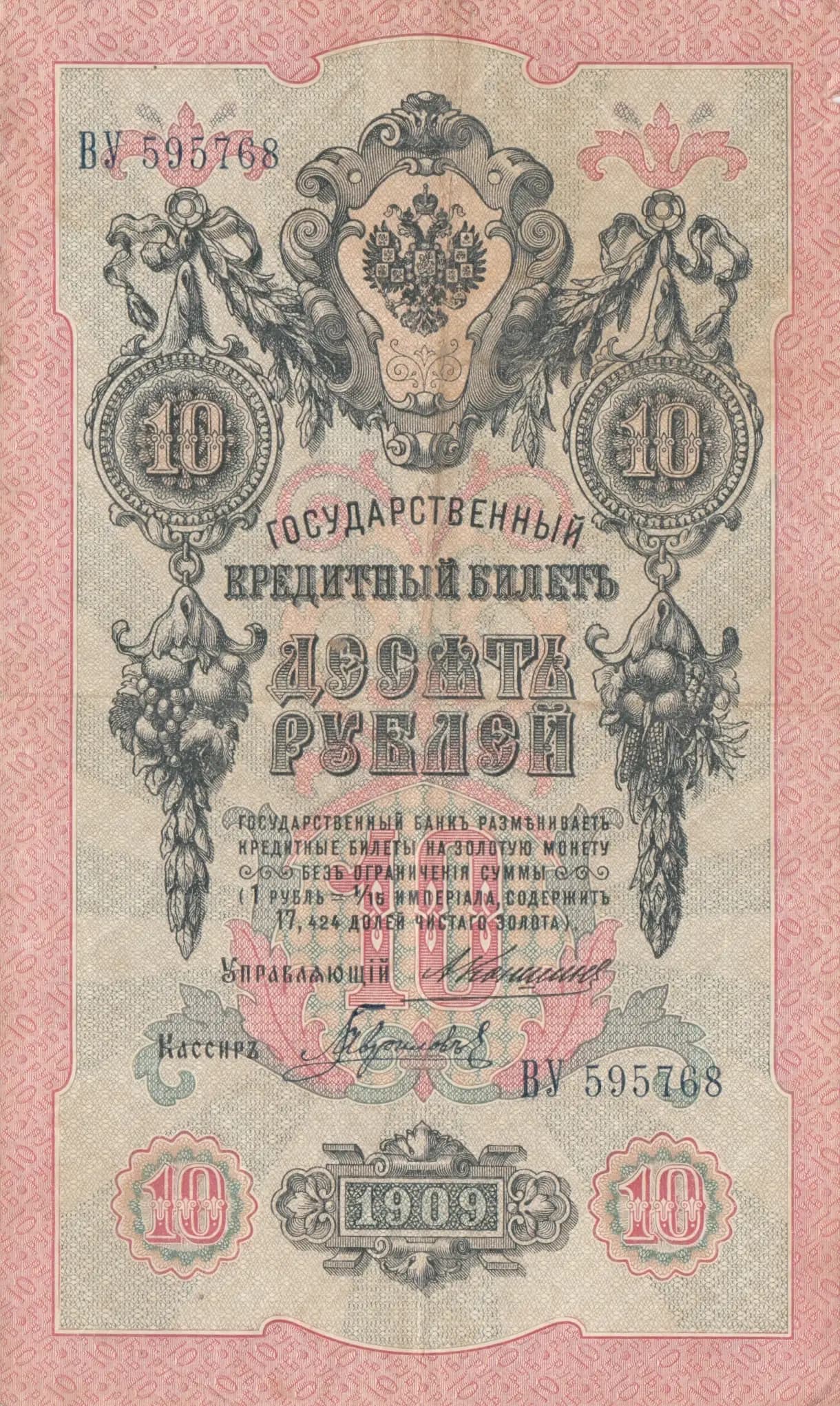
10 rublei 1909
“Sig.Morozov”
About This Note
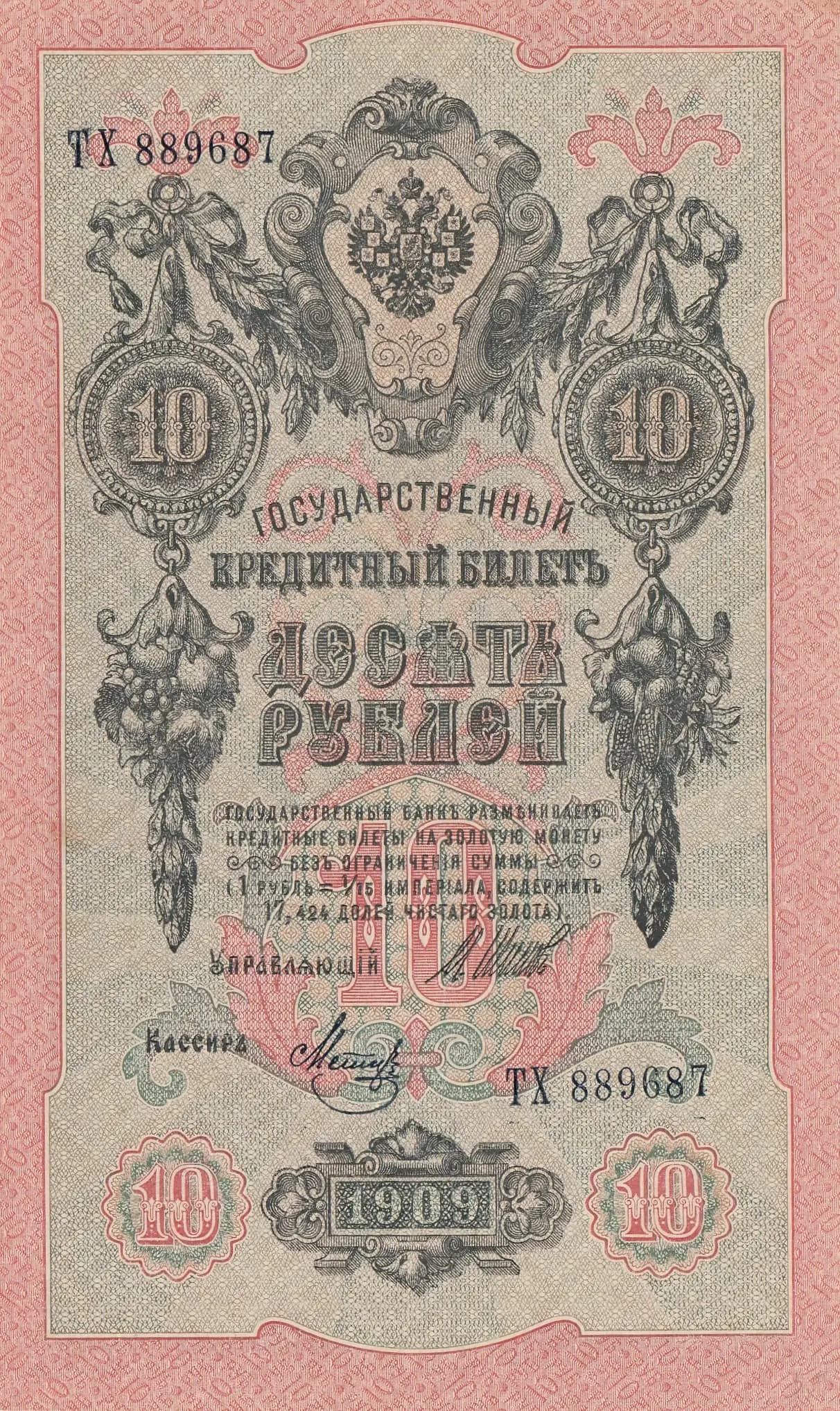
This is an exceptionally well-preserved example of the Russian Empire's 10 Rublei banknote from 1909, graded EF and bearing the signature of Morozov. The note displays the characteristic ornate design of Imperial Russian credit notes, featuring a central double-headed eagle flanked by allegorical winged female figures (representing Prosperity and Commerce) holding cornucopias and wreaths. The sharp, clear printing and complete absence of wear, creases, or foxing suggest this note has been carefully preserved since its issuance over 110 years ago.
Common. The 1909 10 Rublei (Pick-11c) was produced in substantial quantities during the latter years of Tsarist currency circulation and survives in relatively good numbers. While EF condition examples are more desirable than circulated specimens, the note is not scarce in the collector market. Print runs for Imperial credit notes were generally large, and this particular denomination and date are regularly encountered by collectors of Russian currency. No special print run restrictions or recall circumstances apply to this variety.
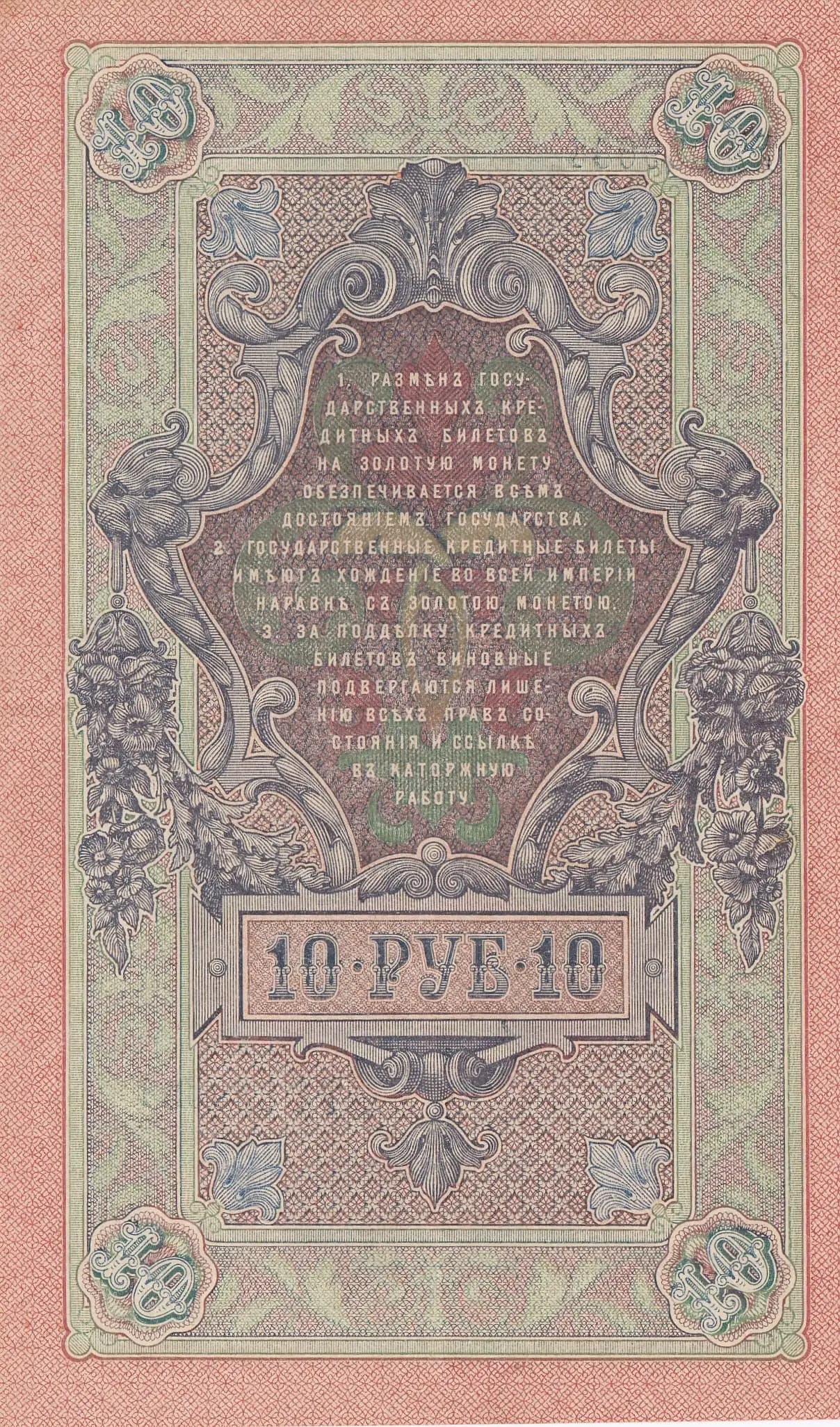
Issued during the final years of Tsarist Russia, this 1909 credit note represents the height of Imperial Russian banknote design and the State's gold-backed monetary system. The reverse inscription guarantees exchange for gold coins and warns of severe penalties (hard labor and deprivation of rights) for counterfeiting, reflecting the Empire's commitment to currency integrity during a period of relative economic stability preceding the 1917 Revolution. The double-headed eagle and allegorical imagery emphasized Imperial authority and prosperity, serving as both security features and nationalist symbolism.
This note exemplifies the Belle Époque aesthetic applied to Imperial Russian currency. The obverse features a symmetrical composition dominated by a heraldic double-headed eagle wearing an ornamental crown, centered within an elaborate oval cartouche. Flanking the eagle are two allegorical female figures personifying Russian prosperity and commerce—each winged in the classical manner, holding cornucopias overflowing with agricultural and mercantile abundance, along with wreaths symbolizing victory and achievement. The denomination '10' appears in ornate circular frames at left and right. The reverse displays dense legal text within an elaborate rococo-style scrollwork frame, with further denomination markers in all four corners and a central cartouche. Fine line engraving with cross-hatching creates texture throughout both sides. The pink/rose and greenish-cream color scheme is characteristic of this series. Signatures for both the State Bank Cashier and Director appear on the obverse, with serial number TH 889687 repeated top and bottom as a security measure.
FRONT SIDE: 'ГОСУДАРСТВЕННЫЙ КРЕДИТНЫЙ БИЛЕТ' (State Credit Note) | 'ДЕВЯТЬ РУБЛЕЙ' (Nine Rubles) [Note: visual analysis shows '10' denomination numerals] | Serial number: 'ТХ 889687' (appears twice, top and bottom) | '1909' (year) | Signature lines for 'КАССМЕР' (Cashier) and 'УПРАВЛЯЮЩИЙ' (Manager/Director). BACK SIDE: Main legal text: 'РАЗМЕНА ГОСУДАРСТВЕННЫХ КРЕДИТНЫХ БИЛЕТОВ НА ЗОЛОТУЮ МОНЕТУ ОБЕСПЕЧИВАЕТСЯ ВСЕЙ ДОСТОЯНИЕМ ГОСУДАРСТВА. ГОСУДАРСТВЕННЫЕ КРЕДИТНЫЕ БИЛЕТЫ ИМЕЮТ ХОЖДЕНИЕ ВО ВСЕЙ ИМПЕРИИ НАРАВНЕ С ЗОЛОТОЮ МОНЕТОЮ. ЗА ПОДДЕЛКУ КРЕДИТНЫХ БИЛЕТОВ ВИНОВНЫЕ ПОДВЕРГАЮТСЯ ЛИШЕНИЮ ВСЕХ ПРАВ СОСТОЯНИЯ И ССЫЛКЕ НА КАТОРНУЮ РАБОТУ.' (The exchange of State Credit Notes for gold coins is guaranteed by all the wealth of the State. State Credit Notes circulate throughout the entire Empire on equal footing with gold coins. Those guilty of counterfeiting Credit Notes are subject to deprivation of all rights of status and exile to hard labor.) | Denomination marker: '10·РУБ·10' (10 Rubles 10)
Steel plate intaglio (engraving) printed on cotton-fiber security paper. The fine line engraving, elaborate cross-hatching patterns, and sharp detail visible throughout are hallmarks of the highest-quality intaglio printing technology available in 1909. For Russian Imperial notes of this period, the State Printing Works (Экспедиция заготовления государственных бумаг) in St. Petersburg was responsible for production, likely in collaboration with security printing specialists. The complexity of the decorative elements and the precision of the line work served as primary anti-counterfeiting measures.
This specimen is identified as Pick-11c(10), with serial number TH 889687. The '10' denomination is explicitly shown in the visual analysis despite the reverse text anomalously referencing 'ДЕВЯТЬ РУБЛЕЙ' (Nine Rubles) in the inscription list—this discrepancy in the transcription should be noted, as the actual denomination is clearly 10 Rublei. The signature of Morozov (as noted in collector attribution) indicates the specific Director or Cashier who authorized this note. Signature varieties exist within the 1909 issue; different officials signed notes during the year, creating minor varieties of interest to specialists. The serial number prefix 'TХ' (ТХ) is standard for this series.