5 pounds 1966
About This Note
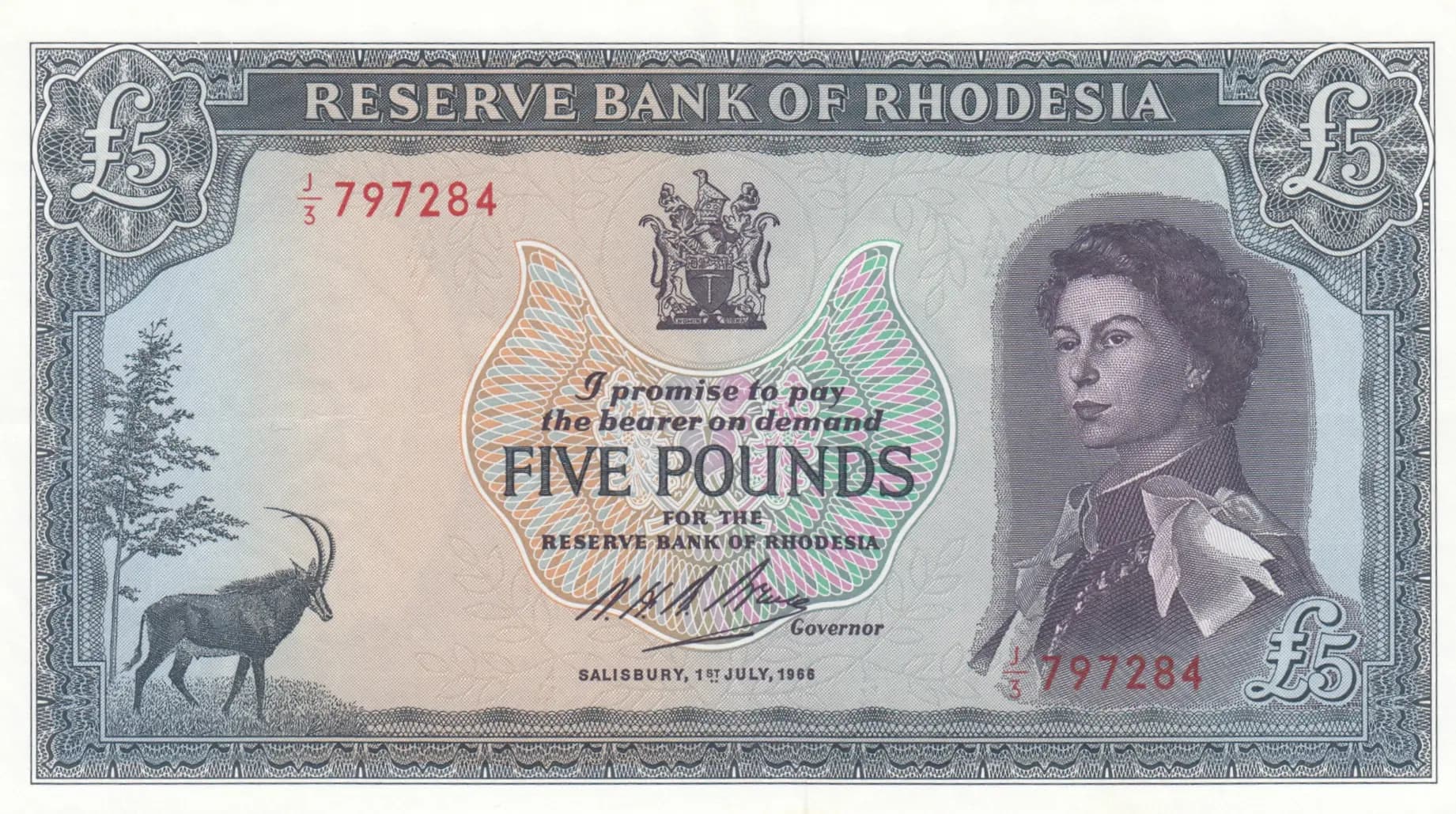
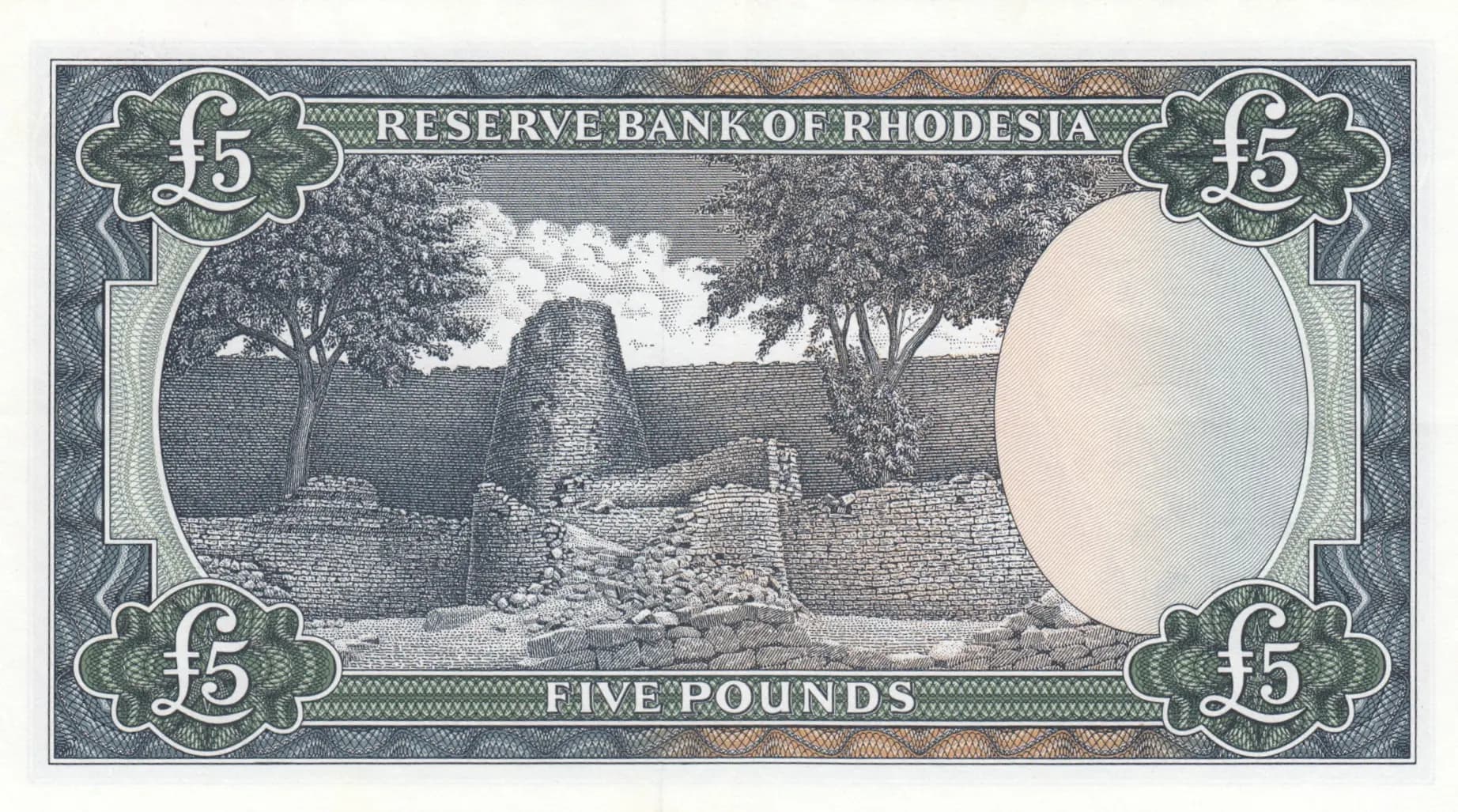
This is an AU-graded 1966 Reserve Bank of Rhodesia 5 Pounds note (Pick P-29), representing one of the first banknotes issued following Rhodesia's declaration of independence in November 1965. The note exhibits exceptional condition with crisp, clean surfaces showing no visible creases, tears, or circulation wear. The obverse features an elegant portrait of a woman in military uniform alongside a sable antelope and ornate heraldic emblems, while the reverse displays a detailed engraved landscape of historic stone ruins, all rendered in refined multi-color intaglio printing.
Common. The 1966 issue of Rhodesian banknotes was produced in standard quantities as the inaugural series of the independent Reserve Bank of Rhodesia. While these notes have historical significance due to Rhodesia's unique geopolitical position, the 5 Pounds denomination in this series was not restricted in print run. Examples in AU condition are readily available in the collector market, and the note does not command significant premiums beyond its face value equivalent in modern currency markets.
This note marks a significant numismatic moment in Rhodesian history—it was issued on 1 July 1966 by the newly independent Reserve Bank of Rhodesia, shortly after the nation's unilateral declaration of independence from Britain in November 1965. The inclusion of the sable antelope, a national symbol, and the architectural ruins on the reverse reflect Rhodesian national identity and heritage. The banknote series from 1966 represents a brief but important period of Rhodesian currency independence before the nation's international isolation deepened throughout the late 1960s.
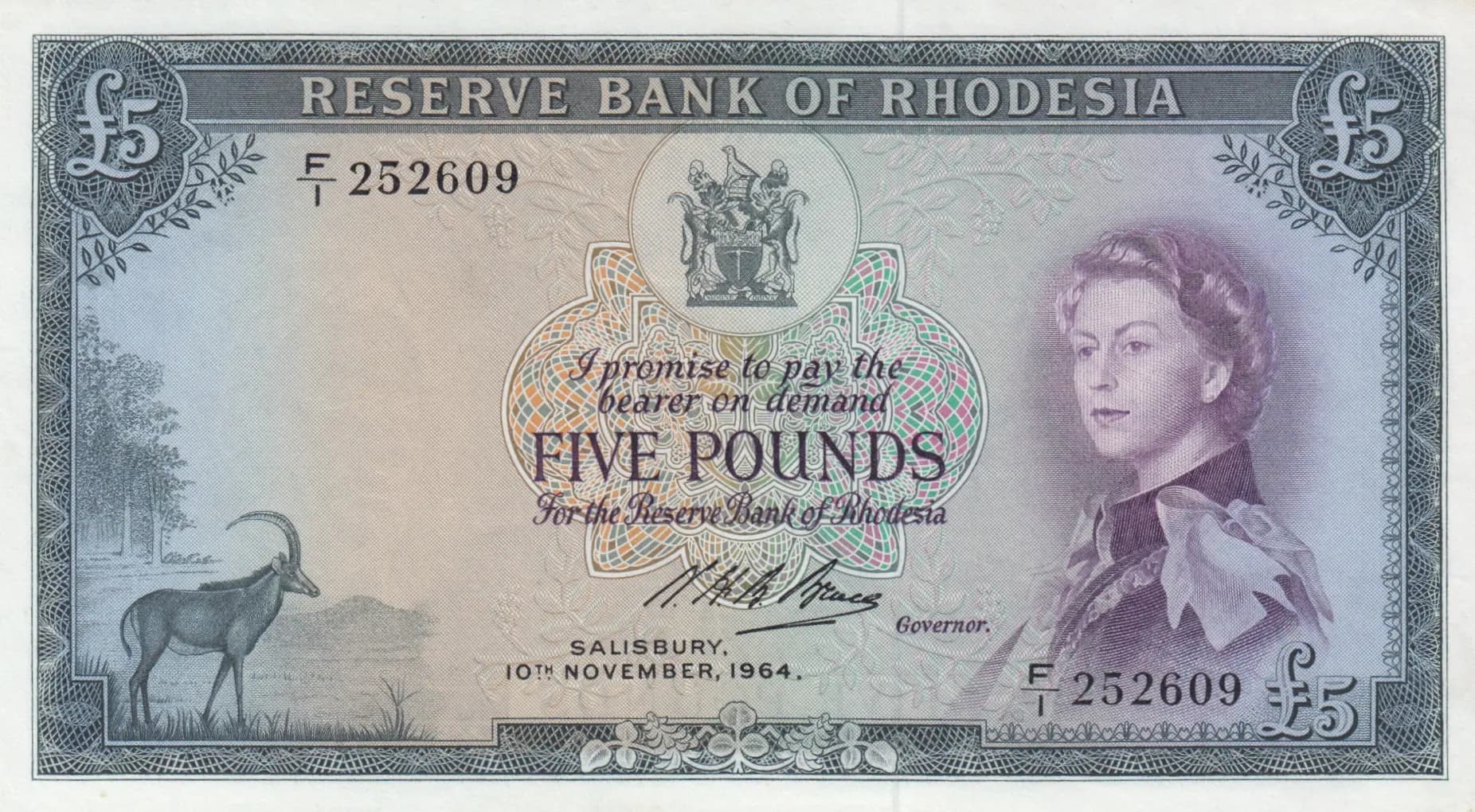
The obverse features a portrait of a woman, identified as representing national identity or leadership, depicted in profile facing right wearing a military-style uniform with detailed collar ornamentation. Dominating the center is an ornate winged emblem containing the Rhodesian coat of arms rendered with intricate cross-hatching in orange and green. A sable antelope—Rhodesia's national animal—is positioned in the lower left, symbolizing the nation's wildlife heritage and natural identity. The reverse displays a meticulously engraved landscape featuring the ruins of what appears to be a significant historical fortification or stone structure, flanked by trees beneath a sky with clouds, rendered through fine stippling and line engraving techniques. All four corners on both sides feature elaborate ornamental frames incorporating the £5 denomination.
Front Side: 'RESERVE BANK OF RHODESIA' (issuing authority); '£5' and 'FIVE POUNDS' (denomination in corners); 'I promise to pay the bearer on demand' (standard promise clause); 'FOR THE RESERVE BANK OF RHODESIA' (authorization statement); 'Governor' (signature line); 'SALISBURY, 1ST JULY, 1966' (issue date and location); 'J/3 797284' (serial number, repeated). Back Side: 'RESERVE BANK OF RHODESIA' (issuing authority); '£5' and 'FIVE POUNDS' (denomination in corners).
Intaglio (recess) engraving throughout, executed with exceptional fineness of line and sophisticated cross-hatching and stippling techniques. The multi-color effect was achieved through traditional intaglio printing, likely with separate passes for different color zones (blues, greens, oranges, and black). This 1966 Rhodesian series was printed by a major security printer utilizing state-of-the-art engraving dies characteristic of Commonwealth banknote production of the mid-1960s, demonstrating the technical capability of the Reserve Bank of Rhodesia's printing facilities.
This specific example carries the serial number J/3 797284, with the 'J/3' prefix indicating the print batch or signature variety. The note is dated 1 July 1966 from Salisbury (Harare), the first date of issue for this series. The signature line for 'Governor' is present but specific signatory identification would require comparison with known signature variants for the opening months of the Reserve Bank of Rhodesia. No overprints or secondary modifications are visible, indicating this is an original-issue note from the first printing run.