100 nouveaux francs 1971 specimen
About This Note
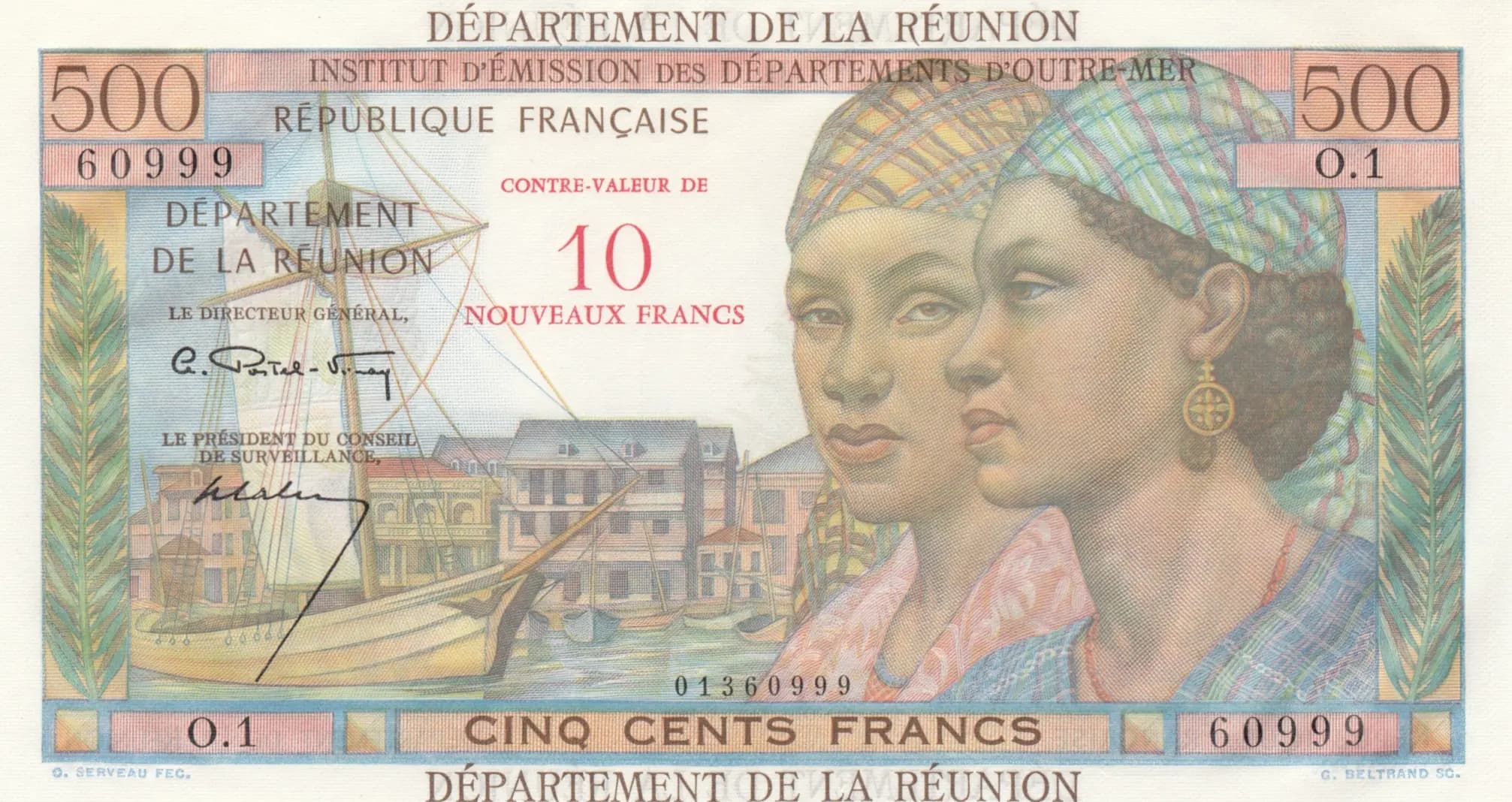
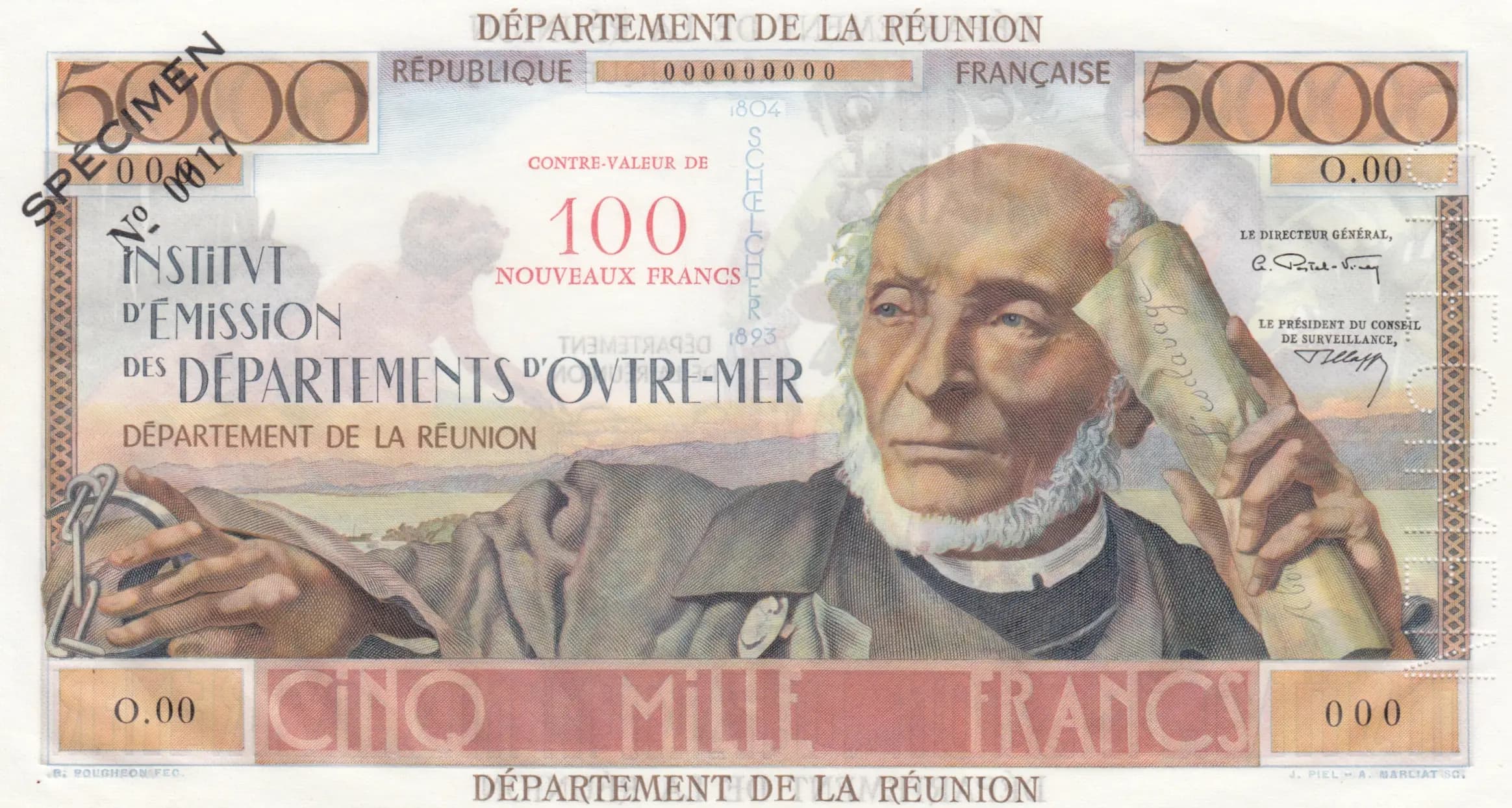
This is an exceptional specimen example of the 1971 Réunion 100 Nouveaux Francs (Pick P-56bs), issued by the Institut d'Émission des Départements d'Outre-Mer. The note displays the characteristic dual denomination marking (5000 Francs with 100 Nouveaux Francs counter-value) and bears bold diagonal 'SPECIMEN' overprinting across the front, confirming its non-circulation status. In uncirculated condition with pristine preservation, this specimen exhibits no wear, creases, or foxing, showcasing the fine engraved details and colorful printing that characterize this colonial-era design.
Common. While specimen notes are sometimes collected separately from circulation examples, the 1971 Réunion 100 Nouveaux Francs was part of a standard series issued for overseas department circulation and specimen distribution. No evidence of restricted print runs, short-lived issuance, or market scarcity supports a rarity classification. Specimen examples, though less common than circulated notes, remain readily available to collectors at modest premiums. The 'bs' designation indicates this is a documented catalog variant, but all variants of this issue appear to have been printed in sufficient quantities for regular institutional use.
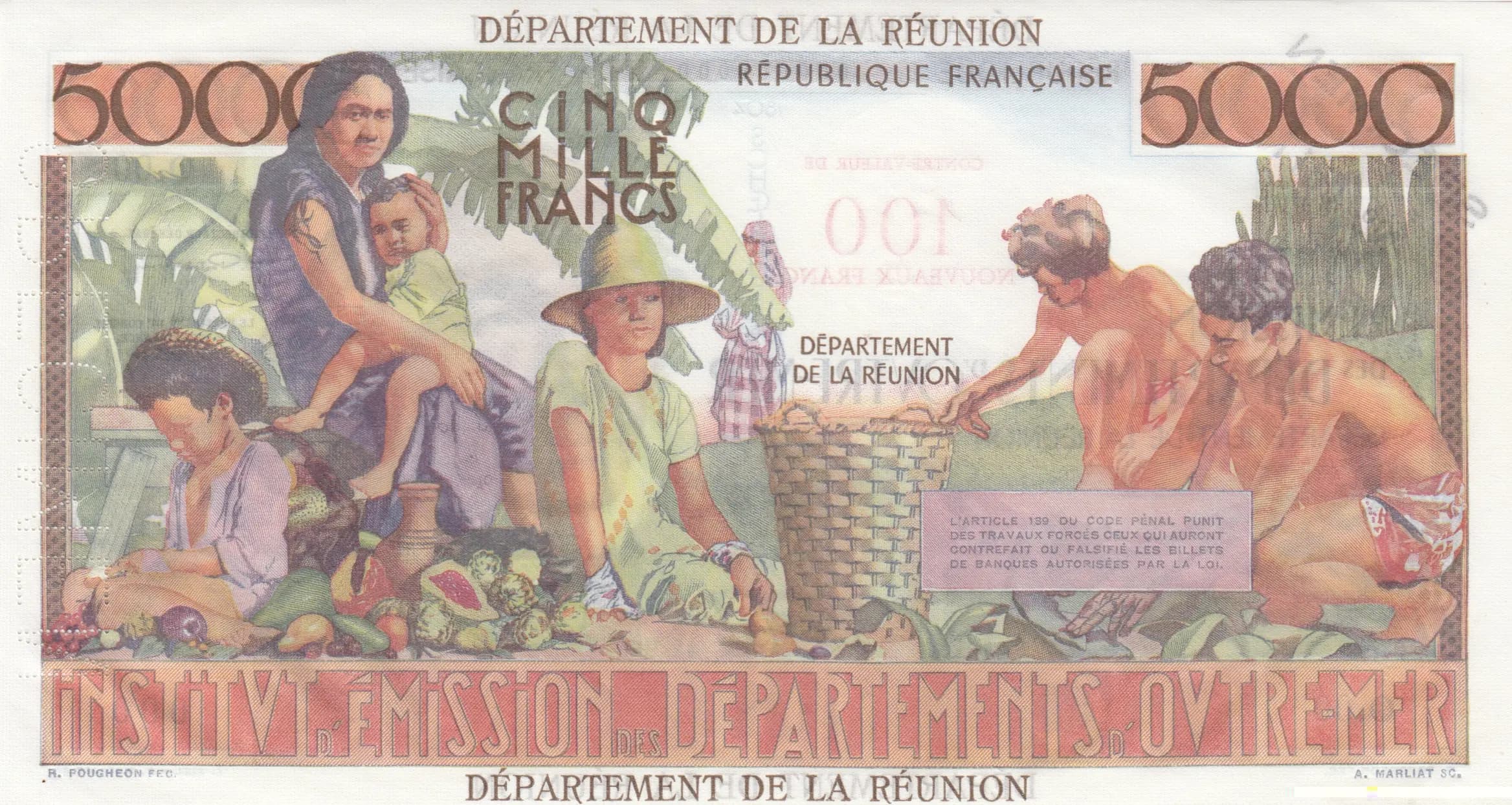
Issued during the post-1960 currency reform period when France transitioned to the nouveau franc system, this note represents Réunion's monetary circulation during its status as an overseas department. The front portrait depicts Victor Schoelcher, the 19th-century French abolitionist and politician instrumental in ending slavery in French colonies, while the reverse illustrates a tropical agricultural scene with multiple figures engaged in harvest activities—reflecting Réunion's economic foundation in sugarcane and agricultural production during the colonial and post-colonial periods.
The front features a dignified portrait of Victor Schoelcher, the renowned French abolitionist and colonial reformer (1804–1893), depicted as an elderly man in formal 19th-century attire with white collar detail, holding a document symbolic of legislative or humanitarian achievement. The background includes a landscape vista suggesting Réunion's topography. The reverse showcases a vibrant tropical scene depicting the labor and agricultural heritage of Réunion, with multiple figures of varying ages—including a woman in blue holding a child, young workers in light-colored clothing and hats, and a male figure in reddish shirt—engaged in harvest activities amid palm fronds, woven baskets, and agricultural produce. Decorative guilloche corner ornaments frame both sides, with denomination markers ('5000') and official seals positioned systematically. The color palette combines tan, brown, and beige on the front with enriched greens, blues, pinks, and earth tones on the agricultural reverse.
{"front":{"header":"RÉPUBLIQUE FRANÇAISE (French Republic) / DÉPARTEMENT DE LA RÉUNION (Department of Reunion)","issuer":"INSTITUT D'ÉMISSION DES DÉPARTEMENTS D'OUTRE-MER (Issuing Institute of Overseas Departments)","denomination":"CONTRE-VALEUR DE 100 NOUVEAUX FRANCS (Equivalent value of 100 New Francs) / CINQ MILLE FRANCS (Five Thousand Francs)","specimen":"SPECIMEN (Specimen—non-circulating)","authorities":"LE DIRECTEUR GÉNÉRAL (The General Director) / LE PRÉSIDENT DU CONSEIL DE SURVEILLANCE (The President of the Supervisory Board)","artist":"R. POUGHEON FEC. (Engraved by R. Pougheon)","dates":"1804 / 1893 (Historical reference dates)"},"back":{"header":"RÉPUBLIQUE FRANÇAISE (French Republic) / DÉPARTEMENT DE LA RÉUNION (Department of Reunion)","issuer":"INSTITUT D'ÉMISSION DES DÉPARTEMENTS D'OUTRE-MER (Issuing Institute of Overseas Departments)","denomination":"CINQ MILLE FRANCS (Five Thousand Francs)","legal":"L'ARTICLE 199 DU CODE PÉNAL PUNIT DES TRAVAUX FORCÉS CEUX QUI AURAIENT CONTREFAIT OU FALSIFIÉ DES BILLETS DE BANQUES AUTORISÉES PAR LA LOI. (Article 199 of the Penal Code punishes with forced labor those who have counterfeited or forged banknotes authorized by law.)","artists":"R. POUGHEON FEC. (Designed by R. Pougheon) / A. MARLIAT SC. (Engraved by A. Marliat)"}}
Intaglio engraving (taille-douce), a traditional security printing method characteristic of French colonial banknotes. The fine detail work evident in portrait rendering and background elements, combined with the precise guilloche patterns and multi-color printing on the reverse, indicates professional security-grade intaglio production. The 'FEC.' and 'SC.' artist attributions confirm the classical engraved banknote production methods typical of IEDOM issues. The 'SPECIMEN' overprint was applied as a secondary security measure to prevent circulation.
This note is identified as Pick P-56bs, the specimen variant of the 100 Nouveaux Francs on 5000 Francs series. PMG catalogs three variants for this base number: P-56a, P-56b, and P-56bs (specimen). The 'bs' suffix indicates this is a specimen issue, confirmed by the bold diagonal black 'SPECIMEN' overprinting visible on the front and the '0.00' value designation. The artist signatures 'R. POUGHEON FEC.' (front design) and 'A. MARLIAT SC.' (back engraving) are consistent across the series. Serial number areas display '00000000', standard for non-circulating specimen notes. No date is printed on the note itself; the catalog designation ND (1967–1971) reflects the known issuance period.