5 zlotych 1944
Market Prices
8 salesAbout This Note
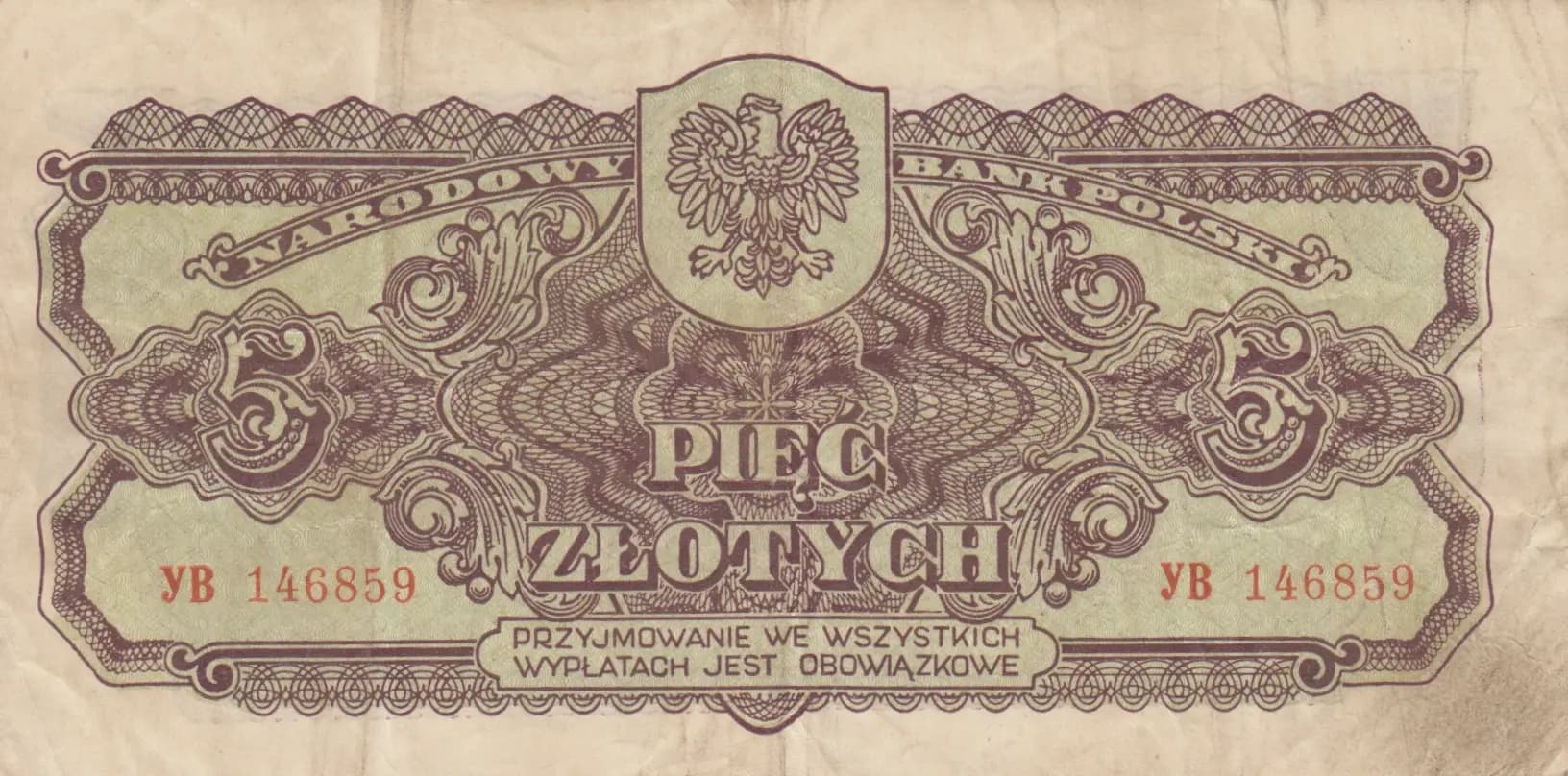
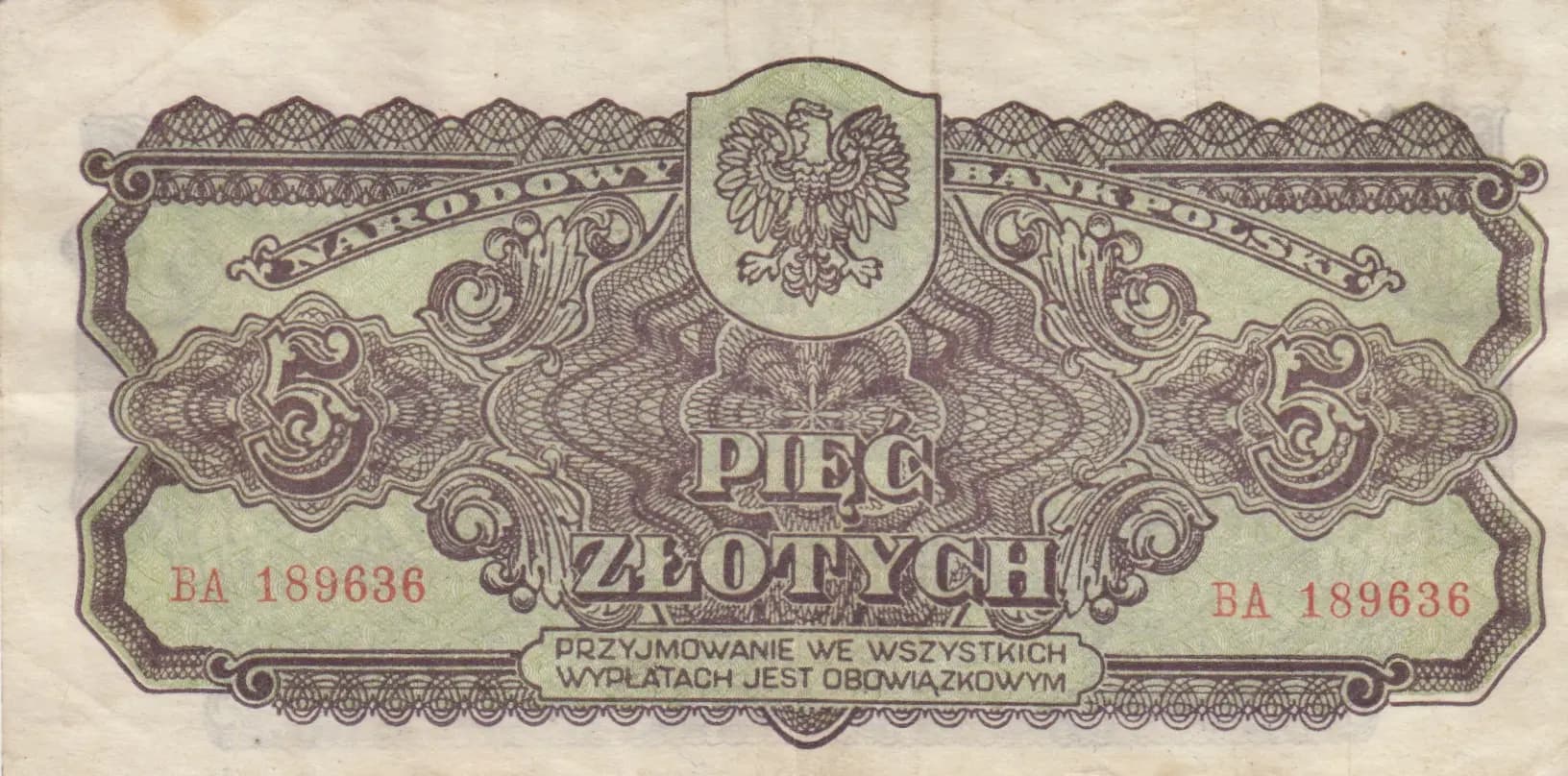
This Polish 5 Złotych note from 1944 represents a significant wartime currency issue featuring the distinctive White Eagle symbol of Poland. The VF-graded specimen displays the characteristic violet-brown on green underprint with intricate engraved borders, though age-related foxing and a visible center crease are evident from its 80-year history. The note is notable for bearing the printer's error 'OBOWIAZKOWYM' at the bottom (versus the corrected spelling on P-109), making it a recognized variant among Polish currency collectors.
Common. While historically significant, the 1944 Polish 5 Złotych (P-108) is readily available in numismatic markets. eBay transaction data shows consistent sales in the $3–$15.50 range for VF specimens over an 8-year period (2015–2022), with catalog valuations of approximately $10 for VF condition. The note was produced in substantial quantities, and examples survive in good numbers. The spelling error variant (OBOWIAZKOWYM) is the standard printing for P-108, making it neither scarce nor particularly premium-valued compared to the corrected P-109 variant.
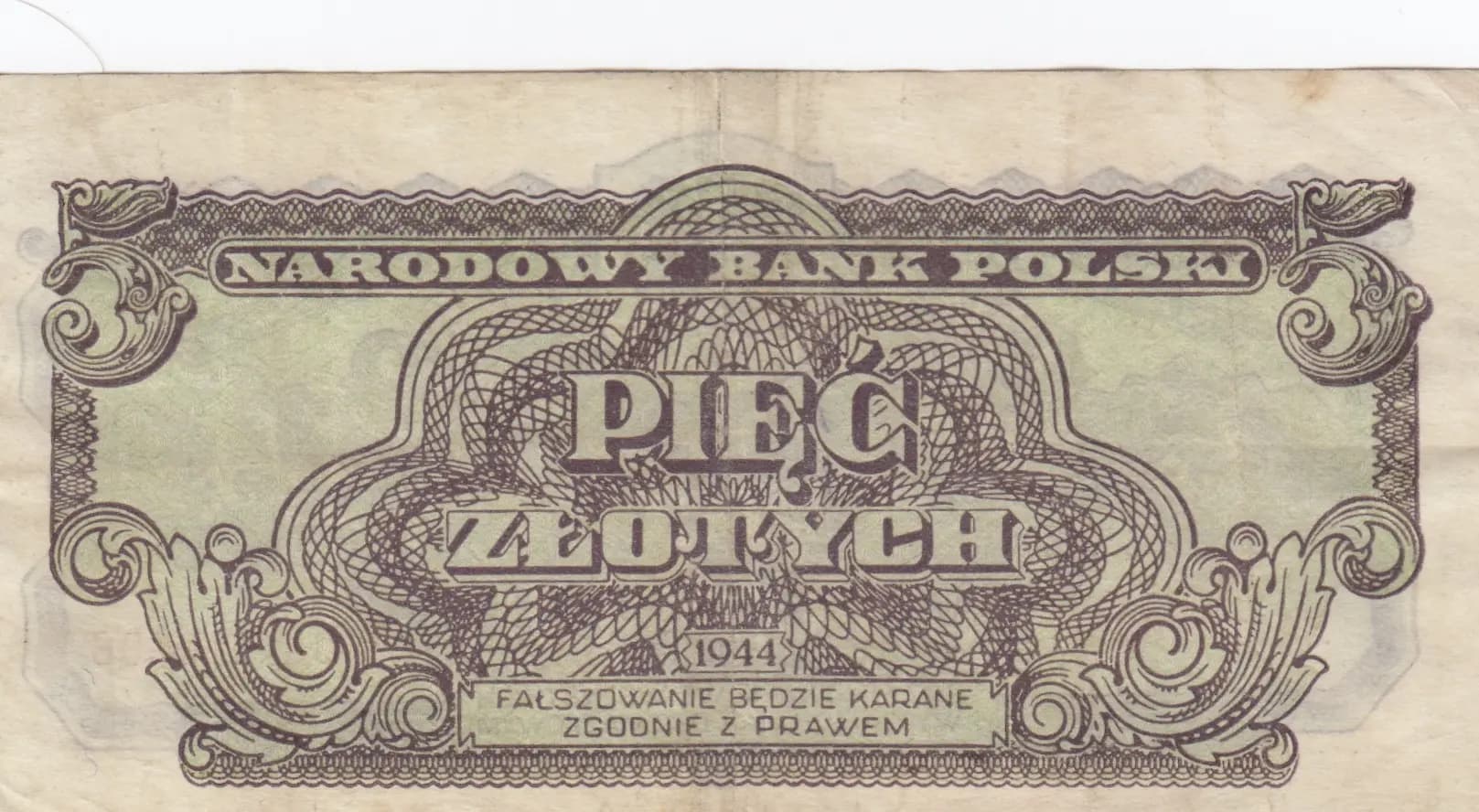
Issued during World War II by the Narodowy Bank Polski, this note reflects Poland's continued assertion of national identity and monetary sovereignty during the Nazi occupation. The prominent White Eagle in a shield—the traditional symbol of Polish sovereignty—served as a powerful emblem of resistance and national pride, while the text warning against counterfeiting ('FALSOWANIE BĘDZIE KARANE ZGODNIE Z PRAWEM') underscores the chaotic monetary conditions of the occupation period. This 1944 issue predates Poland's liberation and represents currency from one of the most turbulent periods in Polish history.
The obverse (front) features a centrally positioned Polish White Eagle (Orzeł Biały) with spread wings contained within an ornate oval medallion, surrounded by elaborate baroque-style scrollwork and geometric patterns. The eagle is crowned, reinforcing royal and national authority. Corner elements display the numeral 5 in decorative frames. The reverse (back) presents a larger heraldic version of the Polish Eagle within a shield at the top, with 'PIEC ZLOTYCH' in large letters below, framed by similarly intricate decorative borders featuring ornamental rosettes and mesh/lattice patterns. The entire design employs fine engraved lines and cross-hatching throughout, typical of high-security banknote production of the era.
FRONT: 'NARODOWY BANK POLSKI' (National Bank of Poland); 'PIEC ZLOTYCH' (Five Zloty); '1944' (year of issue); 'FALSOWANIE BĘDZIE KARANE ZGODNIE Z PRAWEM' (Counterfeiting will be punished according to law). BACK: 'NARODOWY BANK POLSKI' and 'BANK POLSKI' (National/Bank of Poland); 'PIEC ZLOTYCH' (Five Zloty); 'PRZYJMOWANIE WE WSZYSTKICH WYPLATACH JEST OBOWIĄZKOWYM' (Acceptance in all payments is mandatory) [note the spelling error 'OBOWIĄZKOWYM' instead of 'OBOWIĄZKOWE']; Serial number 'BA 189636' appearing on both left and right sides in red.
Intaglio (engraved) printing, as evidenced by the fine-line detail work, intricate geometric patterns, and the three-dimensional quality visible in the visual analysis. The note was printed by Goznak (State Security Printing Works) in Moscow, as documented in catalog references. The complex mesh backgrounds, delicate scrollwork, and precise linework are characteristic of security printing standards used for currency during this period. The registration of multiple color layers (violet-brown on green underprint) was achieved through sequential intaglio passes.
This specimen is P-108 as confirmed by catalog data, identifiable by the printer's error 'OBOWIAZKOWYM' (incorrect spelling) at the bottom of the reverse. The related P-109 variant features corrected spelling 'OBOWIĄZKOWE' and was printed by Narodowy Bank Polski (rather than Goznak). The serial number format 'BA 189636' (red printing, appearing twice) is consistent with documented examples. No other notable varieties (signature variations, date variants, or overprints) are apparent for this 1944 issue.