20 zlotych 1948
Market Prices
62 salesAbout This Note
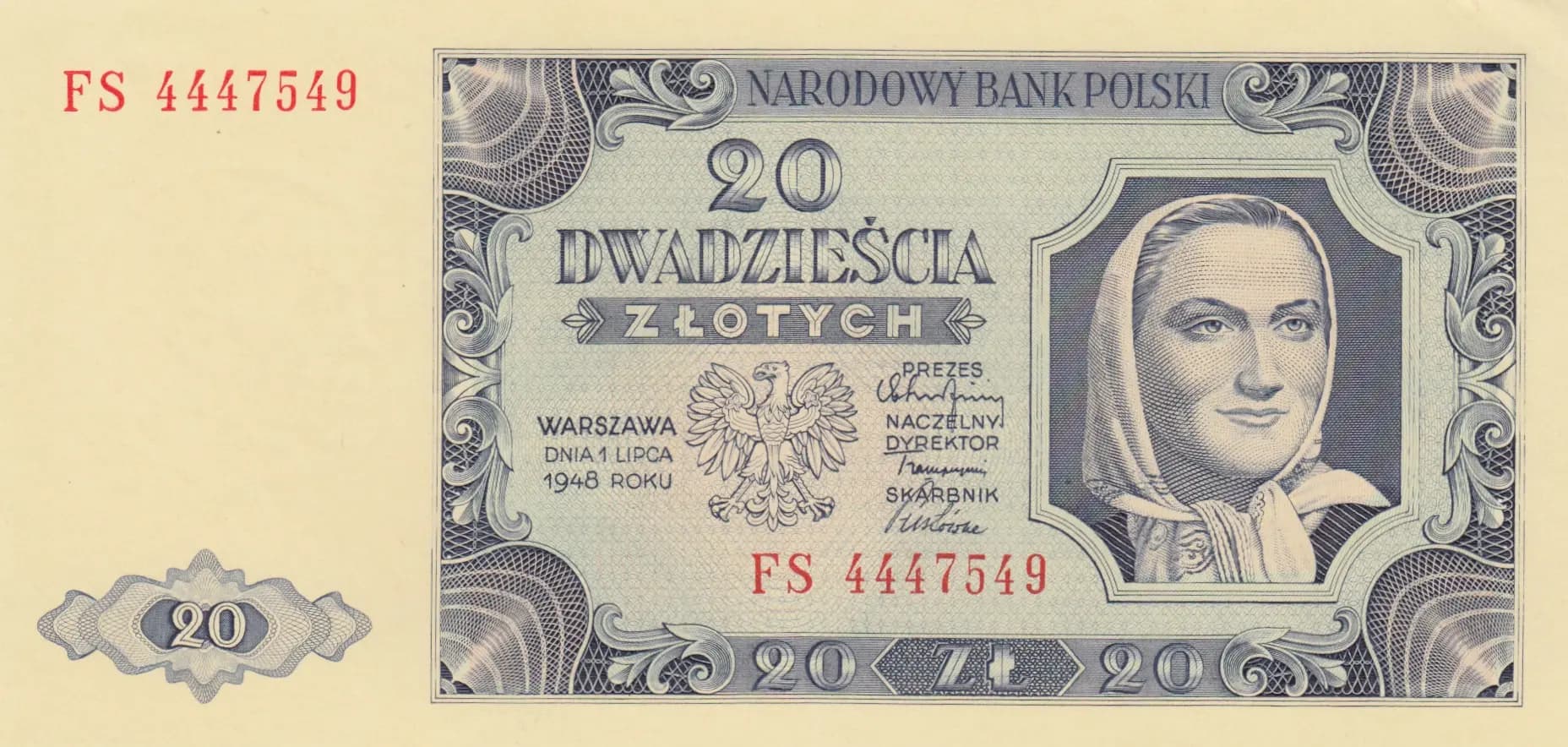
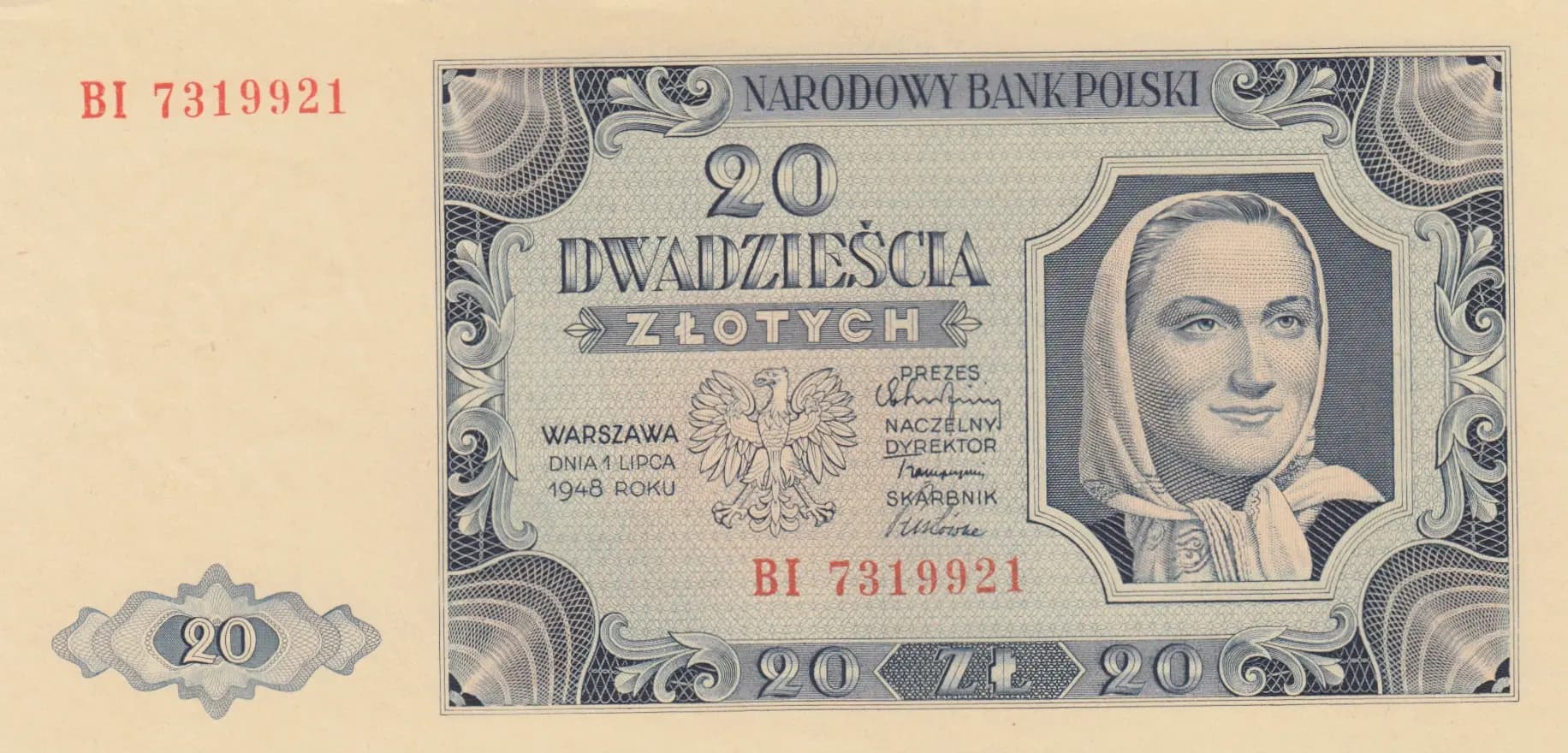
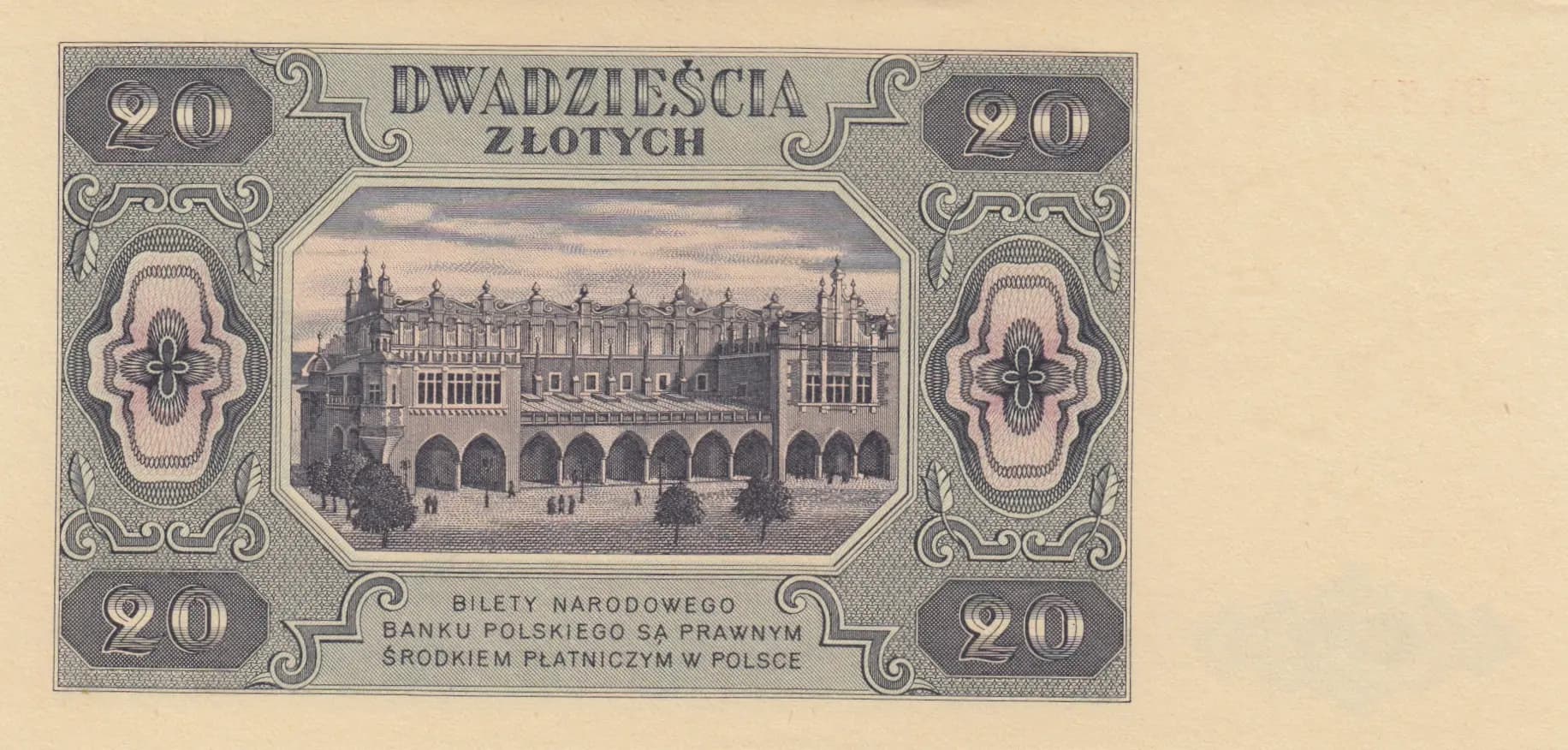
This is a handsome example of Poland's post-war 20 zlotych note from 1948, issued by Narodowy Bank Polski on July 1st. The note is presented in uncirculated condition with crisp, clean surfaces, sharp printing, and no signs of handling or wear. The obverse features a dignified portrait of a woman in traditional Polish dress (headscarf) alongside the national eagle emblem, while the reverse showcases an ornate civic building—the Cloth Hall (Sukiennice) in Kraków—making this note both artistically accomplished and historically significant as Poland's early post-WWII currency.
Common. The 1948 20 zlotych (Pick 137) was a standard circulation note issued in substantial quantities by the newly established Narodowy Bank Polski. eBay sales data demonstrates consistent, robust market activity with examples regularly selling between $2–$100 depending on condition grade, with UNC examples historically commanding $33–$57. The presence of four documented serial number varieties further indicates a substantial print run. The denomination was neither recalled nor subject to unusual attrition, making this note readily available to collectors across all condition grades.
Issued in 1948, this banknote represents Poland's monetary recovery following World War II and the establishment of a new socialist-aligned government. The Cloth Hall (Tuchhalle/Sukiennice) depicted on the reverse is Kraków's iconic Renaissance marketplace, symbolizing Poland's cultural heritage and economic renewal during the reconstruction period. The imagery reflects the government's effort to establish national pride and stability through currency design while incorporating traditional Polish iconography—the eagle and the woman in national dress—that would resonate with the Polish population.
The obverse features a classical engraved portrait of a Polish woman wearing a traditional white headscarf, positioned on the right side within an ornamental frame. The central vignette displays the Polish national eagle (coat of arms) with spread wings. Decorative scrollwork and flourishes occupy the corners and margins. The denomination is prominently displayed as both numerals ('20') and words ('DWADZIEŚCIA ZŁOTYCH'). The reverse presents a detailed engraving of Kraków's famous Cloth Hall (Sukiennice)—a historic Renaissance building with multiple stories, towers, spires, and ornate architectural elements including arched entrances. The building is framed by elaborate decorative panels featuring floral and geometric patterns. The note's color scheme employs gray, blue-gray, and cream tones with red serial numbers on the obverse and subtle pink/rose tints in the ornamental areas, all executed in the fine tradition of pre-war Polish banknote design.
FRONT: 'NARODOWY BANK POLSKI' (National Bank of Poland) | 'DWADZIEŚCIA ZŁOTYCH' (Twenty Zlotych) | 'WARSZAWA' (Warsaw) | 'DNIA 1 LIPCA 1948 ROKU' (Day of July 1st, Year 1948) | 'PREZES' (President) | 'NACZELNY DYREKTOR' (Chief Director) | 'SKARBNIK' (Treasurer) | Serial number: 'BI 7319921'. BACK: 'DWADZIEŚCIA ZŁOTYCH' (Twenty Zlotych) | 'BILETY NARODOWEGO BANKU POLSKIEGO SĄ PRAWNYM ŚRODKIEM PŁATNICZYM W POLSCE' (Banknotes of the National Bank of Poland are legal tender in Poland) | Denomination '20' in all four corners.
Steel plate engraving (intaglio printing), the standard security printing method for Polish banknotes of this era. The note exhibits the characteristic hallmarks of this technique: intricate line work, complex cross-hatching, fine details in architectural elements and facial features, and the dimensional quality visible in the inked impressions. The Narodowy Bank Polski contracted with the established Polish security printing facilities; notes of this period typically bear the hallmarks of precision engraving executed by skilled artisans using traditional lithographic and intaglio methods.
The catalog reference notes four serial number varieties exist for this Pick number. The examined note bears the serial number 'BI 7319921' with red printing, which represents one of the standard letter-prefix varieties. No additional overprints, date variations, or signature variants are evident on this specimen. The note was issued on 1 July 1948 (DNIA 1 LIPCA 1948 ROKU) with signature lines for President, Chief Director, and Treasurer, corresponding to the standard authorization format for this issue.