1 marka 1916
Market Prices
7 salesAbout This Note
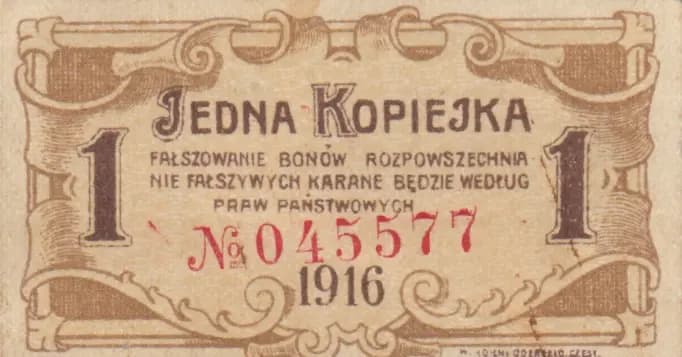
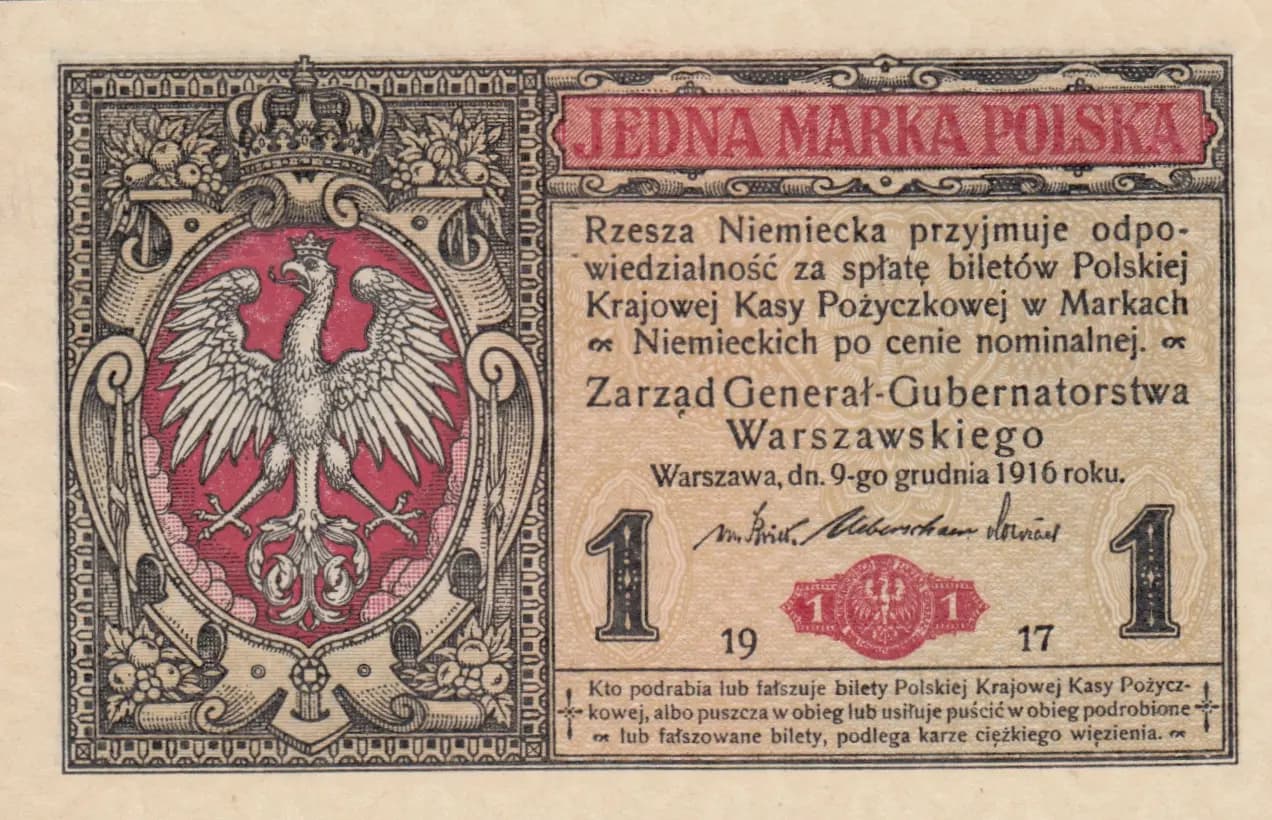
This Polish 1 Marka note from December 1916 is an attractive example of Austro-Hungarian occupation currency issued by the Polska Krajowa Kasa Pożyczkowa (Polish National Loan Bank) during World War I. Graded AU, the note displays excellent preservation with vibrant red and black printing, clear denomination numerals, and well-defined ornamental borders showing only light aging consistent with its century-old provenance. The piece is historically significant as it represents Poland's brief monetary independence during the final years of German occupation, with the German Reich's explicit guarantee of redemption printed prominently on the obverse.
Common. The eBay price tracking data shows consistent sales in the $15–$46 range depending on condition, with multiple transactions recorded across a seven-year period (2016–2023). Even in AUNC condition, examples sell for approximately $40–$46, placing this well within the affordable range typical of common World War I occupation currency. The 1916 Polish Marka issue had a substantial circulation during the occupation and post-war period, resulting in numerous surviving examples. This Pick-8 note is not listed in specialized Polish numismatic catalogs as scarce or rare, and the abundance of comparable sales data confirms broad market availability.
Issued on December 9, 1916, during Germany's administration of the Warsaw General-Governorship (Zarząd Generał-Gubernatorstwa Warszawskiego), this note reflects Poland's complex status as a nominally autonomous state under German military occupation during World War I. The prominent heraldic Polish white eagle on red shield asserts Polish national identity, while the German Reich's guarantee of payment in German Marks demonstrates the economic dependency of the territory on occupying forces. This dual symbolism—Polish sovereignty imagery combined with German financial backing—encapsulates the political tensions of the 1916-1918 occupation period, making it a crucial numismatic artifact of this transitional era.
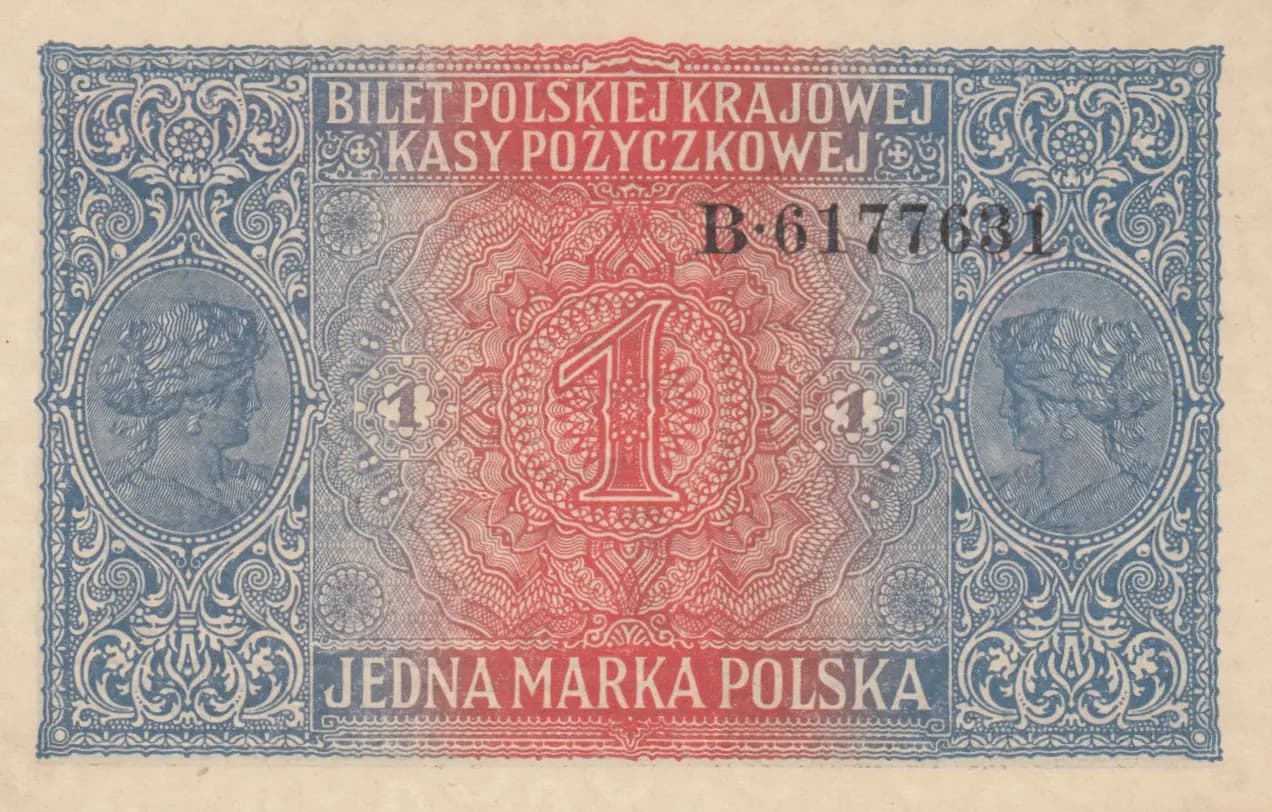
The obverse features a heraldic composition centered on the Polish white eagle (Orzeł Biały) with outstretched wings mounted on a red shield, crowned with an ornamental Polish crown—the principal national symbol of Poland. The eagle is surrounded by an elaborate frame of scrollwork, floral motifs, and geometric patterns rendered in black on cream paper, with red accents in the banner header containing the issuing authority's name. The reverse displays an ornamental central design with a large numeral '1' in red surrounded by intricate floral and geometric decoration in red and gray tones. Flanking the central numeral are two portrait medallions in blue frames, each containing a male profile—likely representing Polish historical or national figures, though not specifically identified in the visual analysis. The entire composition is framed by decorative blue and red borders with scrollwork patterns. The serial number B 617761 is clearly printed on the reverse. This design synthesis of Polish heraldic symbols with occupation-era administrative inscriptions creates a unique historical artifact.
FRONT: 'JEDNA MARKA POLSKA' (One Polish Mark) — the primary denomination. 'Zarząd Generał-Gubernatorstwa Warszawskiego' (Administration of the Warsaw General-Governorship) — issuing authority. 'Warszawa, dn. 9-go grudnia 1916 roku.' (Warsaw, December 9, 1916) — official date. 'Rzesza Niemiecka przyjmuje odpowiedzialność za spłatę biletów Polskiej Krajowej Kasy Pożyczkowej w Markach Niemieckich po cenie nominalnej.' (The German Reich accepts responsibility for payment of Polish National Loan Bank bills in German Marks at face value.) — German guarantee clause. 'Kto podrabia lub fałszuje bilety Polskiej Krajowej Kasy Pożyczkowej, albo puszcza w obieg lub usituje puscić w obieg podrobione lub fałszowane bilety, podlega karze ciężkiego więzienia.' (Whoever counterfeits or forges bills of the Polish National Loan Bank, or puts into circulation counterfeit or forged bills, is subject to severe imprisonment.) — counterfeiting penalty warning. BACK: 'BILET POLSKIEJ KRAJOWEJ KASY POŻYCZKOWEJ' (Bill of the Polish National Loan Bank). 'JEDNA MARKA POLSKA' (One Polish Mark). Serial number: B 617761.
Based on the visual characteristics—the crisp, multi-colored registration of red, black, blue, and gray inks; the fine detail in the ornamental borders and portrait medallions; and the clarity of small text—this note was produced using lithographic printing, the standard technique for banknote production in 1916. The presence of multiple distinct color passes (red, black, blue, gray) and the precise alignment of the heraldic eagle, portraits, and decorative frames indicate color lithography. The printer for Polish occupation notes of this period was typically a Central European security printer operating under German direction; however, the specific printer is not identifiable from catalog data provided for Pick-8.
The note observed corresponds to Pick-8, with the front inscription reading 'Zarząd Generał-Gubernatorstwa...' as specified in the Pick catalog. The catalog reference notes that a similar variety exists (Pick-2) with the text variant 'Zarząd jeneral-gubernatorstwa...' and 'Bilet Krajowej Polskiej Kasy Pożyczkowej' on the back. The observed specimen displays the serial number prefix 'B' (B 617761) on the reverse. The specific date printed is December 9, 1916 (9-go grudnia 1916 roku), with the year split across the design as '19' and '17' on the front. No signatures or additional overprints are noted in the visual analysis. The PMG population report indicates Pick-8s as a cataloged variant, suggesting minor varieties may exist within this Pick number designation, though the precise distinction between Pick-8 and Pick-8s is not specified in the provided catalog data.