50 centavos 1942
Market Prices
5 salesAbout This Note
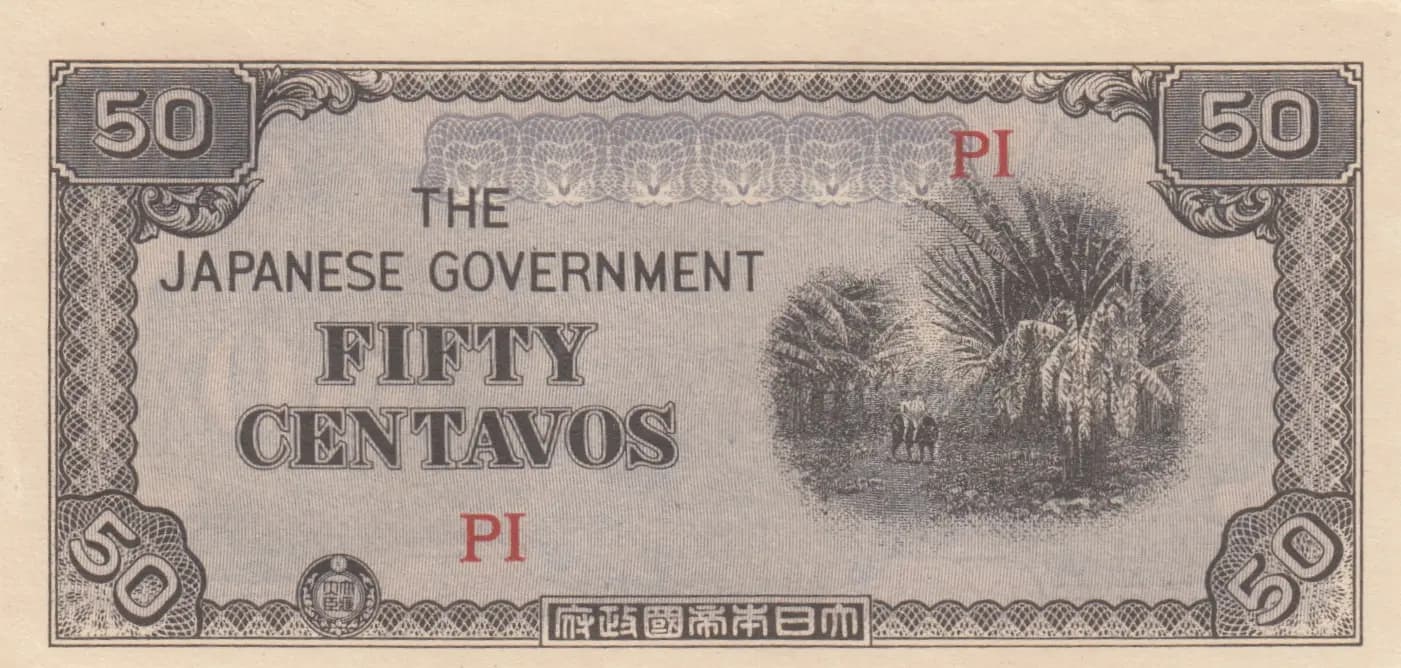
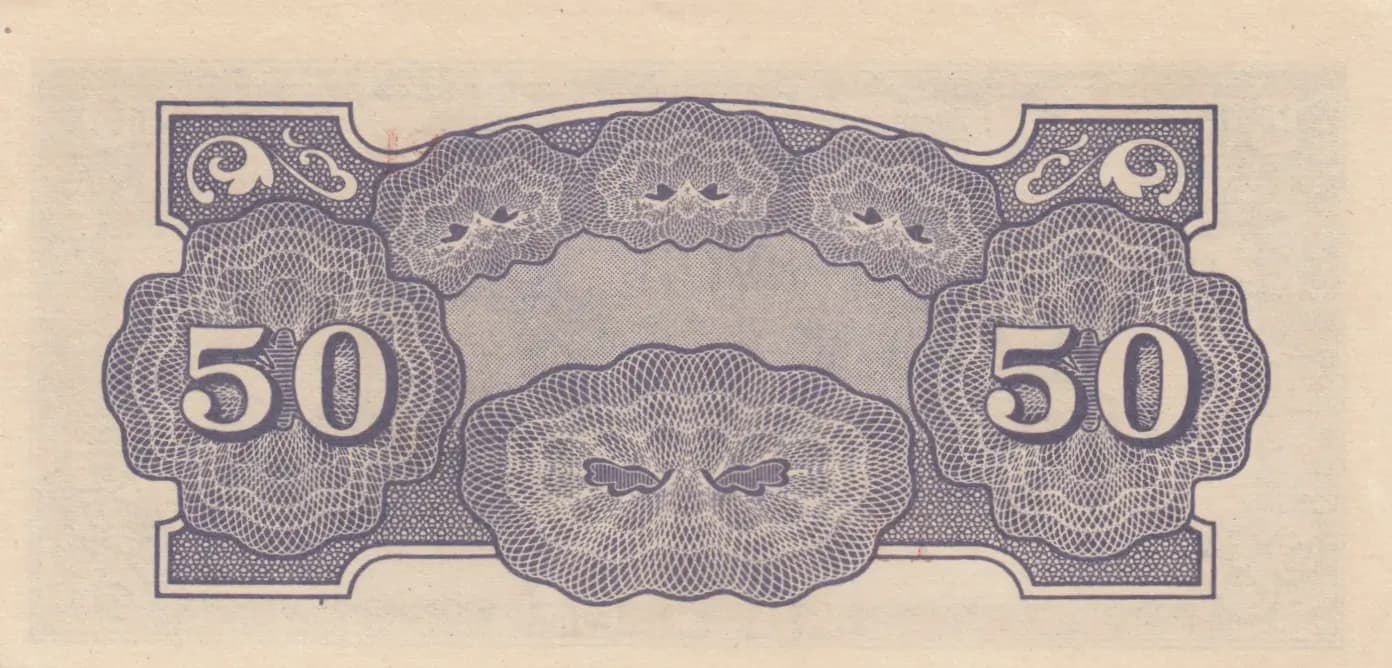
This is a Philippine 50 centavos note issued by the Japanese Government in 1942, presented in AU (About Uncirculated) condition. The obverse features an intricate tropical plantation scene with palm trees and human figures rendered in fine line engraving, complemented by ornate geometric borders and red 'PI' overprints. The reverse displays elegant geometric medallions and lattice patterns in blue ink on cream paper, showcasing exceptional preservation with sharp printing and no visible wear.
Common. eBay market data shows consistent sales at very low prices (under $2 for most grades, with even PMG 66 examples selling for under $10), indicating abundant supply. Catalog values as of 2016 reflect minimal collector value (UNC: $1), consistent with a common occupation currency issue. High print runs were typical for occupation currency to meet administrative needs, and this denomination was produced in substantial quantities.
Issued during Japan's occupation of the Philippines (1942-1945), this banknote represents the Japanese military administration's attempt to establish economic control in occupied territories. The plantation imagery reflects Japan's interest in the Philippines' agricultural resources, particularly hemp and other tropical products needed for the war effort. The bilingual design (English and Japanese) demonstrates Japan's effort to maintain administrative continuity while asserting imperial authority over the occupied territory.
The obverse depicts a detailed tropical plantation landscape as the central vignette, positioned at right-center, featuring palm trees and human figures engaged in agricultural labor. The design is framed by intricate guilloche patterns and geometric borders in the corners, with the denomination '50' displayed prominently in the upper left and right in large numerals. Red 'PI' overprints appear as administrative marks. The reverse employs a minimalist but highly refined aesthetic, featuring a large central oval medallion with fine mesh/lattice geometric patterns flanked by circular ornamental designs. Quatrefoil-shaped frames containing the denomination '50' appear on both left and right sides. A circular seal or emblem is visible in the lower left area of the obverse.
Front side: 'THE JAPANESE GOVERNMENT' (English, top center), 'FIFTY CENTAVOS' (English, center), 'PI' (red overprint, abbreviation for Philippines), '50' (numeric denomination, upper corners), '日本国政府五十銭' (Japanese: 'Japanese Government Fifty Sen,' rectangular box at bottom center). Back side: '50' (numeric denomination, left and right sides within decorative frames).
Intaglio line engraving (recess printing) throughout, evidenced by the fine, precise detail work visible in the guilloche patterns, border decorations, and central vignettes. The sharp definition of the mesh patterns and geometric designs indicates professional security printing. The red overprints appear to have been applied as a separate printing pass, typical of administrative marking procedures used on occupation currency. The uniform color saturation and crisp impressions suggest high-quality work from a specialized security printer.
The red 'PI' overprints visible on the obverse represent the Philippine administration marking variety of this Japanese occupation note. The note exhibits the standard design with bilingual English/Japanese inscriptions. Serial number details are not clearly visible in the provided images, but occupation currency from this series typically includes serial numbering that may vary by printing block. This appears to be from the main issue of 1942 with no evidence of the scarcer overprint varieties that might exist in some Japanese occupation currency.