5 pesos 1943
“Mindanao”
Market Prices
About This Note
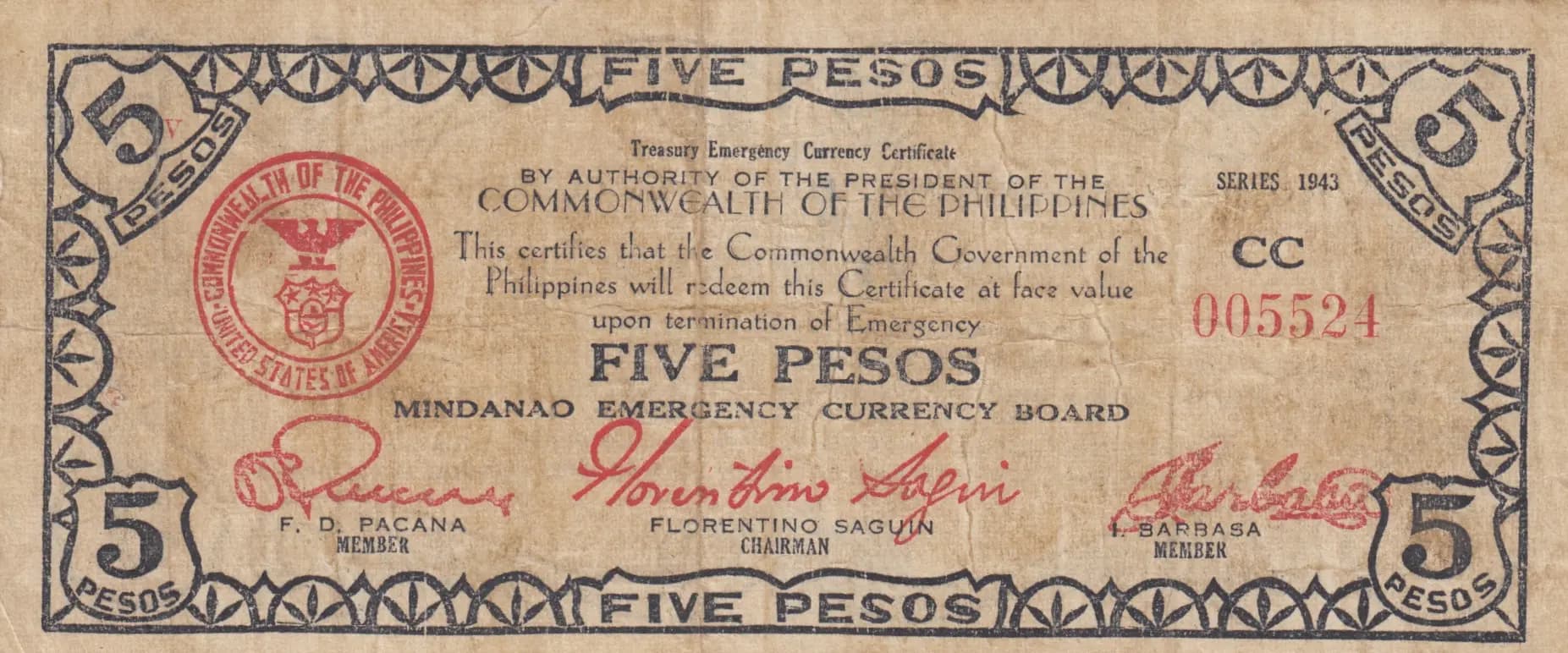
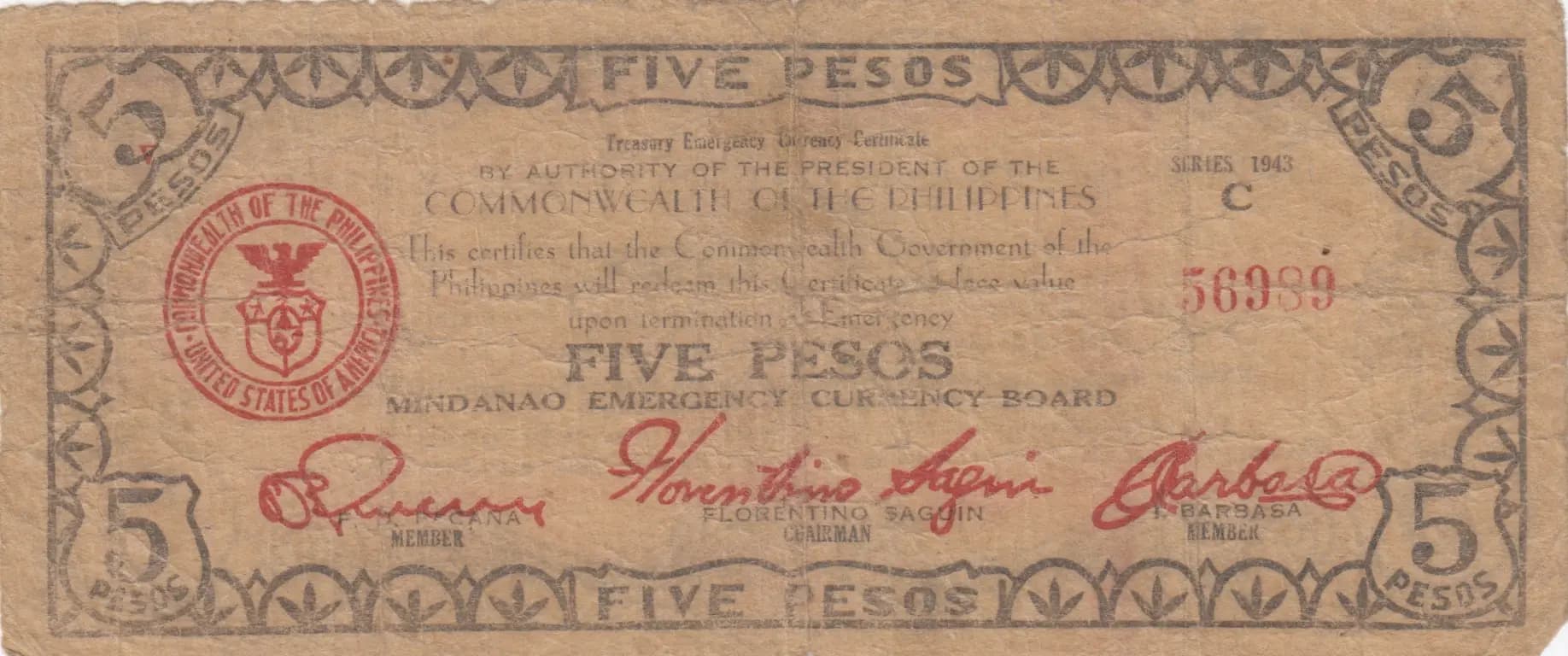
This 1943 Five Pesos Treasury Emergency Currency Certificate from the Mindanao Emergency Currency Board represents a fascinating piece of Philippine wartime monetary history. The note exhibits significant age-related wear with creasing, foxing, and brown staining throughout, consistent with its VG condition grade and likely circulation during or after World War II. The distinctive red circular seal featuring an eagle emblem and dual Commonwealth/United States markings, combined with bilingual English and Tagalog inscriptions, makes this a notable example of emergency currency issued during a critical period in Philippine history.
common. eBay market data shows consistent sales in the $2–$15 USD range depending on condition, with the majority of listings below $10 USD. The catalog Pick number P-S487c designation (note the 'S' prefix indicating a special or emergency issue) and the Mindanao-specific issuing authority suggest this was part of a regional emergency currency program with limited geographic circulation, yet the frequency of available examples and modest pricing indicate adequate survival rates. While historically significant as wartime emergency currency, print runs appear to have been sufficiently large that examples in circulated condition (VG) remain readily available to collectors at modest prices.
Issued in 1943 during the Japanese occupation of the Philippines and the ongoing Pacific War, this emergency currency certificate was authorized by the Commonwealth of the Philippines government as a wartime monetary measure. The dual Commonwealth of the Philippines and United States of America markings on the seal reflect the complex political situation of the period, as the Philippines maintained a Commonwealth government in exile while under Japanese control. The Mindanao Emergency Currency Board's issuance of this note underscores the regional economic disruption and the necessity for alternative currency solutions during the military conflict that ravaged the archipelago.
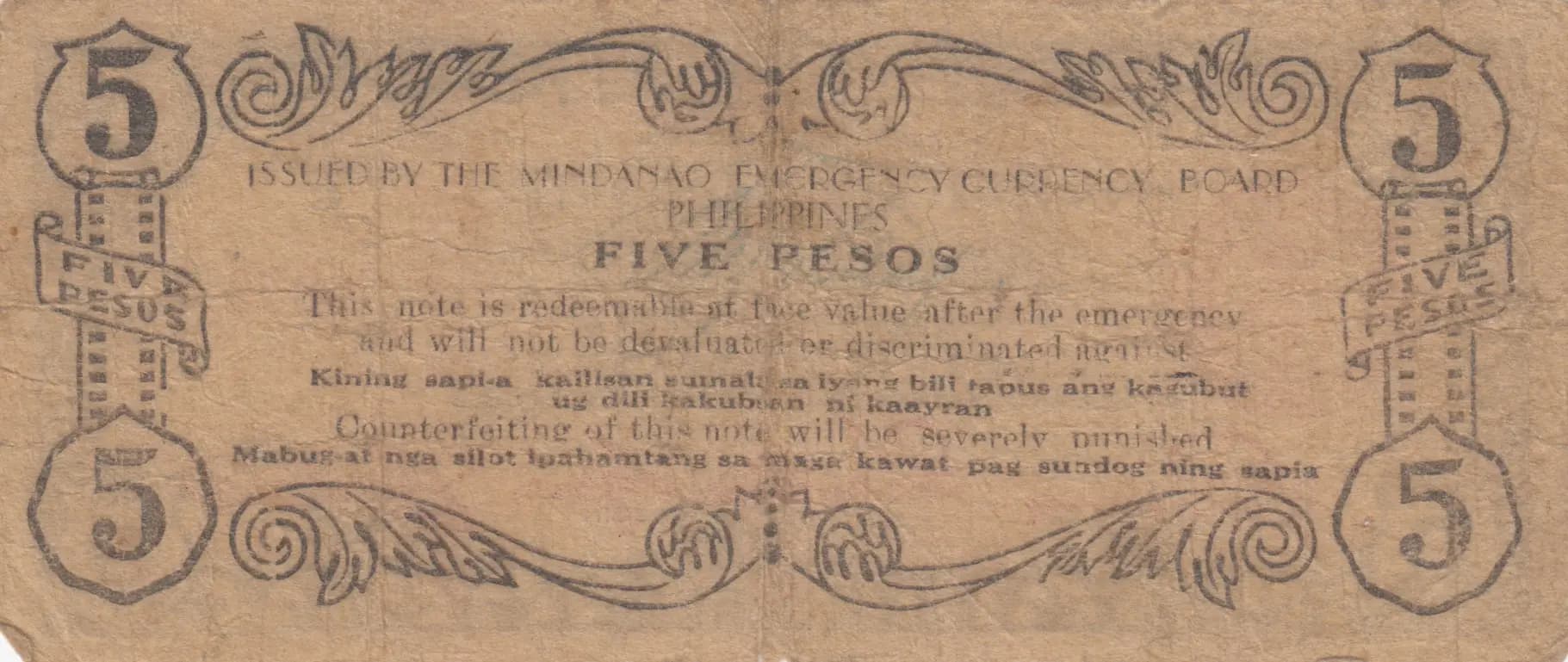
This banknote features a restrained, functional design typical of emergency wartime currency. The front displays a tan/beige field with brown printing, bordered by ornamental geometric patterns in the corners. The central composition is dominated by the red circular seal on the left side—a security feature bearing an eagle emblem (representing either the Philippine Commonwealth or U.S. authority, or both jointly) with inscribed text identifying both the Commonwealth of the Philippines and United States of America. The reverse side employs large decorative '5' numerals positioned in the corners with elaborate scrollwork and floral designs, characteristic of late-19th and early-20th century banknote aesthetics. The bilingual presentation in English and Tagalog reflects the official languages used by the Commonwealth government. Three signatures appear at the bottom of the front, representing the Chairman and Members of the Mindanao Emergency Currency Board, lending official authority to the issue. No portraits or named landmarks are depicted; instead, the note's authority derives from its institutional seals and governmental declarations.
FRONT SIDE: 'FIVE PESOS' / 'Treasury Emergency Currency Certificate' / 'BY AUTHORITY OF THE PRESIDENT OF THE COMMONWEALTH OF THE PHILIPPINES' / 'This certifies that the Commonwealth Government of the Philippines will redeem this Certificate whose value upon termination of emergency currency' / 'FIVE PESOS' / 'MINDANAO EMERGENCY CURRENCY BOARD' / 'SERIES 1943' / 'C' (series designation) / '56939' (serial number) / Signatures of 'Florentino Saguin, CHAIRMAN' and two additional members. BACK SIDE: 'FIVE PESOS' (appears twice in large ornamental numerals) / 'ISSUED BY THE MINDANAO EMERGENCY CURRENCY BOARD PHILIPPINES' / 'This note is redeemable at face value after the emergency and will not be devalued or discriminated against.' / 'Kining sapi-a kasilsan sumatat sa ayong bili tapos any kasibut ug ali makubugan ni kaayran' (Tagalog equivalent of redemption guarantee) / 'Counterfeiting of this note will be severely punished' / 'Mabug-at nga silot ibahamtang sa misya kawat pag sundog ning sapia' (Tagalog counterfeiting warning).
Based on the visual characteristics—the faded, uneven ink coverage, the orange/brown staining patterns, and the overall print quality consistent with wartime production—this note was likely produced using letterpress printing or a similar relief printing method common during the 1940s. The separation and fading of colors, particularly the red seal appearing distinct from the brown text, suggests separate printing passes. The document quality and security features reflect the limitations and pragmatism of emergency currency production during wartime, lacking the sophisticated intaglio techniques employed by established central banks. The specific printer is not definitively documented in standard Pick catalogs for this emergency currency issue, though it may have been produced domestically or by an American security printer contracted by the Commonwealth government-in-exile.
This note is cataloged as Pick P-S487c, with the 'c' suffix indicating it is the third recognized variety of this denomination and issuer. The visible serial number '56939' with series designation 'C' appears to be from the later printing run. Variety distinctions for Mindanao Emergency Currency Board notes typically involve different signature combinations, series letters, and potentially different printer marks. The series designation 'C' on this example and the signatures of Florentino Saguin as Chairman are identifying characteristics. Standard references note that these emergency certificates exist with multiple signature varieties and series designations, reflecting extended issuance periods or multiple administrative groups involved in the redemption process during and after the war.