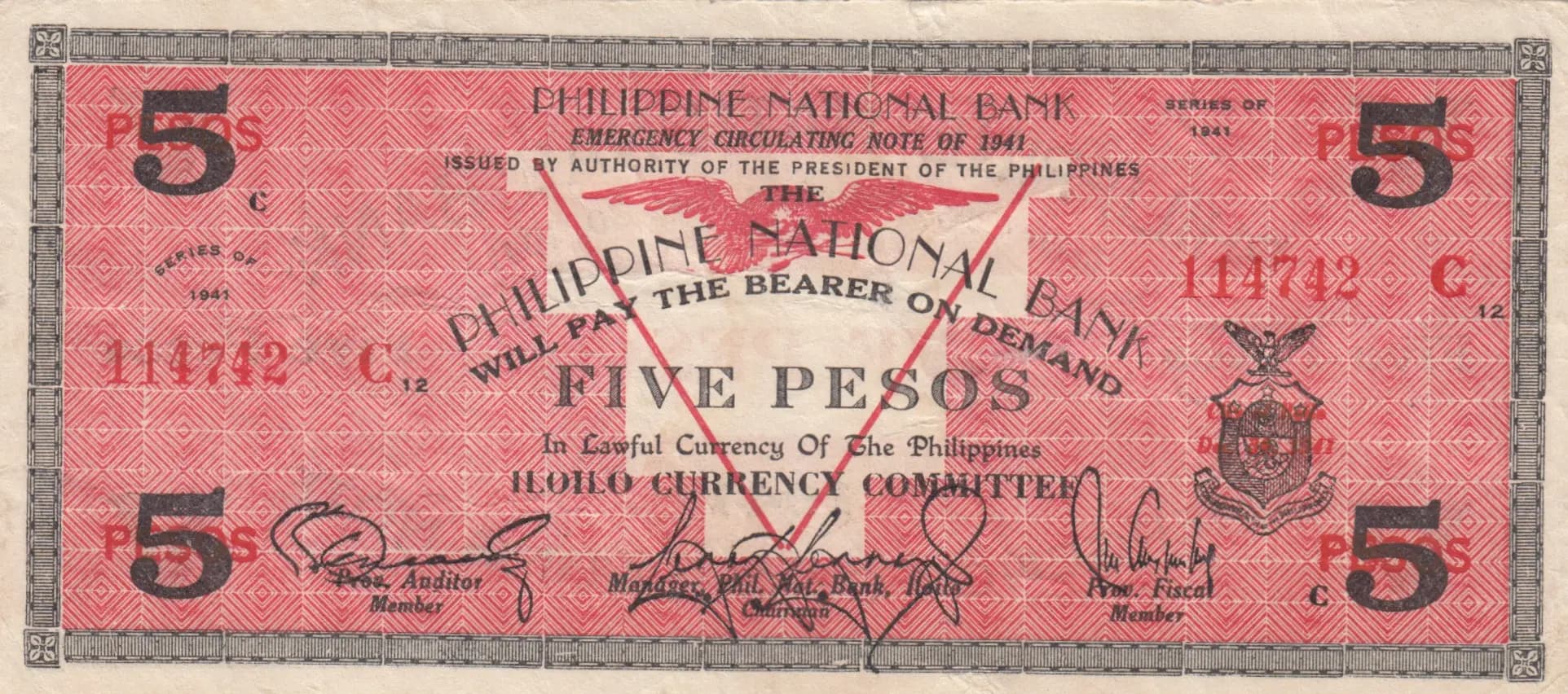
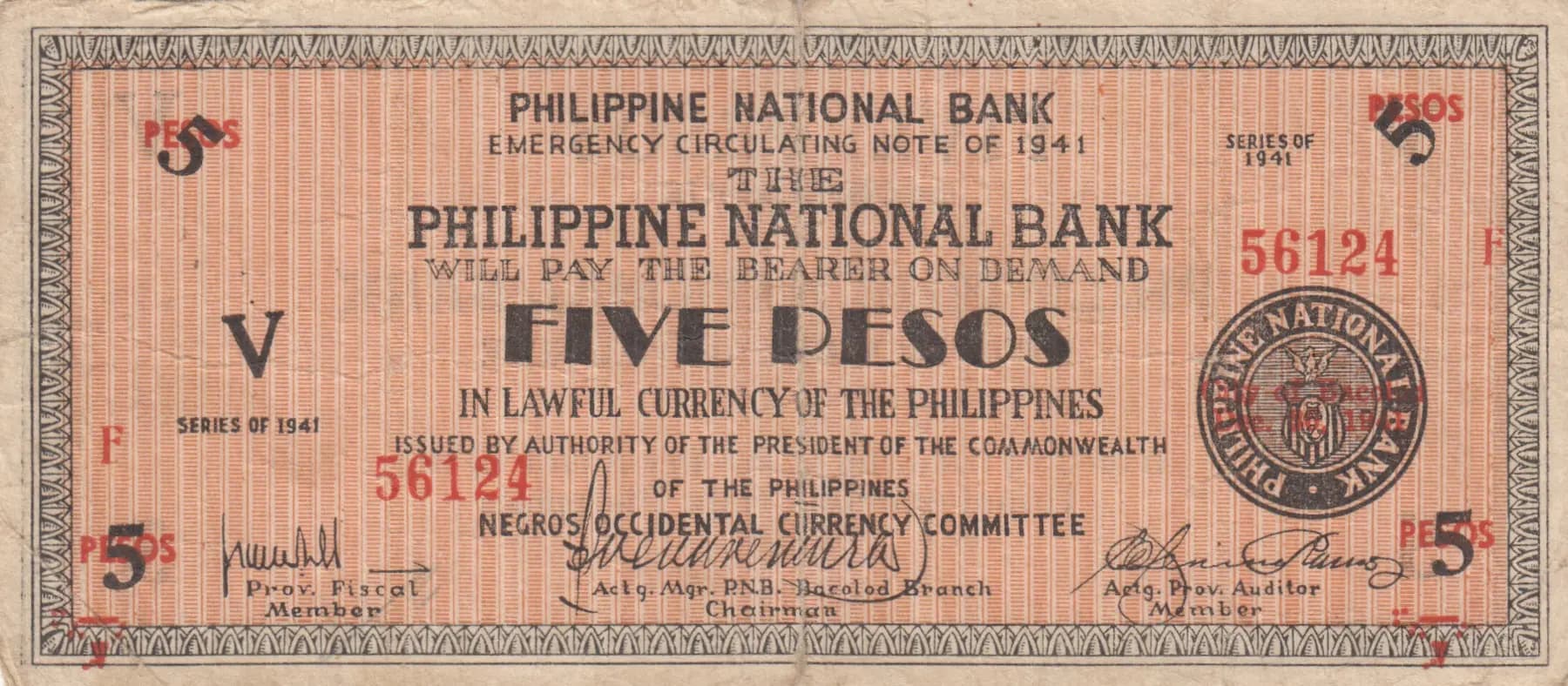
5 pesos 1941
“Cebu”
Market Prices
About This Note
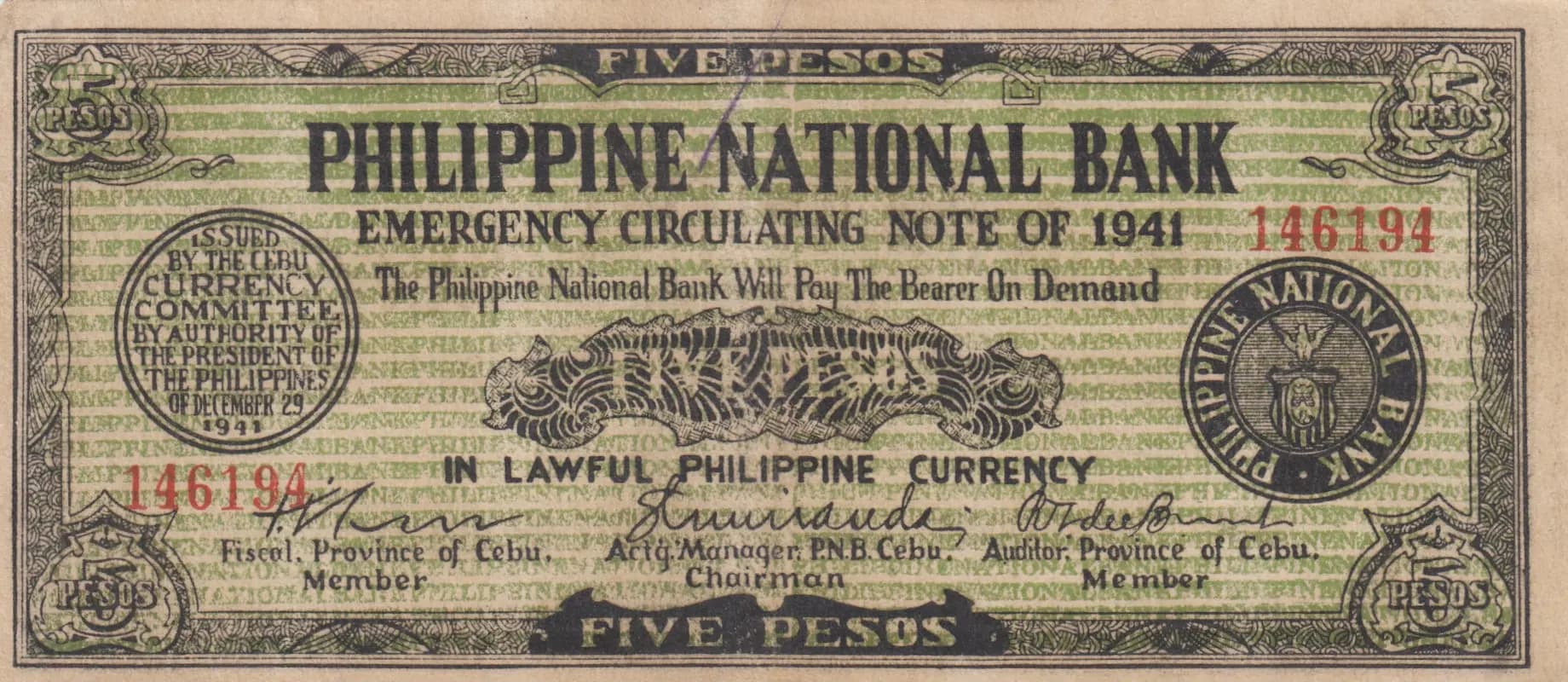
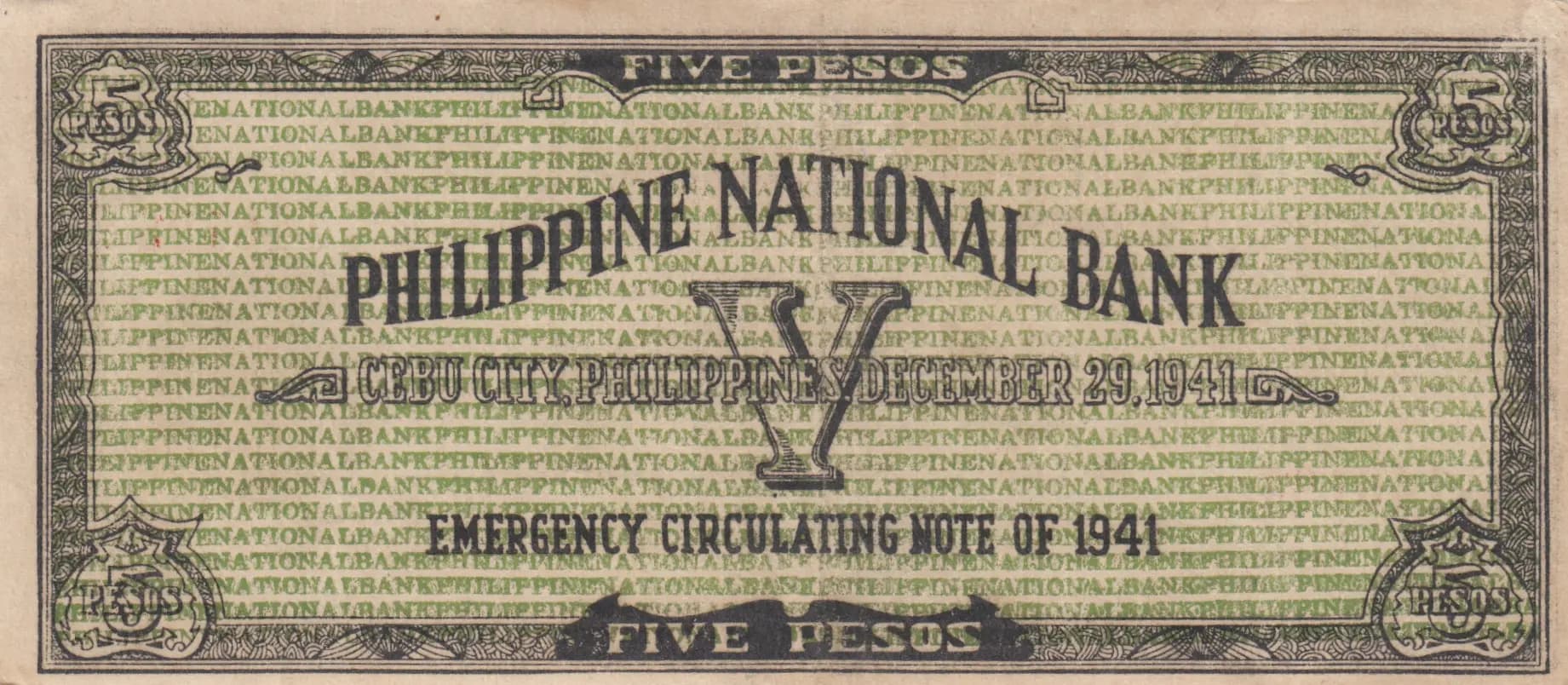
This Philippine National Bank 5 Pesos emergency circulating note from December 29, 1941, is a historically significant example of wartime currency issued during Japan's invasion of the Philippines. The VF-graded specimen displays the characteristic tan and green color scheme with ornate baroque-style design elements, multiple official seals from the Cebu Currency Committee, and clearly visible administrative signatures. Serial number 146194 falls within the documented issue range (#1 to 180,000), and the note exhibits expected aging and handling marks consistent with its 83-year circulation history.
Common. While this is a historically significant emergency issue, the documented print run of serial numbers 1 to 180,000 indicates a substantial issue quantity. The eBay price tracking data shows wide price variation ($2.99 to $130.00) with multiple VF-graded examples available, with VF-condition examples commonly priced between $7.99 and $129.95 USD. Serial number 146194 falls within the watermark-less range (#1-45,000 per catalog), which represents the most common variety. The availability of multiple examples in the secondary market and moderate pricing typical of VF-graded specimens confirm this as a common-to-readily-available issue despite its wartime emergency classification.
This emergency circulating note was issued by authority of the Philippine President on December 29, 1941—just days after Japan's attack on Pearl Harbor and during the initial phase of the Pacific War. The Cebu Currency Committee's authority to issue these notes reflects the Philippine government's emergency response to wartime currency shortages and the need for localized monetary circulation during the Japanese occupation period. The note's baroque decorative design and formal government seals underscore its legitimacy as emergency legal tender despite the extraordinary circumstances of its issue.
The obverse features a formalized layout typical of official Philippine currency with an ornate rectangular border composed of geometric and floral patterns. The central design element is a large baroque-style decorative emblem with elaborate scrollwork and filigree, flanked by two prominent circular seals: the Philippine National Bank seal on the right and the Cebu Currency Committee seal on the left. Administrative text and signature lines are arranged in the center beneath the central emblem. The reverse displays a large decorative serif letter 'Y' as the dominant central design element, with the bank name repeated as a security background pattern. Both sides employ corner ornaments inscribed with 'PESOS.' The color palette of tan, beige, cream, and green with black ink creates a formal yet warm appearance appropriate for emergency wartime currency.
FRONT SIDE: 'FIVE PESOS' (denomination); 'PHILIPPINE NATIONAL BANK' (issuing authority); 'EMERGENCY CIRCULATING NOTE OF 1941' (note classification); 'The Philippine National Bank Will Pay The Bearer On Demand' (promise to pay); 'IN LAWFUL PHILIPPINE CURRENCY' (payment guarantee); 'ISSUED BY THE CEBU CURRENCY COMMITTEE BY AUTHORITY OF THE PRESIDENT OF THE PHILIPPINES OF DECEMBER 29 1941' (authorization and date); Serial number 146194; Administrative signature lines for 'Fiscal, Province of Cebu,' 'Acting Manager, PNB Cebu,' 'Auditor, Province of Cebu' with titles for Chairman and Members. BACK SIDE: 'PHILIPPINENATIONALBANK' (repeated security background text); 'CEBU CITY, PHILIP PINE' (location); 'DECEMBER 29, 1941' (issue date); 'EMERGENCY CIRCULATING NOTE OF 1941' (classification); 'FIVE PESOS' (denomination).
This note was produced using letterpress and intaglio printing techniques, standard for Philippine National Bank currency of the 1941 period. The sharp, crisp impression of the fine line patterns, decorative borders, and the deeply defined baroque emblem are characteristic of intaglio printing. The background green horizontal line patterns and the repeated text security feature on the reverse indicate separate printing passes. Serial numbers printed in red ink were applied during the production process. The printer for the Cebu emergency notes of this period is consistent with Philippine National Bank's contracted security printers, though specific printer attribution for this emergency series would require archival research.
This specimen corresponds to PMG Pick catalog number P-S216b, identified as the Cebu variant with vertical bar watermark. However, the visual analysis indicates this specific note may be from the watermark-less range (#1-45,000) based on the catalog notation that serial numbers 1-45,000 lacked watermarks, while serial number 146194 exceeds this range and should display vertical bar watermarks. The note is confirmed as a regular issue of December 29, 1941, from the Cebu Currency Committee with the standard baroque design and formal government authorization marks. No notable overprints or signature varieties are observed in this specimen.