5 centavos 1949
Market Prices
9 salesAbout This Note
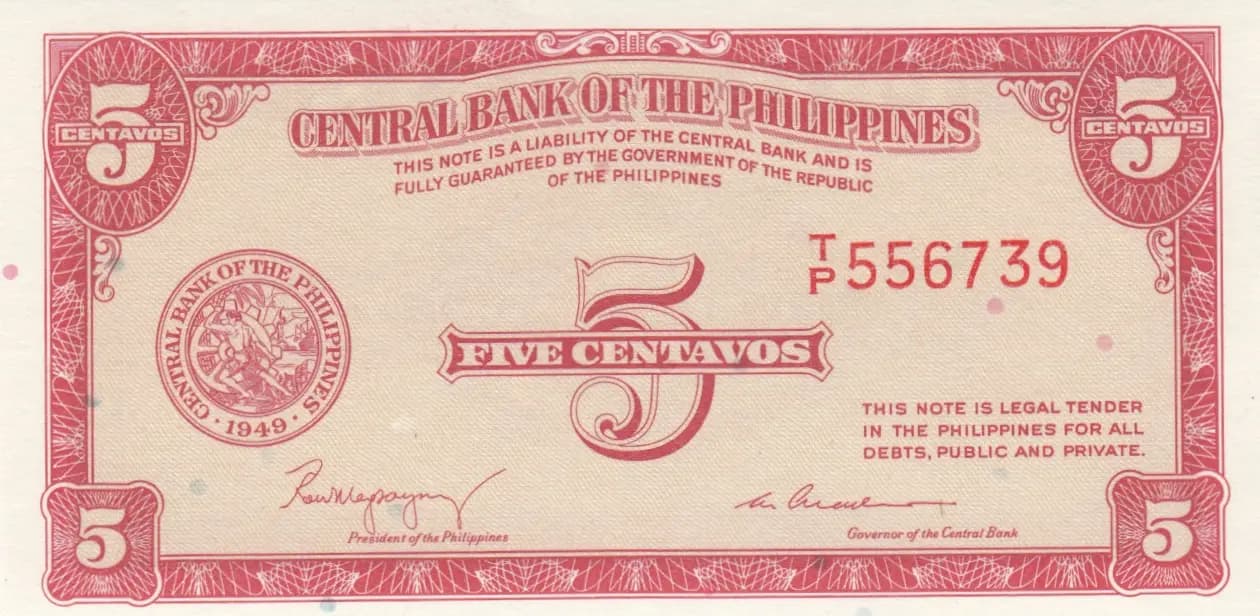
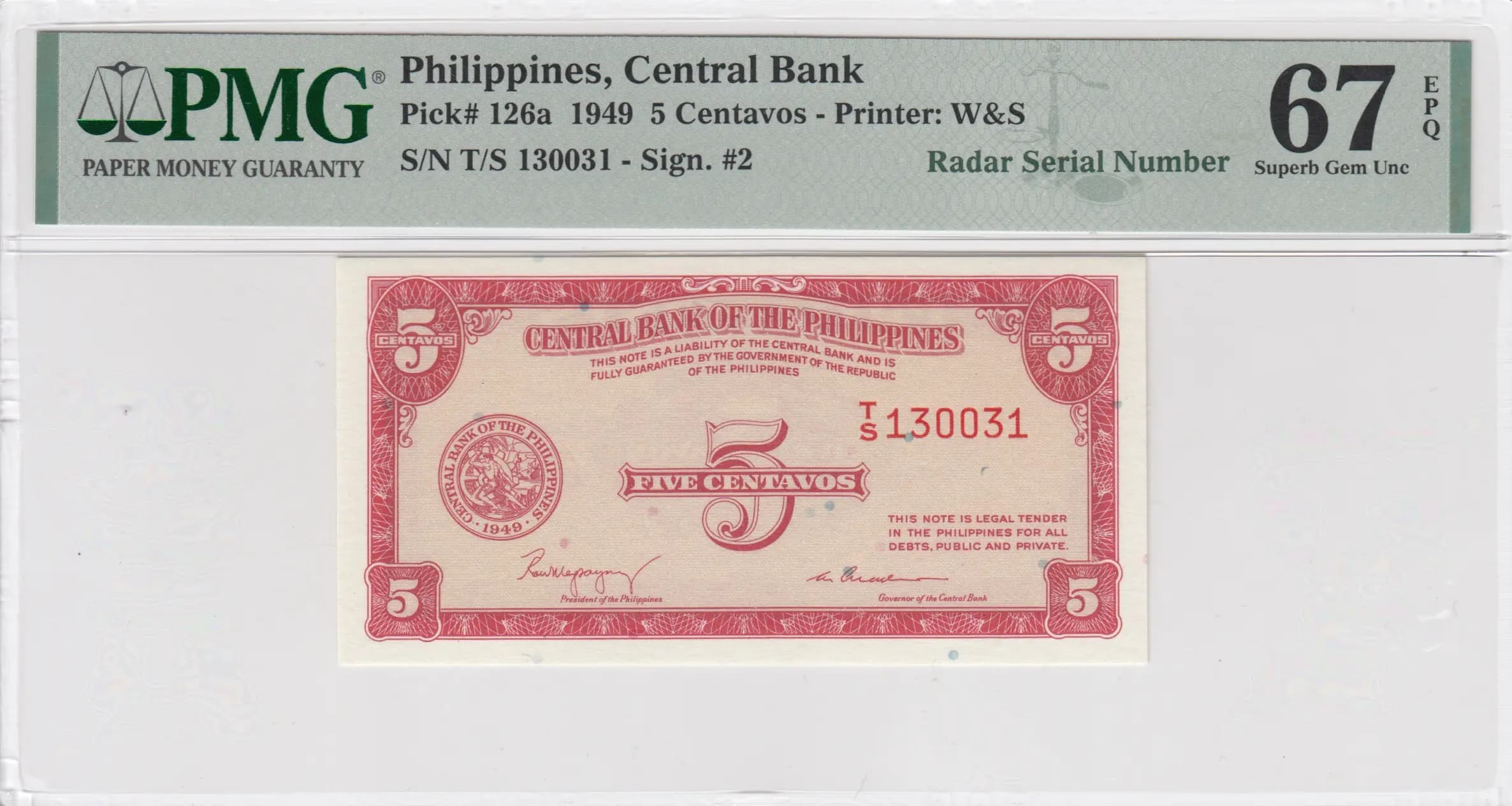
This is a stunning PMG 67 EPQ example of the Philippines 5 Centavos from 1949, issued by the Central Bank of the Philippines. The note exhibits exceptional preservation with crisp paper quality, sharp printing, and no visible wear, creases, or folds. The striking red and pink ornamental design on cream underprint, combined with the Central Bank seal and dual signatures, makes this an attractive example of early Philippine monetary design, with recent market performance showing PMG 67 examples commanding over $100.
Common. While this specific variety (P-126a, 1949) in PMG 67 EPQ condition is well-preserved and desirable to collectors, the denomination itself was part of a standard issue by the Central Bank of the Philippines. eBay market data shows consistent circulation of examples across multiple grades (VF to UNC selling for under $3, with even PMG 66 examples selling for $26), indicating adequate supply in the collector market. The PMG 67 sale at $103.49 in 2020 represents strong demand for this specific condition grade, but the note is not rare in absolute terms—it is rather a common issue in exceptional condition.
This 5 Centavos note was issued during the early years of the Central Bank of the Philippines (established 1949), a critical period following Philippine independence in 1946 as the nation established its monetary sovereignty. The note's dual signature lines for the President of the Philippines and Governor of the Central Bank reflect the institutional cooperation required to stabilize the young nation's currency, while the guarantee text emphasizing the government's backing demonstrates confidence in the new republic's financial systems.
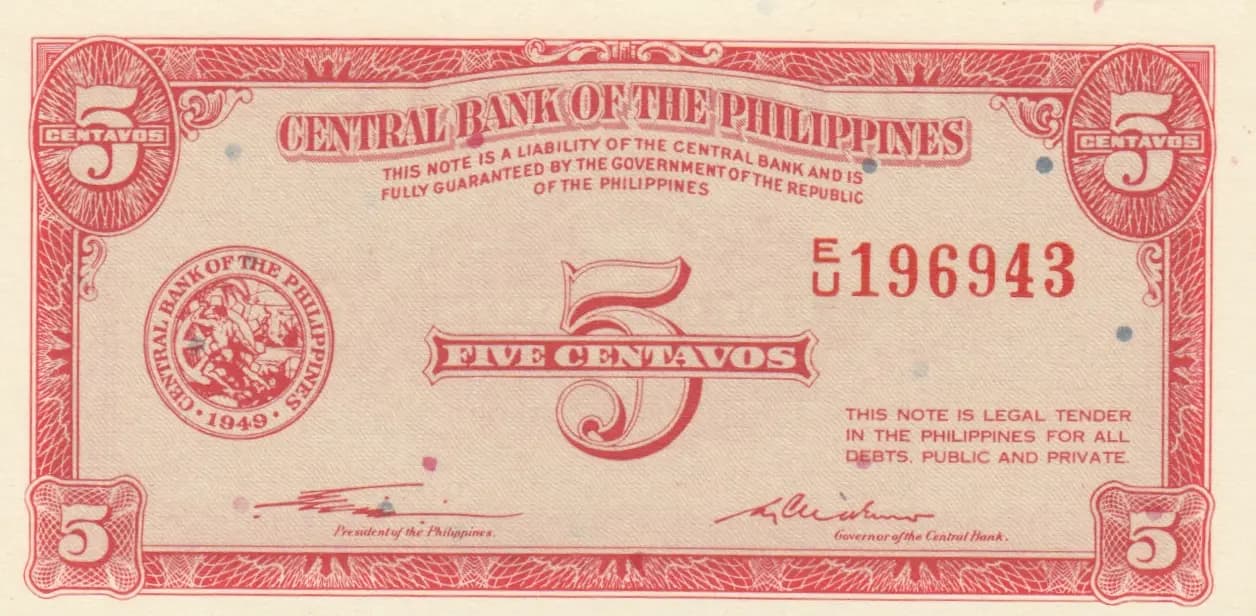
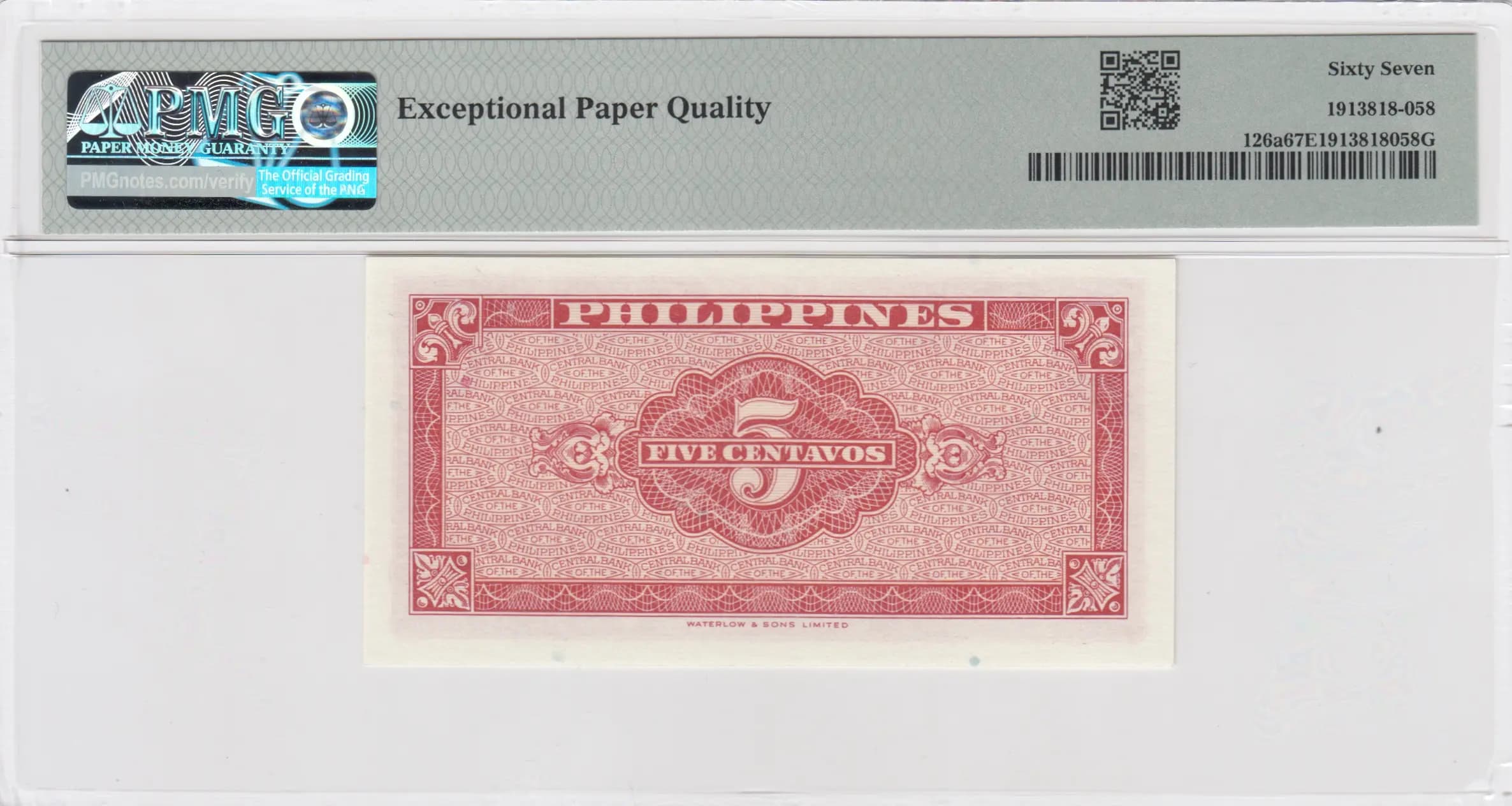
The note features a symmetrical, classically-styled design centered on denomination rather than portraiture. The obverse displays ornate red and pink decorative borders with corner elements featuring the numeral '5' in ornamental cartouches. The Central Bank of the Philippines circular seal (Type 1, dated 1949) is positioned at the left side, with dual signature lines below for the presidential and central bank authorities. The reverse employs a sophisticated security technique using repetitive background text spelling 'CENTRAL BANK OF THE PHILIPPINES' across the entire field, with the denomination 'FIVE CENTAVOS' prominently displayed in an ornate central cartouche. Fine line engraving appears throughout all corner decorations, creating visual depth and anti-counterfeiting complexity typical of high-security banknote design.
Front Side: 'CENTRAL BANK OF THE PHILIPPINES' (main issuer identification); '5 CENTAVOS' (denomination in English); 'THIS NOTE IS A LIABILITY OF THE CENTRAL BANK AND IS FULLY GUARANTEED BY THE GOVERNMENT OF THE REPUBLIC OF THE PHILIPPINES' (legal backing statement); 'THIS NOTE IS LEGAL TENDER IN THE PHILIPPINES FOR ALL DEBTS, PUBLIC AND PRIVATE' (legal tender declaration); 'President of the Philippines' and 'Governor of the Central Bank' (signature lines); Serial number 'T/S 130031' (unique identifier). Back Side: 'PHILIPPINES' (country name); 'FIVE CENTAVOS' (denomination spelled out); 'CENTRAL BANK OF THE PHILIPPINES' (repeated as security background pattern); 'WATERLOW & SONS LIMITED' (printer's mark).
This note was produced using traditional intaglio engraving and letterpress printing methods by Waterlow & Sons Limited (also referred to as W&S in numismatic references), a renowned London-based security printer. The sharp, precise rendering of fine decorative lines, the clarity of the repetitive security text background, and the crisp impression of all design elements throughout the note are characteristic of intaglio printing combined with multi-color registration. The quality of impression visible in the PMG 67 EPQ example demonstrates the high technical standards maintained by Waterlow & Sons during this period.
This is catalogued as Pick 126a, distinguishing it from Pick 125 (similar design with different signatures and printed by Security Banknote Company). The 'a' designation indicates this is a known sub-variety. The serial number observed is 'T/S 130031' with red text formatting. The specific signatures visible (President of the Philippines and Governor of the Central Bank) would correspond to the individuals in office during 1949, though the visual analysis does not identify them by name. Collectors should note that signature varieties within the 1949 issue may exist depending on the exact date of printing and officials serving at different points during that year.