20 pesos 1944
“Mindanao”
Market Prices
About This Note
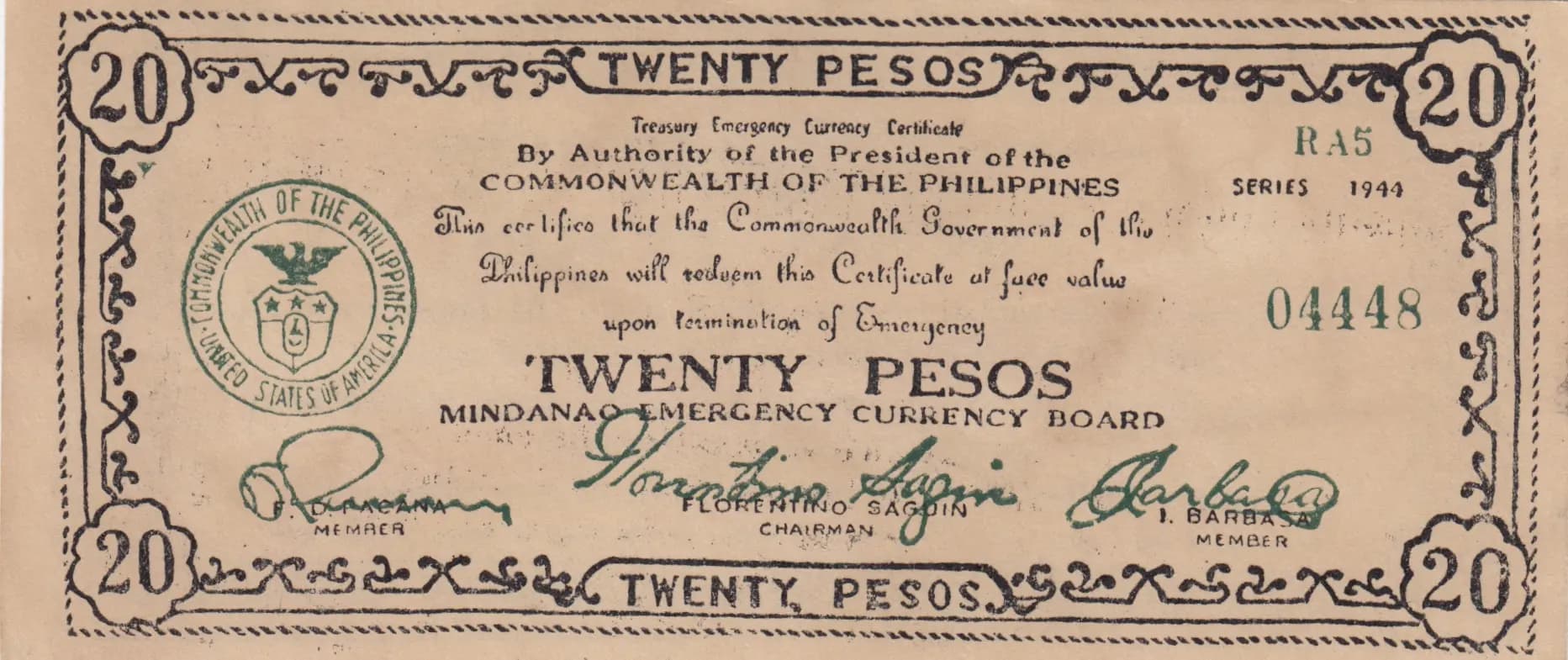
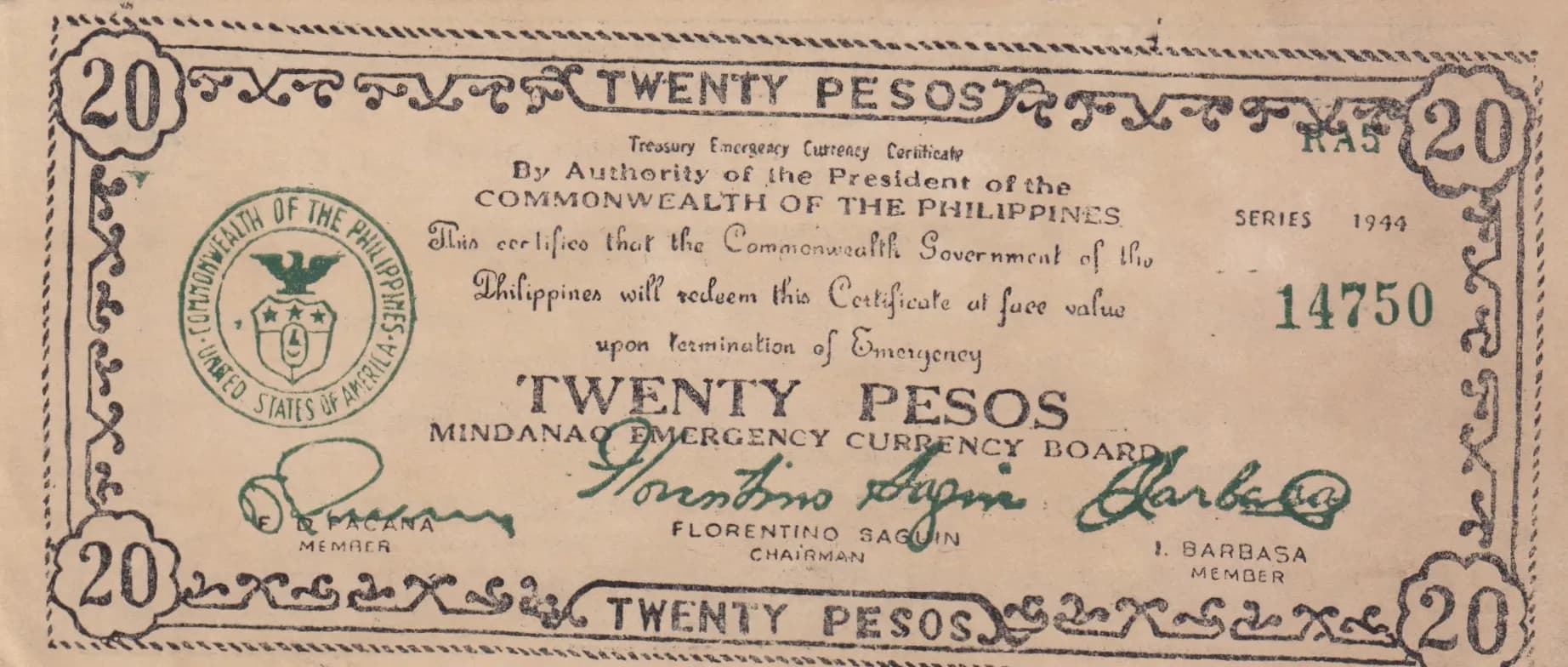
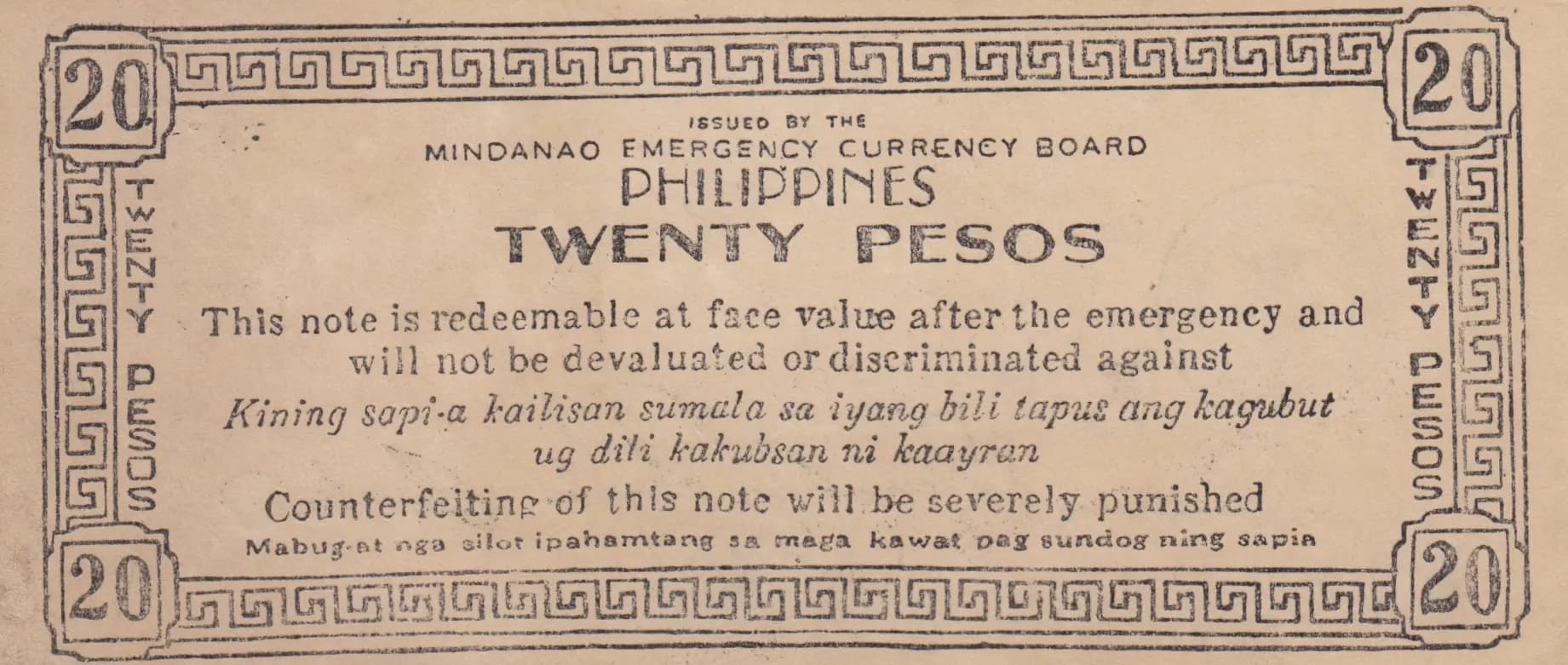
This is a 1944 Commonwealth of the Philippines 20 Pesos Treasury Emergency Currency Certificate, graded AU, issued by the Mindanao Emergency Currency Board during World War II. The note features distinctive ornamental borders with floral/vine patterns on the front and Greek key geometric designs on the reverse, printed in tan/beige, green, and blue tones on aged paper consistent with mid-20th century emergency currency. This is a historically significant regional emergency issue from the Japanese occupation period, with bilingual text in English and Tagalog reflecting the Commonwealth government's commitment to redeem the certificate at face value post-emergency.
Common. The eBay market data provided shows multiple listings with prices predominantly in the $4.50-$58.00 USD range, with an AU example at $255.00 representing an outlier. The prevalence of listings across various condition grades (VG, VF, XF, CIRC) and multiple 'Unknown' condition sales at modest prices ($6.99-$14.00) indicates this is a readily available note in the collector market. While regional emergency currency from Mindanao may be slightly more specialized than mainline Commonwealth issues, the abundant supply of examples in the secondary market and the modest pricing for this specific Pick number (P-S528a) confirm its common status. Emergency currency certificates from the Philippines, though historically significant, were issued in substantial quantities to facilitate regional commerce during the occupation period.
Issued under the authority of the Commonwealth of the Philippines during the critical 1944 period of World War II, this emergency currency certificate represents the economic disruption and innovative financial responses during the Japanese occupation. The Mindanao Emergency Currency Board's issuance of this regional currency demonstrates the decentralized emergency response by Philippine Commonwealth authorities to maintain commerce in areas cut off from normal currency supplies. The bilingual inscriptions in English and Tagalog, along with the official Commonwealth seal featuring an eagle and shield design, underscore the sovereignty and institutional continuity the Philippine government attempted to preserve during the occupation.
The obverse features a formal certificate layout with the ornamental border composed of repeating floral and vine scroll patterns in the corners and margins, creating an elegant frame for the central text. The Seal of the Commonwealth of the Philippines dominates the upper left, depicted as a circular emblem containing an eagle and shield design with three stars and curved design elements, representing the official authority of the issuer. The note displays 'TWENTY PESOS' in multiple locations for redundancy and anti-counterfeiting purposes. Signatures of Florentino Saguin (Chairman) and L. Barbasa (Member) appear prominently, lending official authentication. The reverse employs a more geometric aesthetic with Greek key (meander) pattern borders running along all four edges and corners in dark blue/black, creating decorative corner flourishes with repeating geometric designs. The reverse text focuses on redemption terms and counterfeiting warnings presented in both English and Tagalog, emphasizing the note's post-emergency redeemability and the Commonwealth's commitment to honoring the currency. The bilingual approach reflects the diverse linguistic composition of the Mindanao region and the Philippine Commonwealth's inclusive governance messaging.
FRONT SIDE: '20' / 'TWENTY PESOS' - Denomination value. 'Treasury Emergency Currency Certificate' - Official designation of note type. 'By Authority of the President of the COMMONWEALTH OF THE PHILIPPINES' - Issuing authority. 'This certificate that the Commonwealth Government of the Philippines will redeem this Certificate at face value upon termination of Emergency' - Redemption guarantee (note text appears slightly incomplete in original). 'MINDANAO EMERGENCY CURRENCY BOARD' - Issuing regional authority. 'Florentino Saguin / CHAIRMAN' and 'L. Barbasa / MEMBER' - Official signatures and titles. 'SERIES 1944' and '14750' / 'RAJ' - Series designation, serial number, and printer initials. REVERSE SIDE: '20' / 'TWENTY PESOS' - Denomination value. 'ISSUED BY THE / MINDANAO EMERGENCY CURRENCY BOARD / PHILIPPINES' - Issuer identification. 'This note is redeemable at face value after the emergency and will not be devaluated or discriminated against' - Redemption guarantee in English. 'Kining sapi-a kailisan sumala sa iyong bili tapus ang kagubat ug dili hakubsan ni kaayran' - Tagalog translation: 'This certificate can be exchanged for goods after the war ends and will not be rejected or discriminated against.' 'Counterfeiting of this note will be severely punished' - Counterfeiting warning in English. 'Mabugat aga silot ipahamtang sa mga kawat pag sundos ning sapia' - Tagalog translation: 'Heavy punishment will be imposed on those who counterfeit this note.'
Letterpress/relief printing, typical of 1940s Philippine currency production. The sharp registration of text, clear definition of ornamental borders (both the flowing floral patterns on the obverse and geometric Greek key patterns on the reverse), and the consistent impression of official seals and signatures indicate traditional letterpress printing technology. The aged tan/beige paper with green and blue inks suggests multiple color printing passes. The printer initials 'RAJ' appear on the obverse, likely identifying the printing facility or responsible technician, though the specific security printer for this Philippine Commonwealth emergency issue is not definitively documented in standard catalogs for this variant.
This specific example is identified as Pick P-S528a, indicating it is the 'a' variety of this denomination and issue. The serial number '14750' with initials 'RAJ' is visible on the obverse. The signatories Florentino Saguin and L. Barbasa are consistent with documented Mindanao Emergency Currency Board officials. No overprints or date variations are observed on this example. Potential varieties for this type would include different signature combinations, serial number prefixes, or variations in printer initials, though without access to comprehensive Philippine emergency currency specialization references, specific documented varieties beyond the 'a' designation cannot be authoritatively stated. The collector note indicating 'Mindanao' origin confirms the regional specification of this issue.