2 pesos 1942
“Negros Occid.”
Market Prices
1 saleAbout This Note
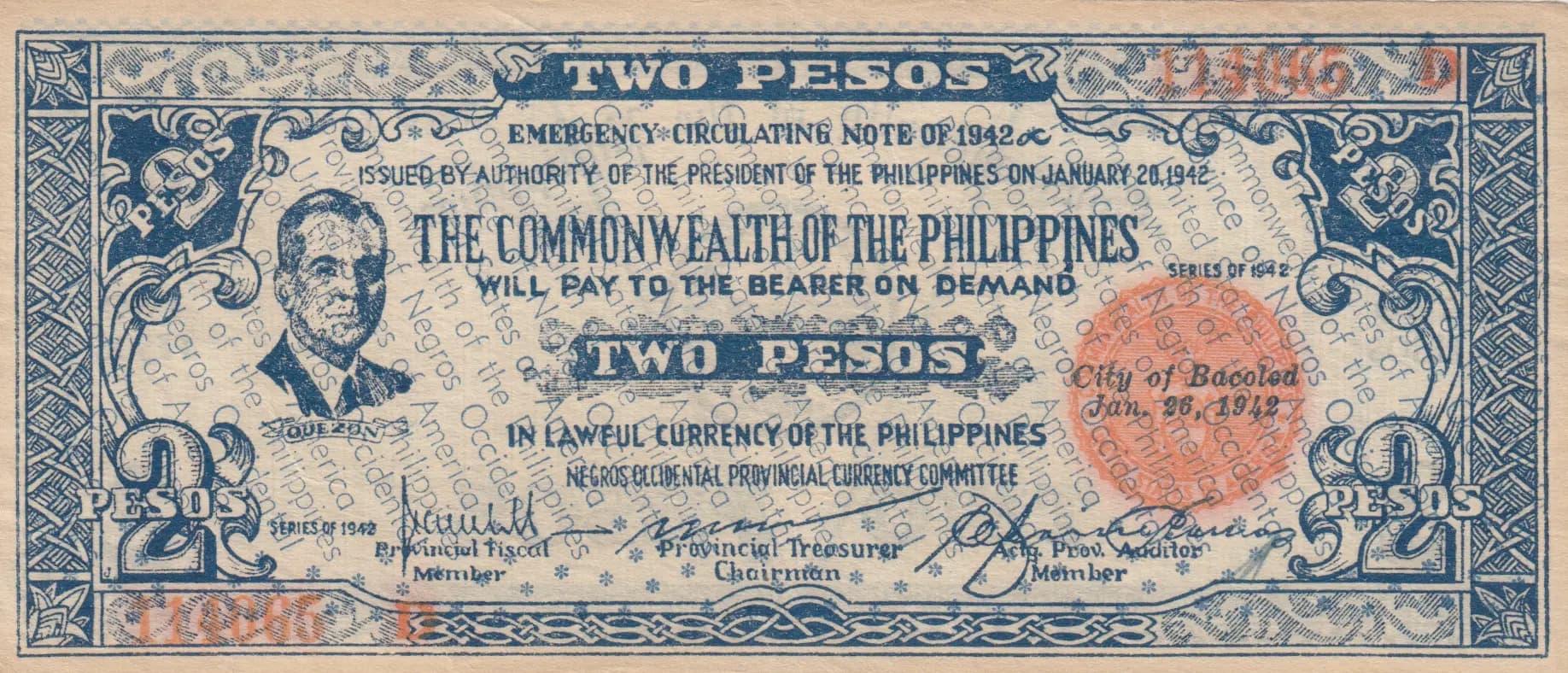
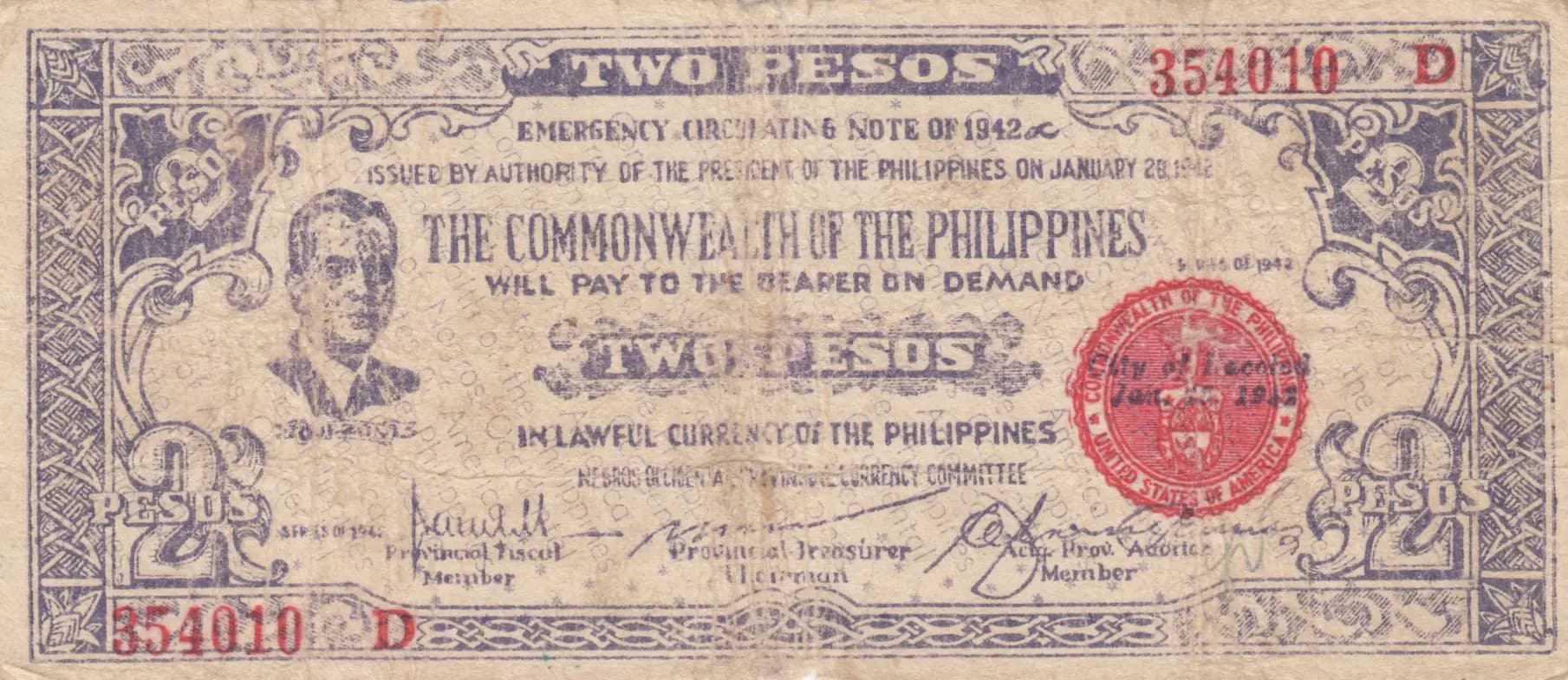
This is a Philippine Commonwealth Emergency Circulating Note of 2 Pesos from January 28, 1942, issued during the critical early months of World War II in the Pacific. The note features a portrait of Manuel L. Quezon on the obverse with the Commonwealth seal in red, ornate purple-printed borders, and displays serial number 354010D. In VG condition, the note exhibits expected aging with multiple creases, foxing, and discoloration throughout, consistent with active wartime circulation from the Negros Occidental region.
Common. While this is a historically significant emergency issue, the serial number range (251,000 to 678,000) indicates a substantial print run of over 400,000 notes. The eBay price data showing a PMG 64 specimen selling for $27 in May 2025 confirms modest collector demand and supply. Emergency notes from this period, though historically important, were produced in large quantities to meet wartime circulation needs and remain readily available in the numismatic market.
This emergency issue was authorized by Philippine President Manuel L. Quezon just weeks after the Japanese invasion of the Philippines on December 8, 1941. The note's inscription—'ISSUED BY AUTHORITY OF THE PRESIDENT OF THE PHILIPPINES ON JANUARY 28, 1942'—marks a desperate period when the Commonwealth government was relocating and establishing the Bataan peninsula as a temporary seat of power. These emergency notes were printed to sustain commerce in occupied and unoccupied zones while normal currency supplies were disrupted, making them vital artifacts of the Philippines' World War II experience.
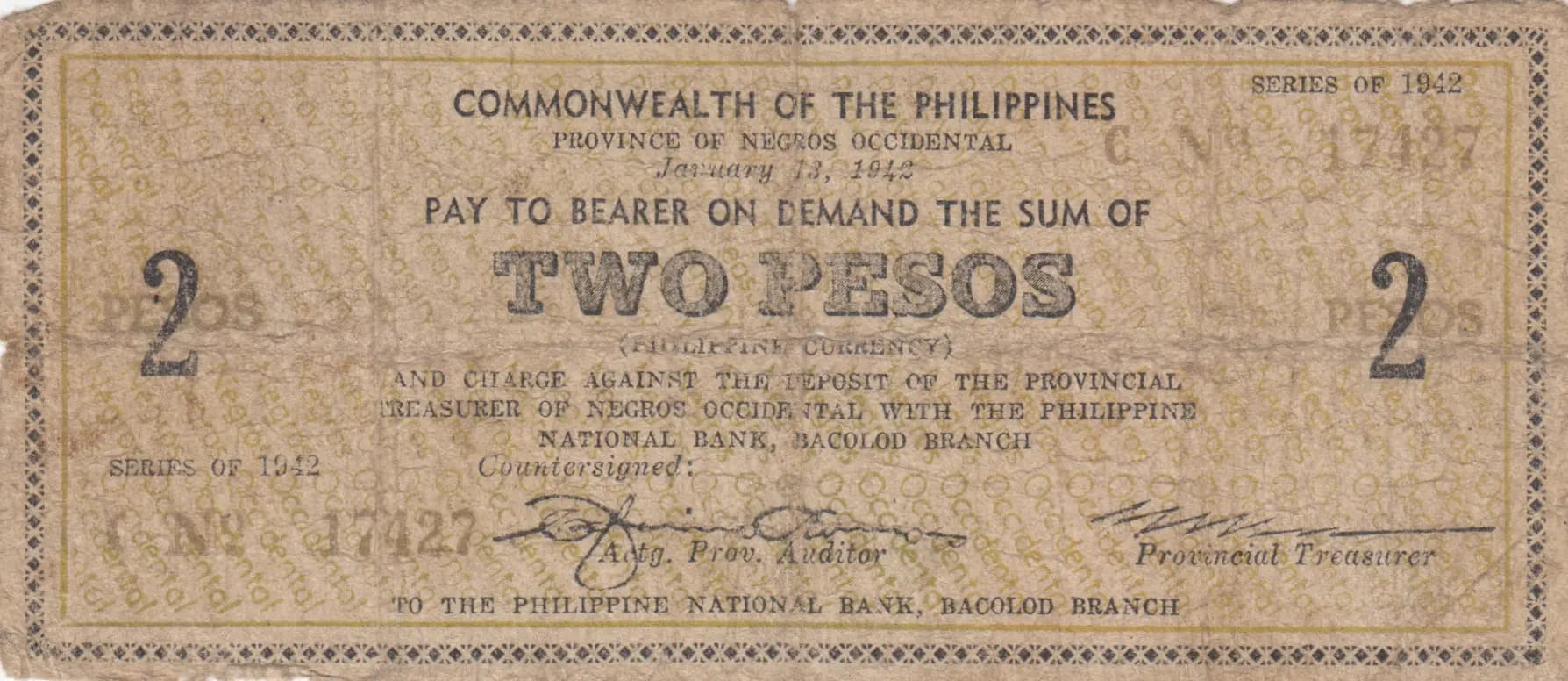
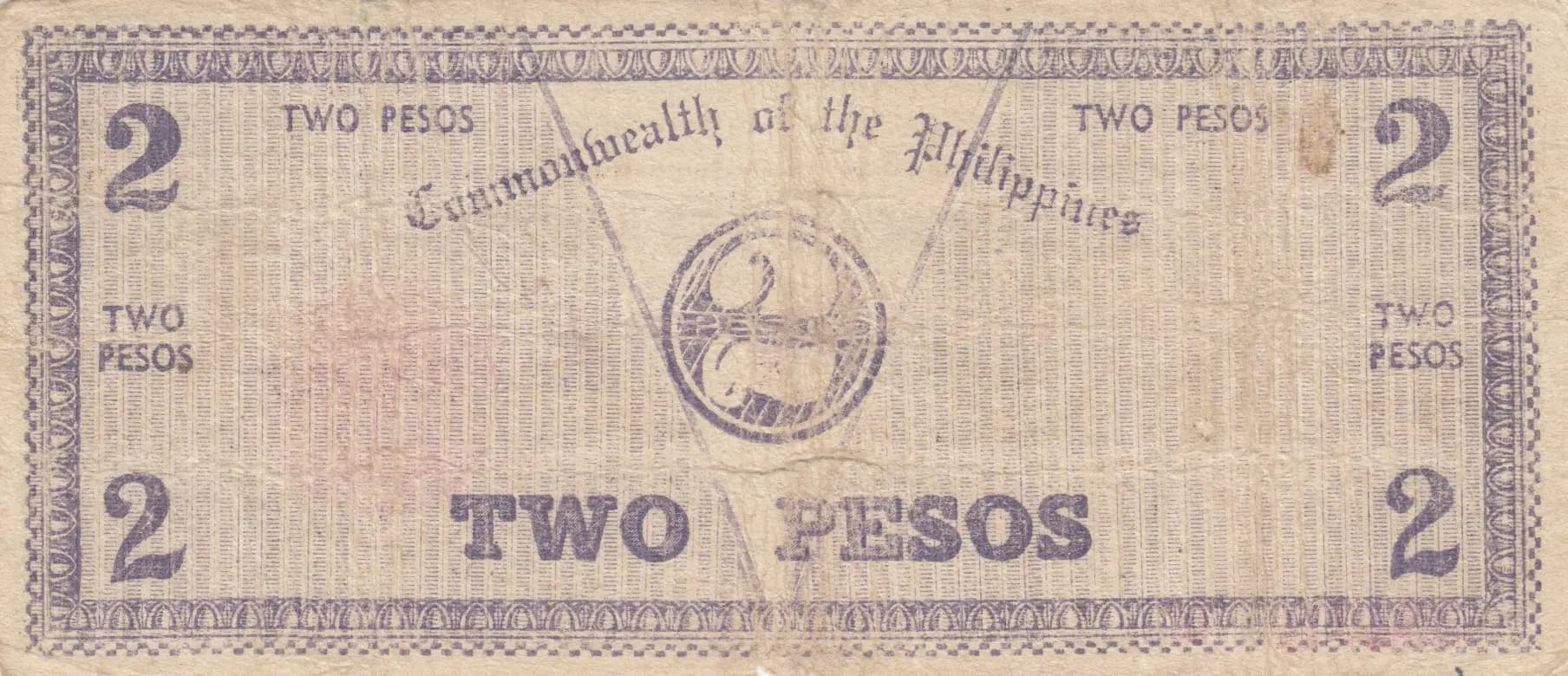
The obverse features a left-facing portrait of Manuel L. Quezon, the Commonwealth's president, positioned at the left side of the note. The right side displays a red circular seal featuring an eagle emblem, representing Philippine governmental authority. The reverse is symmetrically designed with large numerals '2' positioned in all four corners and a central circular emblem with vertical stripe pattern detailing. Both sides employ ornate engraved decorative borders and corner designs executed in purple/blue ink on a tan underprint. The paper base is identified as Bais stock. The overall aesthetic reflects official emergency currency design standards of the early 1940s, balancing security features with functional clarity during wartime conditions.
OBVERSE: 'TWO PESOS' (denomination); 'EMERGENCY CIRCULATING NOTE OF 1942'; 'ISSUED BY AUTHORITY OF THE PRESIDENT OF THE PHILIPPINES ON JANUARY 28, 1942'; 'THE COMMONWEALTH OF THE PHILIPPINES WILL PAY TO THE BEARER ON DEMAND'; 'UNLAWFUL CURRENCY OF THE PHILIPPINES' (security/control inscription); Serial numbers 354010 and 354010 D (red). REVERSE: 'TWO PESOS' (top and bottom); 'TWO PESOS' (repeated); 'Commonwealth of the Philippines' (center); Large numeral '2' in all four corners.
Intaglio (engraved) printing on Bais paper stock, utilizing multiple color printing with primary purple/blue and secondary red inks. The fine line background patterns, ornate border designs, and security elements visible in both the obverse and reverse indicate the use of steel plate engraving. This production method was standard for Philippine Commonwealth currency issued by official government printers during the 1942 emergency circulation period.
This specimen is identified as Pick P-S647B (the B variant designation suggests multiple plate varieties exist for this issue). The specific serial number 354010D falls within the documented range of 251,000 to 678,000. The note originates from the Negros Occidental region, as noted in collector records. Varieties for this issue are typically distinguished by serial number ranges, plate letter suffixes (here 'D'), and regional distribution patterns. No overprints or unusual markings are observed on this particular specimen beyond standard serial numbering.