10 pesos 1949
Market Prices
17 salesAbout This Note
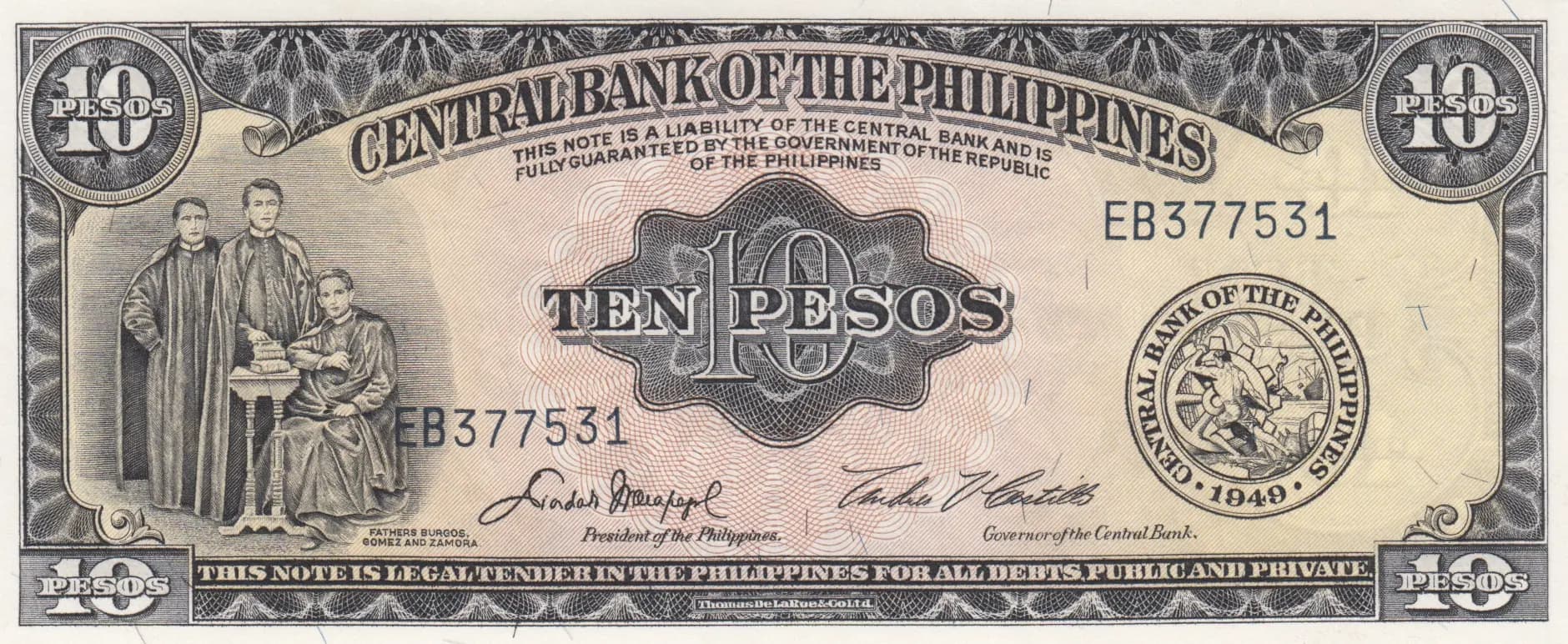
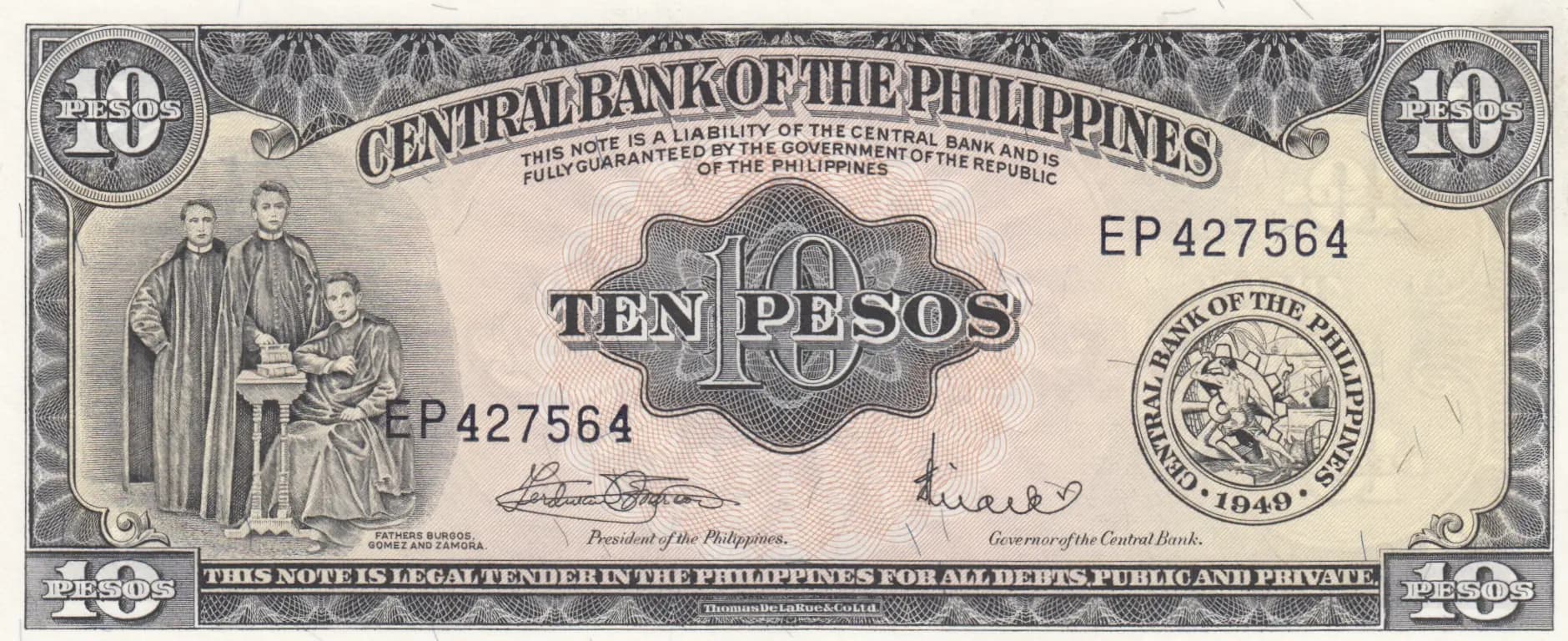
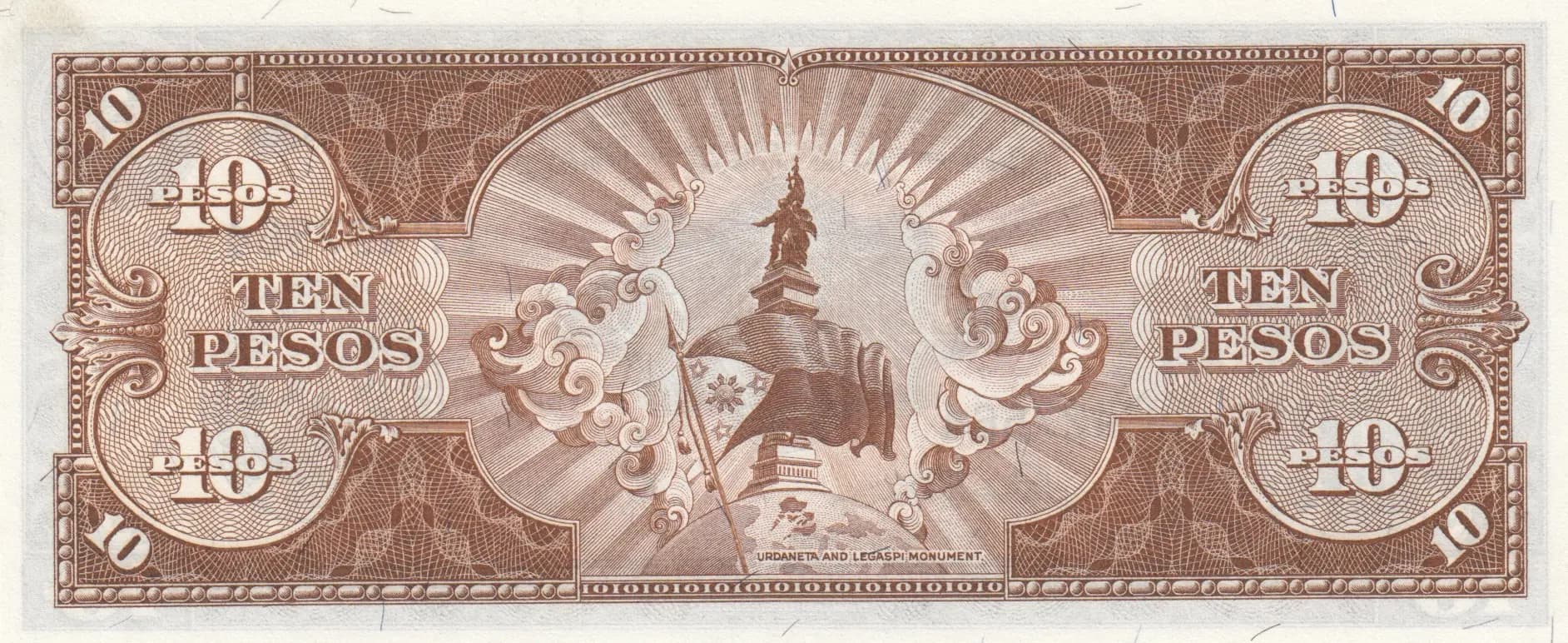
This 1949 Philippine 10 Pesos note (Pick P-136f) presents in uncirculated condition with exceptional clarity and crisp printing throughout. The front features a classical engraved portrait of three robed religious figures (Fathers Burgos, Gomez and Zamora) alongside the prominent Central Bank of the Philippines seal dated 1949, while the reverse displays the Urdaneta and Legaspi Monument rendered in warm brown tones with radiating light effects. This is a notably common note in the secondary market with consistent pricing around $2-3 in UNC condition, making it an affordable entry point for collectors of early Philippine currency.
Common. This note consistently appears in the market with eBay sale prices ranging from $2.35 to $47.07 depending on condition grade and buyer competition, with most UNC examples selling in the $2-15 range. The catalog value for UNC condition is listed at $2 (2019 estimate), and the high frequency of sales across multiple years and condition grades indicates substantial print quantities remain in circulation and collector hands. There is no evidence of limited print runs, recall status, or scarcity factors.
Issued in 1949 by the newly-independent Central Bank of the Philippines, this note commemorates three 19th-century Filipino Catholic priests (Fathers Burgos, Gomez, and Zamora) who were executed during the Spanish colonial period, reflecting the nation's emphasis on nationalist heroes during its early independence era. The reverse's depiction of the Urdaneta and Legaspi Monument celebrates Spanish colonial explorers whose expeditions established the Philippines as a Spanish territory, representing the complex historical narrative of Philippine identity in the post-World War II period.
The obverse features a classical engraved composition with three full-length robed male figures identified as Fathers Mariano Gomez, José Burgos, and Jacinto Zamora—19th-century Filipino Catholic priests and nationalist symbols—positioned on the left side. The center displays the denomination 'TEN PESOS' within an ornate shield design flanked by decorative corner medallions bearing the numeral '10'. The right side bears the circular seal of the Central Bank of the Philippines dated 1949. The reverse showcases the Urdaneta and Legaspi Monument as the central focal point, rendered with fine engraving and surrounded by baroque-style scrollwork, clouds, and radiating light rays suggesting divine or patriotic importance. Four corner medallions repeat the denomination. The entire design employs classical guilloche patterning and geometric security elements characteristic of Thomas de la Rue's premium currency work.
FRONT: Central Bank of the Philippines | This note is a liability of the Central Bank and is fully guaranteed by the Government of the Republic of the Philippines | Ten Pesos | Serial number: EP427564 | President of the Philippines [signature line] | Governor of the Central Bank [signature line] | Fathers Burgos, Gomez and Zamora | This note is legal tender in the Philippines for all debts public and private | Thomas de la Rue & Co Ltd [printer mark]. BACK: Ten Pesos (repeated in corner medallions) | Urdaneta and Legaspi Monument | P10.
This note was produced using intaglio engraving (line engraving), the premium currency printing method employed by Thomas de la Rue & Co Ltd of London. The visual evidence includes extensive fine-line guilloche patterns throughout both sides, complex geometric borders, and the refined detail visible in the portraiture and monument rendering. The security features incorporate layered guilloche backgrounds, ornamental shields, and intricate border designs typical of intaglio production, with color achieved through multi-plate printing using black, brown, tan, and pink/rose undertones.
The observed specimen exhibits the Type 1 Central Bank Seal as noted in reference catalogs. The serial number prefix 'EP' is consistent with Philippine currency of this era. The signature lines for the President of the Philippines and Governor of the Central Bank are present but unfilled in this specimen, which is typical of many surviving examples. Pick catalog designation P-136f indicates this is part of the established series without special varieties noted; no overprints, color variations, or signature varieties are evident in this example that would distinguish it as a notable sub-variety.