10 centavos 1942
Market Prices
9 salesAbout This Note
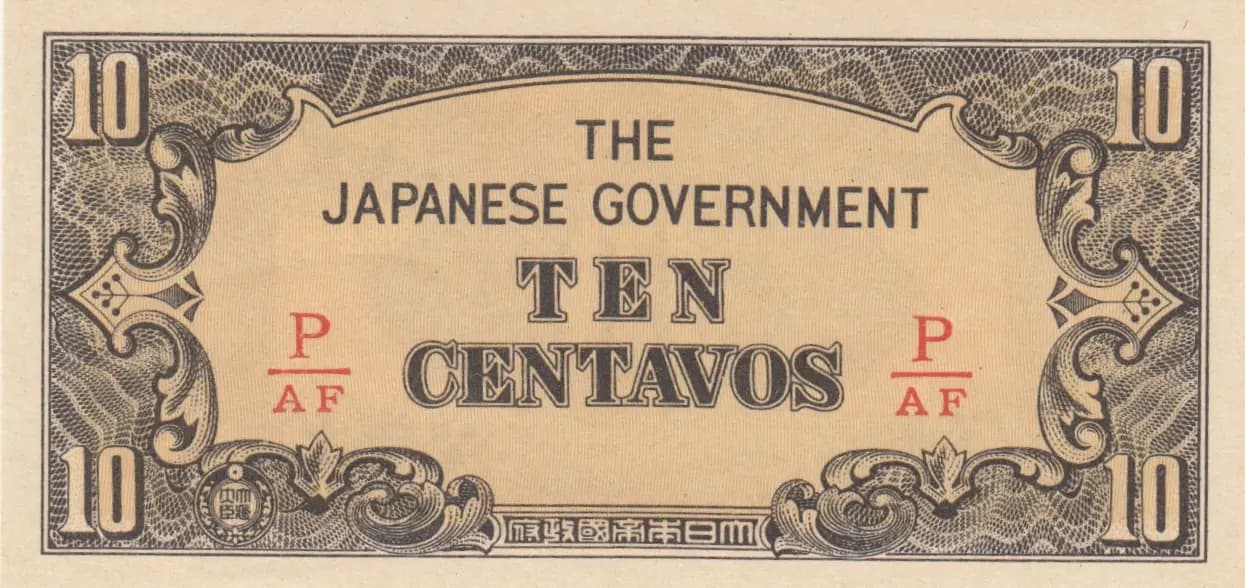
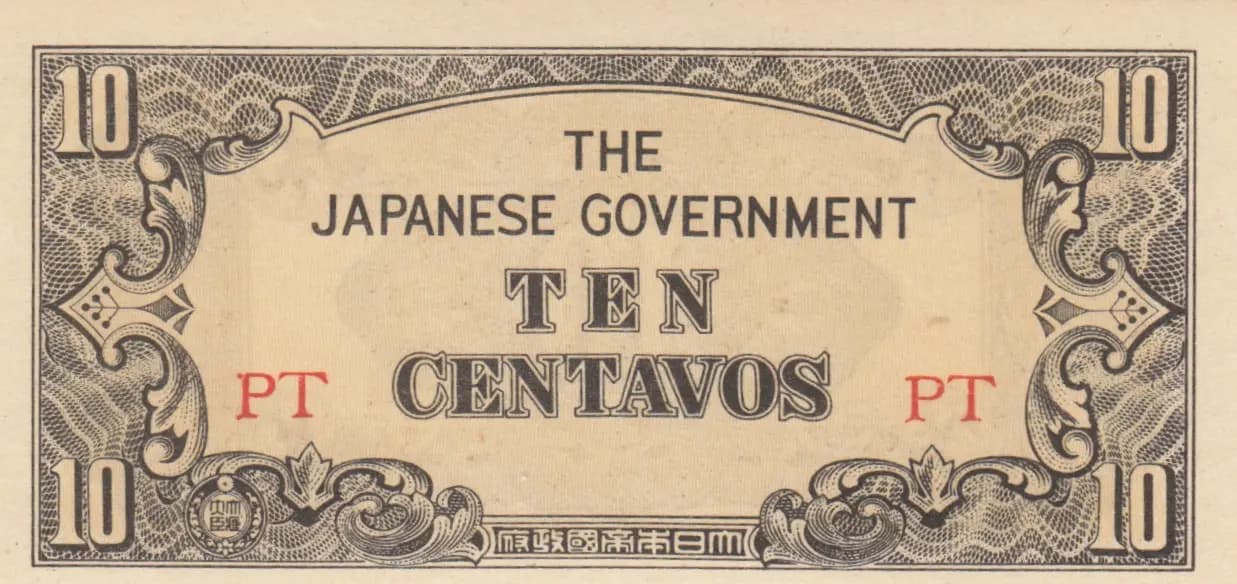
This is a Japanese Government occupation currency note for the Philippines, denominated in 10 centavos and issued in 1942 during World War II. The specimen presents in uncirculated condition with pristine paper quality, cream/beige coloring, and crisp black printing throughout. The ornate design features elaborate scrollwork, decorative borders, and fine crosshatch security patterns characteristic of this series, making it a historically significant example of wartime occupation currency.
Common. Despite its historical significance as wartime occupation currency, these notes were produced in substantial quantities across the Philippines during the 1942-1945 period. eBay market data confirms common status: recent sales in UNC condition fetch only $0.50-$2.25, with even PMG-graded examples (65-66) selling for $13-$32. The catalog value for UNC condition is listed at $0.50. Large surviving populations of this series exist due to the extended occupation period and subsequent preservation of these notes as historical artifacts.
Issued by the Japanese Government during its occupation of the Philippines in World War II, this note represents the military currency system imposed on occupied territories as part of the Greater East Asia Co-Prosperity Sphere initiative. The bilingual English-Japanese inscriptions and the Co-Prosperity Sphere characters visible on the front reflect Japan's attempt to legitimize its occupation through economic structures. This denomination and series were in circulation from 1942 until the end of the war in 1945, making them direct artifacts of the Pacific Theater conflict.
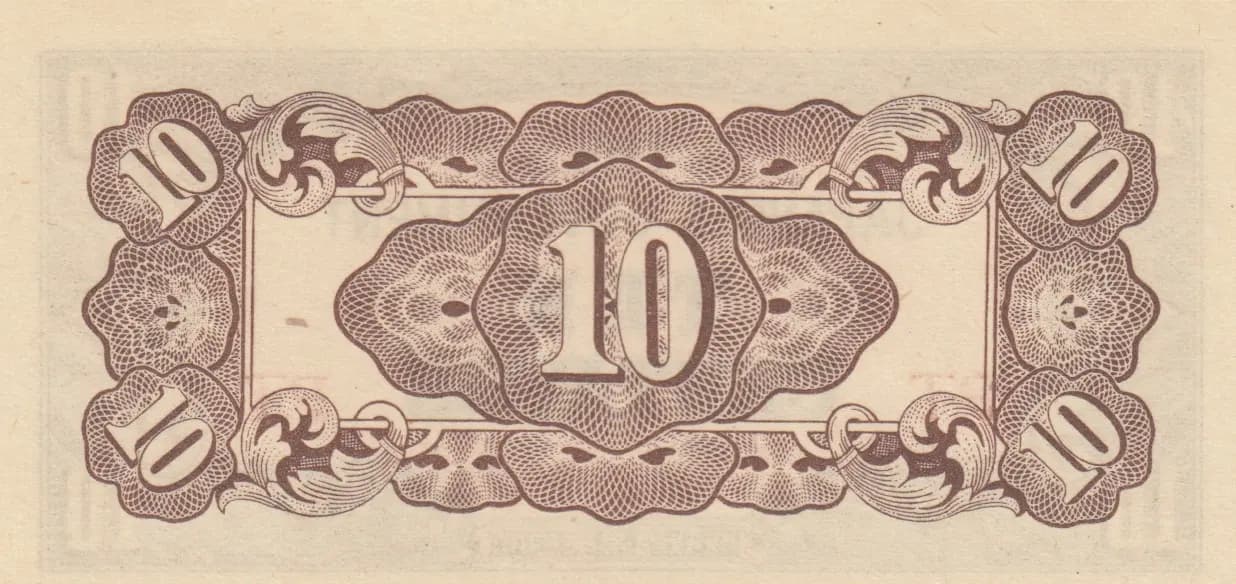
This note exemplifies the Japanese occupation currency design aesthetic with symmetrical, ornate composition emphasizing imperial aesthetic principles. The front features a formal layout with denomination text centered, flanked by decorative scrollwork and floral motifs in all four corners. The back displays a large stylized numeral '10' within an elaborate cartouche frame, surrounded by symmetrical corner ornaments and flourishes. The entire design employs fine crosshatch background patterns as both decorative and security elements. The cream/beige paper with brown and black printing creates a warm, aged appearance. No portraits or specific landmarks are depicted; instead, the design relies on abstract ornamental elements and geometric patterns typical of Japanese-issued occupation currency.
Front side: 'THE JAPANESE GOVERNMENT' (English text indicating issuing authority), 'TEN CENTAVOS' (English denomination), 'PT' (appears twice, likely printer's marks or block identifiers), and Japanese characters '南方共栄圏日間' (Greater East Asia Co-Prosperity Sphere reference). Back side: Multiple instances of the Arabic numeral '10' in corners and central ornamental cartouche, with no additional text inscriptions visible.
Intaglio (engraved) printing method, evidenced by the fine, crisp line work visible in the crosshatch security patterns, ornamental border details, and sharp character definition. The intricate cartouche design and multi-layered border ornamentation are characteristic of high-quality intaglio production. This note was produced by Japanese Government printing facilities established in occupied territories, consistent with occupation currency standards of the era.
Pick number P-104a indicates this is variety 'a' of the 10 centavos Japanese Government note. The visual analysis notes the presence of '2 block letters' (identified as 'PT'), which are printer or block identifiers. The catalog designation with the 'a' suffix suggests multiple printings or varieties exist for this denomination. No specific overprints, date variations, or signature varieties are apparent in this specimen. The block letter designation PT should be noted when cataloging this specific example.