1 peso 1943
“Negros Emerg.”
Market Prices
About This Note
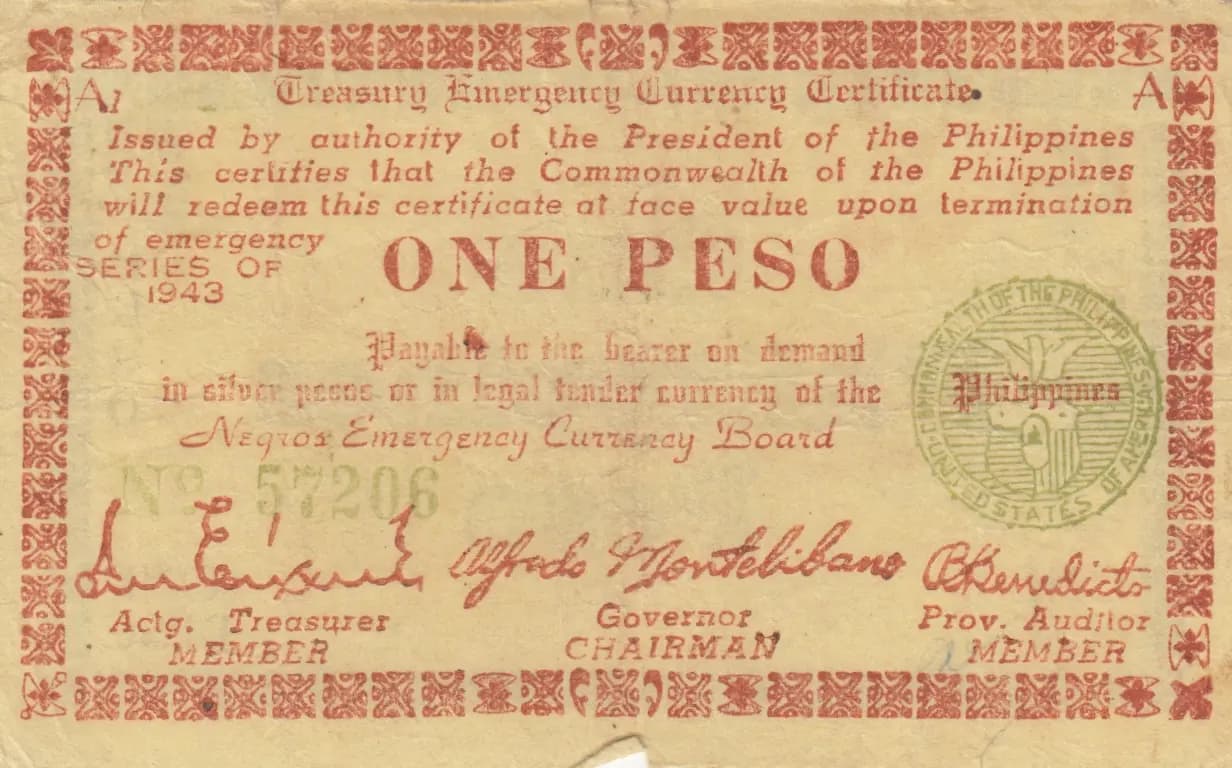
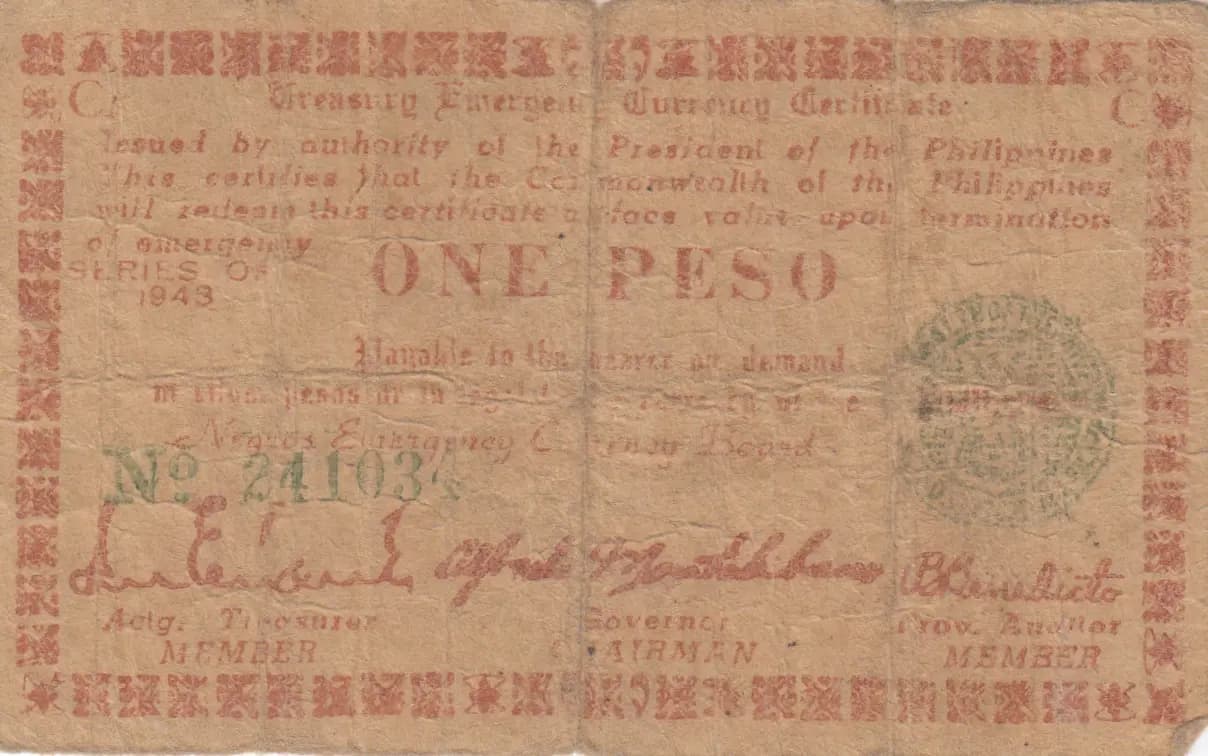
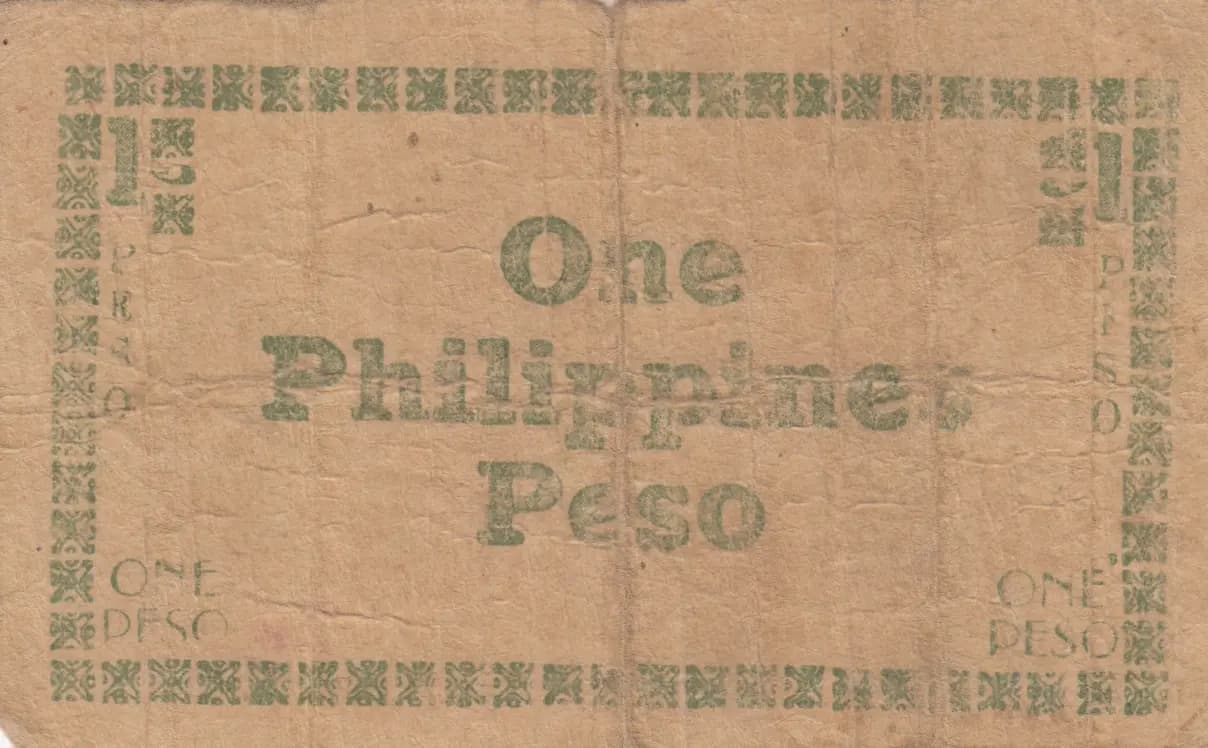
This Philippine 1 Peso note from 1943 (Pick S661b) represents an emergency currency issued during the Commonwealth period, featuring a distinctive reddish-brown front with official seals and signatures, and a green reverse. The note exhibits heavy wear consistent with its age and circulation history, including creasing, foxing, and faded text, placing it in VG condition. The "Negros Emerg." designation indicates this was emergency currency specific to the Negros region, making it a regionally significant piece of Philippine numismatic history.
Common. Despite being an emergency regional issue from 1943, eBay market data shows these notes trading in the $1.99–$19.99 USD range depending on condition, with VG-condition examples typically priced around $2.99–$5.95 USD. The lack of premium pricing and wide availability across multiple condition grades indicates substantial print runs and ready collector supply. Emergency notes from this period, while historically significant, were produced in sufficient quantities to remain accessible to modern collectors.
Issued in 1943 under the authority of the President of the Commonwealth of the Philippines, this emergency note was produced during World War II when Japan occupied the Philippines and normal currency was severely disrupted. The redemption clause stating "the Commonwealth of the Philippines will redeem this certificate at face value" reflects the provisional nature of emergency currencies issued by provincial authorities. Regional emergency issues like this Negros variant represent local government responses to extreme monetary scarcity during the occupation period.
The obverse features a formal government certificate-style layout in reddish-brown with decorative ornamental borders framing the design. The right side displays a circular official seal or stamp, representing provincial authority. Multiple signature lines with titles (Governor/Chairman, Assistant Treasurer/Member, Provincial Auditor/Member) indicate the tri-partite approval structure typical of provincial emergency issues. The reverse presents a simpler, more symmetrical design in green with decorative ornamental corner designs and borders, prominently featuring the denomination 'ONE PESO' and 'One Philippine Peso' as the central text. No portraits or landmarks are depicted—this is a functional emergency certificate rather than a commemorative design.
Front: 'Series O' (series designation), '1943' (year of issue), 'ONE PESO' (denomination), 'Issued by authority of the President of the Philippines' (legal authorization), 'This certifies that the Commonwealth of the Philippines will redeem this certificate at face value upon presentation of emergency' (redemption guarantee), 'No. 241008' (serial number), with signature lines for 'Governor' (CHAIRMAN), 'Ass. Treasurer' (MEMBER), 'Prov. Auditor' (MEMBER). Back: 'One Philippine Peso' (denomination in full), 'ONE PESO' (denomination repeated).
This note employs letterpress printing with multi-color overprinting, as evidenced by the layered reddish-brown and green color schemes on separate sides and the crisp, defined borders visible despite wear. The decorative ornamental patterns and signature lines show characteristics of standard letterpress government security printing. The visible watermark area on the obverse and the precise text registration suggest professional security printing, likely produced by the Philippine Bureau of Printing or under Commonwealth authority during wartime.
This example is identified as Pick S661b, indicating it is a known cataloged variety of the 1943 Negros emergency issue. The serial number 241008 and 'Series O' designation are visible. Varieties within this issue likely relate to different series designations, signature combinations (different signatories for Governor, Treasurer, and Auditor positions), and possibly different printing batches. The 'b' designation in the Pick number suggests there are other varieties (likely 'a' and possibly 'c') with distinguishing characteristics, though without additional reference material, the specific differences cannot be determined from the images alone.