1 peso 1943
“Bohol”
Market Prices
About This Note
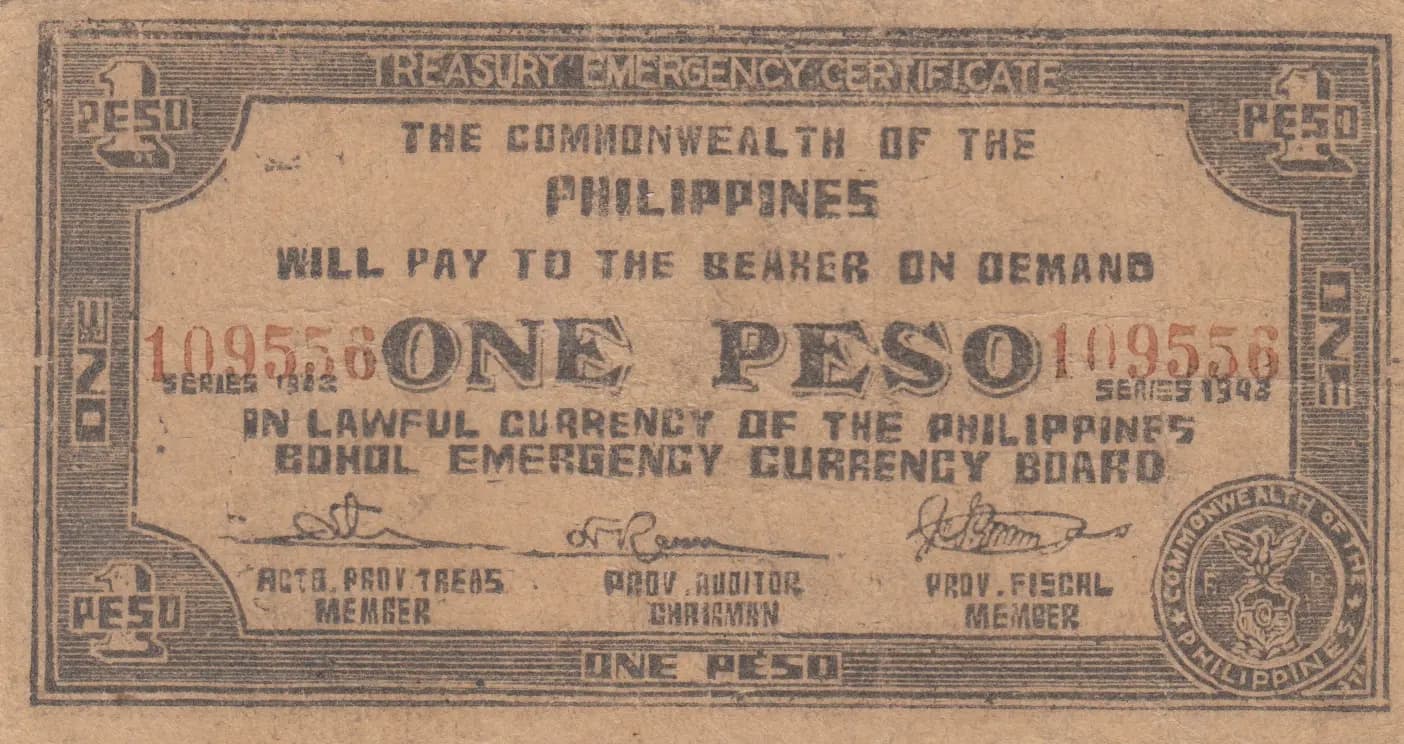
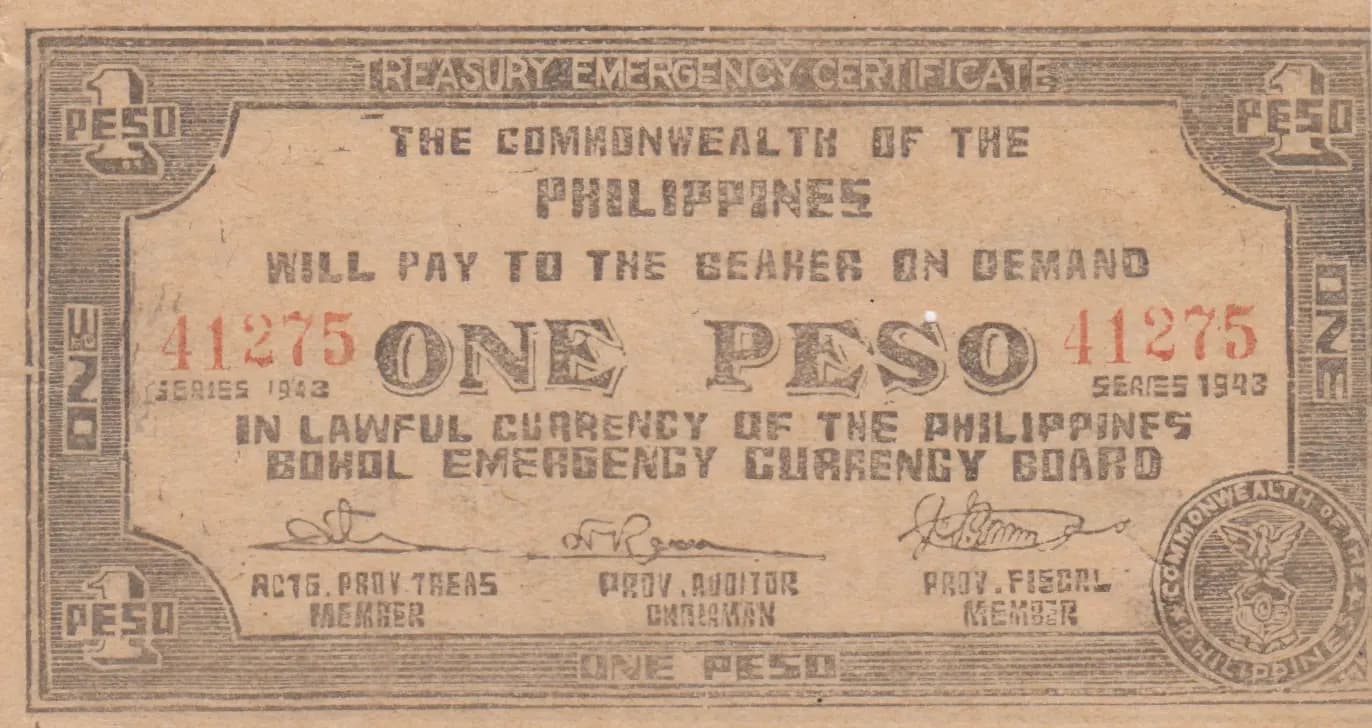
This is a Philippine 1 peso Treasury Emergency Certificate from 1943, issued by the Bohol Emergency Currency Board during the Commonwealth period. The note exhibits heavy aging with significant foxing and tan/beige discoloration throughout, consistent with AU condition grading. This is a scarce regional emergency issue from a specific provincial board, making it particularly interesting to collectors of Philippine wartime currency and Bohol-related numismatic items.
Common. While this is a regional emergency issue from Bohol, the eBay market pricing shows consistent listings across multiple condition grades ranging from $0.99 to $19.99 USD, with AU examples priced between $0.99 and $2.99 USD. These price points—well under $20 for most conditions—indicate steady collector availability rather than scarcity. Emergency certificate issues from the Philippines 1943 period, though historically significant, were produced in sufficient quantities that examples remain relatively accessible to collectors. The collector notation regarding Bohol does not indicate unusual rarity but rather geographic or topical collector interest.
This emergency certificate was issued during World War II by the Bohol Emergency Currency Board, authorized by the President of the Philippines. The note represents a critical period when the Commonwealth of the Philippines, occupied and disrupted by war, relied on local emergency currency boards to maintain basic monetary circulation. The formal designation as a 'Treasury Emergency Certificate' and the prominent display of 'WILL PAY TO THE BEARER ON DEMAND' reflect the transitional financial governance during this turbulent era in Philippine history.
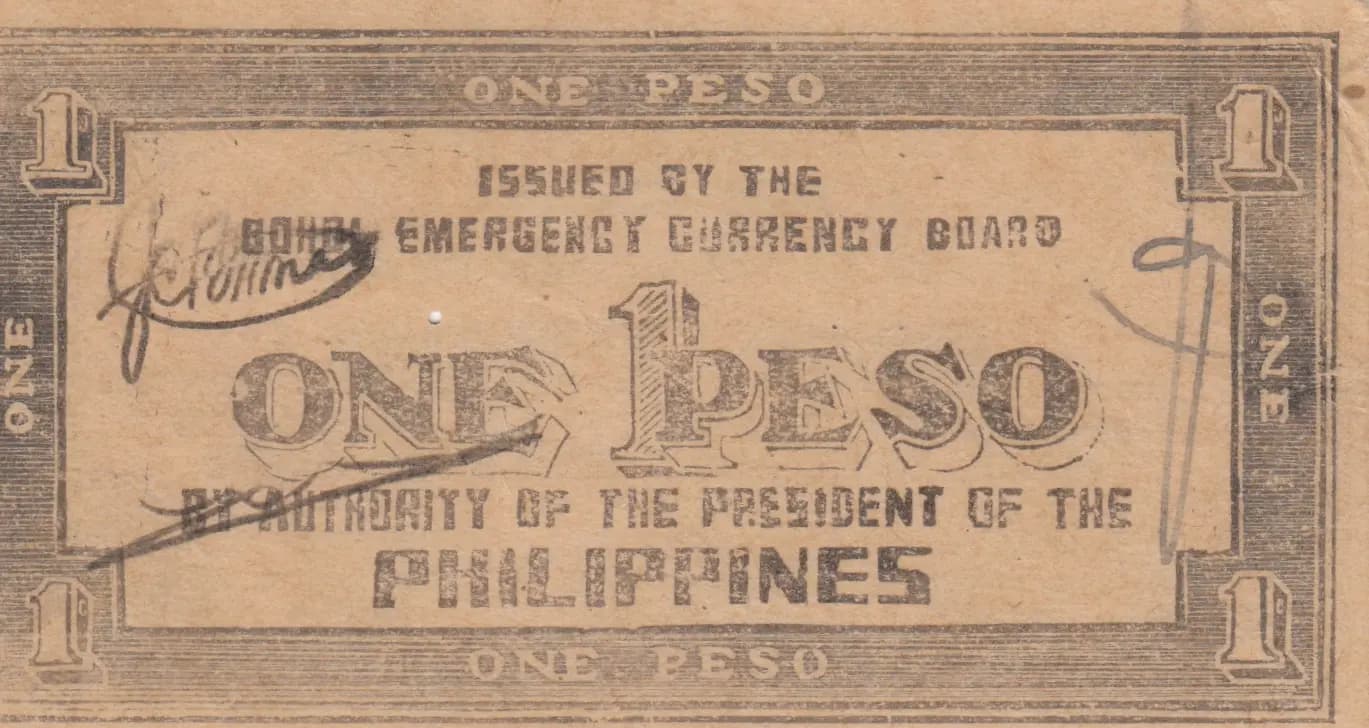
This Treasury Emergency Certificate features a utilitarian design appropriate to its wartime emergency purpose, with no portraits or landmarks depicted. The design consists of ornamental corner ornaments in all four corners and decorative line border designs forming the frame. The denomination 'ONE PESO' is prominently displayed in the center and at multiple locations on both sides. The note identifies itself as issued by the Bohol Emergency Currency Board (a provincial authority in the Visayas region), with three signature lines for official endorsement by the Acting Provincial Treasurer, Provincial Auditor, and Provincial Fiscal. The Commonwealth seal appears in the bottom right corner of the obverse. The tan and beige color scheme reflects both the printing materials available during wartime and the aged appearance from eight decades of storage.
FRONT: 'TREASURY EMERGENCY CERTIFICATE' / 'THE COMMONWEALTH OF THE PHILIPPINES' / 'WILL PAY TO THE BEARER ON DEMAND' / 'ONE PESO' / 'SERIES 1943' / 'IN LAWFUL CURRENCY OF THE PHILIPPINES' / 'BOHOL EMERGENCY CURRENCY BOARD' / Official titles: 'ACTG. PROV TREAS MEMBER' (Acting Provincial Treasurer Member) / 'PROV. AUDITOR OMISSION' (Provincial Auditor Omission) / 'PROV. FISCAL MEMBER' (Provincial Fiscal Member) / Serial number: 41275. BACK: 'ONE PESO' (appears three times) / 'ISSUED BY THE BOHOL EMERGENCY CURRENCY BOARD' / 'BY AUTHORITY OF THE PRESIDENT OF THE PHILIPPINES'.
Letterpress printing on paper stock, typical of Philippine emergency currency production during World War II. The ornamental borders and text show the characteristic crisp lines of letterpress work, though considerable wear and aging are evident. No security printer attribution is standard for these regional emergency issues, as they were produced locally by provincial boards rather than by dedicated security printers.
Serial number 41275 is recorded on this example. The Bohol Emergency Currency Board issued notes with varying serial ranges; this particular number falls within the documented emission. No overprints or significant printing varieties are noted in the visual analysis. The three signature lines show positions for provincial officials, and the specific signatures on this example (visible as handwritten marks on the back) may represent a particular issuing official combination, though without clear legibility of individual signatures in the provided images, specific signatory varieties cannot be confirmed. Pick catalog P-S138 classifies this as a standard 1943 issue without documented major varieties.