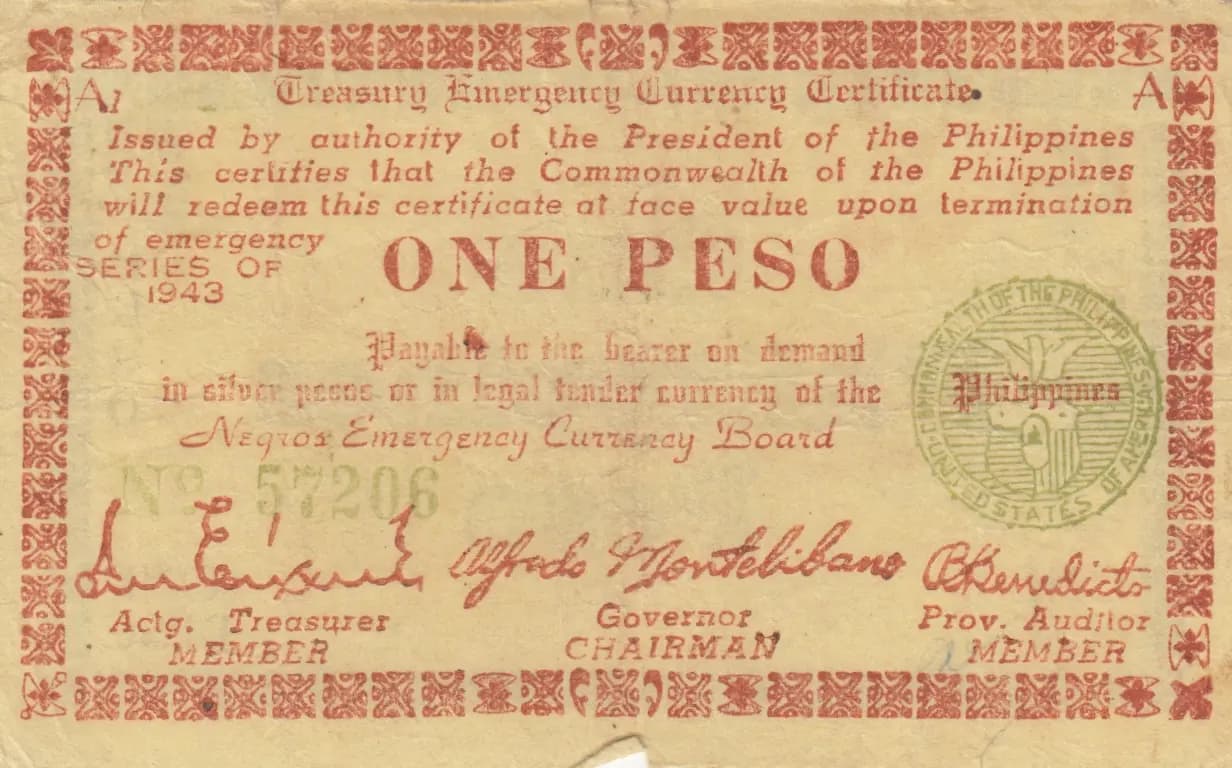
1 peso 1943
“Capiz”
Market Prices
About This Note
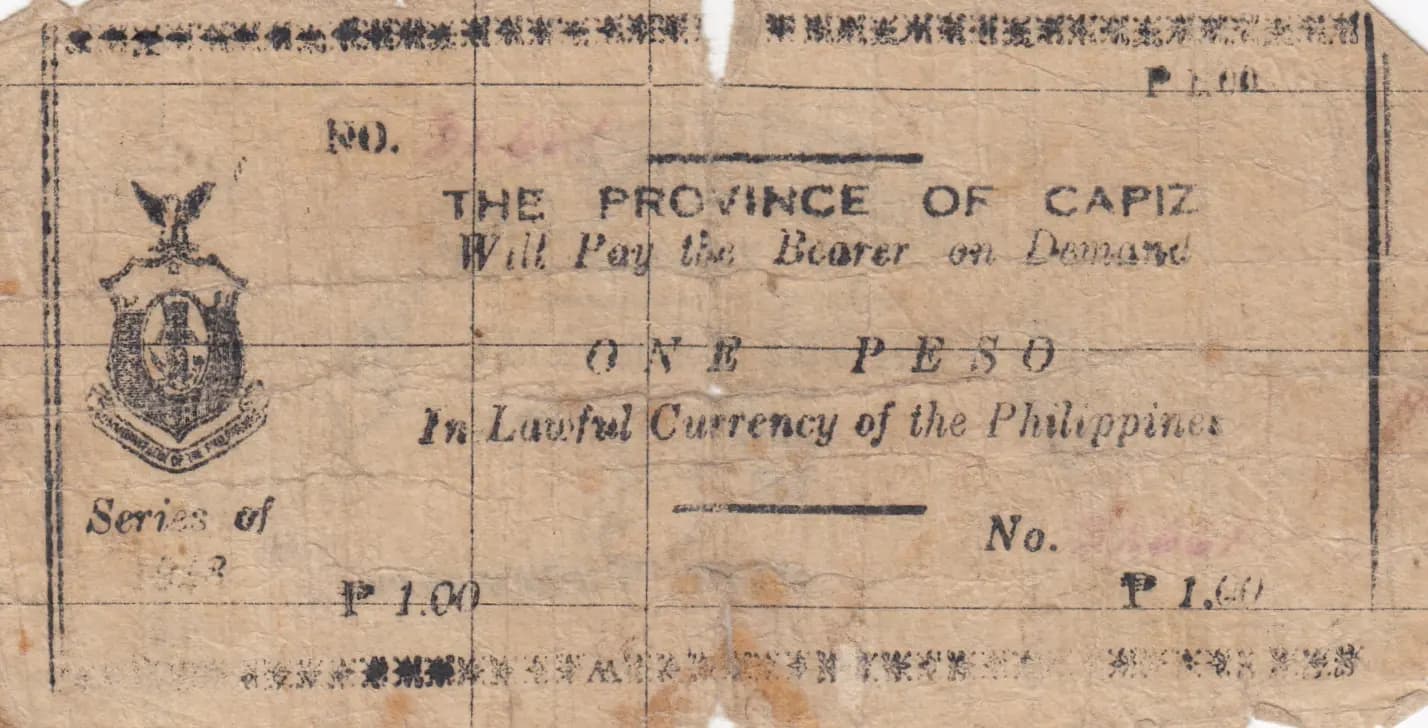
This 1 Peso note from The Province of Capiz (1943) is a scarce emergency currency issue from the Japanese occupation period of the Philippines. The note displays significant aging with yellowed paper, visible creases, foxing, and wear consistent with genuine circulation during wartime. The heraldic coat of arms and formal 'Will Pay the Bearer on Demand' inscription are still discernible despite the Good condition grade, making this a historically meaningful Philippine emergency issue.
Common. While this is a provincial emergency issue with limited circulation area (Capiz province only), the catalog and eBay pricing data indicate modest valuations ranging from $1.99 to $19.99 USD across various conditions, with this Good condition example likely valued in the $2-5 range. The broad price range on eBay reflects typical collector interest in Philippine occupation-era notes rather than scarcity. Print run and survival data for Capiz provincial currency is not extensively documented, but the consistent availability at low prices indicates these notes were produced in sufficient quantities and have survived in quantities that prevent any rarity classification.
The Province of Capiz 1 Peso notes were issued during the Japanese occupation of the Philippines (1942-1945) when legitimate Philippine currency was scarce and provincial authorities issued their own emergency currency. The formal English-language inscriptions and heraldic seal reflect the pre-war Commonwealth administration structure, while the note's survival in worn condition testifies to actual use during this tumultuous period. This represents a lesser-known but important aspect of Philippine World War II history, distinct from the better-known Japanese occupation notes and postwar PCIH/pesos.
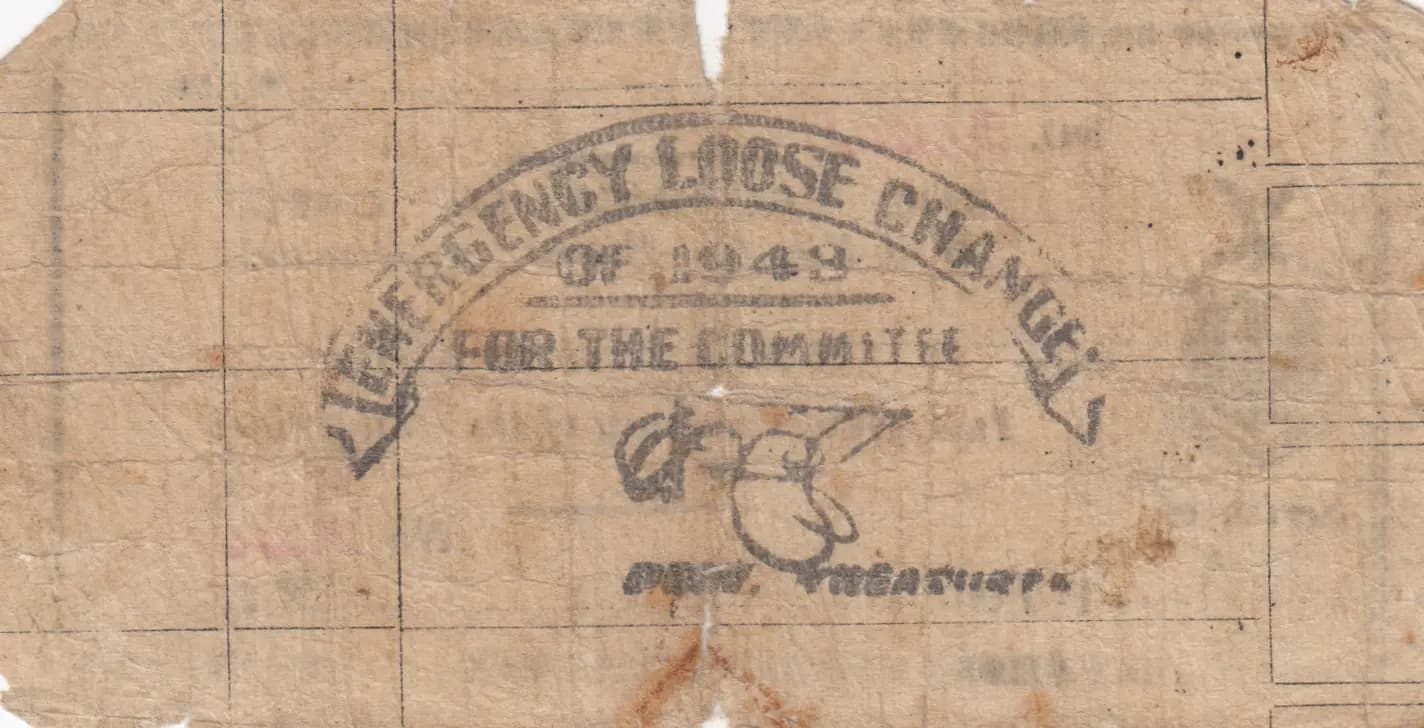
The front features a formal provincial coat of arms prominently displayed on the left side, featuring a shield with a cross and crown—symbols of provincial authority and Christian heritage. The design employs a grid-like border pattern typical of early 20th-century Philippine currency. The center contains denomination and issuer text in a formal, official layout. The back side displays a large circular official stamp or seal impression in the lower-center area, reinforcing the provincial government's authority and the note's temporary emergency status. The overall design is austere and functional, reflecting wartime constraints and the provincial rather than national scope of the issue.
FRONT: 'THE PROVINCE OF CAPIZ' (issuing authority); 'Will Pay the Bearer on Demand' (standard promise-to-pay clause); 'ONE PESO' (denomination); 'In Lawful Currency of the Philippines' (legal tender declaration); 'Series of P 1.00' (series designation). BACK: 'CURRENCY LOOSE CHANGE' and 'FOR TIME LIMIT' (restrictive clauses indicating temporary/emergency status of the currency). The back inscription suggests this currency was designated for limited circulation or redemption within a specified timeframe.
This note was produced using letterpress printing, evidenced by the crisp border designs, formal typography, and the clear circular stamp impression visible on the back. The printing quality shows typical characteristics of Philippine emergency wartime issues—functional rather than elaborate security features, with the ornamental border providing the primary design element. No sophisticated security printing was employed, consistent with provincial-level emergency currency production during the occupation period.
Pick catalog P-S202A denotes this as a specific variety within the Capiz 1 Peso series. Without visible serial numbers, signatures, or date variants clearly discernible in the visual analysis, this cataloging appears to reference the standard issue type rather than a specific sub-variety. The back inscription mentioning 'FOR TIME LIMIT' may indicate this is distinguished from other Capiz notes by redemption restrictions, though this may be standard across all Capiz provincial currency rather than a distinguishing variety characteristic. Further examination of serial number prefixes, signing officials, or printing variations would be needed to identify specific varieties within the P-S202A designation.