5 soles 1968
Market Prices
2 salesAbout This Note
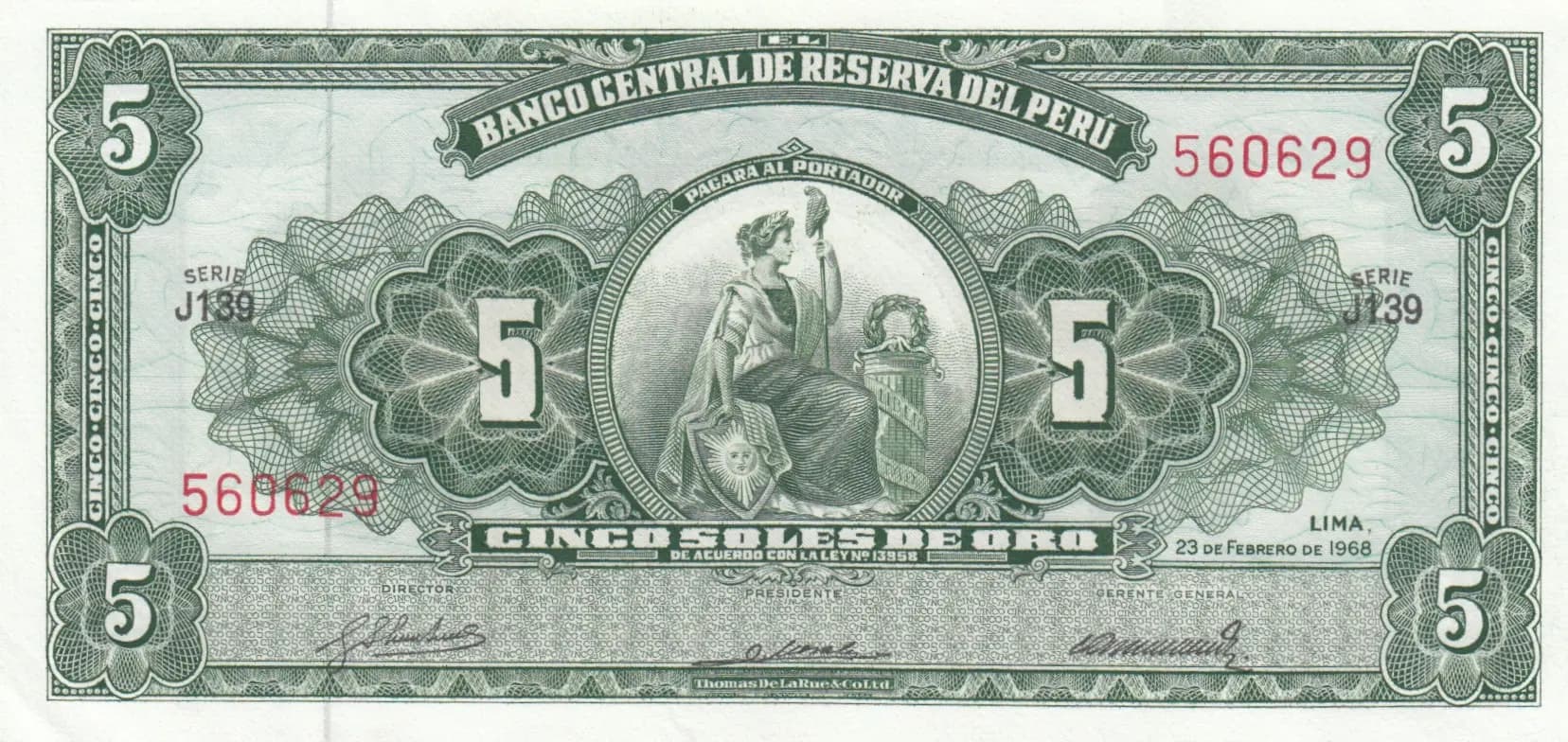
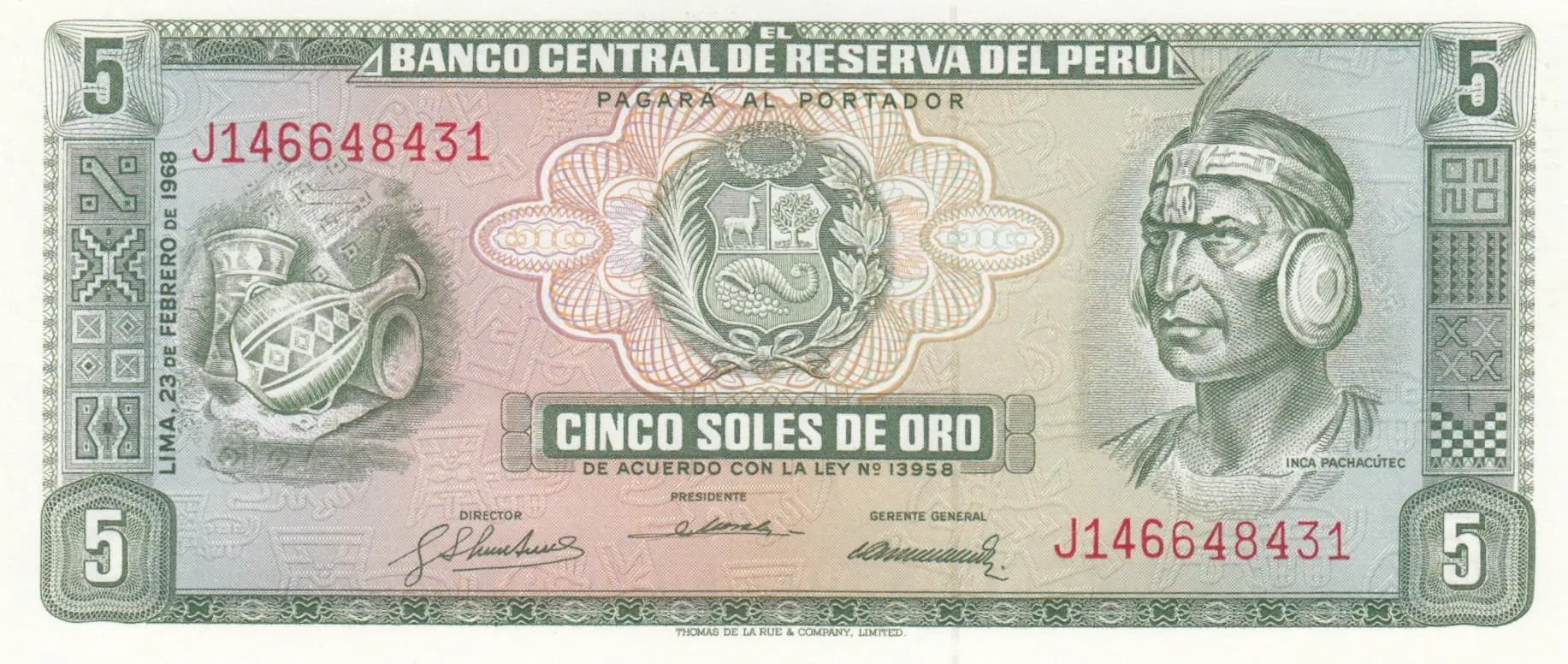
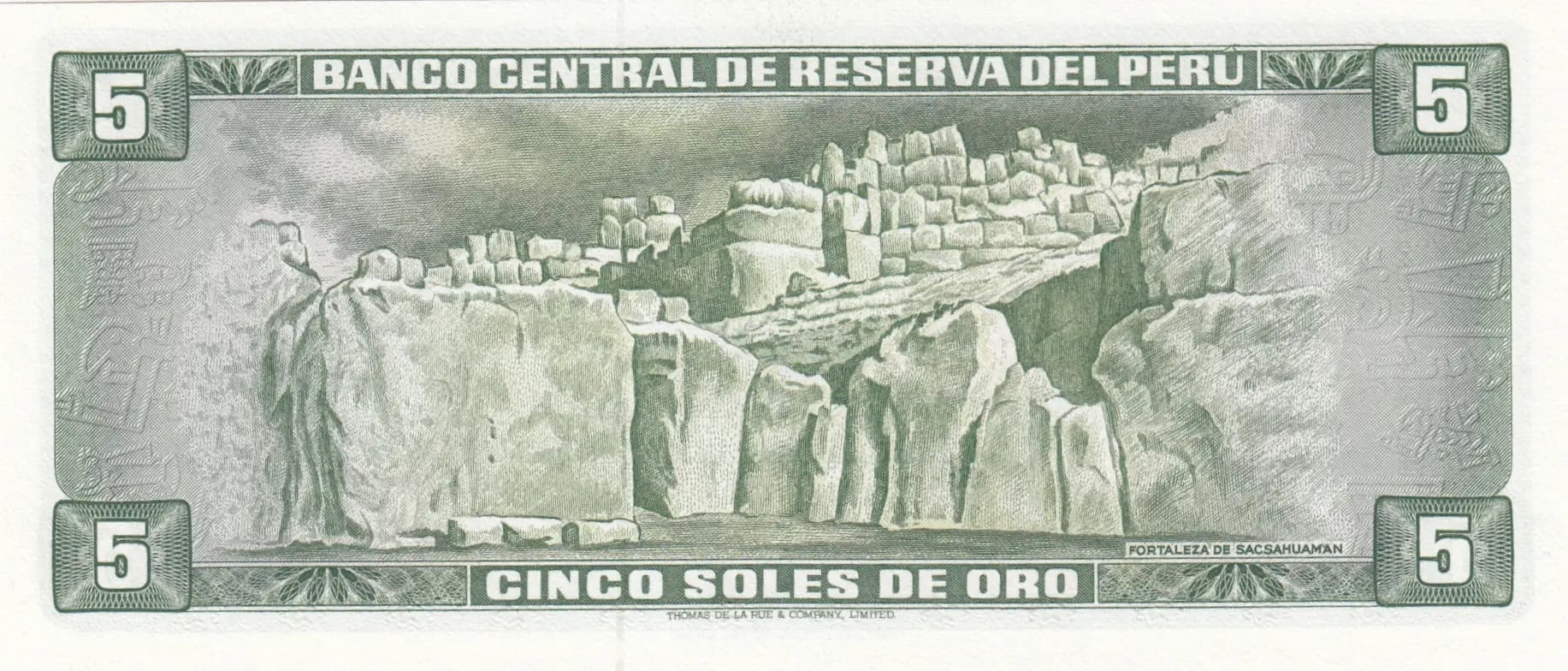
This is an uncirculated 1968 Peruvian 5 Soles de Oro note (Pick P-92) issued by the Banco Central de Reserva del Peru, printed by Thomas de la Rue in London. The note features a striking green and pink color scheme with a central coat of arms, indigenous ceramic vessel imagery on the left, and a portrait of Inca Pachacútec on the right. The reverse displays a detailed engraving of the Fortaleza de Sacsahuamán fortress rendered in green and gray tones—one of Peru's most iconic archaeological sites—making this note a beautiful representation of Peruvian cultural and historical heritage.
Common. This is a standard circulation issue from Peru's 1968 series with no known print run restrictions or early recall. The catalog values and eBay price history ($1.83–$3.25 for UNC examples) confirm that uncirculated specimens trade at modest collector prices typical of common mid-20th century Latin American notes. Series J notes of this type were produced in substantial quantities for regular circulation use. The note has been readily available on the secondary market over multiple decades.
This note was issued in February 1968 during Peru's military regime period, representing a deliberate effort by the central bank to incorporate Peru's pre-Columbian heritage into its currency design. The choice to feature Inca Pachacútec, one of the greatest Inca emperors (15th century), and the magnificent Sacsahuamán fortress reflects the nation's cultural pride and connection to its indigenous legacy. The legal reference to Law No. 13958 and the denomination 'Soles de Oro' (Gold Soles) anchored the note within Peru's monetary framework of that era.
The obverse design centers on the national coat of arms of Peru, flanked by two significant cultural elements: on the left, a ceramic vessel with geometric indigenous patterns representing Peru's pre-Columbian artistic traditions; on the right, a profile portrait of Inca Pachacútec (also known as Pachacuti), the ninth Inca emperor, depicted wearing a royal headband or crown. The portrait is rendered in fine engraved detail with hatching and shading techniques. The field features a predominantly pink/salmon-colored center with green borders, enhanced by ornate guilloche patterns and geometric designs in the side margins. Three signature lines accommodate the bank's officials. The reverse showcases a dramatic landscape engraving of the Fortaleza de Sacsahuamán, the 15th-century Inca fortress near Cusco, rendered in meticulous detail with a small human figure included for scale against the massive rectangular stone blocks. The fortress's distinctive polygonal masonry construction is carefully depicted. Both sides prominently display the denomination and issuing bank information, with Thomas de la Rue's printer credit mark on both obverse and reverse.
FRONT: 'BANCO CENTRAL DE RESERVA DEL PERU' (Central Reserve Bank of Peru); 'PAGARÁ AL PORTADOR' (Will Pay to Bearer); 'CINCO SOLES DE ORO' (Five Gold Soles); 'DE ACUERDO CON LA LEY Nº 13958' (In Accordance with Law No. 13958); 'LIMA 23 DE FEBRERO 1968' (Lima, February 23, 1968); 'INCA PACHACÚTEC' (identifying the portrait); signature lines labeled 'PRESIDENTE' (President), 'DIRECTOR' (Director), and 'GERENTE GENERAL' (General Manager); serial number 'J14664843-1'; printer mark 'THOMAS DE LA RUE & COMPANY, LIMITED'. BACK: 'BANCO CENTRAL DE RESERVA DEL PERU' (Central Reserve Bank of Peru); '5' and 'CINCO SOLES DE ORO' (Five Gold Soles); 'FORTALEZA DE SACSAHUAMAN' (Sacsahuamán Fortress); printer mark 'THOMAS DE LA RUE & COMPANY, LIMITED'.
This note was produced using intaglio (engraving) printing by Thomas de la Rue & Company, Limited, London—a leading security printer of the era. The intricate engraved designs visible on both obverse and reverse, characterized by fine line work, sophisticated guilloche patterns, and detailed shading in the landscape engraving of Sacsahuamán, are hallmarks of the intaglio process. The color work—green on multicolor underprint for the obverse, and green/gray tones for the reverse—indicates a multi-pass printing process combining engraved plates with color underlays typical of Thomas de la Rue's high-security production methods.
This specific note exhibits Series J designation with serial number J14664843-1, indicating it belongs to one of the standard series issued under the February 23, 1968 authorization date. Thomas de la Rue notes typically exist with series variations (A through Z series), and replacement notes (prefix Z999) are documented for this Pick number according to reference catalogs. The three-signature format (President, Director, General Manager) is standard for the issue. No significant varieties (date variations, overprints, or signature combination rarities) have been identified for this particular denomination and year.