5 soles 1968
Market Prices
47 salesAbout This Note
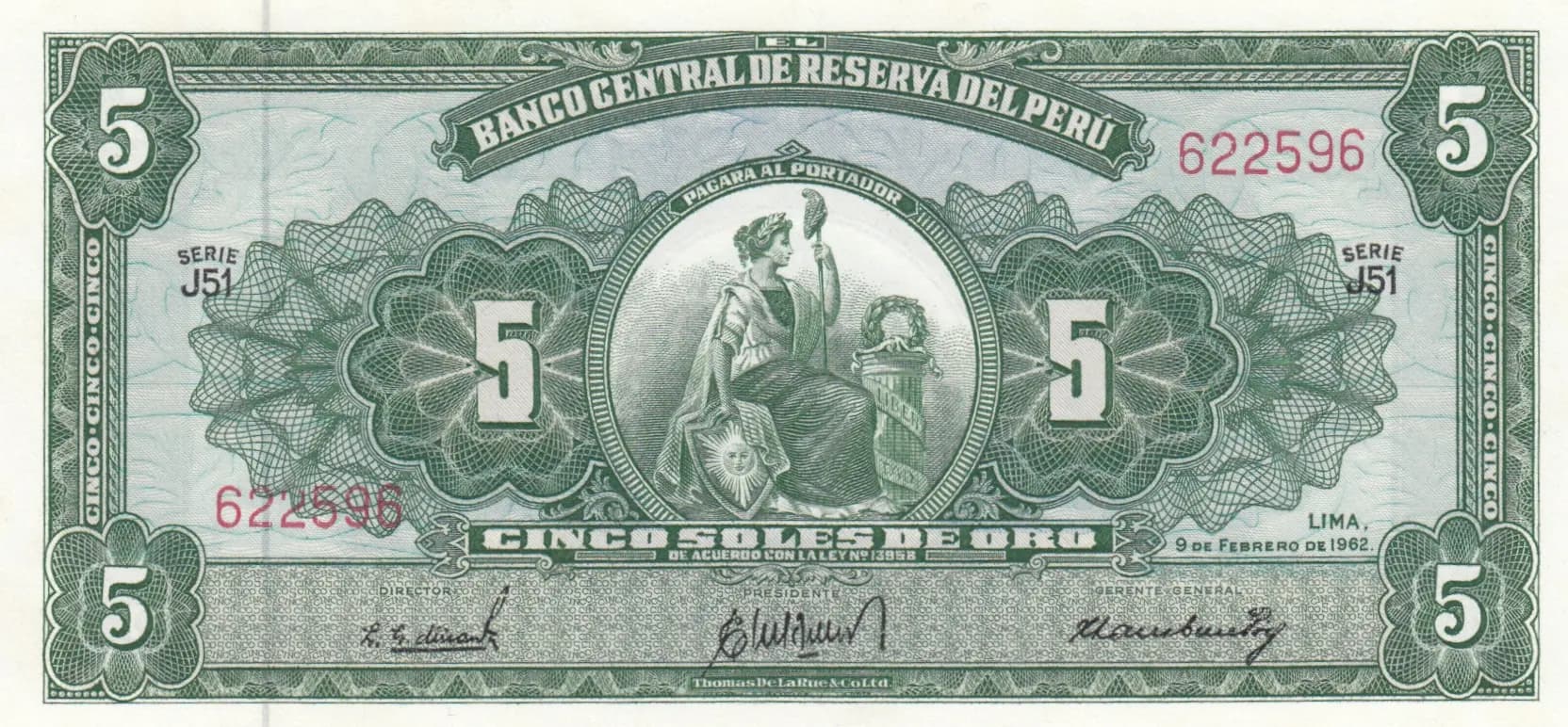
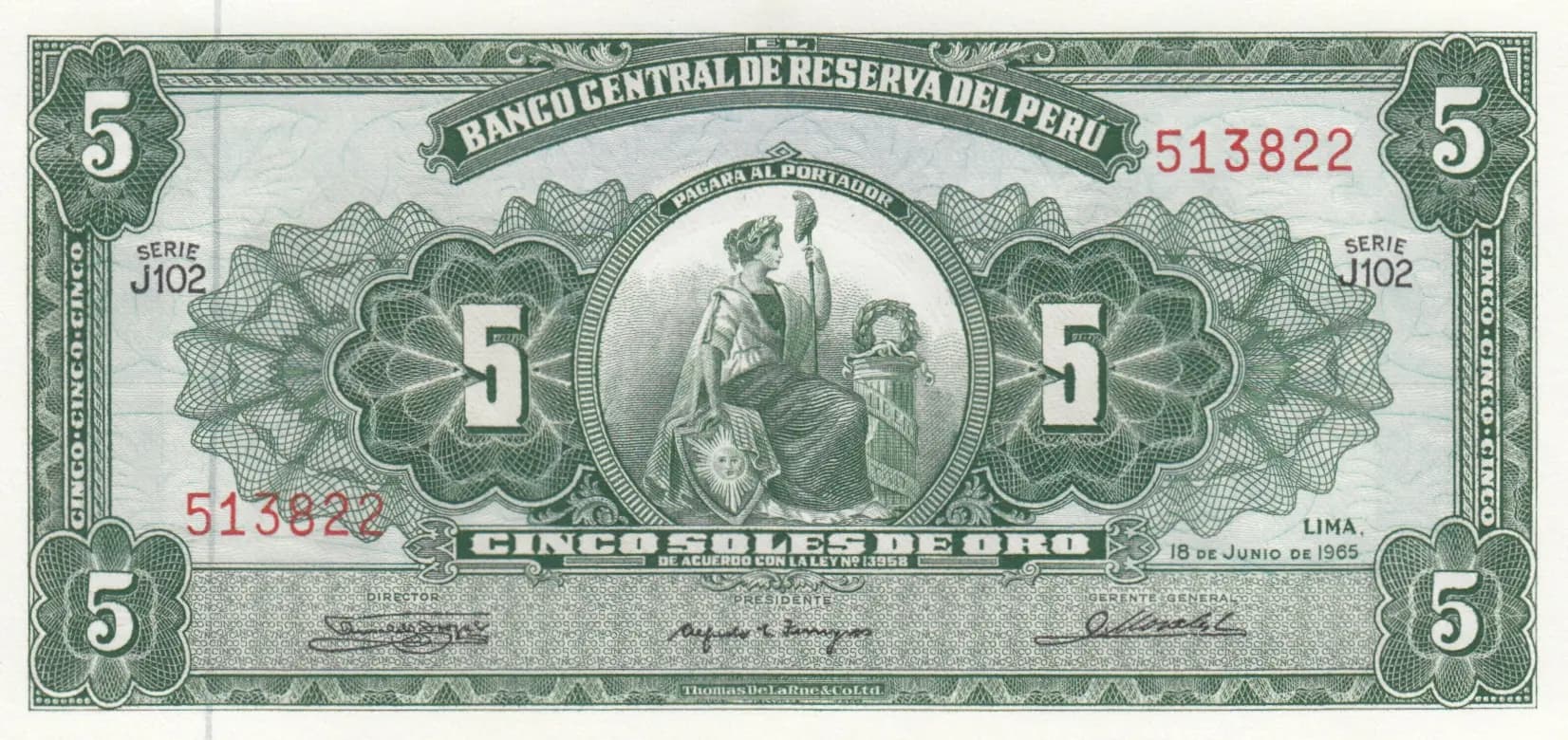
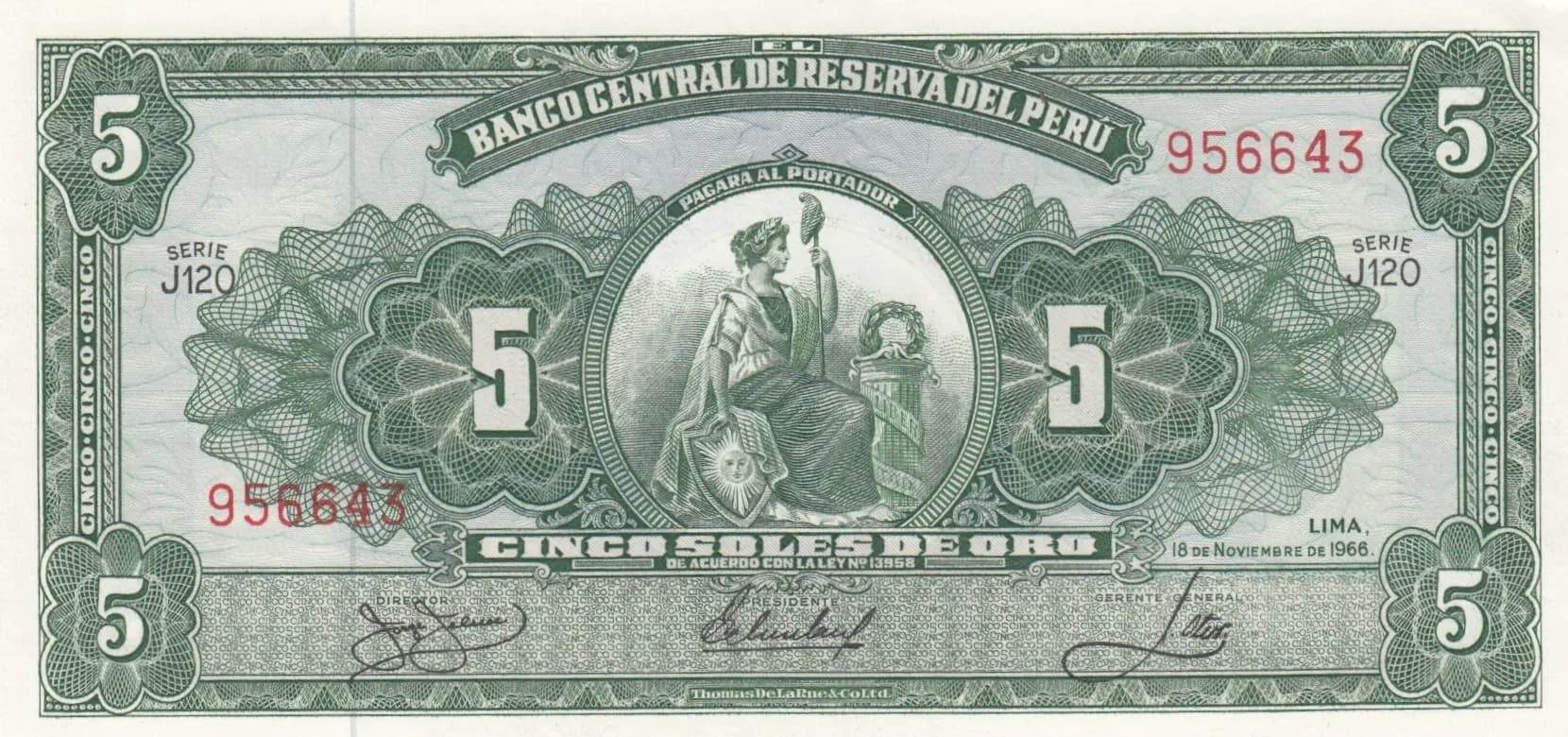
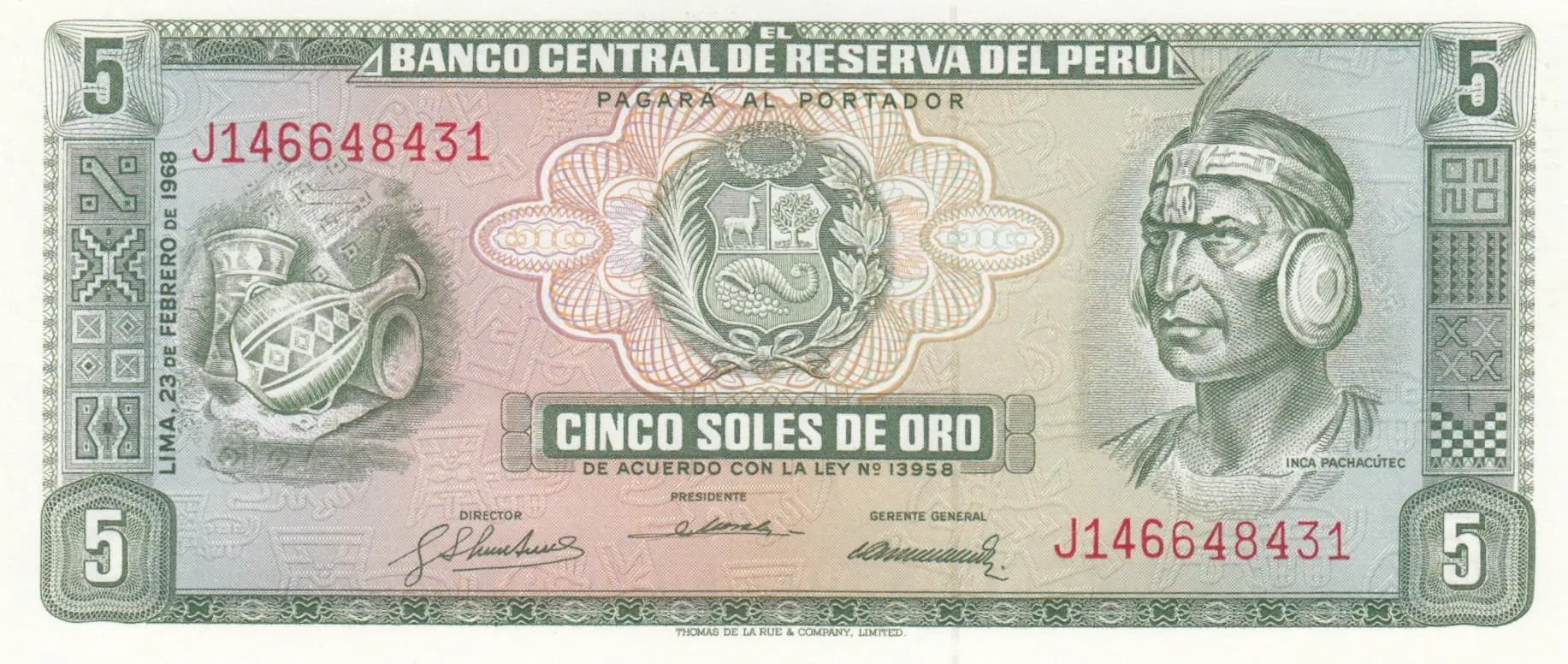
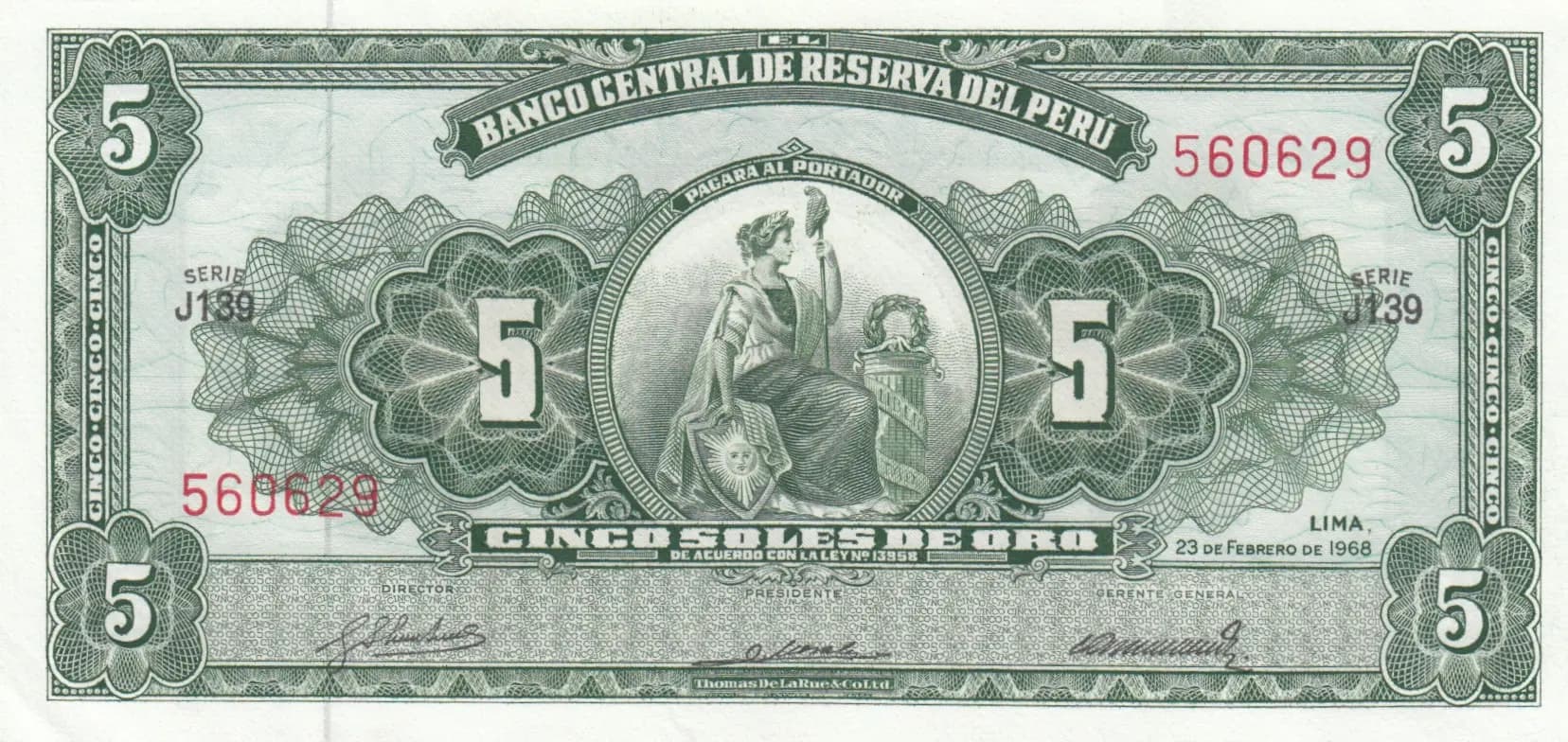
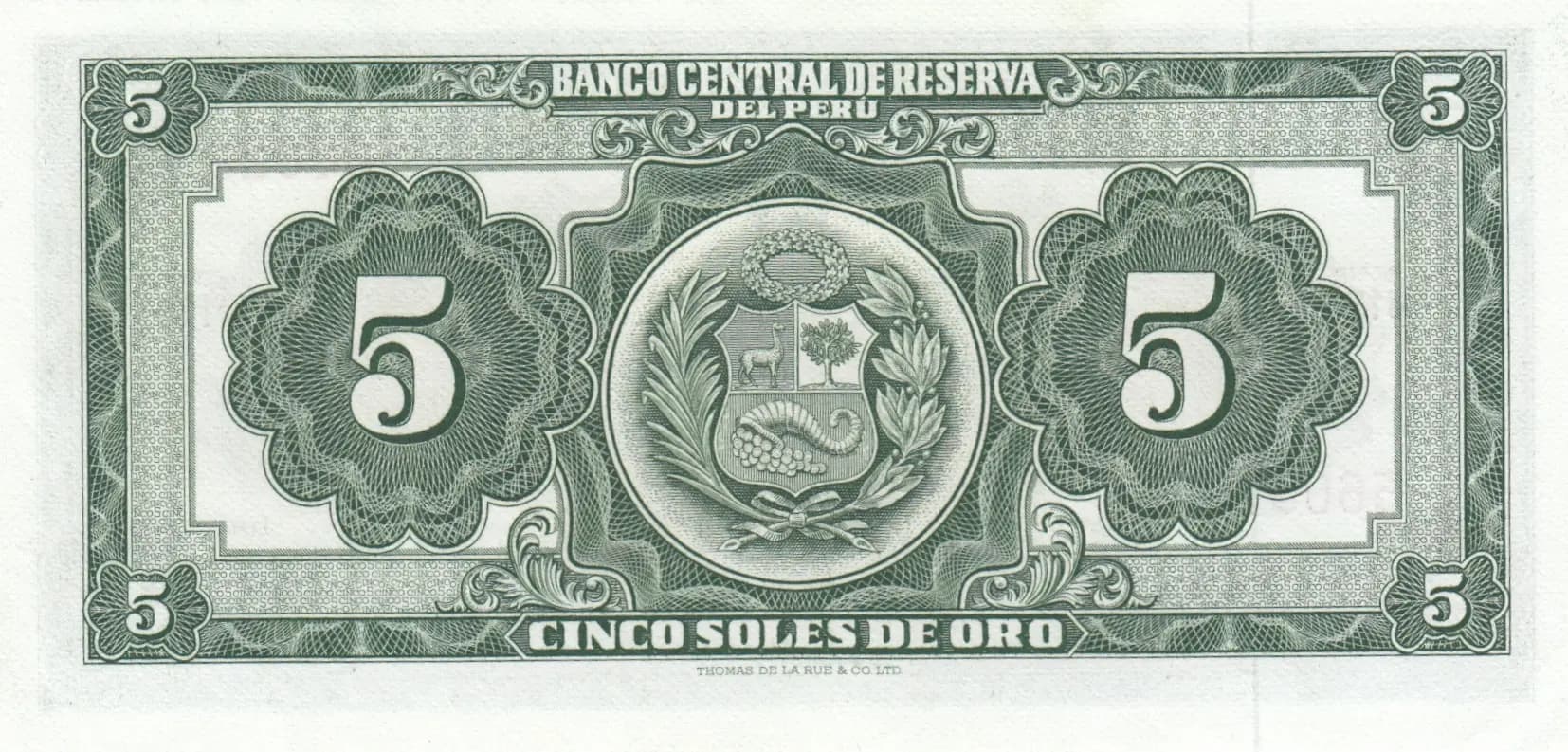
This is a striking Peruvian 5 Soles de Oro note from the February 23, 1968 issue, graded UNC and featuring exceptional clarity and detail throughout. The obverse displays an allegorical Liberty figure in classical robes holding a torch and staff within an ornate medallion, while the reverse showcases Peru's national coat of arms with its distinctive guanaco, cinchona tree, and cornucopia. The note demonstrates the fine intaglio engraving characteristic of Thomas de la Rue's production, with sharp printing, vibrant green coloring, and no signs of wear or handling.
Common. The extensive eBay transaction history spanning from 2012 to 2025 demonstrates this note is actively traded and readily available in all condition grades. UNC examples have consistently sold for $1.99 to $6.75 across multiple years, with catalog values (2019) assigning UNC notes at $4. The Pick P-83 designation covers notes issued across a 6-year period (1962-1968), indicating a substantial total print run. The presence of the PMG population report with only minimal variants further supports that this is a standard issue without scarcity factors. Current market pricing under $7 for UNC examples confirms common circulation status.
Issued during Peru's military period under General Juan Velasco Alvarado's revolutionary government (1968-1975), this note reflects nationalist symbolism through its prominent display of Peru's natural wealth and resources. The cinchona tree on the coat of arms represents Peru's pharmaceutical heritage and important agricultural product, while the guanaco symbolizes the Andean fauna central to Peruvian identity. The Liberty figure on the obverse, holding torch and staff, embodies classical republican ideals that the Banco Central de Reserva del Peru continued to champion on its currency.
The obverse features an allegorical female figure representing Liberty, depicted in classical Greco-Roman style seated within an ornate circular medallion. She wears classical robes and holds a torch (symbol of enlightenment) and a staff or scepter (symbol of authority and governance). A cherub or putto figure appears below the main allegorical figure, adding decorative emphasis. The design is surrounded by intricate scrollwork, geometric patterns, and floral ornaments typical of 19th-century banknote aesthetics. Large numerals '5' appear in all four corners within ornamental frames. The reverse displays the Peruvian national coat of arms centered in an elaborate wreath: the shield is divided into three sections showing a guanaco (South American camelid), a cinchona tree (representing botanical wealth), and a cornucopia or horn of plenty (representing agricultural abundance). The shield is flanked by laurel and palm branches symbolizing victory and honor. The entire composition is framed with fine geometric and floral decorative elements.
FRONT: 'BANCO CENTRAL DE RESERVA DEL PERU' (Central Reserve Bank of Peru) / 'PAGARA AL PORTADOR' (Will pay to bearer) / 'CINCO SOLES DE ORO' (Five Soles of Gold) / 'DE ACUERDO CON LA LEY' (In accordance with the law) / 'LIMA' (Lima) / '23 DE FEBRERO DE 1968' (February 23, 1968) / 'SERIE J139' (Series J139) / Additional signatures inscribed as 'DIRECTOR' (Director), 'PRESIDENTE' (President), and 'GERENTE GENERAL' (General Manager). BACK: 'BANCO CENTRAL DE RESERVA DEL PERU' (Central Reserve Bank of Peru) / 'CINCO SOLES DE ORO' (Five Soles of Gold).
Intaglio engraving (line engraving) executed by Thomas de la Rue, London, the renowned British security printer. The visual analysis confirms the characteristic fine line work, sharp detail reproduction, and complex geometric patterns that are hallmarks of intaglio printing. The note exhibits no evidence of offset printing or lithography — the precise registration, fine hairline details in the scrollwork, and the crisp rendering of the coat of arms elements are consistent with traditional engraved steel plate production. The multi-color effect (green as dominant color with black and cream tones) was achieved through multiple plate passes, a standard intaglio technique.
The specific variety observed is the February 23, 1968 issue date with Series J designation (Series J139 noted on the specimen). The Pick P-83a variant designation from the PMG population report indicates this represents the standard obverse design for this denomination. The note features red serial number printing in both upper right and lower left positions, characteristic of the J-series printings. No overprints, commemorative markings, or error characteristics are evident in this example, making it a standard regular-issue variant of Pick P-83.