100 soles 1879
Market Prices
1 saleAbout This Note
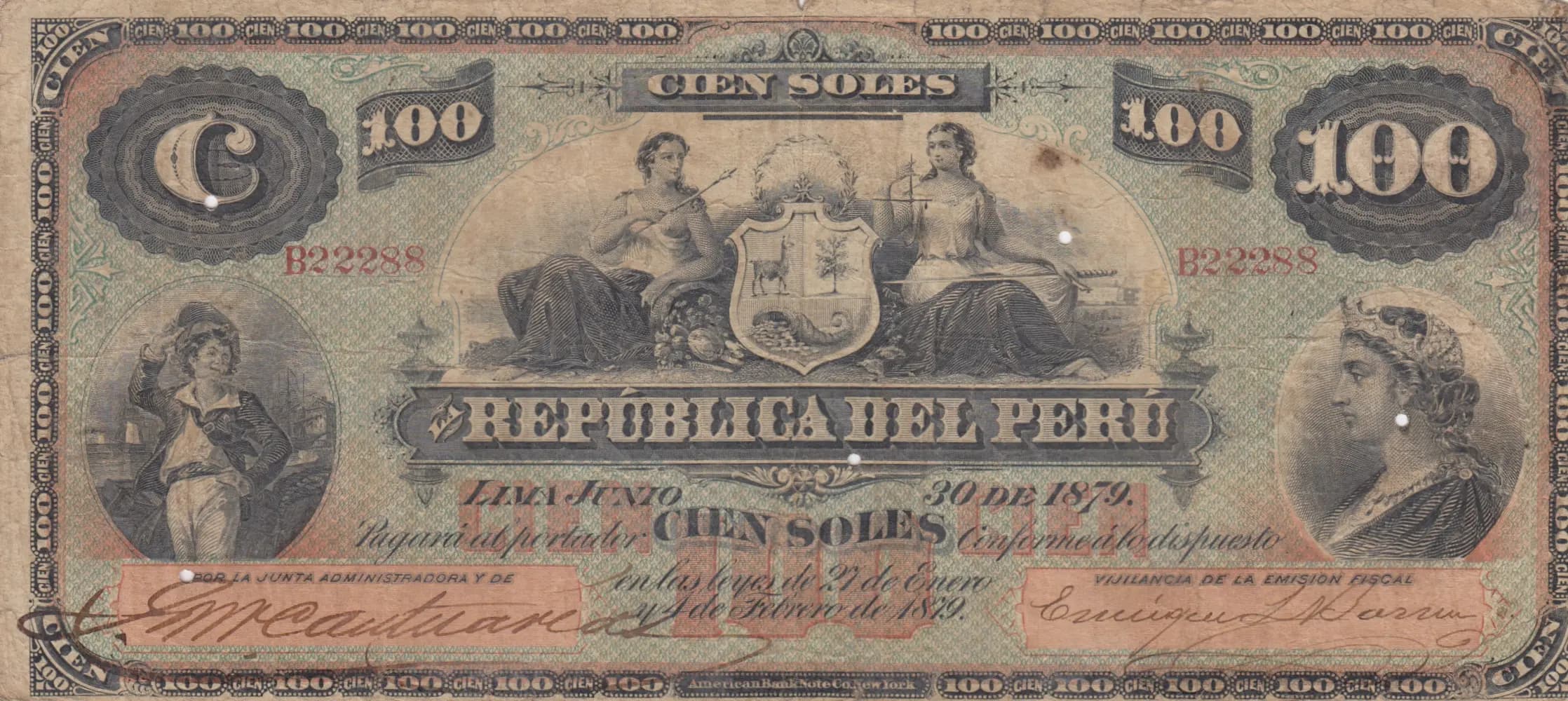
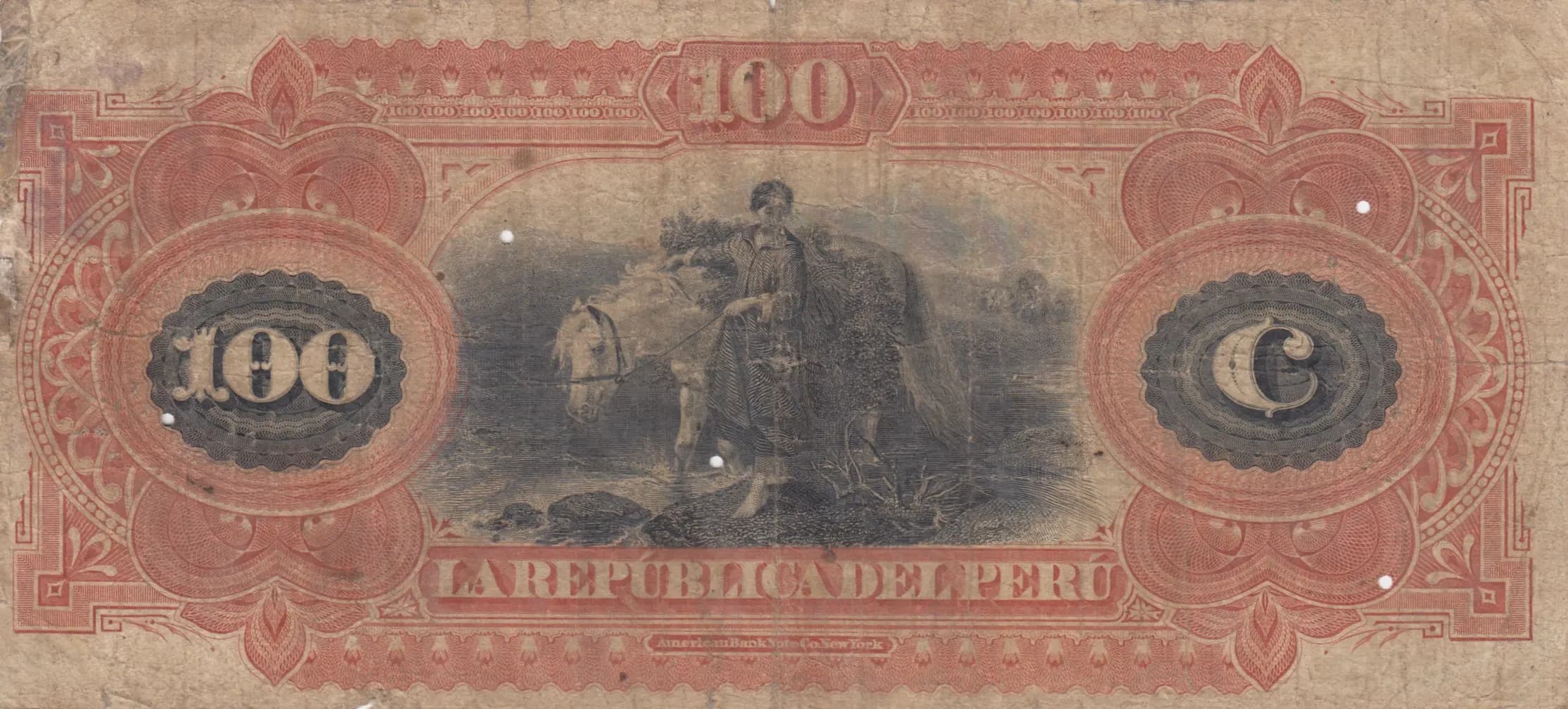
This is a Peru 100 Soles banknote from June 30, 1879, issued by the República del Perú and printed by the American Bank Note Company. The note displays the characteristic Victorian-era engraving style with allegorical female figures flanking a central coat of arms on the obverse, and a mounted equestrian scene on the reverse rendered in red and black. In VG condition, the note shows appropriate age-related wear including foxing, creasing, and overall discoloration consistent with 145+ years of storage, yet maintains good visual clarity of the intricate engraving work.
Common. The catalog value of $100 in Fine condition and eBay sales data (VG example sold for $141.38) indicate this is a readily available note in the collector market. Peru's 100 Soles 1879 (P-9) had a substantial print run and circulated widely. Notes in VG condition are not difficult to locate, consistent with common designation. The denomination was a standard high-value note of the period, and ABNC printing quality and volume production typically resulted in survivors across multiple condition grades.
This banknote was issued during Peru's early republican period, following the War of the Pacific (1879-1884), when Peru was establishing its financial infrastructure and national identity. The imagery reflects the nation-building symbolism typical of the era: allegorical representations of liberty and commerce (the women), the national coat of arms, and the equestrian figure suggesting military strength or leadership. The June 30, 1879 date places this note at the very outbreak of the War of the Pacific, making it a historically significant document of Peru's financial system during a critical period.
The obverse features a symmetrical allegorical design typical of late 19th-century banknote artistry. Two seated female figures in classical dress flank a central heraldic shield (Peru's coat of arms), representing the virtues of the republic. Additional portrait medallions in circular frames appear on the left and right margins, likely representing Liberty and Commerce or similar national ideals. The decorative border contains repeated denomination text and security patterns. The reverse depicts an equestrian scene with a mounted figure (likely representing a national hero or Peru's military tradition) accompanied by attendants in a landscape setting with fortified structures visible in the background. Large circular medallions containing '100' and 'G' (possibly a plate identifier or engraver's mark) anchor the design corners.
Front: 'CIEN SOLES' / '100' (One Hundred Soles / 100); 'REPÚBLICA DEL PERÚ' (Republic of Peru); 'LIMA JUNIO 30 de 1879' (Lima June 30, 1879); 'Ingrese al portador CIEN SOLES conformemente disposición del Banco' (Payable to bearer one hundred soles in accordance with bank regulations); Serial number 'B22288'; Two handwritten signatures (illegible). Back: '100' (100); 'LA REPÚBLICA DEL PERÚ' (The Republic of Peru); 'American Bank Note Co New York' (American Bank Note Co New York).
Steel engraving on banknote paper, characteristic of American Bank Note Company's production methods of the 1870s-1880s. The note exhibits the high-quality intaglio printing typical of ABNC work, with fine line engraving visible throughout both obverse and reverse designs. Multiple color printing was achieved through successive passes: sepia/brown, green, and red tones on the obverse; red/crimson, black, and cream tones on the reverse. Serial numbers and signatures were added by hand after printing.
Serial number B22288 is observed on this example. This note belongs to the primary P-9 variety (100 Soles, 1879). The PMG population report indicates variant designations exist (P-9p for plate varieties, P-9s for specimen notes), but without additional comparative imagery or technical analysis, the specific plate variety cannot be definitively determined from visual inspection alone. Signature varieties are noted in catalog references but are not clearly legible in the provided images. The 'G' marking in the circular medallion appears on both front and back, which may indicate a printer's plate designation or series letter.