500 rupees 1964
Market Prices
20 salesAbout This Note
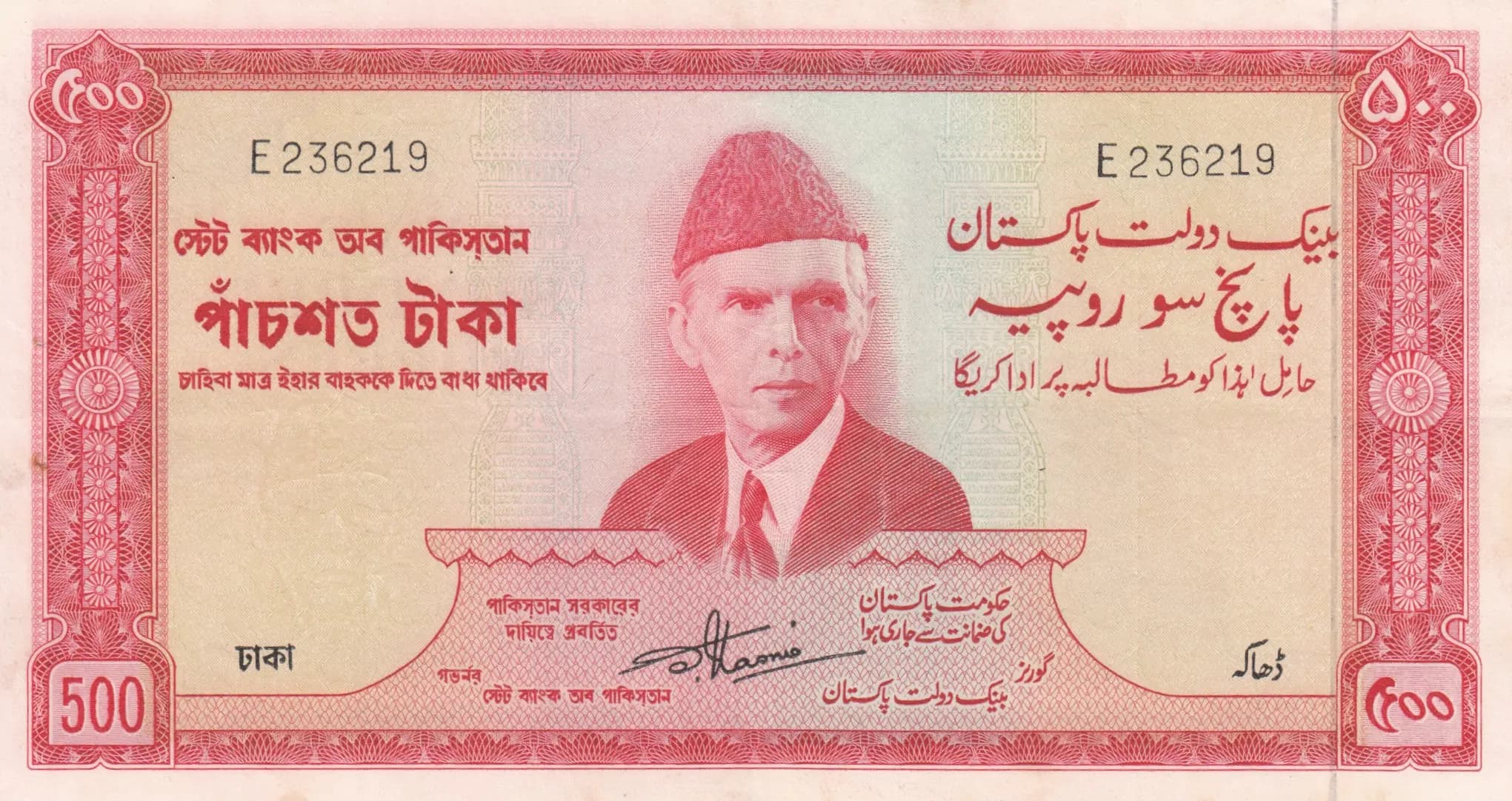
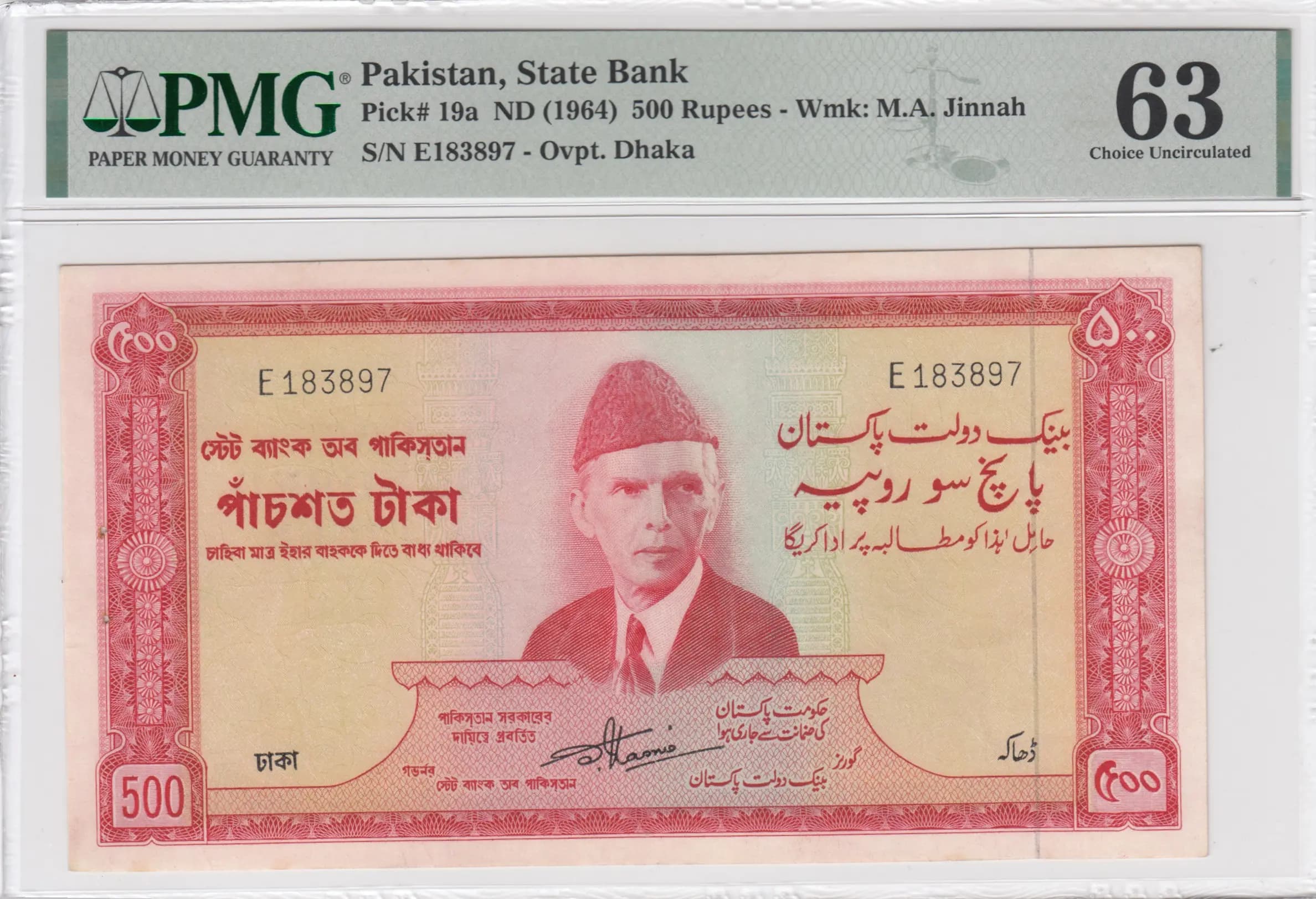
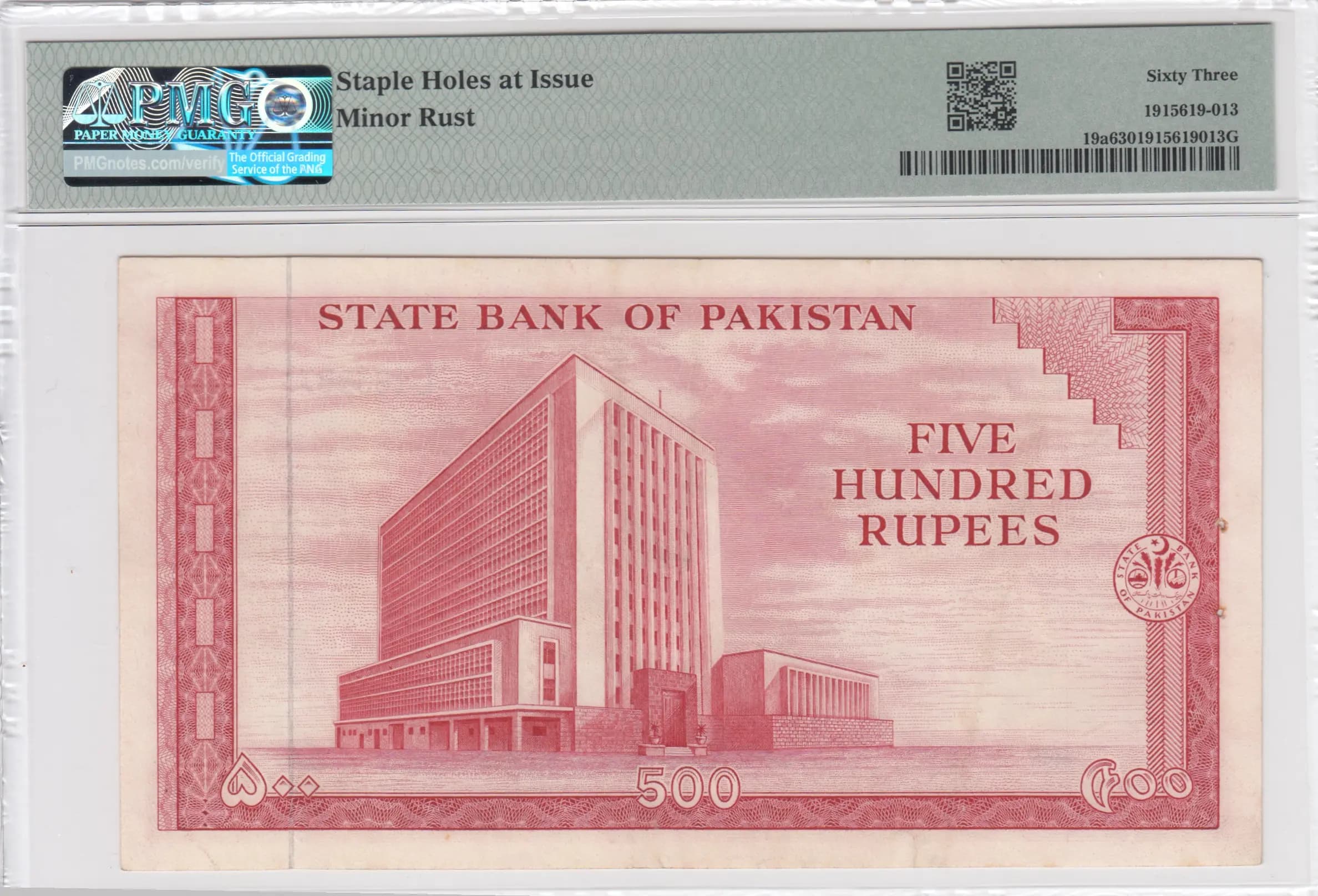
This is a Pakistan State Bank 500 Rupees note from 1964 (Pick-19a) graded PMG 63 (Choice Uncirculated). The note features a striking portrait of Mohammed Ali Jinnah in formal dress wearing a red fez, centered on the obverse against an ornate red and gold decorative background. The reverse displays the modernist State Bank of Pakistan building in red tones. This example shows excellent preservation with minimal handling marks, though it exhibits characteristic staple holes at issue and minor rust staining from original bank operations, which are typical features of notes from this era that were bundled and stapled during distribution.
Common. eBay market data shows consistent sales activity for PMG 63 graded examples at approximately $57, with numerous comparable sales across various grades (PMG 50-65 range) from 2013-2022 averaging $20-$70. The catalog value for UNC examples is listed at $45, and VF at $25. The high frequency of graded examples in PMG census records and the steady, moderate pricing across multiple sales indicates this is a readily available issue in the collector market. The 1964-1967 production run was substantial, and the note does not show characteristics of scarcity or recall status.
Issued in 1964, this note represents the early period of Pakistan's independent monetary system under the State Bank of Pakistan. The portrait of Mohammed Ali Jinnah, Pakistan's founding father (the Quaid-e-Azam), appears on the obverse with the Dhaka overprint, reflecting the note's circulation in East Pakistan (now Bangladesh) during the pre-1971 partition period. The modernist State Bank building depicted on the reverse symbolizes Pakistan's post-independence institutional development and economic aspirations during the 1960s.
The obverse features a center portrait of Muhammad Ali Jinnah (Quaid-e-Azam), the founding father of Pakistan, depicted wearing formal business attire with a distinctive red fez cap and necktie. The portrait is surrounded by ornate guilloche patterns and decorative floral/geometric elements in red and gold on a beige/cream background. Diamond-shaped decorative devices appear at the top corners. The reverse displays the headquarters building of the State Bank of Pakistan, rendered in a modernist architectural style with characteristic vertical striped facade and geometric design elements, also on a beige/cream background with red printing. The design reflects mid-twentieth century institutional typography and artistic conventions. Multilingual inscriptions in English, Urdu, and Bengali accommodate Pakistan's diverse linguistic populations, with the Dhaka overprint indicating specific circulation in East Pakistan during this period.
FRONT SIDE: 'STATE BANK OF PAKISTAN' and 'FIVE HUNDRED RUPEES' in English; 'پاکستان' (Pakistan) and 'ریاستِ پاکستان' (State of Pakistan) in Urdu; Bengali denominations '৫০০' (500) and 'پاچھامات ٹکہ' (Five hundred rupees/taka); 'ڈاکہ' (Dhaka) overprint indicating East Pakistan circulation; Serial number 'E183897' appears on both left and right. BACK SIDE: 'STATE BANK OF PAKISTAN' and 'FIVE HUNDRED RUPEES' in English; Denomination '500' in numerals at corners.
Intaglio (recess) printing on banknote paper, evidenced by the fine line work, detailed guilloche patterns, and dimensional quality visible throughout the design. The ornate decorative borders, portrait rendering, and architectural details all show characteristics of professional security printing typical of State Bank of Pakistan currency production in the 1960s. The banknote exhibits the fine line complexity and precision expected of currency-grade intaglio work.
This note is identified as Pick-19a, characterized by the Jinnah watermark. PMG census records indicate three catalogued varieties for this base Pick number (P-19a, P-19b, and P-19s). The specific variety status of this note is P-19a with Jinnah watermark. The Dhaka overprint visible on the obverse indicates this example was issued for circulation in East Pakistan. The serial number E183897 and presence of staple holes at issue are consistent with original bank bundling practices of the period. No exceptional signatures, date variations, or rare overprint characteristics are evident from the visual analysis.