100 rupees 1957
Market Prices
36 salesAbout This Note
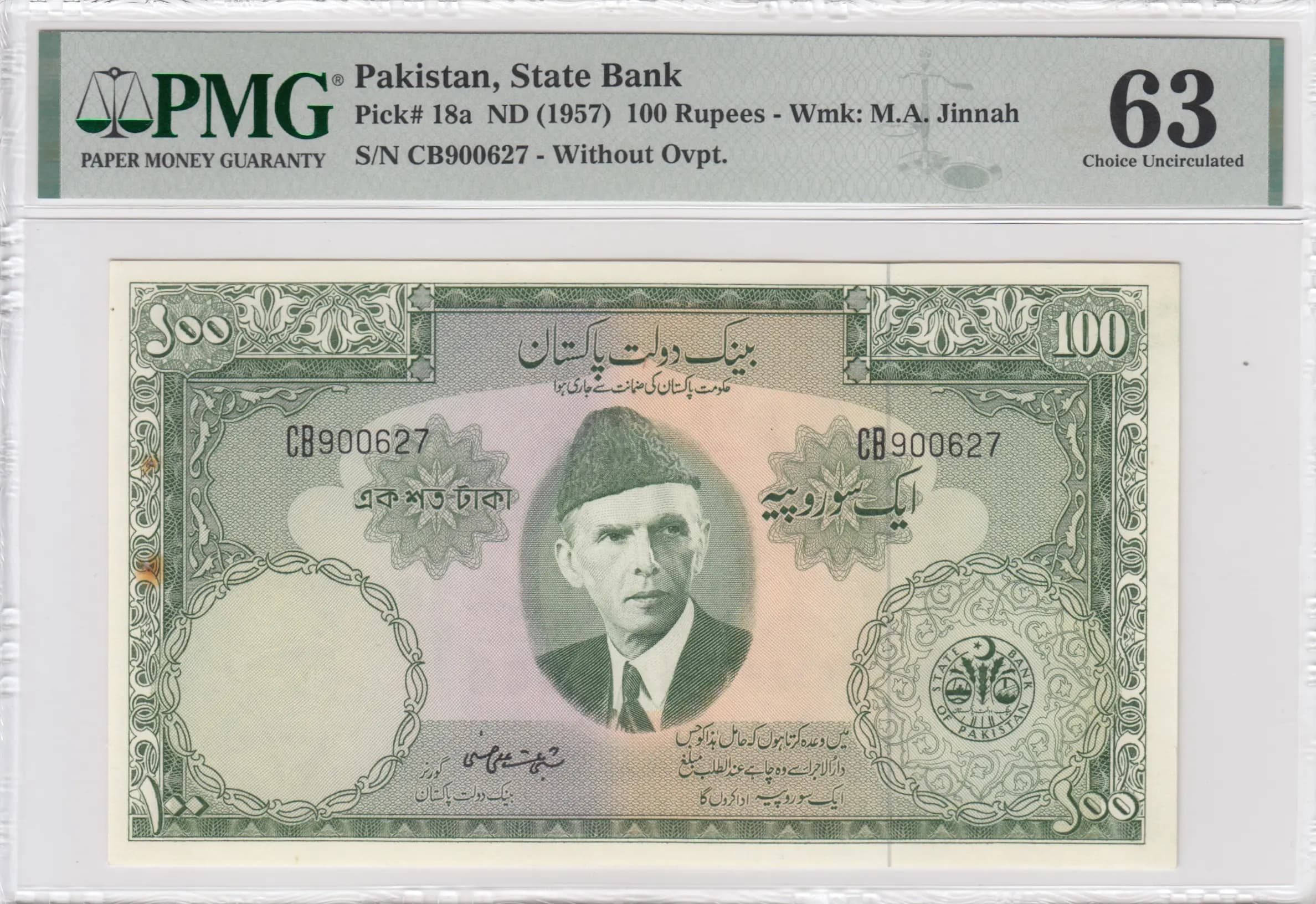
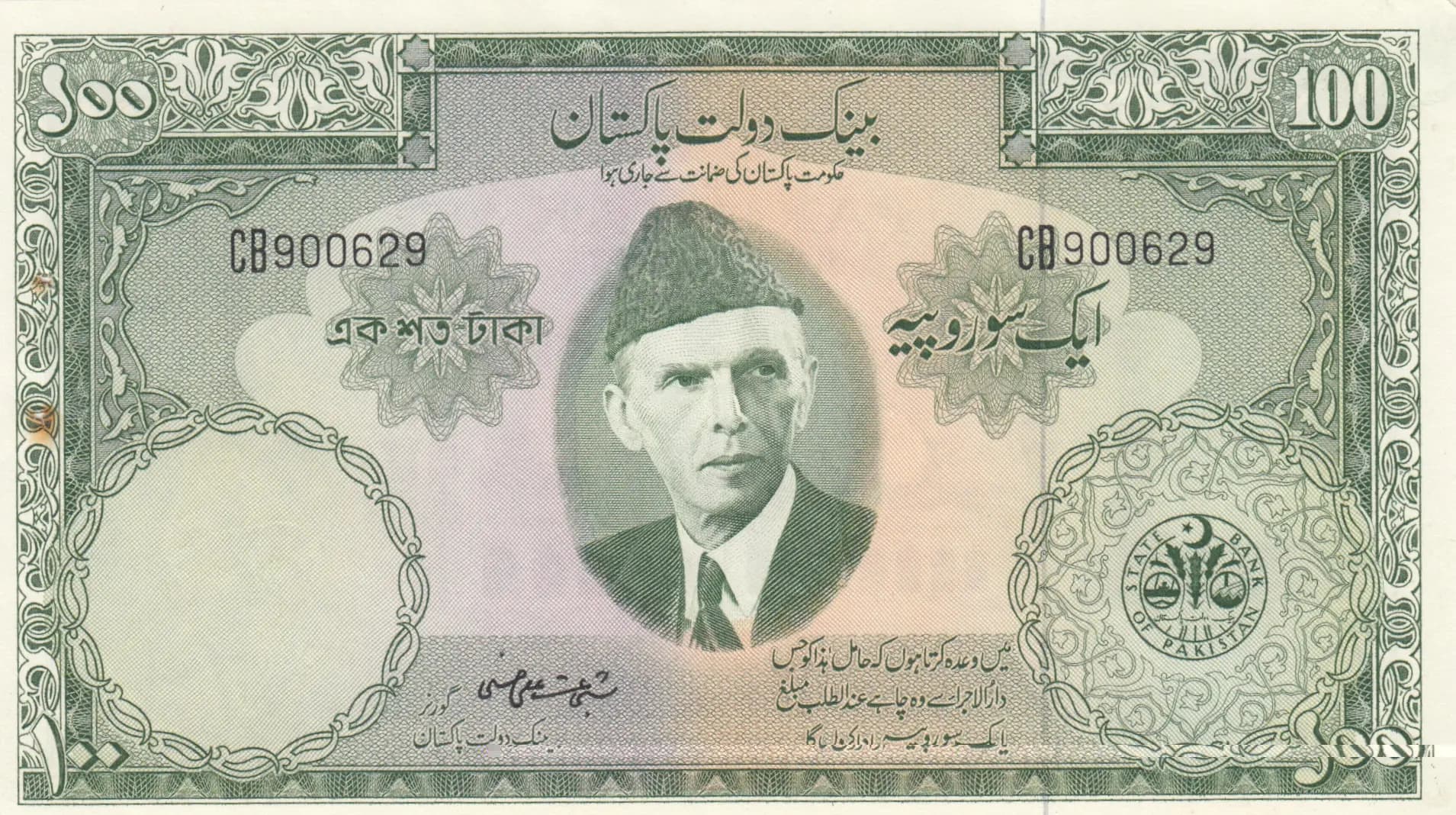
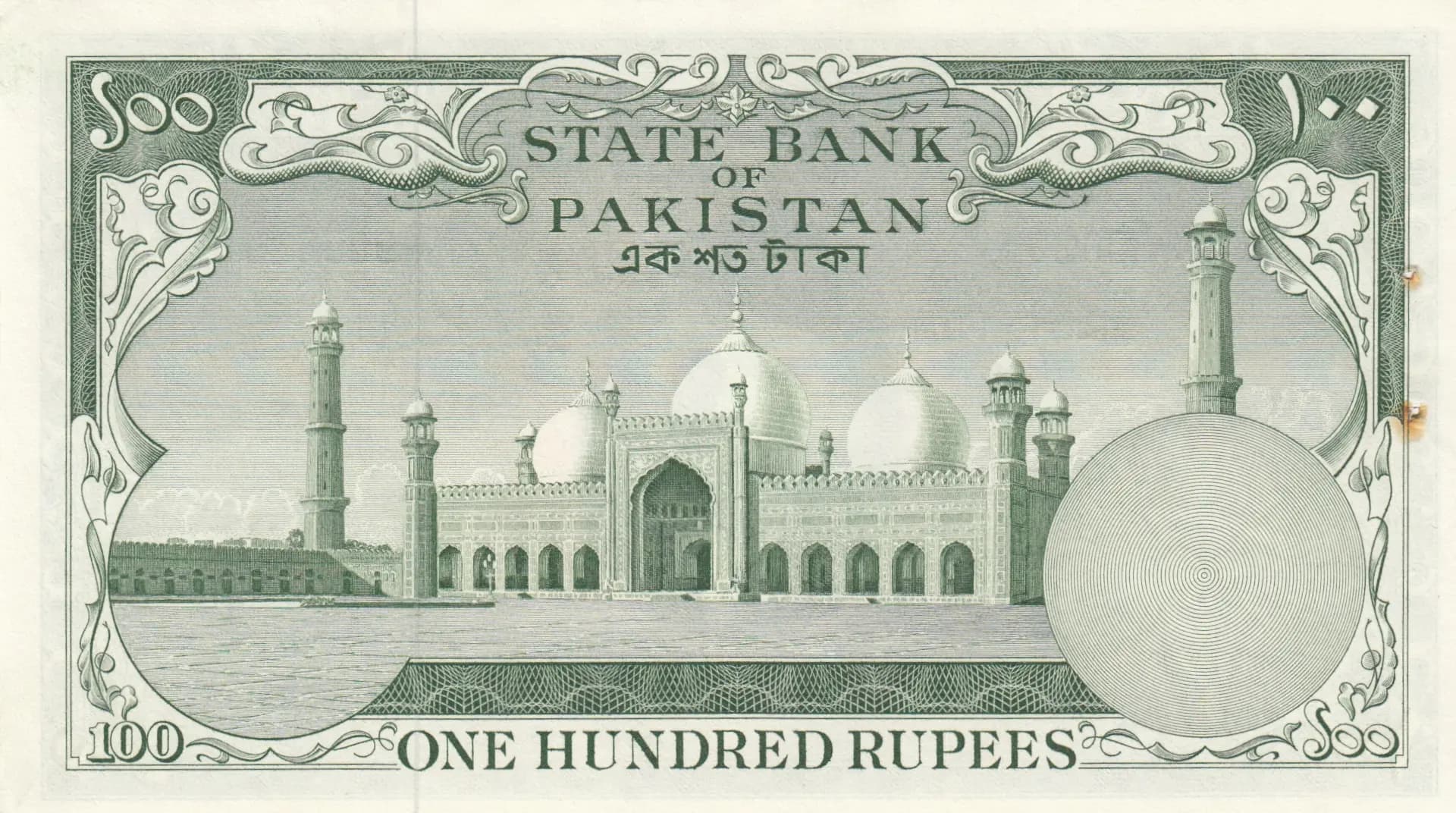
This is a Pakistan 100 Rupees note from 1957 (Pick P-18a), depicting the founder Mohammed Ali Jinnah on the obverse and the Badshahi Mosque in Lahore on the reverse. The note exhibits AU (About Uncirculated) condition with sharp intaglio engraving, vibrant green and multicolored printing, and no significant wear or creasing visible. This is an early State Bank of Pakistan issue featuring bilingual (Urdu and Bengali) text, reflecting the unified currency period before Bangladesh's separation.
Common. Despite being from 1957, the early issue date, this note is readily available in the collector market. eBay price tracking data shows consistent sales ranging from $1.51 to $97 depending on condition grade, with most AU/EF examples selling in the $15–30 range. The catalog value for UNC condition is listed at $15, and regular-condition examples frequently appear at modest prices, indicating substantial surviving circulation. No print run restrictions or recall history are documented for P-18a.
Issued in 1957, this note represents the early post-independence monetary authority of Pakistan under the State Bank of Pakistan. The obverse portrait honors Mohammed Ali Jinnah, the founder of Pakistan, establishing him as the authoritative figure on the nation's currency. The reverse showcases the Badshahi Mosque (also known as the Emperor's Mosque) in Lahore, a magnificent example of Mughal architecture and a symbol of Pakistan's Islamic heritage and cultural identity.
The obverse features a centrally positioned intaglio portrait of Mohammed Ali Jinnah, the Quaid-e-Azam (Great Leader), rendered in grayscale and wearing formal attire with the distinctive white Jinnah cap. The portrait is framed by ornate Islamic geometric and floral border patterns with star-shaped decorative elements flanking the portrait and a circular emblem in the lower right. The reverse displays a detailed engraved architectural representation of the Badshahi Mosque in Lahore, shown in frontal view with its characteristic multiple minarets and domes executed in the Mughal architectural style. Both sides feature ornamental corner scrollwork and fine line background patterns typical of high-security currency engraving. The overall color scheme combines green with beige, pink, and rose tones on a white field.
Front Side: '100' (English numerals), 'ONE HUNDRED RUPEES' (English), 'ایک سو روپے' (Urdu: 'One Hundred Rupees'), 'একশত টাকা' (Bengali: 'One Hundred Rupees'), Serial Number 'CB900629' (appears in two locations). Back Side: 'STATE BANK OF PAKISTAN' (English), '100' (English numerals), 'ONE HUNDRED RUPEES' (English), 'একশত টাকা' (Bengali: 'One Hundred Rupees'). The presence of Bengali text confirms this note predates the 1971 Bangladesh independence.
Intaglio engraving (line engraving) on white paper, producing the fine detailed line work visible in both the portrait and architectural rendering. The multicolor printing technique incorporates green as the primary color with secondary colors (beige, rose, pink) applied to create depth and visual interest. This note was produced by Thomas De La Rue & Company, the established British security printer for State Bank of Pakistan during this period, using traditional currency production methods of the 1950s.
This note exhibits the characteristics of Pick P-18a, which is part of the 1957–1967 series issued by the State Bank of Pakistan. The visual analysis indicates serial number CB900629, with the CB prefix typical of early Pakistani notes. The reference sources note two signature varieties exist for this Pick number. The absence of overprint and the presence of Jinnah watermark are standard for P-18a. No date is printed on the face, consistent with the ND (No Date) designation; the 1957 date refers to the authorized issue year. The bilingual Urdu/Bengali text is characteristic of all notes from this unified-currency period.