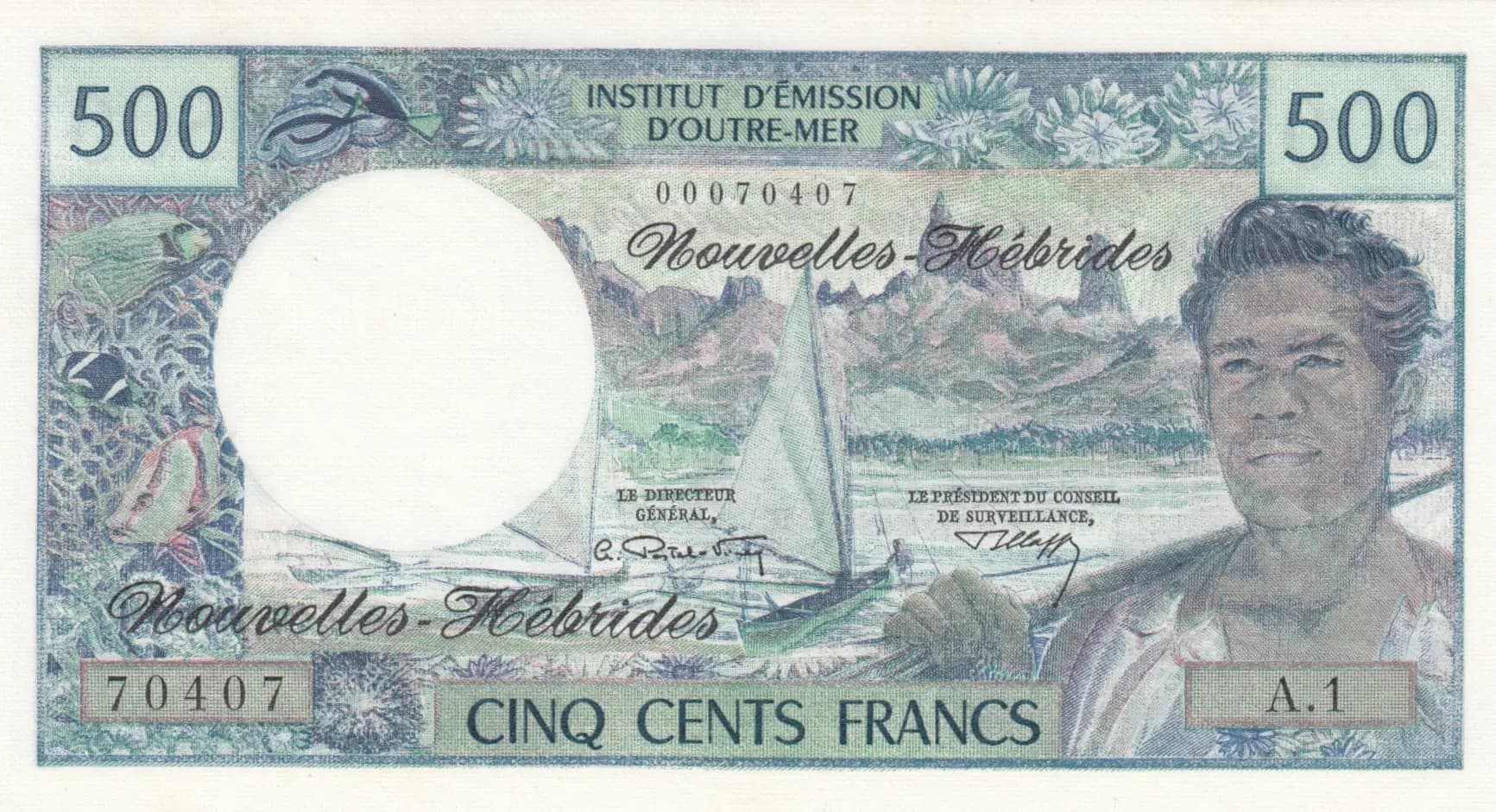
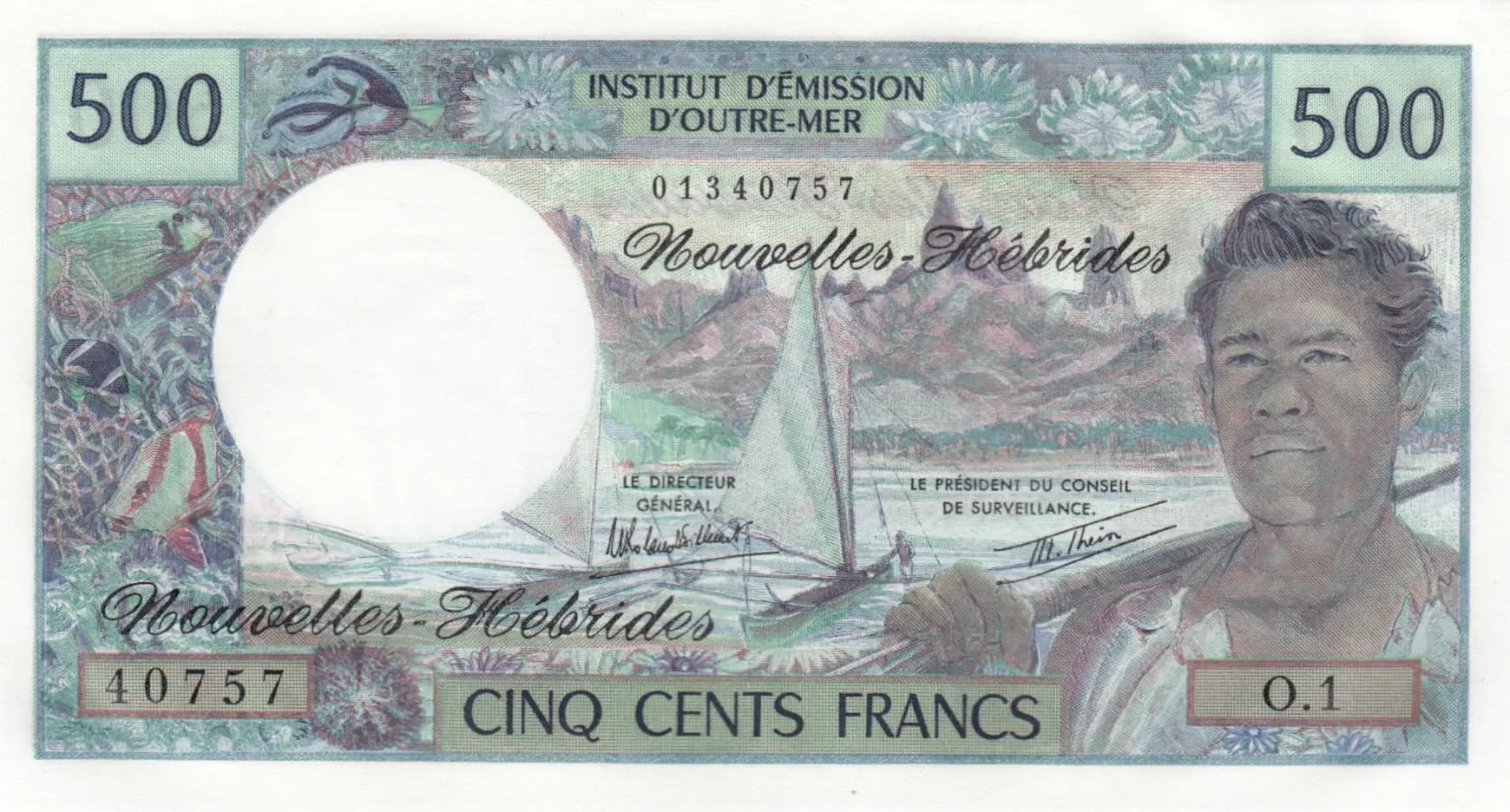
500 francs 1970 specimen
About This Note
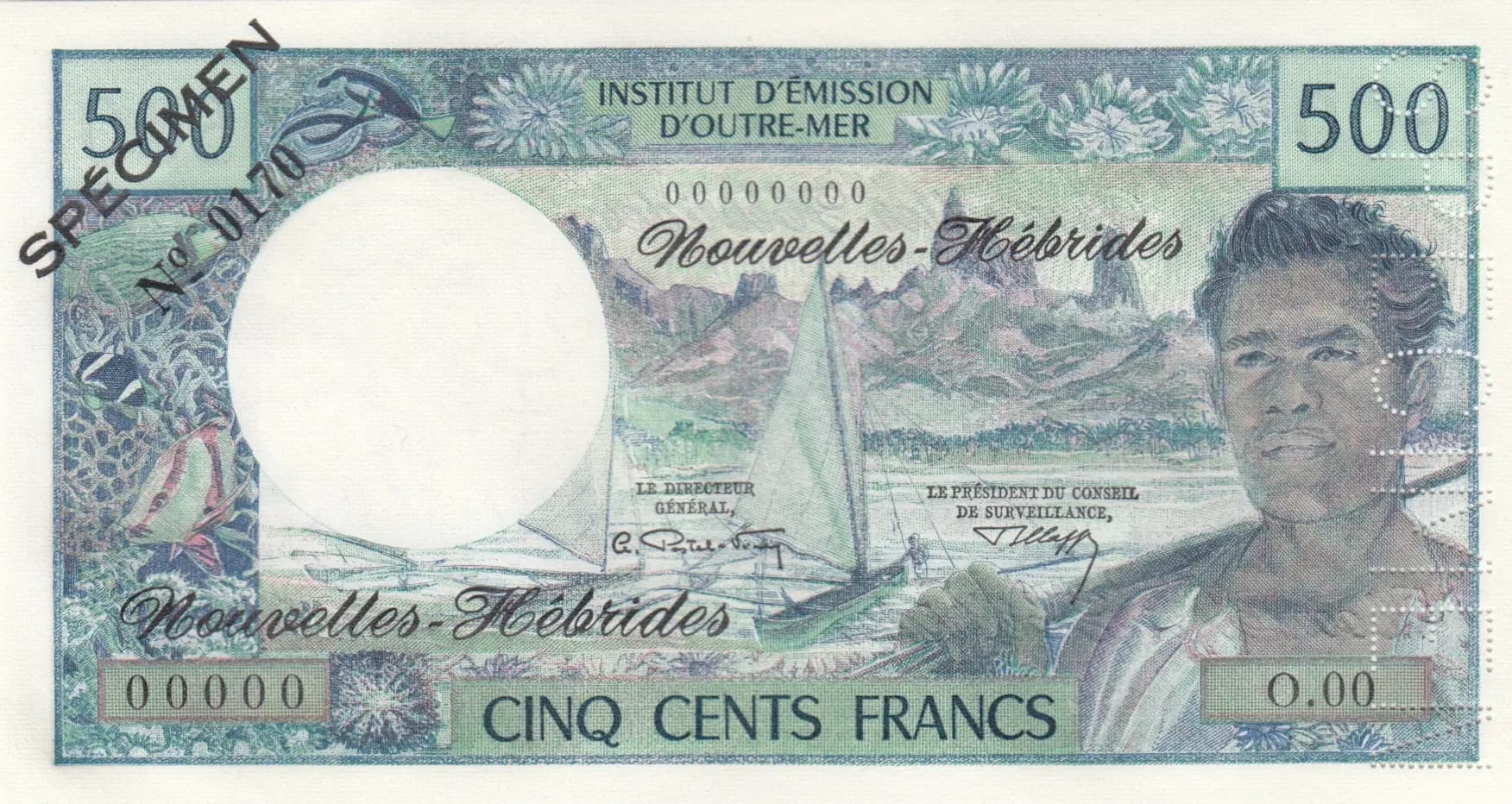
This is a spectacular specimen example of the 1970 New Hebrides 500 Francs note (Pick P-19s), issued by the Institut d'Émission d'Outre-Mer. The note exhibits pristine uncirculated condition with crisp, sharp printing throughout, featuring an elegant blue-green color palette enhanced by tropical botanical motifs and a striking central white circular vignette. The diagonal 'SPECIMEN' overprint confirms its non-circulating status, making this an excellent example for collectors of French colonial currency and Pacific island numismatics.
Common. Specimen notes from this series, while not circulated, were produced in sufficient quantities to serve administrative and archival purposes. The 1970 issue of 500 Francs New Hebrides notes had reasonable print runs, and specimen overprints were standard practice. Specimen notes are generally more common than their circulated counterparts because they were preserved in institutional collections rather than subjected to circulation wear. No specific data indicates an exceptionally limited mintage for this particular specimen variety.
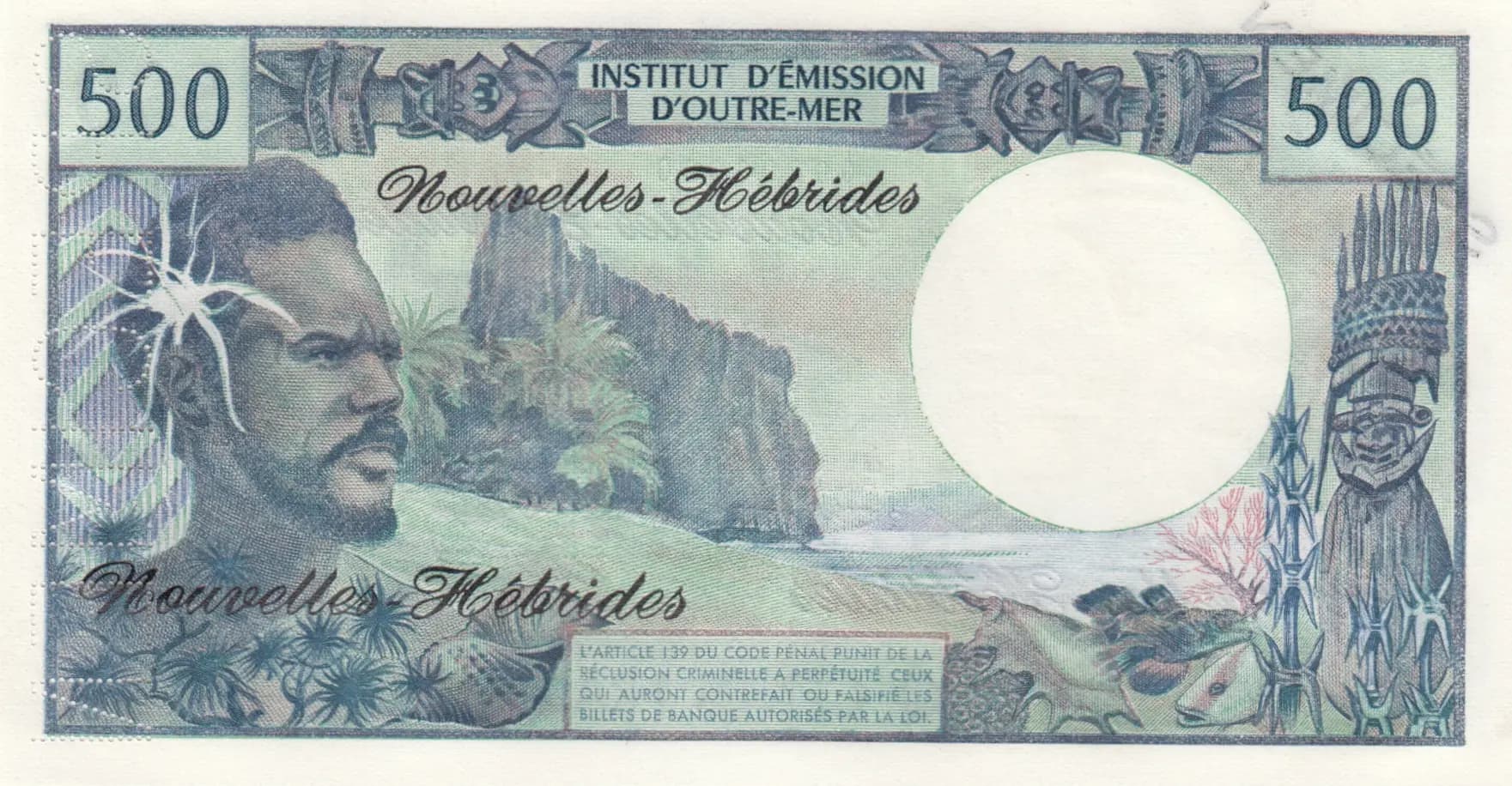
Issued in 1970, this note represents the currency of the New Hebrides during the final years before the territory's independence in 1980. The Institut d'Émission d'Outre-Mer (Institute of Overseas Emission) managed currency for various French Pacific territories, and this denomination reflects the monetary system inherited from French colonial administration. The reverse depicts rocky coastal formations and traditional island landscapes that are characteristic of the New Hebrides archipelago, while the obverse features portraits representative of the local population, reflecting the cultural identity of the territory during this transitional period.
The obverse features a woman in profile on the right side, rendered in traditional styling with distinctive jewelry characteristic of New Hebridean culture. The composition includes elaborate floral and botanical patterns on the left, with a large central white circular vignette containing a mountainous landscape. The reverse displays two male portraits—one on the left and one on the right—both shown in profile, flanking a dramatic central vignette depicting the rugged coastal scenery typical of the New Hebrides archipelago, including rocky cliff formations, seascapes, and what appears to be a traditional ceremonial or architectural structure. Throughout both sides, tropical plant designs and decorative marine-inspired patterns reinforce the island nation theme. The consistent blue-green and teal color palette, punctuated with pink and coral accents, creates visual harmony while maintaining the formal aesthetic required of currency design.
FRONT SIDE: 'INSTITUT D'ÉMISSION D'OUTRE-MER' (Institute of Overseas Emission); 'Nouvelles-Hébrides' (New Hebrides); 'CINQ CENTS FRANCS' (Five Hundred Francs); '500' (denomination); 'SPECIMEN' (specimen overprint); 'LE DIRECTEUR GÉNÉRAL' (The General Director); 'LE PRÉSIDENT DU CONSEIL DE SURVEILLANCE' (The President of the Supervisory Board). REVERSE SIDE: 'INSTITUT D'ÉMISSION D'OUTRE-MER' (Institute of Overseas Emission); 'Nouvelles-Hébrides' (New Hebrides); '500' (denomination); 'L'ARTICLE 139 DU CODE PÉNAL PUNIT DE LA RÉCLUSION CRIMINELLE À PERPÉTUITÉ CEUX QUI AURAIENT CONTREFAIT CES BILLETS DE BANQUE AUTORISÉS PAR LA LOI' (Article 139 of the Penal Code punishes with life imprisonment those who would have counterfeited these banknotes authorized by law).
This note employs intaglio engraving (also known as line engraving), the standard security printing technique for banknotes of this era. The fine line patterns, detailed portrait engraving, and sharp definition visible throughout the design are characteristic of high-security intaglio printing. The technique's complexity and the requirement for specialized plates made counterfeiting extremely difficult. Notes of the Institut d'Émission d'Outre-Mer series were typically produced by Banque de France-authorized security printers specializing in colonial currency.
This is cataloged as Pick P-19s, the specimen variety of the 1970 500 Francs New Hebrides note. The PMG population report indicates five recorded variants of this base Pick number: P-19a (Signature #1), P-19b (Signature #3), P-19c (Signature #3A), P-19cs (Signature #3A), and P-19s (specimen, no specific signature designation recorded). This particular note is distinguished by its 'SPECIMEN' overprint and serial number zeros (00000000 and 00000), which are characteristic identifiers of specimen/non-issued examples. The absence of signature notation in the catalog entry for P-19s suggests this specimen predates or exists outside the standard signature variants, possibly representing a presentation or archival specimen.