1000 francs 1970 specimen
About This Note
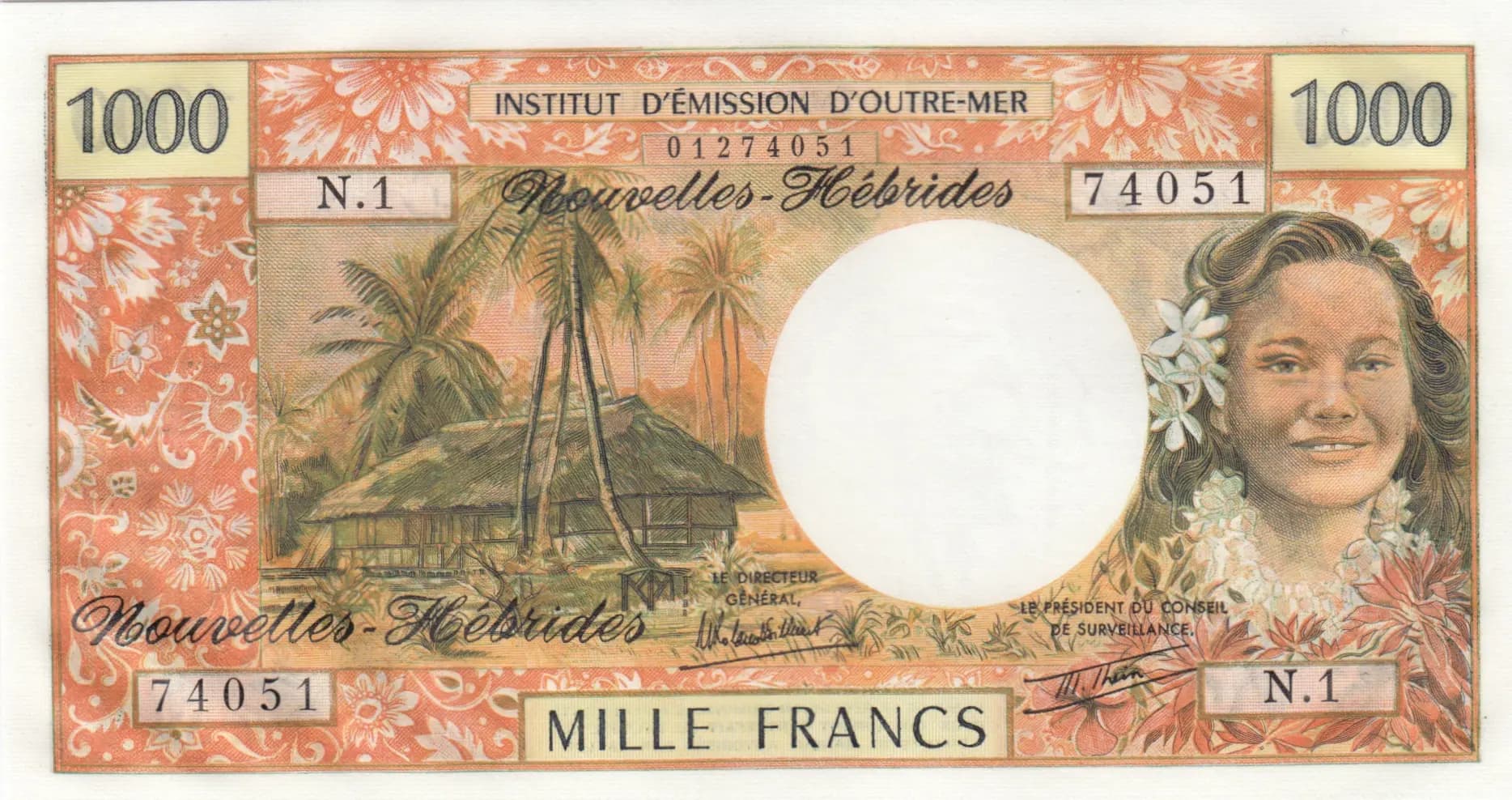
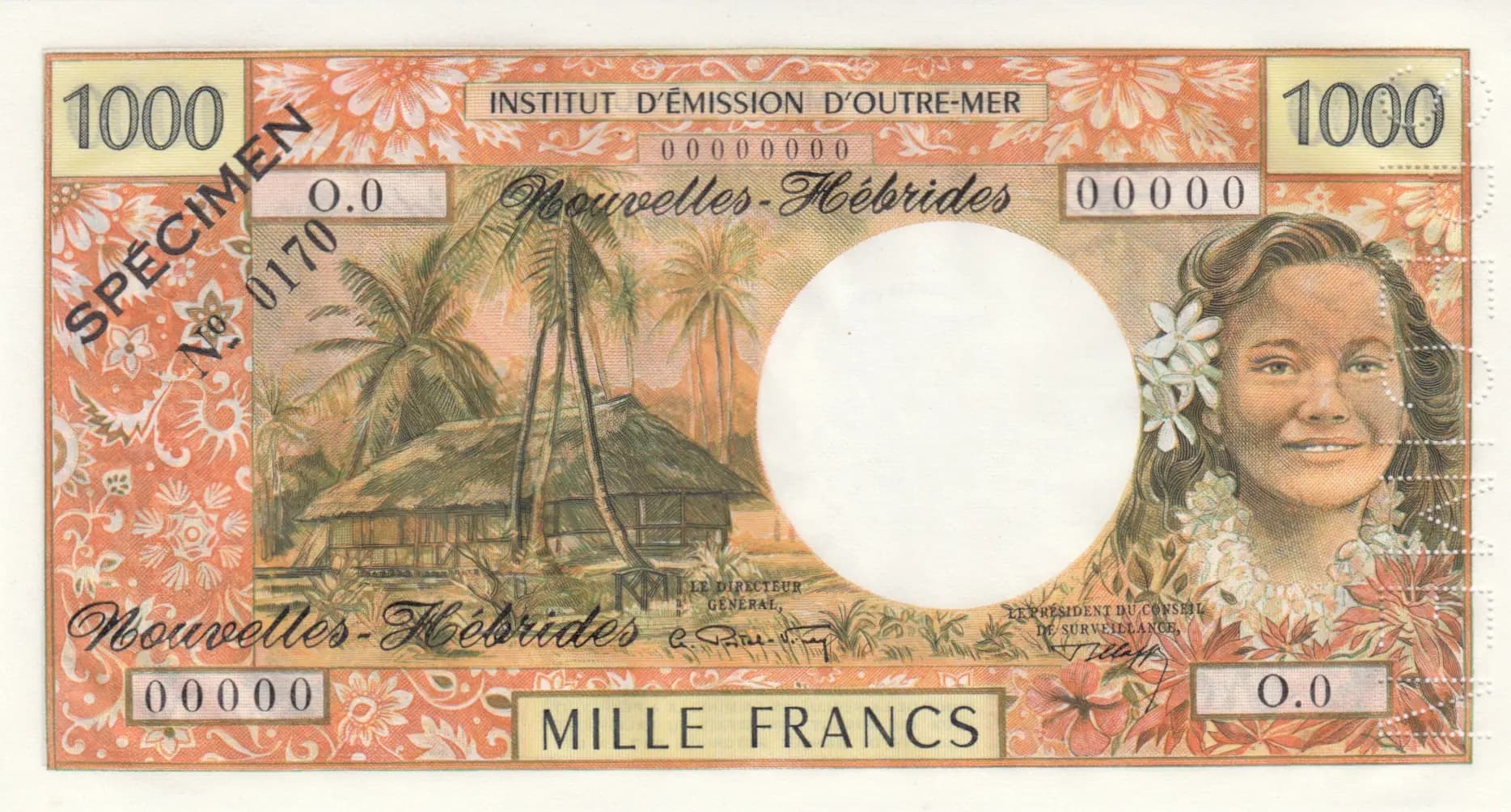
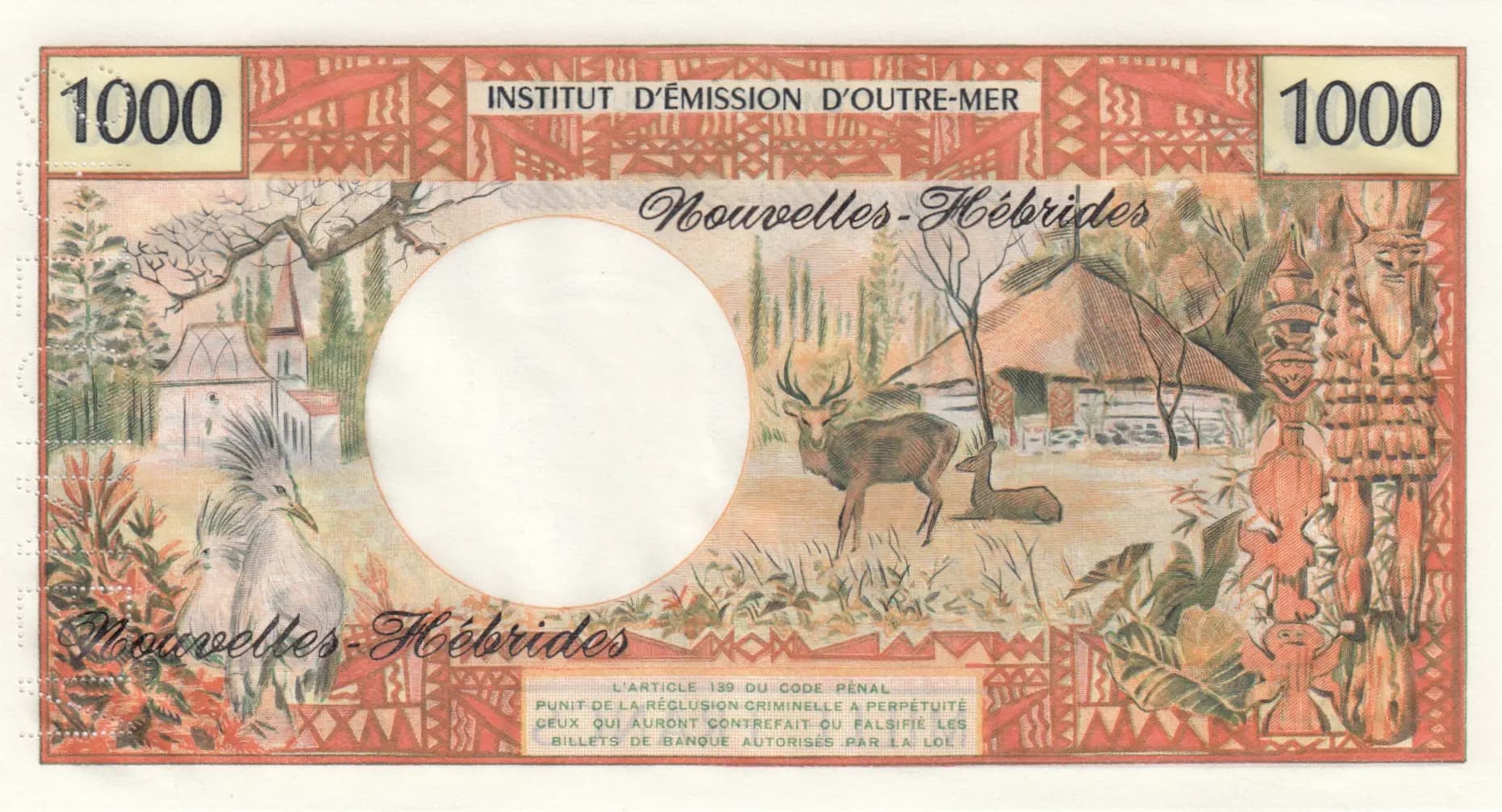
This is an uncirculated specimen of the 1000 Francs New Hebrides banknote from 1970 (Pick P-20s), issued by the Institut d'Émission d'Outre-Mer. The note features vibrant coral and orange tones with colonial-era imagery including a tropical stilt house on the obverse and ethnographic design elements on the reverse, both incorporating ornamental floral and geometric patterns characteristic of French Pacific territory currency. As a specimen note with SPECIMEN overprint and zero serial numbers, this piece represents a unique category within New Hebridean numismatics, preserving the design intent without circulation use.
Common. New Hebridean banknotes from the 1970 issue were produced in substantial quantities for circulation by the Institut d'Émission d'Outre-Mer across the condominium territory. Specimen notes, while designated as non-circulating, were issued in standard institutional quantities for archival, educational, and official distribution purposes. No evidence of restricted print runs, early recall, or exceptional scarcity exists for this Pick number. The specimen designation does not elevate rarity significantly in the broader numismatic market, as specimen notes represent a standard production category for most central banks.
The New Hebrides condominium (jointly administered by France and Britain until 1980) issued this banknote through the Institut d'Émission d'Outre-Mer during the late colonial period. The obverse's depiction of a tropical stilt house reflects the indigenous Melanesian architectural tradition, while the reverse showcases baobab trees, carved totems, and savanna wildlife—imagery that romanticized the territory's cultural landscape for metropolitan audiences. The specimen designation indicates this note was produced for currency release preparation and archival purposes during a period of monetary standardization across French overseas territories.
The obverse features a woman's portrait in profile facing right, adorned with white tropical flowers in her hair, positioned on the right side of the note. The central vignette depicts a characteristic Melanesian stilt house with thatched roof, surrounded by coconut palms and tropical vegetation rendered in warm earth tones. The reverse presents an ethnographic landscape scene typical of French colonial currency design, including baobab or acacia trees, a traditional domed hut structure, carved wooden totems or tribal poles on the right margin, and wildlife including an antelope or deer. Both sides incorporate extensive decorative borders featuring coral/orange floral motifs and geometric patterns in red and linear designs. A prominent white circular watermark area occupies the center-right portion of both sides, serving as a security and design feature. The color palette—dominated by coral orange, cream/beige, green, and brown—creates the warm aesthetic characteristic of 1970s French overseas territory banknote design.
FRONT SIDE: 'INSTITUT D'ÉMISSION D'OUTRE-MER' (Institute of Overseas Emission), 'Nouvelles-Hébrides' (New Hebrides), 'MILLE FRANCS' (One Thousand Francs), '1000' (denomination), 'SPECIMEN' (specimen designation), 'LE DIRECTEUR GÉNÉRAL' (The General Director), 'LE PRÉSIDENT DU CONSEIL DE SURVEILLANCE' (The President of the Supervisory Board), with serial number references 'O.0', '00000000', '00170', '00000'. BACK SIDE: 'Nouvelles-Hébrides' (New Hebrides), 'INSTITUT D'ÉMISSION D'OUTRE-MER' (Institute of Overseas Emission), '1000' (denomination), 'L'ARTICLE 139 DU CODE PÉNAL PUNIT DE LA RÉCLUSION CRIMINELLE À PERPÉTUITÉ CEUX QUI AURAIENT CONTREFAIT CES BILLETS DE BANQUE AUTORISÉS PAR LA LOI' (Article 139 of the Penal Code punishes with life imprisonment those who would have counterfeited these banknotes authorized by law).
Multi-color intaglio (engraved) printing, a standard security printing method for high-denomination currency of this era. The fine detail work visible in the floral patterns, portrait rendering, and geometric borders indicates professional security printer production, consistent with notes produced by the Banque de France's authorized contractors for overseas territories during this period. The specimen overprint and specimen-grade serial number formatting (zeros) were applied as part of the production authorization process.
This note is cataloged as P-20s, the specimen variant of the base Pick 20 type. According to PMG population data, four variants exist for this base number: P-20a (Signature Variety #1), P-20b (Signature Variety #2), P-20c (Signature Variety #3A), and P-20s (Specimen). The specimen variant (P-20s) is distinguished by the 'SPECIMEN' overprint and zero serial numbers (O.0 / 00000000 / 00170 / 00000) visible on this note. No signature variations are present on specimen notes, as they precede the circulation-intended production run.