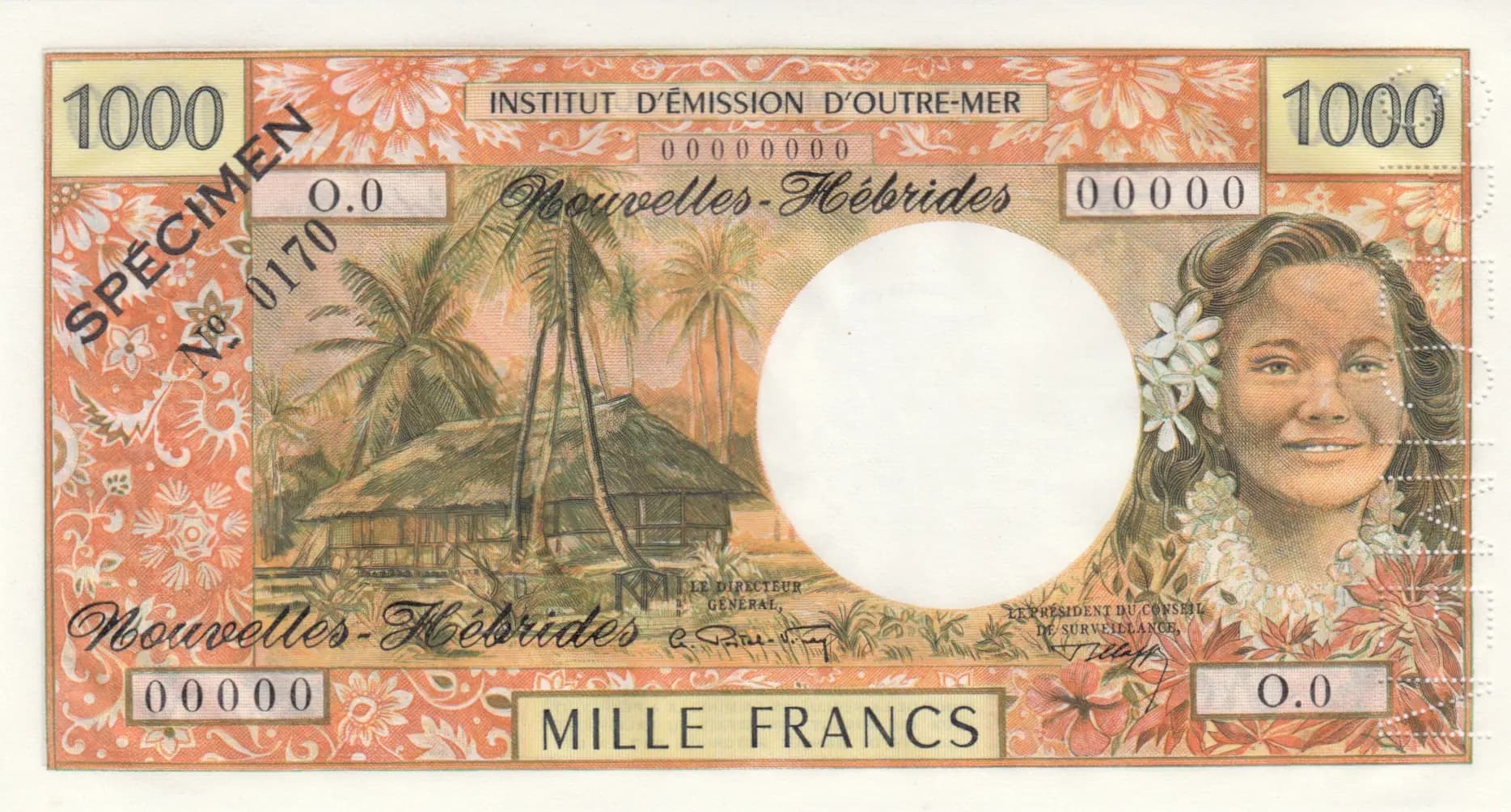
1000 francs 1979
About This Note
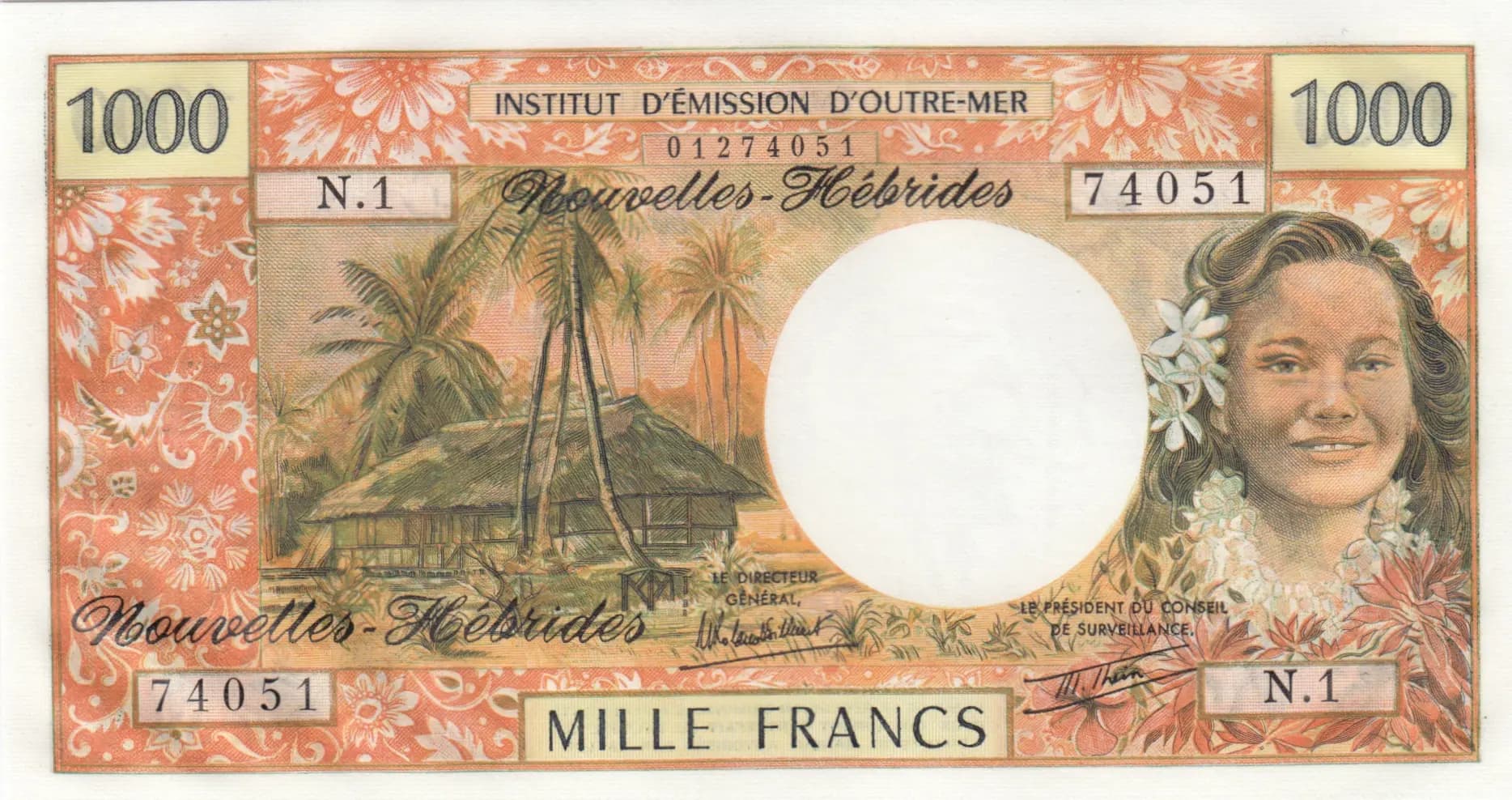
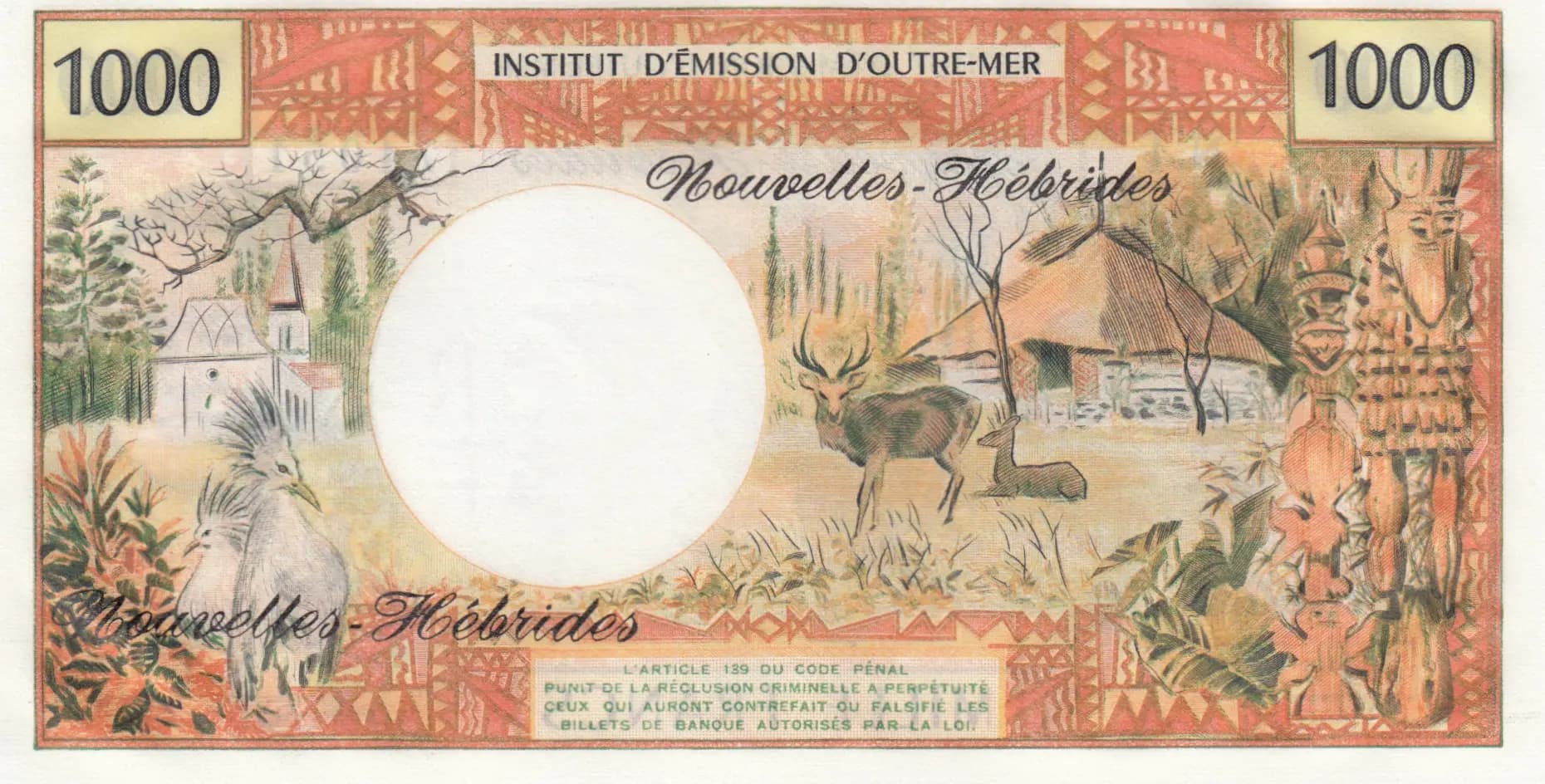
This 1000 Francs note from New Hebrides (1979) represents an exceptional example of French colonial-era Pacific banknote design, issued by the Institut d'Emission d'Outre-Mer. The note presents pristine uncirculated condition with vibrant coral and salmon pink coloring, featuring distinctive tropical imagery including a thatched-roof dwelling, palm trees, and a portrait of a woman adorned with white flowers on the obverse, while the reverse depicts indigenous wildlife and traditional architectural elements. The meticulous engraving and multi-color printing showcase the technical sophistication of late 1970s banknote production for overseas territories.
Common. The New Hebrides 1000 Francs note from 1979 (Pick-20c) represents a standard-issue denomination from a working currency series that circulated until independence in 1980. The Pick catalog recognizes four signature varieties (P-20a, P-20b, P-20c, P-20s), with P-20c being one of three primary signature variants, indicating substantial print runs across multiple signature combinations. Notes from this series and denomination range regularly appear in the collector market at modest valuations, reflecting widespread availability despite the territory's small population.
The New Hebrides (modern-day Vanuatu) remained under joint Anglo-French administration during the late 1970s, reflected in the French-language inscriptions and the Institut d'Emission d'Outre-Mer issuer. The banknote's imagery—featuring tropical settlements, indigenous fauna, and traditional structures—represents the colonial-era aesthetic documentation of Pacific island life during the period immediately preceding the territory's independence in 1980. The denomination in francs reflects the French monetary influence that persisted in the New Hebrides condominium administration.
The obverse features a woman's portrait positioned on the right side, with wavy dark hair adorned with white tropical flowers, rendered in classical colonial portraiture style. The left side depicts a tropical settlement scene with a traditional thatched-roof dwelling surrounded by palm trees and indigenous vegetation, symbolizing the islands' indigenous culture. The reverse showcases the fauna and cultural heritage of the New Hebrides, including a tropical bird (likely a native parrot species) on the left, antelope or deer in the central landscape, and traditional architectural or carved totem elements on the right, with a chapel or colonial-era structure visible in the background. Ornate geometric and floral borders frame both sides, executed in elaborate engraved patterns typical of French banknote design aesthetics of the period.
FRONT: '1000' (denomination), 'INSTITUT D'ÉMISSION D'OUTRE-MER' (Overseas Emission Institute), 'Nouvelles-Hébrides' (New Hebrides), 'MILLE FRANCS' (One Thousand Francs), 'LE DIRECTEUR GÉNÉRAL' (The General Director), 'LE PRÉSIDENT DU CONSEIL DE SURVEILLANCE' (The President of the Supervisory Board), 'N.1' (Number 1), serial number '01274051'. BACK: '1000' (denomination), 'INSTITUT D'ÉMISSION D'OUTRE-MER' (Overseas Emission Institute), 'Nouvelles-Hébrides' (New Hebrides), 'ARTICLE 139 DU CODE PÉNAL PUNIT DE LA RÉCUSION CRIMINELLE À PERPÉTUITÉ CEUX QUI AURAIENT CONTREFAIT OU FALSIFIÉ LES BILLETS DE BANQUE AUTORISÉS PAR LA LOI.' (Article 139 of the Penal Code punishes with criminal imprisonment for life those who would have counterfeited or falsified banknotes authorized by law).
Intaglio engraving with multi-color lithographic printing, characteristic of Institut d'Emission d'Outre-Mer banknotes of this era. The intricate border patterns, fine line work in the landscape scenes, and precise color registration evident in the coral, salmon pink, cream, orange, green, and brown palette indicate the use of multiple engraved plates combined with offset printing techniques. The sharp definition of details and absence of color bleeding observed in the uncirculated specimen reflect high-quality security printer production standards typical of French overseas currency of the 1970s.
This note is identified as Pick-20c, representing 'Sign. #3A' (Signature Variant 3A) according to the PMG population report. The visible serial number '01274051' and the 'N.1' designation are consistent with standard issue numbering. The P-20c variety is one of three primary signature variants in the 1000 Francs series, with P-20a and P-20b representing earlier signature combinations. The P-20s variant likely represents a specimen overprint or special issue. As a Sign. #3A note, this represents the standard late-issue period of this banknote before the territory's transition to independence.