5000 francs 1971 specimen
Market Prices
About This Note
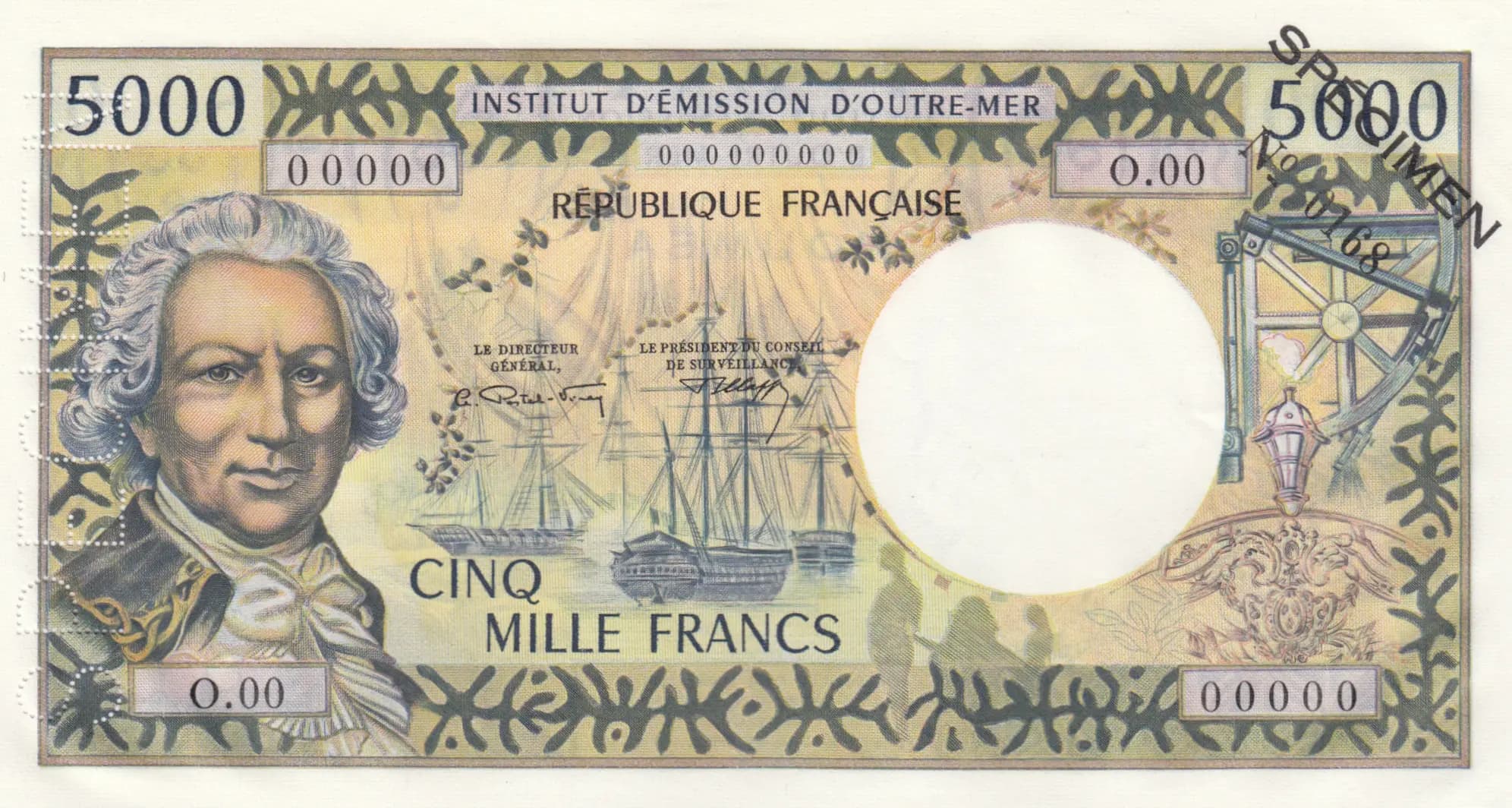
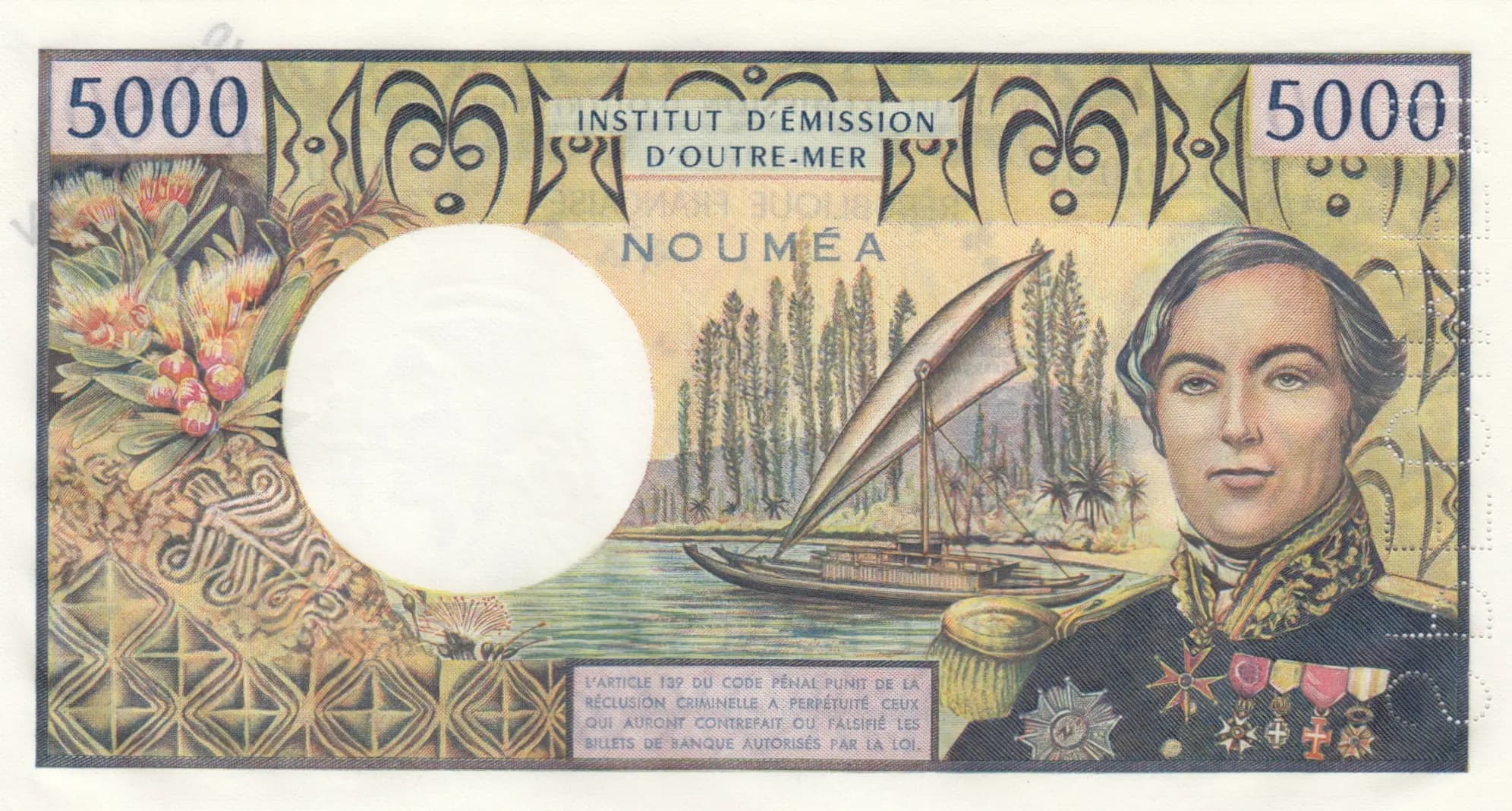
An outstanding specimen note of New Caledonia's 5000 francs from 1971, issued by the Institut d'Emission d'Outre-Mer. This UNC example features exquisite color printing with dominant yellow, gold, and green tones, depicting the historical explorer Louis Antoine de Bougainville on the obverse and Admiral Février-Despointes in military dress on the reverse, both surrounded by sailing vessels and ornamental botanical elements. The note exhibits pristine condition with no circulation wear, creases, or damage, and displays the characteristic zero serial numbers and specimen markings that identify it as a presentation piece rather than currency for circulation.
uncommon. While specimen notes are inherently produced in smaller quantities than circulation notes, the P-65s has achieved moderate market visibility with UNC examples trading between $110 and $899 on recent eBay sales, indicating limited but consistent collector demand. The broad price range ($110–$899 for UNC grades) suggests variability in premium pricing, possibly reflecting signature variations or serial number characteristics. The 2019 catalog valuation of $400 for UNC examples supports an 'uncommon' rather than 'rare' assessment. The note is not from a recalled series or short-lived issuer, and specimen notes of this type were produced in enough quantity to enter the secondary market regularly, though far fewer examples exist than circulation-strike notes.
This banknote commemorates French colonial presence in the Pacific, specifically New Caledonia's ties to the French overseas territories during the post-World War II period. Louis Antoine de Bougainville (1729-1811), depicted on the front with his characteristic 18th-century styling and sailing ships, was a French explorer and naval officer instrumental in Pacific exploration and French territorial expansion. Admiral Février-Despointes, shown in 19th-century military regalia on the reverse, represents the military and administrative heritage of French colonial governance in New Caledonia, while the forested landscape and coastal imagery reflect the territory's natural character.
This banknote presents a sophisticated dual-portrait design typical of French colonial-era currency. The obverse features Louis Antoine de Bougainville in left-center position, rendered in 18th-century dress with white curled hair characteristic of the Enlightenment period, accompanied by two multi-masted sailing vessels in the center representing his maritime expeditions. The reverse showcases Admiral Février-Despointes in right-center position, depicted in full military dress uniform with medals, ribbons, and decorative insignia including a cross, seated against a backdrop of a sailing vessel and a forested pine landscape typical of New Caledonian territory. Both sides incorporate elaborate ornamental framing with botanical motifs—flowering vines, decorative leaf patterns, and geometric borders rendered in gold and green—emphasizing the territory's natural wealth. Large circular watermark areas are positioned in the center-right (obverse) and center-left (reverse). The color palette of cream, gold, yellow, green, pink, and blue-gray creates visual richness while maintaining the formal aesthetic appropriate to a high-denomination note.
FRONT SIDE: '5000' (denomination in numerals); 'INSTITUT D'ÉMISSION D'OUTRE-MER' (Overseas Emission Institute); 'RÉPUBLIQUE FRANÇAISE' (French Republic); 'CINQ MILLE FRANCS' (Five Thousand Francs); 'LE DIRECTEUR GÉNÉRAL' (The General Director); 'LE PRÉSIDENT DU CONSEIL DE SURVEILLANCE' (The President of the Supervisory Board); Serial number fields marked 'O.00' and '00000' (specimen indicators). BACK SIDE: '5000' (denomination); 'NOUMÉA' (place of issue, capital of New Caledonia); 'INSTITUT D'ÉMISSION D'OUTRE-MER' (Overseas Emission Institute); Legal warning: 'L'ARTICLE 139 DU CODE PÉNAL PUNIT DE LA RÉCLUSION CRIMINELLE À PERPÉTUITÉ CEUX QUI CONTREFAIT OU FALSIFIENT LES BILLETS DE BANQUE AUTORISÉS PAR LA LOI' (Article 139 of the Penal Code punishes with life imprisonment those who counterfeit or forge banknotes authorized by law).
This note was produced using intaglio engraving combined with multi-color letterpress printing, standard for French banknote production of the 1970s. The fine line work, detailed portraiture, and complex botanical ornaments visible in the visual analysis are characteristic of intaglio processes, which create the deeply incised designs typical of high-security banknotes. The Institut d'Emission d'Outre-Mer utilized French security printing facilities, likely Banque de France contractors, employing the advanced anti-counterfeiting techniques of the era reflected in the sophisticated watermark areas and intricate geometric patterns.
This note is cataloged as P-65s in the Pick standard, indicating it is the specimen variety of the base P-65 design. The PMG population report confirms four cataloged variants (P-65a, P-65b, P-65c, P-65s), all issued from Nouméa. The specimen designation is confirmed by the zero serial numbers ('O.00' and '00000' visible in the visual analysis) and specimen overprint stamp visible in the upper right corner of the obverse, which are standard identifiers for presentation/non-circulation examples. Specimen notes typically feature these characteristic markings to distinguish them from circulation currency and may carry slight printing variations compared to standard issues. Collectors should note the 'Nouméa' designation on the reverse, which is consistent across documented variants of this issue.