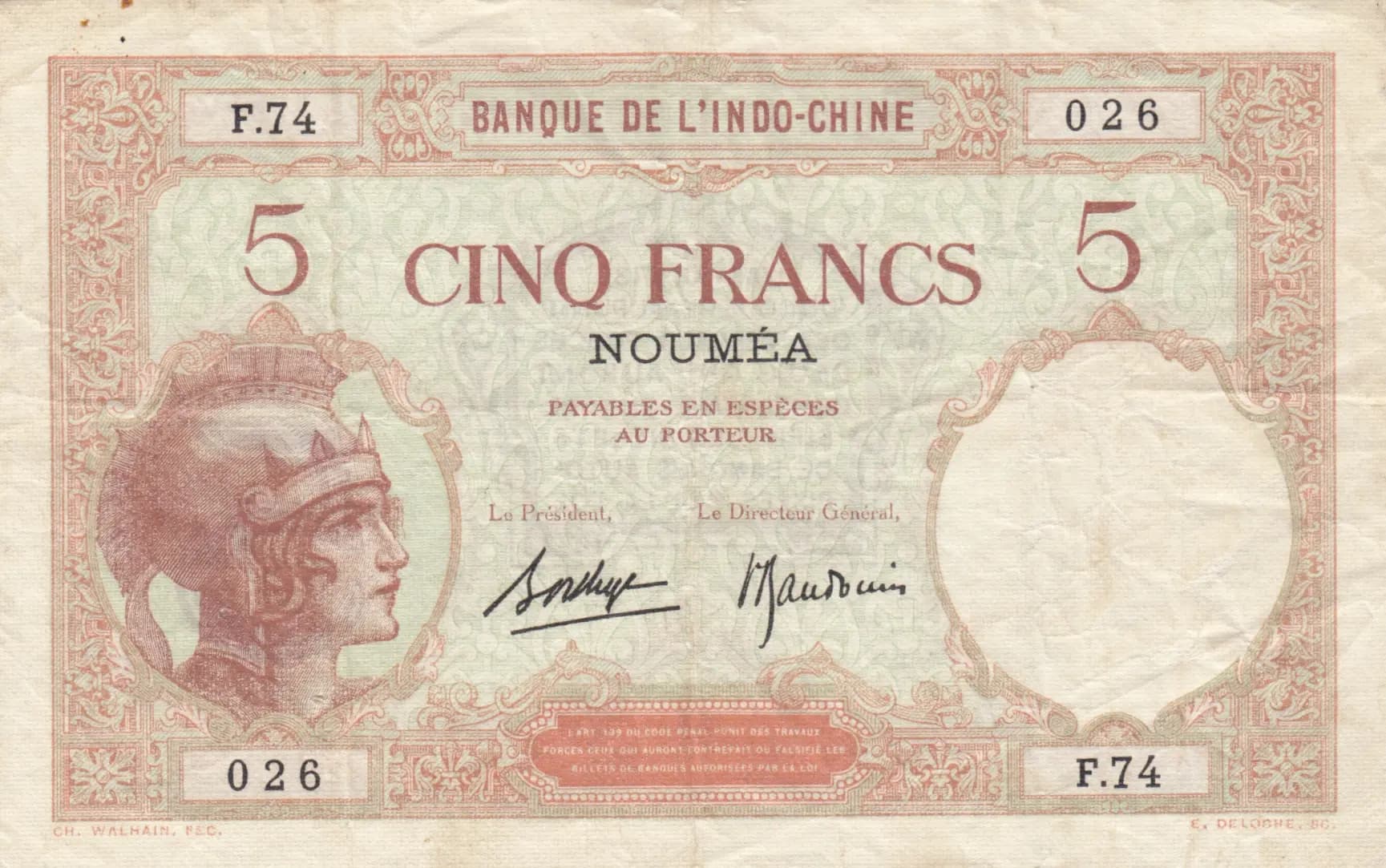
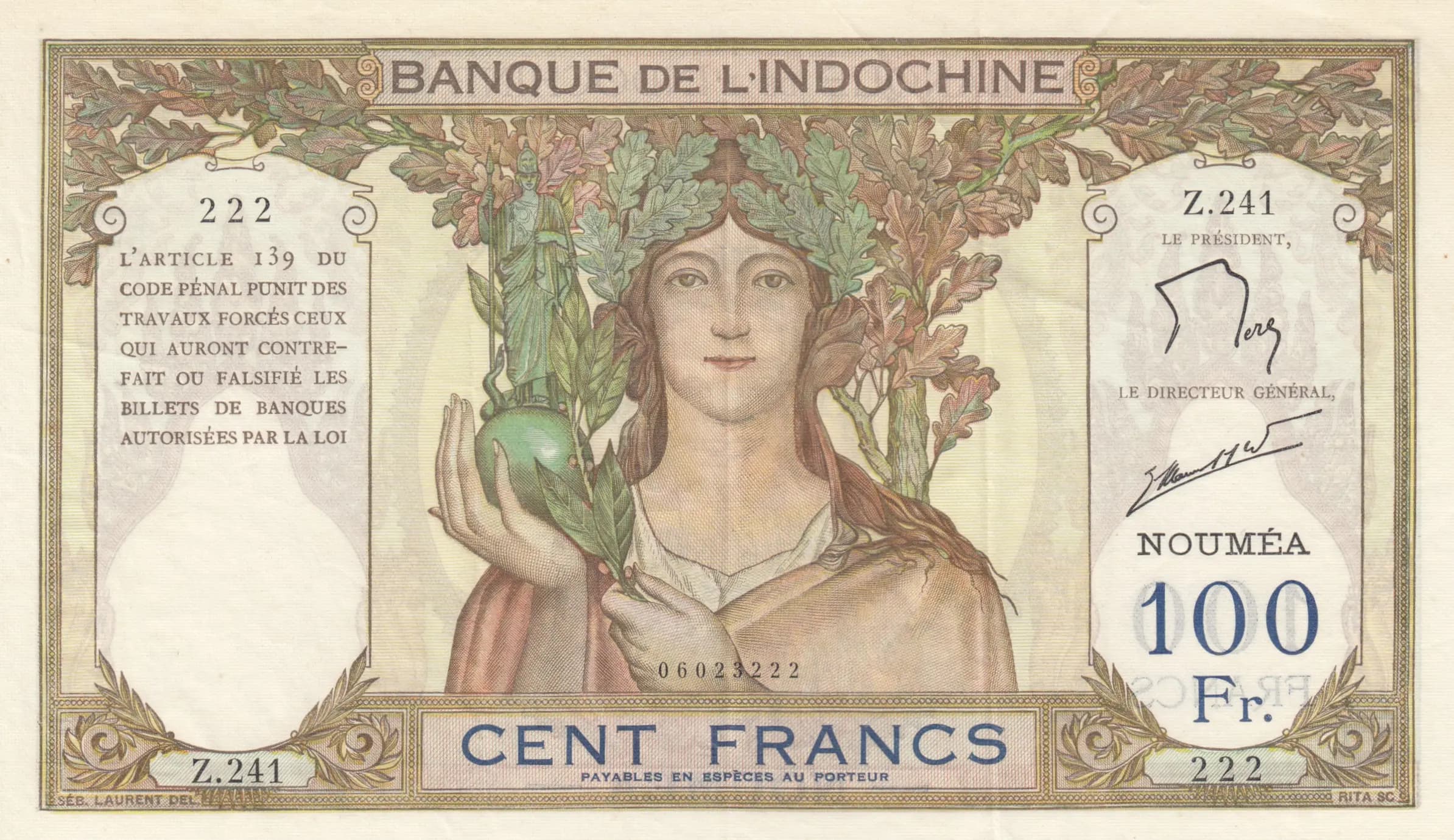
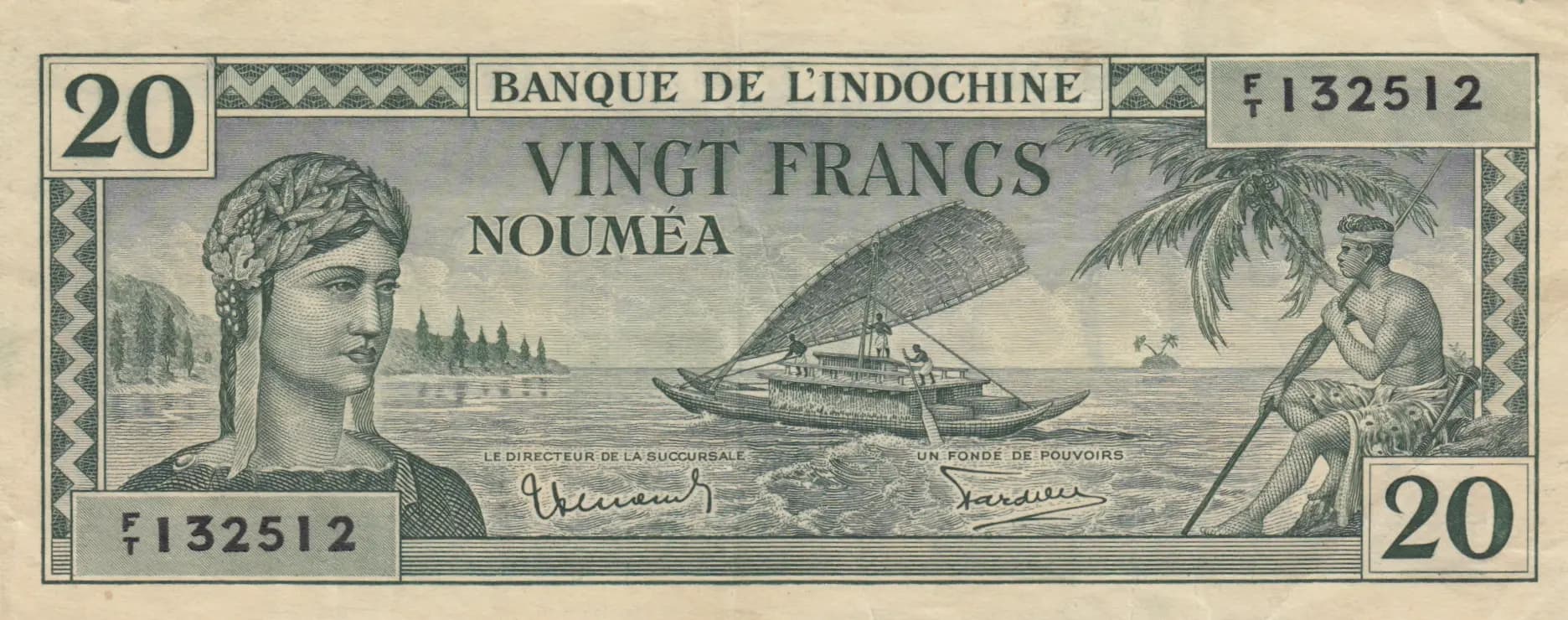
20 francs 1939
Market Prices
14 salesAbout This Note
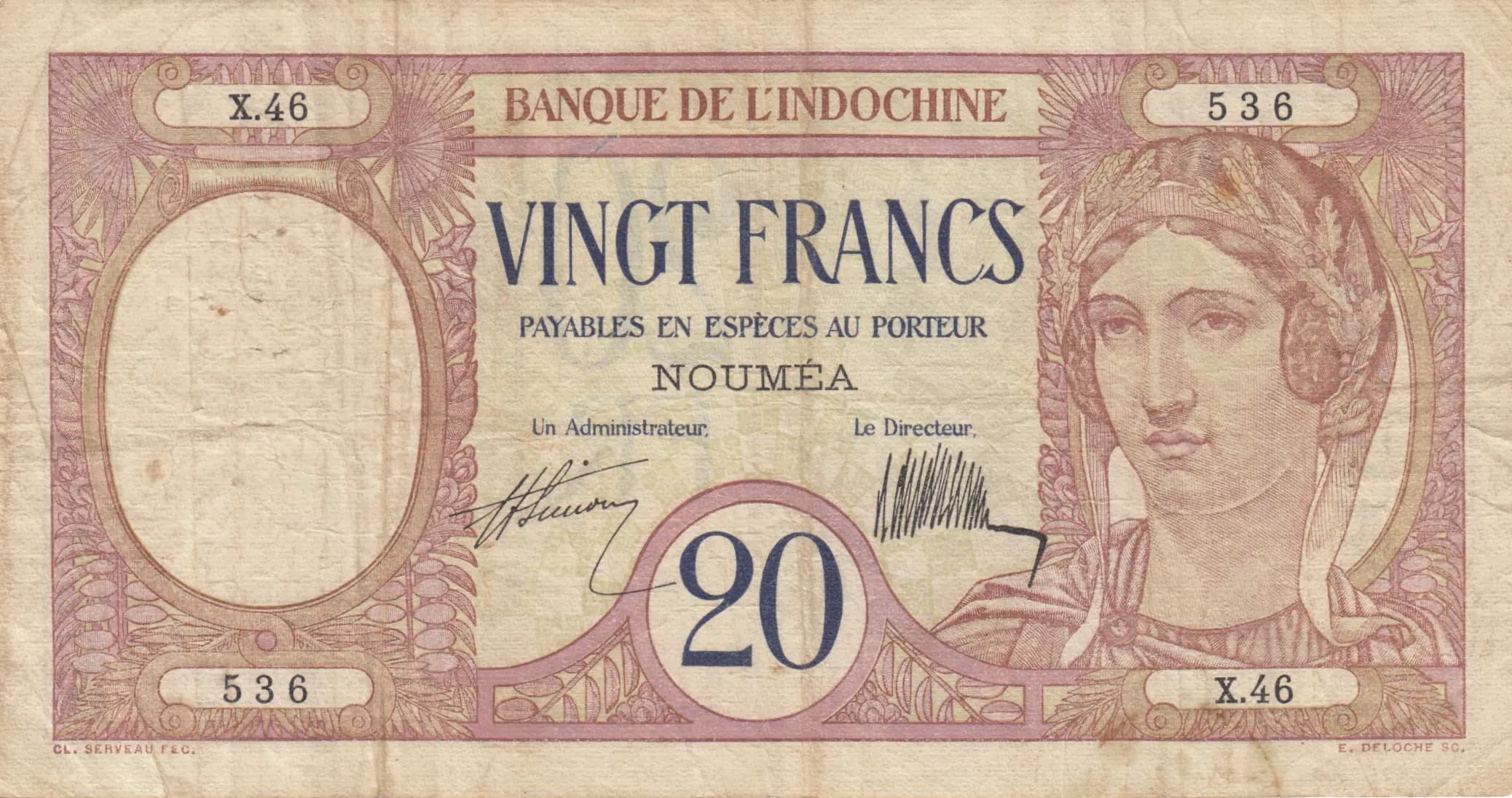
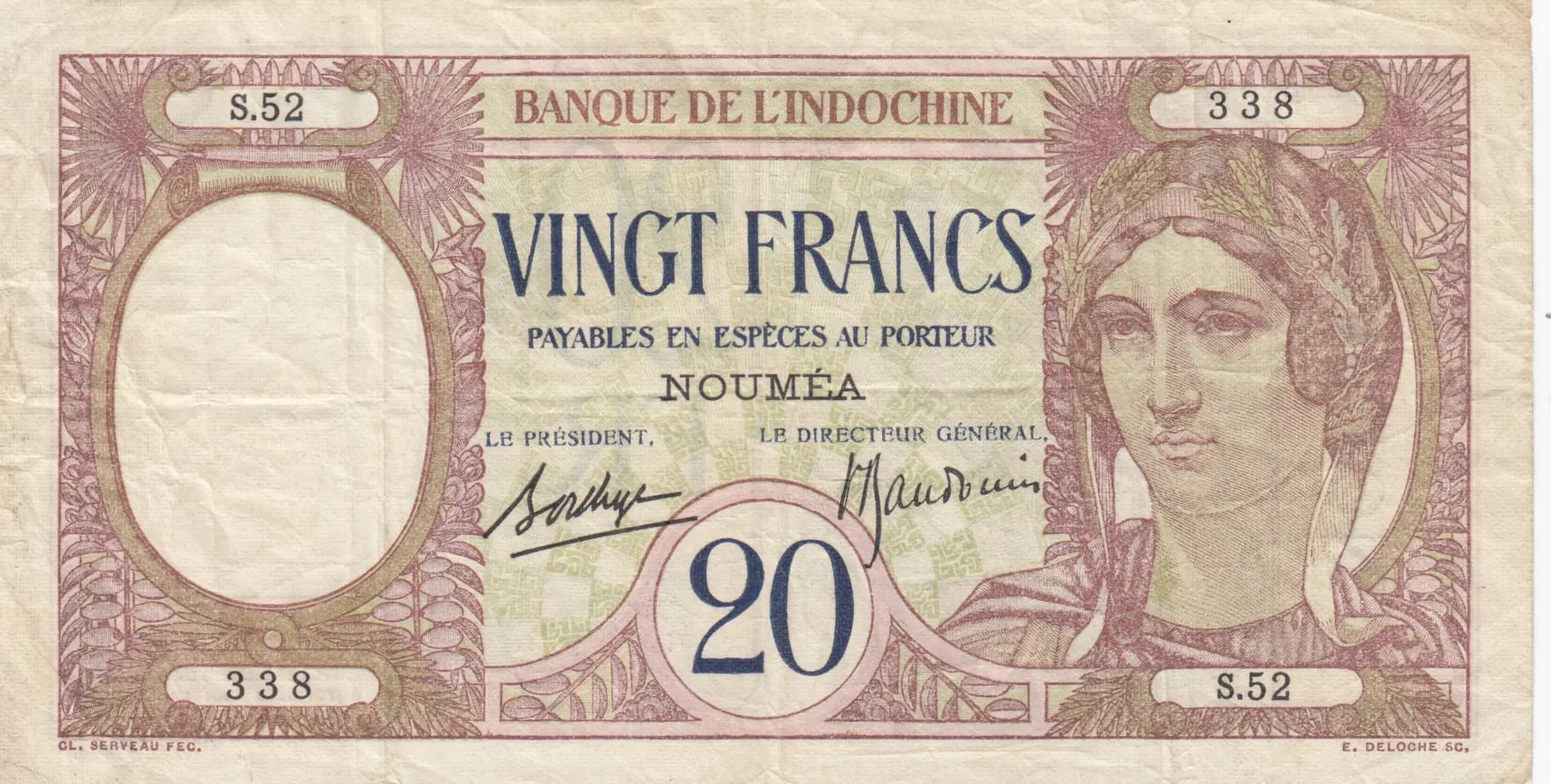
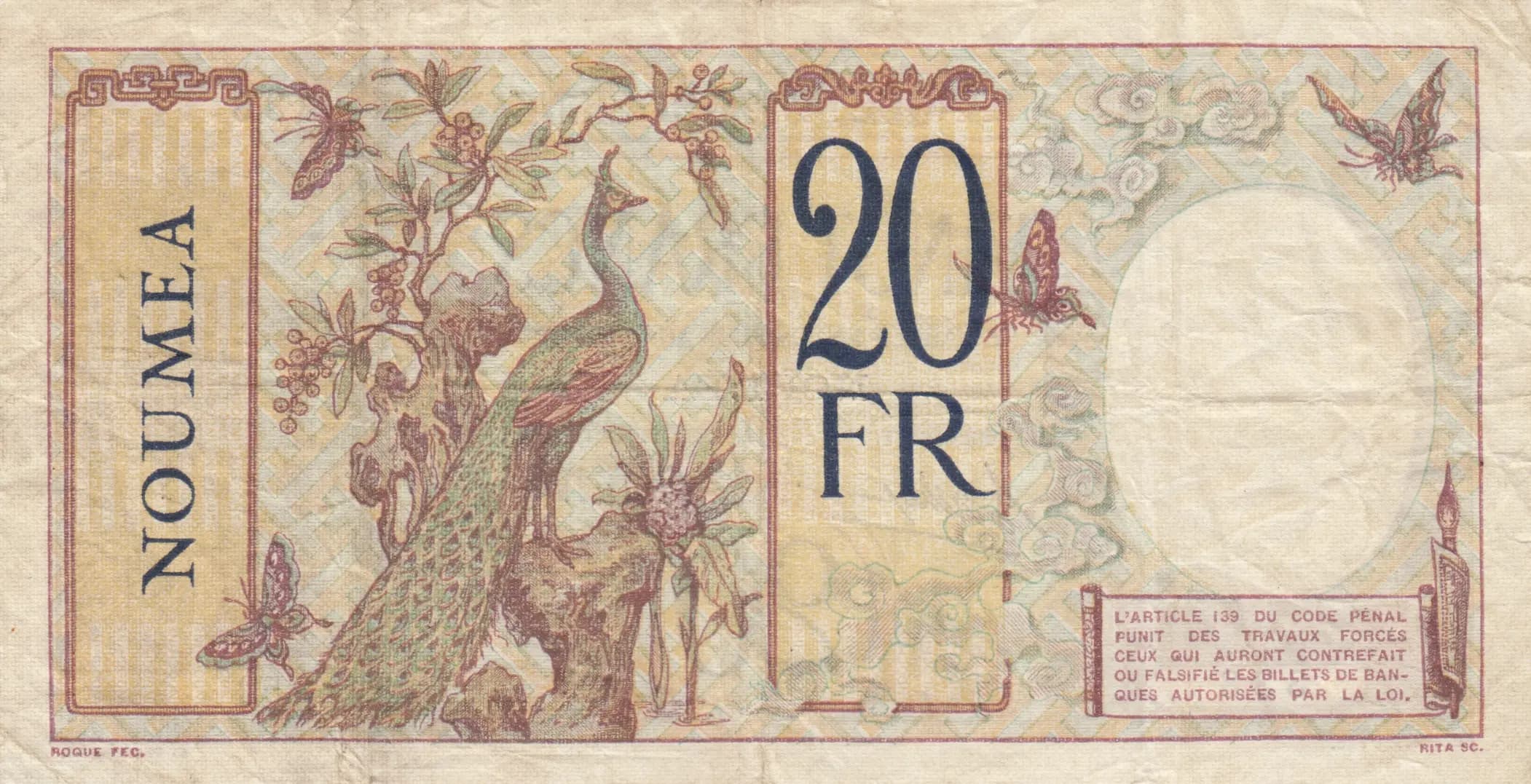
A handsome example of the Banque de l'Indochine's 20 Francs note from New Caledonia, circa 1939 (P-37b), displaying the classic vignette of a woman in classical dress on the obverse and an elaborate peacock surrounded by botanical elements on the reverse. The note exhibits the wear consistent with VF grade, including a visible central horizontal fold and light foxing throughout the aged cream paper, yet remains structurally sound with clear impressions of the fine engraved design work. This is a popular French colonial issue featuring masterful engraving by GL. Serveau and E. Deloghe on the front, with the back designed by Nogue and Kita, representing a significant piece of New Caledonian monetary history.
Common. This P-37b variety appears frequently in the secondary market with consistent VF-grade sales ranging from approximately $5 to $67 over the past decade, with a 2016 catalog value of $25 in VF. The eBay price tracking data shows regular sales activity at modest prices, indicating a readily available supply. Print runs for the Banque de l'Indochine's colonial issues were substantial, and this particular denomination and design saw extended circulation. No significant rarity factors—short print run, recall, or extreme scarcity—apply to this variety.
Issued by the Banque de l'Indochine during the late 1930s, this 20 Francs note reflects France's colonial monetary administration in the Pacific. The woman's portrait likely represents Marianne or a classical allegory of French values, while the peacock on the reverse is a symbol of prosperity and beauty, both common motifs in Art Deco-influenced French colonial currency design. Produced during a transitional period before World War II disrupted colonial trade and administration, these notes represent a distinctive chapter in the monetary systems of French Oceania.
The obverse features an allegorical female portrait (likely representing France or a classical muse) positioned in profile facing left, wearing an elegant head covering or classical headdress, rendered in fine engraved line work. She is framed by ornate Art Deco-inspired decorative borders in burgundy/mauve with sunburst corner ornaments. The denomination '20' is prominently displayed in a circular ornamental frame in the center, with space for two official signatures (President and General Director) below. The reverse showcases an elaborate peacock as the central motif, its magnificent tail feathers displayed in full splendor and surrounded by flowering vines and botanical elements—a design celebrating the natural beauty and exotic character of New Caledonia. The denomination '20 FR' appears vertically on the right side. Both sides employ identical ornamental border frames and employ the classical typography and design sensibilities characteristic of interwar French colonial currency.
FRONT SIDE: 'BANQUE DE L'INDOCHINE' (Bank of Indochina) | 'VINGT FRANCS' (Twenty Francs) | 'PAYABLES EN ESPÈCES AU PORTEUR' (Payable in cash to bearer) | 'NOUMÉA' (Noumea - city in New Caledonia) | 'LE PRÉSIDENT' (The President) | 'LE DIRECTEUR GÉNÉRAL' (The General Director) | 'GL. SERVEAU FEC.' (GL. Serveau made it - artist signature) | 'E. DELOGHE SC.' (E. Deloghe sculpted it - engraver signature). BACK SIDE: 'NOUMÉA' (Noumea - displayed vertically) | '20 FR' (20 Francs) | 'L'ARTICLE 139 DU CODE PÉNAL PUNIT DES TRAVAUX FORCÉS CEUX QUI AURONT CONTREFAIT OU FALSIFIÉ LES BILLETS DE BANQUES AUTORISÉES PAR LA LOI' (Article 139 of the Penal Code punishes with forced labor those who will have counterfeited or falsified banknotes authorized by law) | 'NOGUE FEC.' (Nogue made it - artist signature) | 'KITA SC.' (Kita sculpted it - engraver signature).
Intaglio engraving (line engraving), the traditional security printing method used for high-value banknotes of this era. The fine detail work and security features evident in the intricate botanical designs and decorative patterns are characteristic of steel plate engraving. The note was likely produced by the Banque de l'Indochine's printing facilities or a specialized French security printer; the artist and engraver signatures (Serveau, Deloghe on obverse; Nogue, Kita on reverse) indicate the collaborative classical engraving process. The impressed quality and fine line work throughout confirm professional intaglio production.
This is specifically cataloged as P-37b (variant 'b') by Pick, with the PMG Population Report identifying four catalog variants: P-37a, P-37as, P-37b, and P-37s, all designated as '20 Francs - Nouméa.' The 'b' designation likely refers to a specific printing state or signature variety within the Banque de l'Indochine's issuance. The visual analysis reveals serial reference codes 'S.52' and '338' visible on the front, which may constitute part of the serial numbering scheme for this issue. Without additional comparative examples, the precise distinguishing characteristics of the P-37b variant (as opposed to P-37a or P-37s) cannot be definitively stated from the visual evidence alone, though the presence and positioning of signatures may be a key differentiator.